
 German
 Japanese
 Portuguese
 Korea
Korea
 Mexico
 Dutch
Dutch
CDC MCU
The Chassis Domain Controller (CDC) MCU is a critical component in modern automotive electronics systems, designed to manage and control various chassis-related functions. As part of the broader Chassis & Vehicle Dynamics domain, the CDC MCU serves as a central processing unit that integrates and coordinates multiple chassis systems, such as braking, suspension, and stability control. It plays a vital role in enhancing vehicle safety, performance, and driver experience.
This microcontroller unit (MCU) is typically found in advanced driver assistance systems (ADAS) and autonomous driving architectures, where real-time data processing and decision-making are essential. The CDC MCU processes inputs from sensors, executes control algorithms, and communicates with other vehicle systems to ensure smooth and safe operation.
Its applications span across a wide range of vehicles, including passenger cars, commercial vehicles, and electric vehicles. In passenger cars, it helps improve handling and stability, while in commercial vehicles, it enhances load management and braking efficiency. In electric vehicles, the CDC MCU contributes to energy optimization and overall system reliability.
Designed for high-performance and reliability, the CDC MCU supports advanced features like adaptive cruise control, lane-keeping assist, and automatic emergency braking. It is built to withstand harsh environmental conditions and operates efficiently under varying temperatures and vibrations.
As part of the Automotive Electronics ecosystem, the CDC MCU represents a key step toward more integrated and intelligent vehicle systems. Its implementation reflects the industry's shift towards domain-based architecture, enabling better scalability, software integration, and system efficiency.
Details
CDC MCU
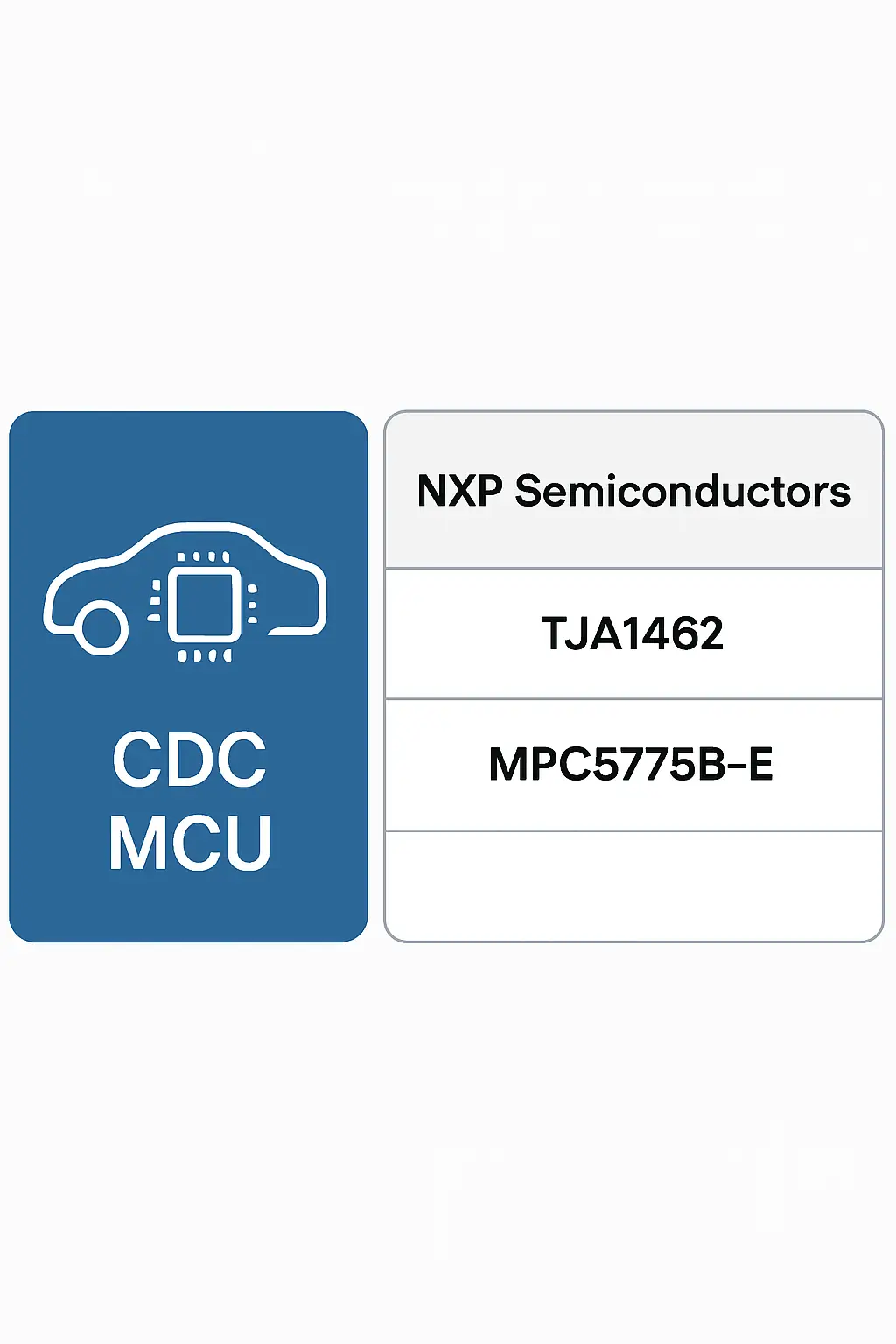
Related Parts
| Series Name | Description | Manufacturer Name | Attribute Description |
|---|---|---|---|
| NXP Semiconductors | 5V CAN FD controller, 16Mbps data rate, integrated 5V LDO, low EMI, high noise immunity, VIO interface, partial network, wake-up via CAN bus, -40°C to +125°C operating temperature. | ||
| NXP Semiconductors | 32-bit Power Architecture core, 240 MHz, 4 MB Flash, 320 KB RAM, 12-channel DMA, Ethernet, CAN-FD, LIN, SPI, ADC, temperature sensor, 1.2/3.3V operation, 176-pin package. |






.png?x-oss-process=image/format,webp/resize,h_32)


