
 German
 Japanese
 Portuguese
 Korea
Korea
 Mexico
 Dutch
Dutch
Sensor Signal Conditioning
The Sensor Signal Conditioning module is an essential component within the Electric Power Steering (EPS) system, which falls under the broader category of Chassis & Vehicle Dynamics in Automotive Electronics. This module is responsible for processing and refining the electrical signals from various sensors that monitor steering wheel position, torque, and vehicle speed. By conditioning these signals, it ensures accurate and reliable data is sent to the EPS control unit, enabling precise and responsive steering assistance.
The primary function of sensor signal conditioning is to filter out noise, amplify weak signals, and convert analog inputs into digital formats suitable for electronic control units (ECUs). This process enhances the overall performance and safety of the vehicle by ensuring the EPS system responds correctly to driver input and road conditions.
This technology is widely used in modern vehicles to improve driving comfort, reduce driver fatigue, and enhance vehicle stability. It plays a key role in advanced driver assistance systems (ADAS), such as lane-keeping assist and adaptive cruise control, where accurate sensor data is crucial.
Designed for reliability and durability, the Sensor Signal Conditioning module is built to operate efficiently in harsh automotive environments, including extreme temperatures and high vibration levels. Its integration into the EPS system contributes to smoother, more intuitive steering, making it a vital part of today’s intelligent and connected vehicles.
Details
Sensor Signal Conditioning
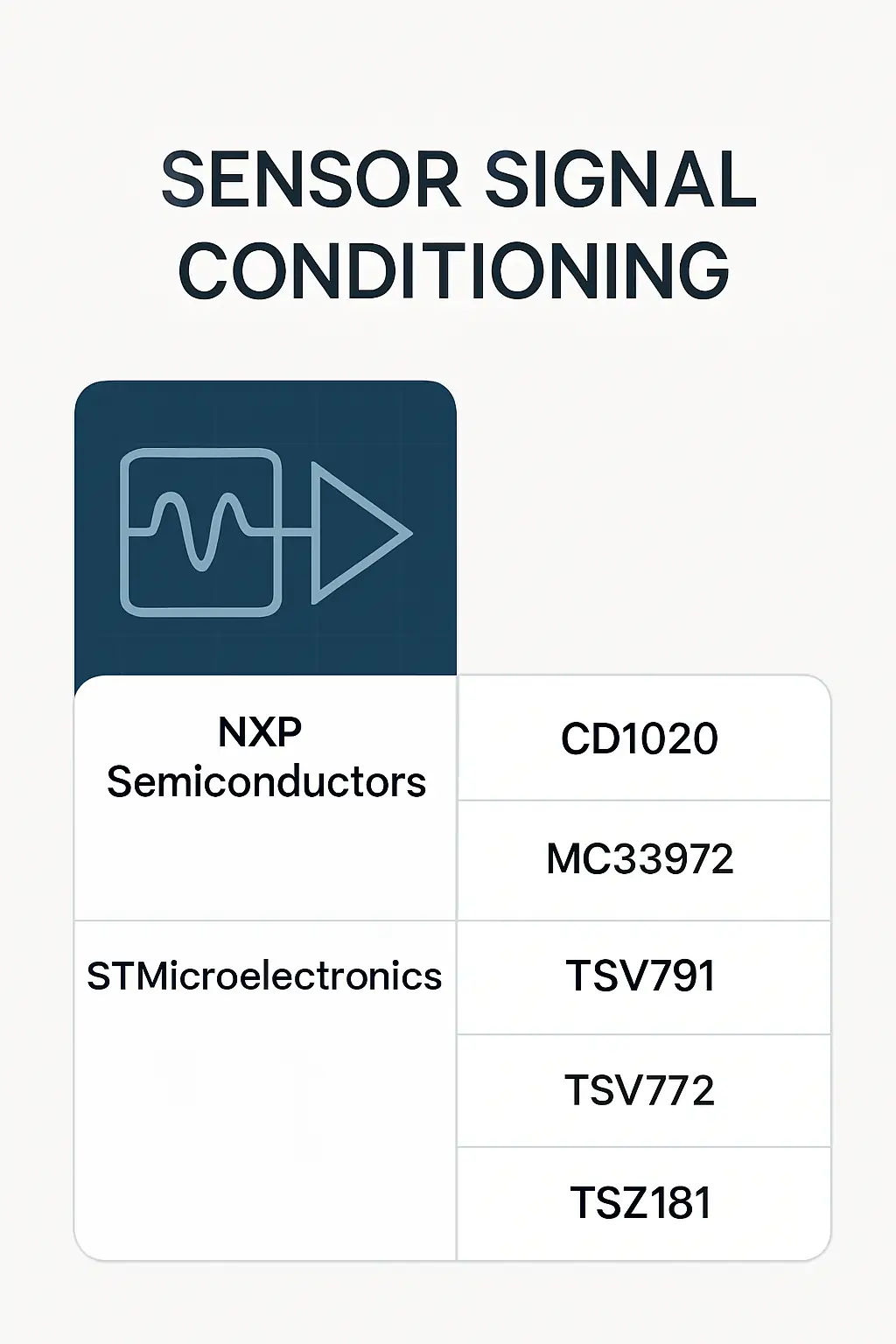
Related Parts
| Series Name | Description | Manufacturer Name | Attribute Description |
|---|---|---|---|
| NXP Semiconductors | 20-bit audio DAC with integrated headphone amplifier, I2S/PCM interface, 24 kHz to 96 kHz sample rate, low power consumption, 3.3 V supply, supports digital volume control. | ||
| NXP Semiconductors | 16-bit SPI, 12-ch input, 4-ch output, 4.5-5.5V supply, -40°C to 125°C, high-immunity GPIO expander with watchdog and voltage monitoring for automotive applications. | ||
| STMicroelectronics | Rail-to-rail input/output, 1.6MHz GBW, 0.75V/µs slew rate, 45µA quiescent current, single-supply 2.0V to 5.5V, low input bias current, unity-gain stable, SC70-5 package. | ||
| STMicroelectronics | Dual operational amplifier, 2.7V to 12V supply, 1.5MHz bandwidth, 0.75V/µs slew rate, rail-to-rail input/output, low input offset voltage, low power, unity gain stable. | ||
| STMicroelectronics | Dual low-power operational amplifier, 1.5MHz GBW, 1.8V to 5.5V supply, rail-to-rail I/O, 45μA per amplifier, -40°C to +125°C operating temperature. | ||
| STMicroelectronics | Quad operational amplifier with 1.5 MHz bandwidth, 2.1 V/µs slew rate, 2.7V to 12V supply, low input bias current, unity gain stable, available in TSSOP-14 package. | ||
| STMicroelectronics | Rail-to-rail input/output, 1.6MHz bandwidth, 0.9V/μs slew rate, 40μA supply current, single supply 2.0V to 5.5V, low input bias current, available in SOT23-5 and SC70-5 packages. | ||
| STMicroelectronics | Rail-to-rail input/output, 1.8V to 5.5V supply, 1.3MHz bandwidth, 0.8V/µs slew rate, low input bias current, available in SC70-5 package. | ||
| STMicroelectronics | Rail-to-rail input/output, 1.8V to 5.5V supply, 1.3MHz bandwidth, 0.9V/µs slew rate, low power, CMOS input, available in SC70-5 and SOT23-5 packages. | ||
| STMicroelectronics | Dual operational amplifier, 5.5V supply, 1.7MHz GBW, 2.5V/μs slew rate, rail-to-rail I/O, low power, CMOS input, available in SO-8 and Mini-Power SO-8 packages. |






.png?x-oss-process=image/format,webp/resize,h_32)


