
 German
 Japanese
 Portuguese
 Korea
Korea
 Mexico
 Dutch
Dutch
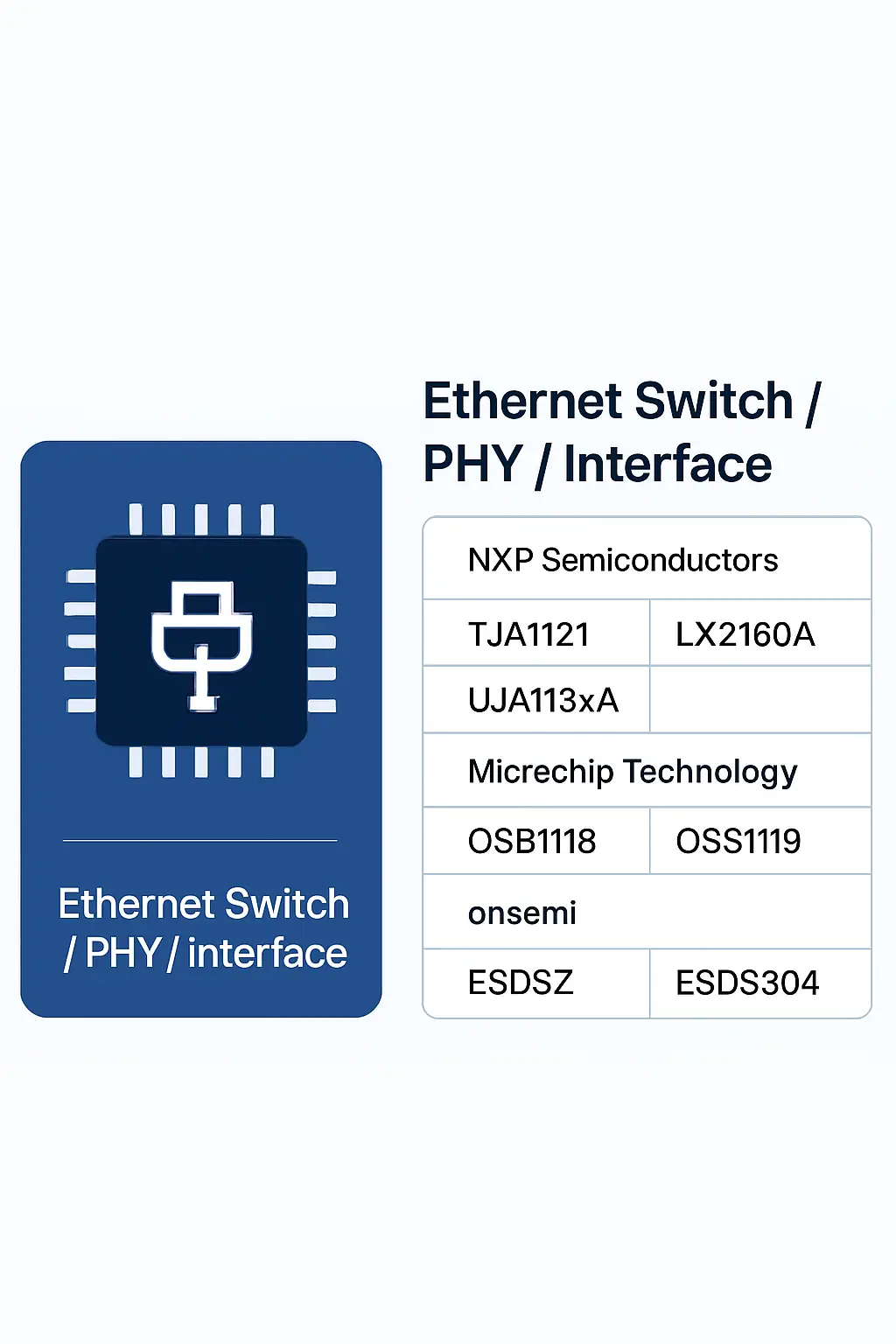
Ethernet Switch / PHY / Interface
Automotive Electronics is a critical component in modern vehicles, enabling advanced functionalities and enhancing driving experiences. Within this domain, Connectivity & Telematics plays a vital role by facilitating communication between the vehicle and external systems. Communication Interfaces serve as the bridge that allows seamless data exchange, ensuring reliable and high-speed connectivity. Among these interfaces, Ethernet Switch, PHY, and Interface are essential for supporting high-bandwidth applications in automotive systems.
Ethernet Switch enables efficient data routing within the vehicle, managing traffic between various electronic control units (ECUs). The PHY (Physical Layer) ensures reliable signal transmission over cables, while the Interface provides the necessary hardware and software connections for communication. Together, they support applications such as infotainment systems, advanced driver assistance systems (ADAS), and vehicle-to-everything (V2X) communication.
These components are widely used in modern vehicles to enable features like real-time navigation, remote diagnostics, over-the-air updates, and connected car services. They also play a key role in autonomous driving technologies, where fast and secure data transfer is crucial. With the increasing demand for smart and connected vehicles, Ethernet-based communication interfaces are becoming the standard in automotive design. Their robustness, scalability, and high performance make them ideal for future-proofing vehicle electronics. Whether in passenger cars, commercial vehicles, or electric vehicles, these interfaces contribute significantly to improving safety, comfort, and efficiency on the road.
Details
Ethernet Switch / PHY / Interface
Related Parts
| Series Name | Description | Manufacturer Name | Attribute Description |
|---|---|---|---|
| NXP Semiconductors | 1 Mbps CAN FD controller, 5 V supply, high-speed mode, low-power sleep mode, integrated LDO, TXD input, RXD output, thermal & fault protection, wide temperature range, suitable for automotive applications. | ||
| NXP Semiconductors | 16-core ARM Cortex-A72, 1.8 GHz, 16 nm process, integrated packet processing, 128 GB/s interconnect, LPDDR4/DDR4 support, PCIe Gen3, SATA, USB 3.0, 10 GbE interfaces. | ||
| NXP Semiconductors | 32V max supply voltage, 5V/3.3V regulator outputs, high-side/low-side drivers, CAN FD and LIN transceivers, watchdog timer, SPI interface, operating temperature -40°C to +150°C, 48-pin LQFP package. | ||
| NXP Semiconductors | 3.3V CAN FD controller transceiver, 2 Mbps data rate, ±40V fault protection, low EMI, high-speed mode, VIO interface, -40°C to +125°C operating temperature, 14-pin HVSON package. | ||
| NXP Semiconductors | Quad-core ARM Cortex-A53, 1.2GHz, 32-bit, 2MB L2 cache, 8MB eMMC, 2x Ethernet, CAN FD, PCIe, HDMI, MIPI CSI-2, GPU: GC3000, DSP: CVP, supports automotive vision and ADAS applications. | ||
| NXP Semiconductors | 100BASE-T1 Ethernet transceiver, 2.3V to 3.6V supply, supports AEC-Q100 grade 2, MII/RMII interface, -40°C to 125°C operating temperature, low EMI, integrated termination and DC-balanced signaling. | ||
| NXP Semiconductors | 32-bit ARM Cortex-M33 core, 256 KB flash, 64 KB RAM, 1.8 V to 3.6 V supply, 64-pin LQFP package, supports I²C, SPI, UART, USB, and 10-bit ADC. | ||
| NXP Semiconductors | Dual-core ARM Cortex-A72, 1GB DDR4, 800MHz audio DSP, integrated PMIC, 2.5D GPU, 40nm process, -40°C to 125°C junction temperature, 689-pin FBGA package, supports automotive and industrial applications. | ||
| NXP Semiconductors | Input voltage: 2.7V to 5.5V; Output current: up to 1.2A; Switching frequency: 3MHz; Efficiency: up to 95%; Operating temperature: -40°C to +125°C; Package: WLCSP-12. | ||
| NXP Semiconductors | 32-bit ARM Cortex-M0+ core, 50 MHz, 64 KB flash, 8 KB RAM, 4-channel 12-bit ADC, UART, SPI, I2C, 24 GPIOs, 1.8–3.6 V operation, QFN32 package. |






.png?x-oss-process=image/format,webp/resize,h_32)


