
 German
 Japanese
 Portuguese
 Korea
Korea
 Mexico
 Dutch
Dutch
Power Supply / Power Management
The Battery Management System (BMS) is a critical component in modern electrified vehicles, responsible for monitoring and managing the performance, safety, and efficiency of the battery pack. It ensures optimal operation by regulating charge and discharge processes, balancing cell voltages, and providing real-time data on battery health and state of charge. The BMS plays a vital role in extending battery life, enhancing vehicle range, and ensuring safe and reliable power delivery.
Integrated into the broader category of Automotive Electronics, the BMS is a key element of Electrification & Battery Systems. It works in conjunction with power supply and power management systems to support the efficient distribution and control of electrical energy throughout the vehicle. This makes it essential for electric vehicles (EVs), hybrid electric vehicles (HEVs), and other advanced automotive applications.
The BMS finds application in various sectors, including passenger cars, commercial vehicles, and industrial equipment that rely on battery power. Its functions are crucial in maintaining system stability, preventing overcharging or deep discharging, and protecting against thermal runaway. With the growing demand for sustainable transportation solutions, the BMS has become an indispensable part of the automotive industry's transition toward electrification.
By combining advanced sensor technology, sophisticated algorithms, and real-time communication capabilities, the BMS enhances overall vehicle performance and user experience. It supports seamless integration with other vehicle systems, contributing to the development of smarter, more efficient, and safer electric mobility solutions.
Details
Power Supply / Power Management
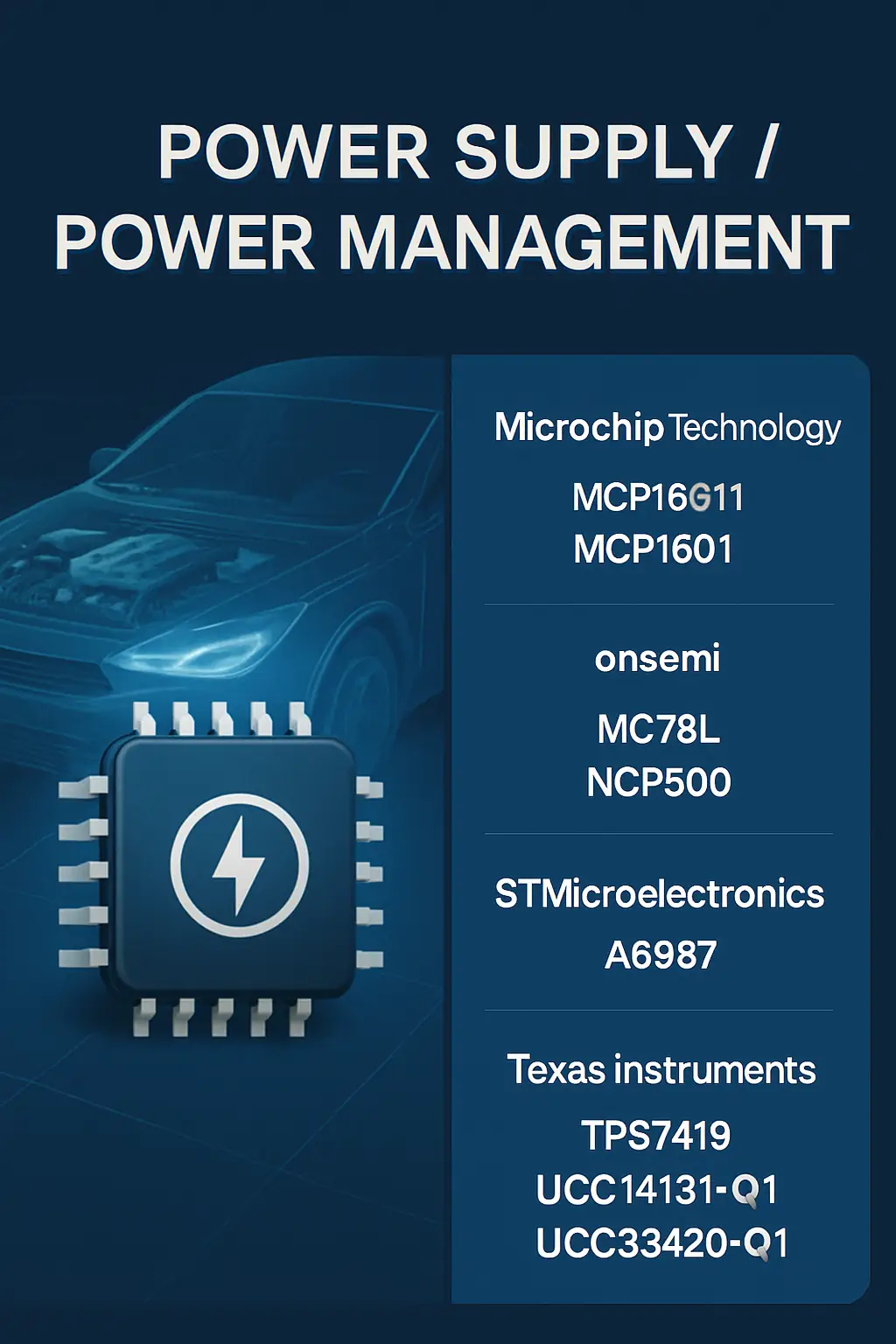
Related Parts
| Series Name | Description | Manufacturer Name | Attribute Description |
|---|---|---|---|
| Microchip Technology | Input voltage: 2.7V to 5.5V; Output current: up to 1.4A; Fixed frequency: 1.2MHz; Efficiency: up to 95%; Operating temperature: -40°C to +125°C; Package: 8-pin MSOP. | ||
| Microchip Technology | 1.5V voltage reference, ±0.5% initial accuracy, 4ppm/°C temp drift, 2.7V to 5.5V supply, 8μA quiescent current, SOT-23 package. | ||
| Microchip Technology | Input voltage: 2.7V to 5.5V; Output current: up to 1.4A; Fixed output options: 3.3V, 5V; Efficiency: up to 95%; Operating temperature: -40°C to +125°C; Package: 8-pin MSOP. | ||
| Microchip Technology | 4-channel PMIC, 2.7V-5.5V input, 1.8A/1.2A/600mA/300mA output, 2.2MHz switching frequency, I²C programmable, synchronous buck converters, 20-pin QFN package, operating temperature -40°C to +125°C. | ||
| Microchip Technology | Input voltage: 2.0V to 5.5V; Output voltage: Adjustable up to 5.0V; Max output current: 300mA; Efficiency: Up to 95%; Operating frequency: 1.6MHz; Quiescent current: 28µA. | ||
| Microchip Technology | 64 Kbit (8K x 8) SPI Bus Interface, 2.5V to 5.5V Operation, Low Power CMOS, 1 MHz Clock, 8-pin SOIC, TSSOP, or DFN Package | ||
| Microchip Technology | 3.3V fixed LDO regulator, 300mA output current, low dropout voltage, enable pin, thermal overload protection, stable with 1µF ceramic capacitor, operates from 2.5V to 16V input. | ||
| Microchip Technology | 2.8V to 5.5V operating voltage, 8-channel 12-bit ADC, 1 MSPS sampling rate, SPI interface, low power consumption, 16-pin SOIC package, internal voltage reference, ±1 LSB INL, -40°C to +85°C temperature range. | ||
| Microchip Technology | 2.048V precision voltage reference, 10ppm/°C temp drift, 5μA quiescent current, SOT-23 package, operates from 2.7V to 5.5V supply, 0.1% initial accuracy, low dropout. | ||
| onsemi | 3-terminal positive voltage regulator, 5V output, 100mA current, ±4% output voltage accuracy, operating input voltage up to 30V, low quiescent current, TO-92 package. |






.png?x-oss-process=image/format,webp/resize,h_32)


