
 German
 Japanese
 Portuguese
 Korea
Korea
 Mexico
 Dutch
Dutch
Sensor Signal Conditioning
The Sensor Signal Conditioning System is an essential component within Electric Two-Wheeler Systems, falling under the broader category of Mobility, Two-Wheelers & Charging in the Automotive Electronics domain. This system is designed to process and optimize sensor signals, ensuring accurate data transmission for critical vehicle functions. It plays a vital role in enhancing the performance, safety, and reliability of electric two-wheelers such as e-bikes and e-scooters.
The primary function of the sensor signal conditioning system is to amplify, filter, and convert raw sensor outputs into usable signals for the vehicle's control units. These sensors may monitor parameters like speed, battery status, motor temperature, and rider input. By conditioning these signals, the system ensures that the electronic control unit (ECU) receives clean, reliable data, which is crucial for efficient power management and real-time decision-making.
This technology finds wide application in electric two-wheelers, where precise sensor data is essential for optimal performance. It supports features such as regenerative braking, battery management, and ride stability control. Additionally, it contributes to improved user experience by enabling smoother operation and enhanced safety features.
Designed for integration with modern electric vehicle architectures, the sensor signal conditioning system is compact, energy-efficient, and compatible with various sensor types. Its adaptability makes it suitable for both consumer and commercial electric two-wheeler models. With the growing demand for sustainable mobility solutions, this system is a key enabler in the evolution of smart, connected, and safe electric transportation.
Details
Sensor Signal Conditioning
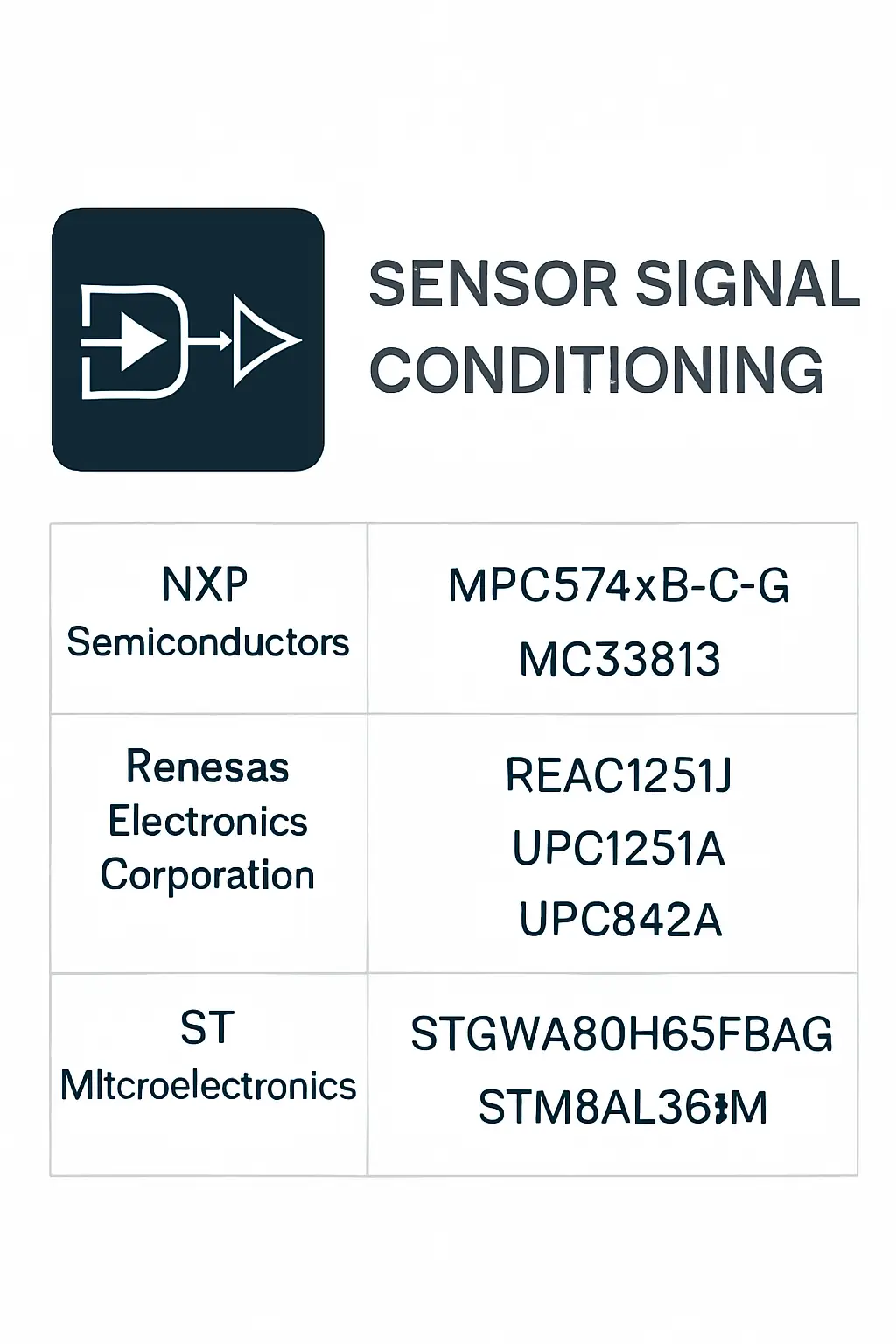
Related Parts
| Series Name | Description | Manufacturer Name | Attribute Description |
|---|---|---|---|
| NXP Semiconductors | 32-bit Power Architecture MCU, up to 300 MHz, 2.97–3.6 V, -40°C to 125°C, 2 MB Flash, 256 KB RAM, triple-core (2x e200z7, e200z4), CAN FD, Ethernet, FlexRay, 12-bit ADC. | ||
| NXP Semiconductors | 3-phase BLDC motor controller, 8-bit CISC, 24V max supply, integrated gate drivers, supports sensorless and sensored control, 16-pin SOIC package, operates from -40°C to 125°C. | ||
| NXP Semiconductors | 3.3V/5V supply, 4-channel H-bridge driver, integrated charge pump, fault detection, thermal shutdown, 28-pin TSSOP package, operates from -40°C to 125°C, designed for brush DC motor control. | ||
| Renesas Electronics Corporation | 12-bit resolution, 1 MSPS sampling rate, low power consumption, SPI interface, wide supply voltage range (2.7V to 5.5V), high accuracy, integrated temperature sensor, small package size. | ||
| Renesas Electronics Corporation | FM/AM radio receiver IC with wide supply voltage range, high sensitivity, low noise, and integrated oscillator and mixer. Supports monaural/stereo reception, ideal for portable radios. | ||
| Renesas Electronics Corporation | 8-bit microcontroller, 4KB Flash, 256B RAM, 10-bit ADC, 16MHz CPU, I2C, UART, 20-pin SSOP package, operating voltage 2.7V to 5.5V, -40°C to +85°C temperature range. | ||
| Renesas Electronics Corporation | 16-bit microcontroller, 256KB flash, 16KB RAM, 32MHz CPU, 10-bit ADC, UART/SPI/I2C interfaces, operating voltage 2.7V to 5.5V, temperature range -40°C to +85°C. | ||
| STMicroelectronics | 80A, 650V, SiC MOSFET, high-speed switching, low on-resistance, TO-247-3 package, suitable for power conversion, PFC, and inverter applications, operating temperature up to 175°C. | ||
| STMicroelectronics | 1200V, 12A, 60mΩ typical RDS(on), N-channel power MOSFET, TO-220FP package, high-efficiency switching, suitable for power conversion and motor control applications. | ||
| STMicroelectronics | 8-bit STM8 core, 16 MHz, 64 KB Flash, 2 KB RAM, 2 KB EEPROM, 1.8-3.6V operation, 12-channel 12-bit ADC, UART, SPI, I2C, low power modes, 28-pin package. |






.png?x-oss-process=image/format,webp/resize,h_32)


