
 German
 Japanese
 Portuguese
 Korea
Korea
 Mexico
 Dutch
Dutch
Safety & System Control
Automotive Electronics refers to the advanced electronic systems used in modern vehicles to enhance performance, safety, and comfort. Among these, Powertrain & ICE Management plays a crucial role in optimizing engine efficiency and emissions. At the core of this system are Engine Control Units (ECUs), which act as the central processing unit for managing engine operations. ECUs monitor various sensors and control actuators to ensure smooth and efficient engine performance.
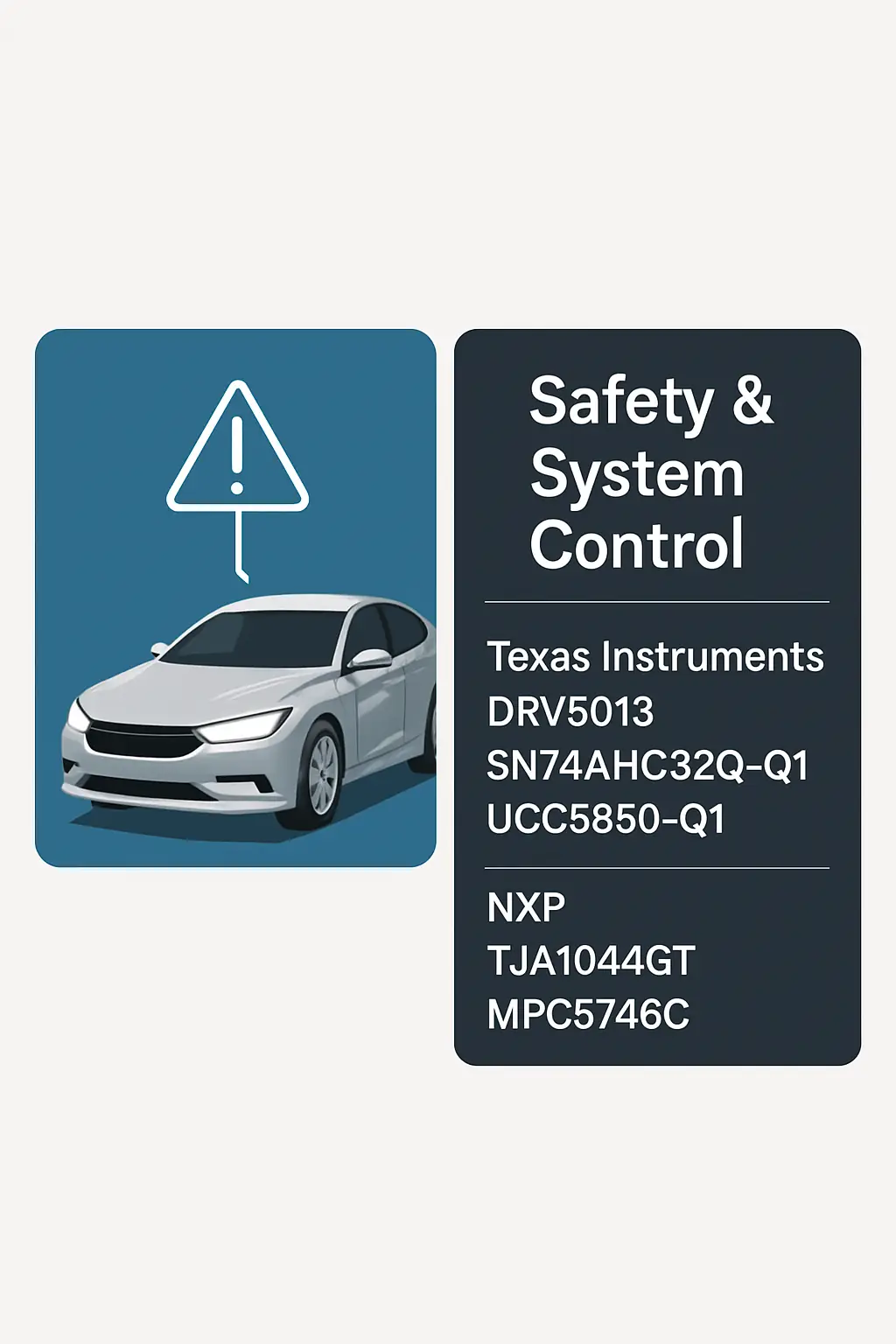
Safety & System Control is another essential aspect of automotive electronics, focusing on ensuring vehicle stability, driver assistance, and overall system reliability. These systems include features like anti-lock braking, traction control, and advanced driver-assistance systems (ADAS). By integrating with ECUs, they provide real-time responses to driving conditions, enhancing both safety and driving experience.
The applications of these systems span across passenger cars, commercial vehicles, and electric vehicles. In traditional internal combustion engine vehicles, ECUs manage fuel injection, ignition timing, and emission control. In electric vehicles, they regulate battery management, motor control, and energy efficiency. Safety systems are critical in all vehicle types, supporting functions such as collision avoidance, lane keeping, and autonomous driving capabilities.
Together, these technologies contribute to smarter, safer, and more efficient vehicles. They enable manufacturers to meet stringent environmental regulations while delivering enhanced performance and user experience. As automotive technology continues to evolve, the integration of advanced electronics will remain a key driver of innovation in the industry.
Details
Safety & System Control
Related Parts
| Series Name | Description | Manufacturer Name | Attribute Description |
|---|---|---|---|
| Texas Instruments | 3V to 5.5V supply, ±35G sensitivity, digital output, open-drain, unipolar switch, 2.5mm × 1.5mm SOT-23 package, operates from -40°C to +125°C. | ||
| Texas Instruments | Quad 2-input OR gate, 2.0-V to 5.5-V VCC, operating temperature: -40°C to 125°C, tpd = 3.5 ns, low power consumption, AEC-Q100 qualified for automotive applications. | ||
| Texas Instruments | Single-channel isolated gate driver, 5.7kVRMS isolation, 4A peak output current, 2.5ns propagation delay, 200V/ns common-mode transient immunity, 2.7V to 15V input supply, 3V to 15V output supply, UVLO protection, SOIC-8 package. | ||
| Texas Instruments | Quad 2-input AND gate, operating voltage 2V to 5.5V, output drive ±8mA, propagation delay 8ns typical, operating temperature -40°C to 125°C, designed for automotive applications. | ||
| Texas Instruments | Hex Schmitt-Trigger Inverter with 2-V to 5.5-V VCC, operating temperature: -40°C to 125°C, low power consumption, TTL-compatible inputs, designed for automotive applications. | ||
| Texas Instruments | 14-input inverting Schmitt trigger, 2V to 5.5V supply, TTL-compatible inputs, low power consumption, high noise immunity, operates from -40°C to 125°C, designed for automotive applications. | ||
| Texas Instruments | Quad 2-input NAND gate with Schmitt-trigger inputs, operating voltage 2V to 5.5V, output drive ±8mA, propagation delay 10ns typical, rated for automotive temperature range -40°C to 125°C, available in small-package options. | ||
| Texas Instruments | 3.3V to 5.5V supply, 12-bit resolution, 8-channel, I2C interface, 100ksps sampling rate, integrated oscillator, ±0.5% typical accuracy, low-power operation, Q1 automotive qualified. | ||
| Texas Instruments | 3.2V to 5.5V operating voltage, 2.1W output power, 85% efficiency, integrated boost converter, mono audio amplifier, 2.2mV noise, 113dB PSRR, I2C control, shutdown current <1μA. | ||
| Texas Instruments | Single-channel buffer with 3-state output, 2.3V to 5.5V supply voltage, up to 100MHz operation, low power consumption, automotive-grade temperature range. |






.png?x-oss-process=image/format,webp/resize,h_32)


