
 German
 Japanese
 Portuguese
 Korea
Korea
 Mexico
 Dutch
Dutch


Programmable Display Switches & Intelligent Interaction Modules

Table of Contents
5. Illuminated Programmable Switch
OLED Display Switch
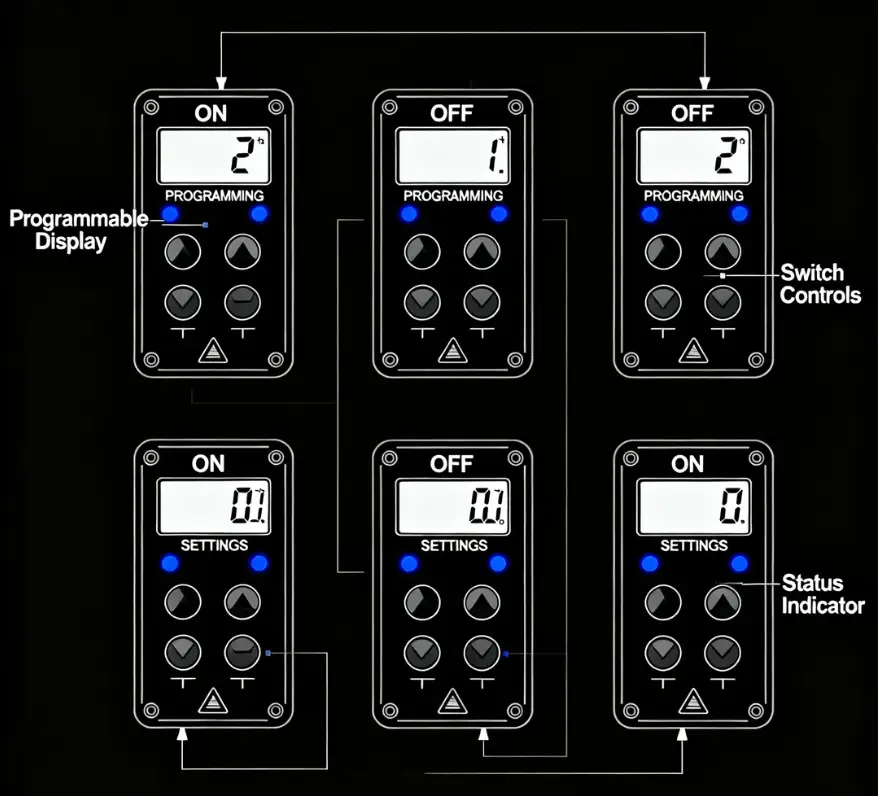
OLED display switch is a human-machine interaction device integrating an OLED screen and button/toggle switch, featuring both status display and control input functions. It is widely used in industrial control and smart home applications.
1. Core Composition and Principles
OLED screen: self-illuminating, high contrast, wide viewing angle (approx. 180°), typically a 0.92-inch, 96×64 pixel monochrome (mostly white) screen.
Switch body: mostly toggle/button type, equipped with SPI and other serial ports, supporting programmable configuration and status feedback.
Working principle: OLED pixels emit light automatically after power-on; when the switch is activated, the controller updates screen content (status, parameters, icons, etc.) via the serial port.
2. Key Parameters (Industrial Version)
Resolution: 96×64 pixels
Viewing angle: 180°
Lifespan: 52,000 hours (30% brightness), 15,600 hours (100% brightness)
Interface: SPI serial communication
Mechanical lifespan: ≥ 1 million operations
Operating temperature: -20°C ~ +70°C
3. Mainstream Types and Applications
Industrial rocker type (e.g., NKK/HONYONE)
Integrated sealing, waterproof and dustproof, SP3T (Single Pole Three Throw) configuration.
Applications: Industrial control panels, medical equipment, testing instruments.
Smart home screen display switch (e.g., Lingpu E2 series)
Ultra-thin design, supports Mi Home/Bluetooth Mesh, with human body sensing for screen activation.
Applications: Whole-house intelligent lighting control, scene switching, non-engraved and customizable key labels.
Lite intelligent screen display switch
4. OLED Display vs Traditional Switch
Advantages:
High contrast: pure black background with clear text/icons, far superior to LCD backlit screens.
Low power consumption: self-illuminating, only active pixels consume power; standby power <1W.
Flexible display: content can be modified at any time without physical engraving.
Disadvantages:
High cost: OLED screens and driver circuits are more expensive than standard switches.
Screen burn-in risk: long-term static images easily cause ghosting (alleviated by low brightness or dynamic refresh).
LCD Programmable Button
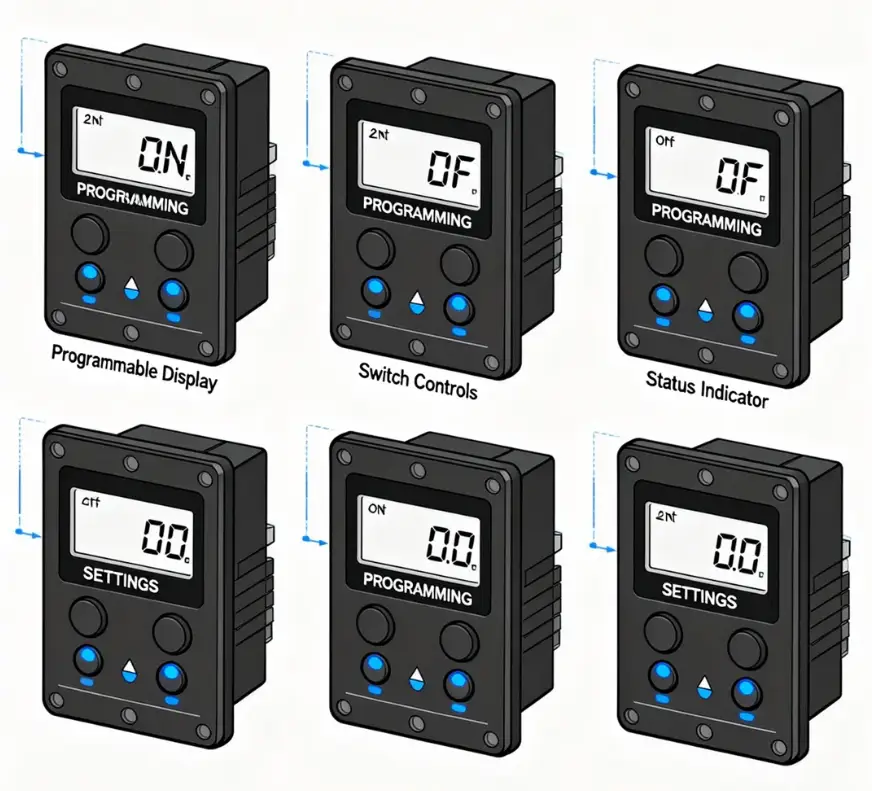
LCD programmable button is a programmable interactive device integrating a small LCD display with physical buttons. Each button independently displays icons/text and supports customized functions. It is widely used in industrial control, desktop consoles, and smart homes.
1. Core Composition and Principles
LCD display screen: mostly 0.85–1.3 inches, resolution 128×64/128×128, monochrome/color (65K colors), SPI/I2C interface, supports dynamic refresh of icons, text, and status.
Physical buttons: mechanical axis or touch-sensitive, with backlight/tactile feedback, supporting single-key, combination-key, and macro command programming.
Control unit: built-in MCU/driver chip (e.g., ST7735), defines key functions, display content, and communication logic via host software or embedded code.
Workflow: Host/controller sends commands → LCD updates display → button triggers and returns status → executes preset actions (e.g., shortcuts, device control).
2. Mainstream Types and Typical Products
Industrial-grade LCD display button (NKK/HONYONE)
Specifications: 0.9–1.3 inch monochrome LCD, SPDT/SP3T contacts, IP65 waterproof, -20°C~+70°C, mechanical lifespan ≥ 1 million cycles.
Applications: Industrial panels, medical equipment, testing instruments, supporting custom status text/icons.
Desktop Programmable Console (Stream Deck/Optimal Basket)
Specifications: 6–32 keys, 0.85–1 inch color LCD (128×128) per key, USB connection, supports Windows/macOS, visual programming via software.
Applications: Video editing, live streaming control, office shortcut operations, one-click triggering of shortcuts/macros/applications.
Embedded LCD button module (Banli Electronics/DFRobot)
Specifications: 0.85-inch IPS LCD (128×128), SPI interface, 3.3V, compatible with STM32/ESP32/Arduino, provides development libraries and sample code.
Applications: DIY projects, embedded devices, intelligent terminals, rapid implementation of on-screen button interaction.
3. Key Parameter Comparison
Parameter | Industrial | Desktop | Embedded Module
Screen | 0.9–1.3 inches monochrome | 0.85–1 inch color | 0.85 inch color
Resolution | 96×64 | 128×128 | 128×128
Interface | SPI/I2C | USB | SPI
Voltage | 12–24V | 5V (USB) | 3.3V
Lifespan | ≥ 1 million cycles | ≥ 500,000 cycles | ≥ 300,000 cycles
Environment | Industrial grade (-20°C~+70°C) | Room-temperature consumer grade (0°C~+50°C)
4. LCD vs OLED Programmable Buttons
LCD advantages: low cost, no screen burn-in risk, uniform backlight, adjustable brightness, ideal for long-term static display.
LCD disadvantages: low contrast, narrow viewing angle (approx. 120°), slightly higher power consumption, slow response (approx. 10ms).
OLED advantages: self-illuminating, high contrast, wide viewing angle (180°), ultra-fast response (μs level), ultra-thin profile.
OLED disadvantages: high cost, screen burn-in from long static images, shorter brightness lifespan (approx. 10,000–20,000 hours).
5. Development and Programming (STM32+SPI Example)
Hardware connection: LCD (ST7735) → STM32: SCK → PA5, MOSI → PA7, CS → PA4, DC → PA3, RST → PA2.
Core code (initialization + display):
#include "stm32f1xx_hal.h"
#include "st7735.h"
// Initialize LCD
void LCD_Init(void) {
  ST7735_Init();
  ST7735_FillScreen(ST7735_BLACK);
}
// Display button icons/text
void LCD_DisplayKey(uint8_t key, const char* text, uint16_t color) {
  ST7735_DrawString(10, key*20+5, text, color, 2);
}
// Button callback
void Key_Callback(uint8_t key) {
  // Custom functions: relay control, command sending, etc.
}
6. Selection Suggestions
Industrial scenarios: Choose NKK SmartSwitch series, IP65 rated, wide temperature range, high reliability.
Desktop/Live streaming: Choose Stream Deck (15 keys) or YouBasket D200H, plug-and-play, user-friendly software.
Embedded development: Choose 0.85-inch SPI module from Banli Electronics, cost-effective with complete documentation.
Digital Tact Switch
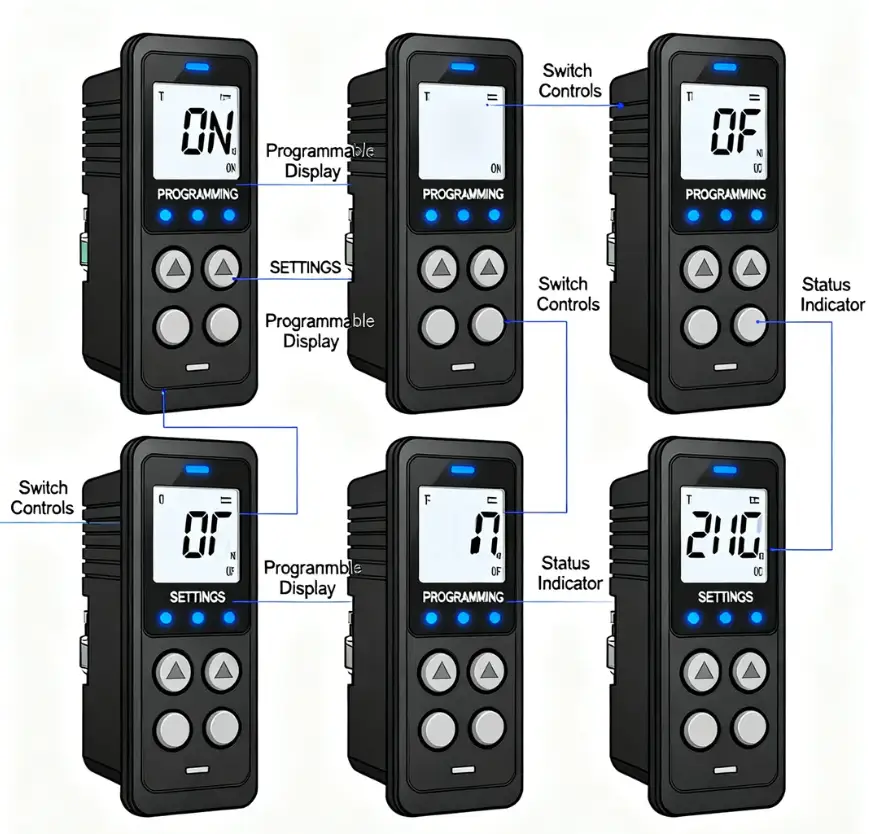
Digital Tactile Switch is essentially a tactile switch with digital logic and programmable functions. It integrates digital chips, LED/small screens, and programmable I/O based on traditional tactile buttons, realizing the integration of "button + display + programmable". It is the basic form of LCD/OLED programmable buttons.
1. Core Definition and Principles
Traditional tactile switch: purely mechanical, press on/off, non-latching, only outputs on/off analog signals.
Digital tact switch: built-in MCU/logic chip, outputs digital signals (I2C/SPI/pulse) after pressing, supports customizable short/long/combo functions, with status memory and LED indication.
Working Principle:
Press → Metal dome deformation → Contact conduction.
Chip detects key action → debounce + encode → output digital signals.
Drive LED/small screen to display status (power, mode, etc.).
2. Core Structure (5 Parts)
Button/keycap: silicone/plastic, provides tactile feedback.
Metal dome: core component, deformation and conduction, determines feel and lifespan.
Base/shell: insulating material, fixes pins and chips.
Digital chip: handles keys, debounce, encoding, and LED driving.
Pin: power, ground, signal output, LED control (commonly 4/5 pins).
3. Key Parameters
Size: 3×3mm ~ 12×12mm (SMT/through-hole)
Operating force: 160–300gf (crisp tactile feel)
Travel: 0.1–0.5mm (short stroke, quick trigger)
Lifespan: 100,000 to 1 million cycles (up to 5 million for industrial grade)
Electrical: 50mA/12V DC, contact resistance ≤ 50mΩ
Interfaces: GPIO, I2C, SPI, UART (digital type)
4. Types (by Function)
Basic digital type: with debounce and encoding, outputs high/low levels/pulses, no display, suitable for simple button matrices.
LED indicator type: built-in RGB/monochrome LED, programmable color/brightness/flashing, displays switch status (e.g., power on = blue, standby = red).
Programmable key module: equipped with STM32/ESP32, supports custom key logic, long/short/combo presses, I2C communication, allows cascading multiple keys.
OLED/LCD equipped type: refers to LCD/OLED programmable buttons, digital tact switch + screen, displays text/icons/parameters.
5. Advantages and Disadvantages
Advantages:
Digital signal: strong anti-interference, stable long-distance transmission.
Programmable: one-key multi-function, flexible adaptation to various scenarios.
Rich feedback: LED/screen display + crisp tactile feel.
Compact size: suitable for dense panels.
Disadvantages:
High cost: 2–5 times more expensive than traditional tact switches.
Power required: digital circuits need 3.3V/5V power supply.
Development effort: requires simple driver/configuration coding.
6. Application Scenarios
Industrial control: PLC panels, instruments, CNC equipment (function keys/reset keys).
Smart Home: intelligent switch panels, remote controls, gateways (scene switching/device control).
Consumer electronics: headphone remotes, camera shutters, controller buttons, laptop power buttons.
Automotive electronics: central control buttons, steering wheel controls (volume/phone/mode).
7. Differences from Similar Devices
Digital tact vs traditional tact: digital version provides digital signals, programmable functions, and LED indication; traditional version is purely mechanical on/off.
Digital tact vs LCD programmable buttons: digital version has no screen (only LED); LCD version has LCD/OLED for richer display.
Digital tact switch vs membrane switch: digital version is a single unit with good feel and long lifespan; membrane switch is an integrated panel with soft feel and short lifespan.
8. Key Selection Points
Size/Package: SMT for mass production; THT for manual soldering.
Functional requirements: button only → basic type; status indication → LED type; customization → programmable module; display needed → LCD/OLED type.
Lifespan/Environment: IP65+ for industrial use, 5 million cycles; consumer electronics can use 1 million cycles.
Interface: simple use → GPIO; multi-key cascading → I2C; high speed → SPI.
Smart HMI Switch
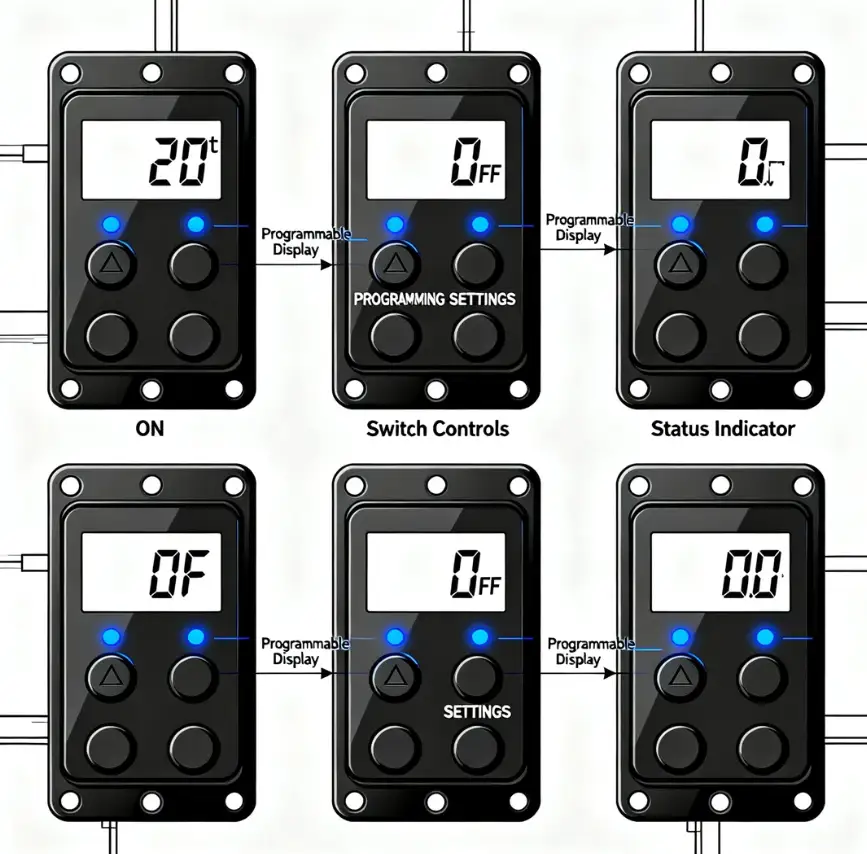
Smart HMI switch is a human-machine interaction device integrating display, touch, programmability, and communication. It combines "buttons + screen + intelligent chip + bus interface" in one unit, representing the industrial/high-end form of LCD/OLED programmable buttons. The core features are independent single-key display, digital interaction, and remote control.
1. Core Definition and Positioning
Essence: A programmable switch with intelligent HMI functions, built-in MCU, driver, display (LCD/OLED/LED), and communication interface (I2C/SPI/IO-Link/CAN). Supports customizable short/long/combo presses and status display, outputs digital signals and returns status.
Differences from traditional switches:
Traditional: purely mechanical on/off, no display, no programming, no communication.
Digital tact: chip/LED, digital output, no screen or only small indicators.
Smart HMI switch: screen (LCD/OLED) + programmable + bus communication + status visualization + remote configuration.
2. Core Components (6 Parts)
Display unit: 0.85–1.3 inch LCD/OLED (128×64/128×128), monochrome/color, displays text/icons/status/parameters.
Input unit: capacitive touch/mechanical tact, with vibration/audio/light feedback, supports multiple gestures.
Main control MCU: STM32/ESP32/dedicated HMI chip, handles keys, display, logic, and communication.
Communication interface: GPIO/I2C/SPI/IO-Link/CAN/Ethernet; IO-Link for industry, BLE/Mesh for smart home.
Feedback unit: RGB LED (16 million colors), vibration motor, buzzer, intuitive status indication.
Power/Protection: wide voltage (12–24V DC/5V), IP65/IP67 waterproof and dustproof, anti-interference.
3. Mainstream Types and Typical Products
1. Industrial-grade Smart HMI Switch (NKK/CAPTRON)
NKK SmartDisplay: 0.9/1.3-inch LCD/OLED, single-key/multi-key matrix, RS232/485, for industrial panels/broadcast control, IP65, -20°C~+70°C, 5 million cycles.
CAPTRON CANEO series 4x: capacitive touch + LED ring + 7-segment display, IO-Link, 16 million colors, IP67, stainless steel version (medical/food).
2. Desktop/Live Programmable Console (Stream Deck/Optimal Basket)
Specifications: 6–32 keys, 0.85-inch color LCD per key, USB, Windows/macOS, drag-and-drop software programming, one-click shortcuts/macros/applications.
3. Smart Home HMI Switch (Sumi/Yiwu)
Sumi Cielo: touch + vibration feedback, AG glass, proximity sensor screen, Mi Home Mesh, 4-way lighting + 2-way curtains + scene control.
4. Embedded Smart HMI Module (Banli/DFRobot)
Specifications: 0.85-inch IPS LCD (128×128), SPI/I2C, 3.3V, compatible with STM32/ESP32/Arduino, open-source libraries for DIY/embedded devices.
4. Key Parameter Comparison
Parameters | Industrial (NKK/CAPTRON) | Desktop (Stream Deck) | Home (Sumi Cielo) | Embedded Module
Screen | 0.9–1.3-inch LCD/OLED | 0.85-inch color LCD | 1–2 inch touch LCD | 0.85-inch IPS LCD
Interface | IO-Link/CAN/RS485 | USB | Mi Home Mesh/BLE | SPI/I2C
Voltage | 12–24V DC | 5V (USB) | 220V AC/5V | 3.3V
Protection | IP65/IP67 | IP30 | IP44 | IP30
Temperature | -20°C~+70°C | 0°C~+50°C | -10°C~+50°C | 0°C~+50°C
Lifespan | 5 million cycles | 500,000 cycles | 1 million cycles | 300,000 cycles
5. Core Advantages
Highly integrated: single-key display + input + feedback + communication, reduces panel space and wiring.
Programmable flexibility: one-key multi-function, customizable short/long/combo presses, editable status/icon/text.
Visual feedback: screen display + RGB LED + vibration, clear status at a glance, reduces misoperation.
Remote controllable: bus communication (IO-Link/CAN), remote configuration/monitoring/diagnosis, compatible with Industry 4.0.
High reliability and durability: industrial version IP67, wide temperature range, 5 million cycles, suitable for harsh environments.
6. Application Scenarios
Industrial automation: PLC panels, machine tools, robots, testing equipment (function keys/mode switching/status display).
Broadcast/live streaming: director consoles, video editing workstations (shortcuts/macros/scene switching).
Smart home: intelligent panels, central control screens, scene switches (lighting/curtain/AC control, scene linkage).
Medical equipment: analyzers, monitors, surgical devices (waterproof, hygienic, high reliability).
Automotive electronics: central control, steering wheel controls (volume/phone/mode, high shock resistance).
7. Key Selection Points
Scenario matching: Industrial → NKK/CAPTRON (IP67/IO-Link); Desktop → Stream Deck; Home → Sumi/Yiwu; DIY → Banli Module.
Display requirement: Status only → LED; Text/icon → LCD/OLED; High contrast → OLED; Low cost → LCD.
Communication method: Industrial priority IO-Link/CAN; Simple control → GPIO/I2C; Home → Mesh/BLE.
Environment and lifespan: harsh environment → IP67, wide temperature, 5 million cycles; normal environment → IP44, 1 million cycles sufficient.
Illuminated Programmable Switch
Illuminated Programmable Switch is a button device integrating LED lighting, programmable logic, and digital control. It features a built-in MCU and driver circuit, supporting customized lighting color/mode, button functions, and communication protocols. It is the "lighting-enhanced version" of digital tact switches and the "screenless basic version" of smart HMI switches.
1. Core Definition and Principles
Essence: Adds programmable chips and digital interfaces to traditional illuminated switches (only on/off + fixed lighting), achieving "key action → chip processing → custom output + controllable lighting feedback".
Lighting principle: built-in monochrome/dual-color/RGB LED, MCU-controlled brightness, color, flashing/breathing modes, matching device status (e.g., standby = red, running = green, fault = red flashing).
Programmable core: supports short/long/combo press customization, status memory, linkage logic, remote triggering, outputs GPIO/I2C/SPI/IO-Link digital signals.
2. Core Structure (5 Parts)
Keycaps/buttons: transparent silicone/plastic, light diffusion, tactile feedback.
LED lighting unit: monochrome (red/green/blue/white), dual-color (red-green/red-blue), RGB (16 million colors).
Tact mechanism: metal dome, press conduction, lifespan 100,000 to 5 million cycles.
Programmable MCU: handles key debouncing, logic programming, LED driving, communication.
Pin/Interface: power (3.3V/5V/12–24V), ground, signal output, LED control, communication bus.
3. Mainstream Types (by Function/Form)
1. Small SMD type (6×6–12×12mm)
Form: SMT/through-hole tact, monochrome/RGB LED, 3–5 pins.
Function: basic programmable, short/long press, GPIO/I2C, 1 million cycles.
Applications: instruments, remote controls, small appliances, DIY electronics.
2. Industrial button type (round/square, IP65/IP67)
Form: large button (22/30mm), circular/full-surface illumination, RGB, stainless steel/plastic.
Function: IO-Link/CAN communication, 8–16 lighting modes, 5 million cycles, wide temperature (-20°C~+70°C).
Representatives: NKK SmartSwitch, EAO 84 series, CAPTRON.
3. Smart panel type (smart home/central control)
Form: 86-type wall-mounted, touch/mechanical buttons, RGB strip/backlight, glass panel.
Function: WiFi/BLE/Mesh, APP programming, scene linkage, voice control (Alexa/Mi Home).
Representatives: Lingpu E2 Pro, Sumi Cielo, Kasa HS200.
4. Matrix programmable keyboard (live/console)
Form: 6–24 key matrix, independent RGB backlight per key, USB power.
Function: software drag-and-drop programming, one-click macro/shortcut/scene switching, Windows/macOS.
Representatives: Stream Deck, Optimal Basket.
4. Key Parameters
Size: 6×6mm (SMD) – 30mm (industrial button)
Lighting: monochrome, dual-color, RGB (16 million colors); steady-on/flashing/breathing/gradient
Voltage: 3.3V/5V (small), 12–24V DC (industrial), 220V AC (home)
Interfaces: GPIO, I2C, SPI, IO-Link, CAN, WiFi, BLE
Lifespan: 1 million cycles (consumer), 5 million cycles (industrial)
Protection: IP30 (normal), IP65/IP67 (industrial/outdoor)
5. Advantages and Disadvantages
Advantages:
Programmable flexibility: one-key multi-function, light-status linkage, adaptable to multiple scenarios.
Intuitive feedback: LED color/mode displays real-time status, reduces misoperation.
High integration: buttons + lighting + control in one unit, saves panel space and wiring.
Strong anti-interference: digital signal output, stable long-distance transmission.
Disadvantages:
High cost: 2–5 times more expensive than traditional illuminated switches.
Power required: digital circuits need stable voltage.
Development effort: requires simple programming configuration (basic versions are code-free).
6. Application Scenarios
Industrial control: PLC panels, machine tools, robots, testing equipment (mode switching, status indication).
Smart home: intelligent switch panels, scene controllers, lighting/curtain control.
Consumer electronics: headphone remotes, camera shutters, game controllers, laptop power buttons.
Medical equipment: analyzers, monitors (waterproof, hygienic, low interference).
Live streaming/broadcasting: director consoles, video editing workstations (shortcut/macro triggering).
7. Key Selection Points
Size/Package: Small SMD → DIY/consumer electronics; Industrial button → industrial control panels; 86-type → smart home.
Lighting requirement: status only → monochrome; multi-status → dual-color/RGB; special effects → breathing/flashing.
Communication method: Simple control → GPIO/I2C; Industrial → IO-Link/CAN; Home → WiFi/BLE.
Environment and lifespan: harsh environment → IP67, wide temperature, 5 million cycles; normal environment → IP44, 1 million cycles sufficient.
Multi-Function Display Key
The Multi-Function Display Key is an integrated human-machine interaction device combining a micro screen, programmability, illuminated feedback, and digital communication within a single button. It is the "screen-equipped high-end version" of illuminated programmable switches and the "compact single-button form" of smart HMI switches. Core features: one-button one-screen, dynamic display, one-key multi-function, visual status.
1. Core Definition and Positioning
Essence: A 0.5–1.3 inch micro LCD/OLED/Micro LED embedded on the button surface, with built-in MCU, driver, RGB backlight, and communication interface. Display content, button logic, and lighting modes are customizable, realizing "button = display + input + feedback + communication".
Differences from similar devices:
Digital tact: no screen, only LED indicators.
Illuminated programmable: no screen, RGB backlight, fixed icons/no text.
Multi-Function Display Key: screen displays text/icons/values + programmable + RGB feedback + communication.
Smart HMI switch: multi-key matrix/large screen; multi-function display key is a simplified single-button version.
2. Core Structure (6 Parts)
Micro display: 0.5–1.3 inch OLED/LCD, 128×32~128×128, monochrome/color, displays text/icons/values/status.
Button mechanism: mechanical tact/capacitive touch, lifespan 1–5 million cycles, with vibration/audio/light feedback.
RGB lighting layer: circular/bottom backlight, 16 million colors, steady-on/breathing/flashing, linked with screen status.
Main control MCU: STM32/ESP32/dedicated driver, manages display refresh, key logic, lighting control, communication.
Communication interface: GPIO/I2C/SPI/IO-Link/CAN/USB; IO-Link for industry, USB for consumer electronics.
Power/Protection: 3.3V/5V/12–24V, IP65/IP67 waterproof and dustproof, wide temperature range -20°C~+70°C.
3. Mainstream Types and Typical Products
1. Industrial grade (single key, round/square, 22/30mm)
Form: metal/engineering plastic, IP67, wide temperature, 5 million cycles, circular RGB + center screen.
Function: IO-Link/CAN, customizable short/long/combo presses/status display, compatible with PLC/machine tools/robots.
Representatives: NKK SmartDisplay, CAPTRON CANEO, EAO 84 series.
2. Desktop/Live Console (matrix keys, 0.85-inch screen)
Form: 6–32 key matrix, 0.85-inch color LCD per key, USB power, aluminum alloy panel.
Function: software drag-and-drop programming, one-click macro/shortcut/scene switching, Windows/macOS, for live streaming/editing/office.
Representatives: Stream Deck, Optimal Basket, Loupedeck.
3. Smart home/panel (86-type wall-mounted, touch+screen)
Form: glass panel, 1–2 inch touch LCD, RGB backlight, Mi Home/Huawei Mesh, IP44.
Function: WiFi/BLE/Mesh, APP programming, lighting/curtain/AC control + scene linkage + status display.
Representatives: Sumi Cielo, Lingpu E2 Pro, Home Intelligence Key.
4. Embedded module (DIY/device panel, 6×6–12×12mm)
Form: small SMD/through-hole, 0.5–0.85 inch OLED, SPI/I2C, 3.3V, open-source library.
Function: custom icon/text/numeric display + button logic + RGB backlight, for instruments/medical/small appliances.
Representatives: Banli Electronics, DFRobot, Waveshare.
4. Key Parameter Comparison
Parameter | Industrial | Desktop | Home | Embedded Module
Screen | 0.9–1.3 inch OLED | 0.85 inch color LCD | 1–2 inch touch LCD | 0.5–0.85 inch OLED
Interface | IO-Link/CAN/24V | USB/5V | WiFi/BLE/220V | SPI/I2C/3.3V
Protection | IP67, -20°C~+70°C | IP30, 0°C~+50°C | IP44, -10°C~+50°C | IP30, 0°C~+50°C
Lifespan | 5 million cycles | 500,000 cycles | 1 million cycles | 300,000 cycles
Price | High (500–2000 RMB) | Medium (200–800 RMB) | Medium (100–500 RMB) | Low (50–200 RMB)
5. Core Advantages
One-key multi-function: replaces "button + indicator + status screen" with one button, saves panel space and wiring.
Dynamic visualization: screen displays text/icons/values, RGB backlight status linkage, intuitive feedback, reduces misoperation.
Programmable flexibility: short/long/combo press customization, functions/display/lighting switchable by scene.
High integration: display + input + feedback + communication + control integrated, simplifies system design and shortens development cycle.
High reliability and durability: industrial version IP67, wide temperature, 5 million cycles, suitable for harsh environments.
6. Application Scenarios
Industrial automation: PLC panels, machine tools, robots, testing equipment (mode switching, parameter adjustment, status display).
Live streaming/broadcasting: director consoles, video editing workstations (shortcuts, macro triggers, scene switching).
Smart home: intelligent switch panels, scene controllers, central control screens (lighting/curtain/AC control, scene linkage).
Medical equipment: analyzers, monitors, surgical devices (waterproof, hygienic, high reliability, parameter settings).
Automotive electronics: central control, steering wheel controls, seat adjustment (function switching, status display, high shock resistance).
7. Key Selection Points
Scenario matching: Industrial → NKK/CAPTRON (IP67/IO-Link); Desktop → Stream Deck; Home → Sumi/Lingpu; DIY → Banli Module.
Display requirements: Text/icon → OLED; Color UI → LCD; High contrast → OLED; Low cost → LCD.
Communication method: Industrial priority IO-Link/CAN; Simple control → GPIO/I2C; Home → WiFi/BLE.
Environment and lifespan: harsh environment → IP67, wide temperature, 5 million cycles; normal environment → IP44, 1 million cycles sufficient.
Frequently Asked Questions (FAQ)
Q1: What is the main difference between OLED and LCD programmable switches?
A: OLED is self-illuminating with higher contrast and wider viewing angles but risks burn-in and higher cost. LCD has no burn-in, lower cost, and uniform backlight but lower contrast and narrower viewing angles.
Q2: Which switch is best for industrial harsh environments?
A: Industrial-grade Smart HMI Switches or Illuminated Programmable Switches with IP65/IP67 protection, wide temperature (-20°C~+70°C), and IO-Link/CAN communication are recommended.
Q3: Do I need to program these switches myself?
A: Consumer/desktop products (Stream Deck, smart home panels) support code-free software configuration. Industrial/embedded modules require basic programming for custom functions.
Q4: How to avoid OLED screen burn-in?
A: Use dynamic screen content, reduce brightness, enable screen savers, and avoid fixed static images for long periods.
Q5: What is the lifespan difference between consumer and industrial versions?
A: Consumer versions typically last 300,000–1 million cycles; industrial versions can reach 5 million cycles with higher durability.








.png?x-oss-process=image/format,webp/resize,h_32)


