
 German
 Japanese
 Portuguese
 Korea
Korea
 Mexico
 Dutch
Dutch
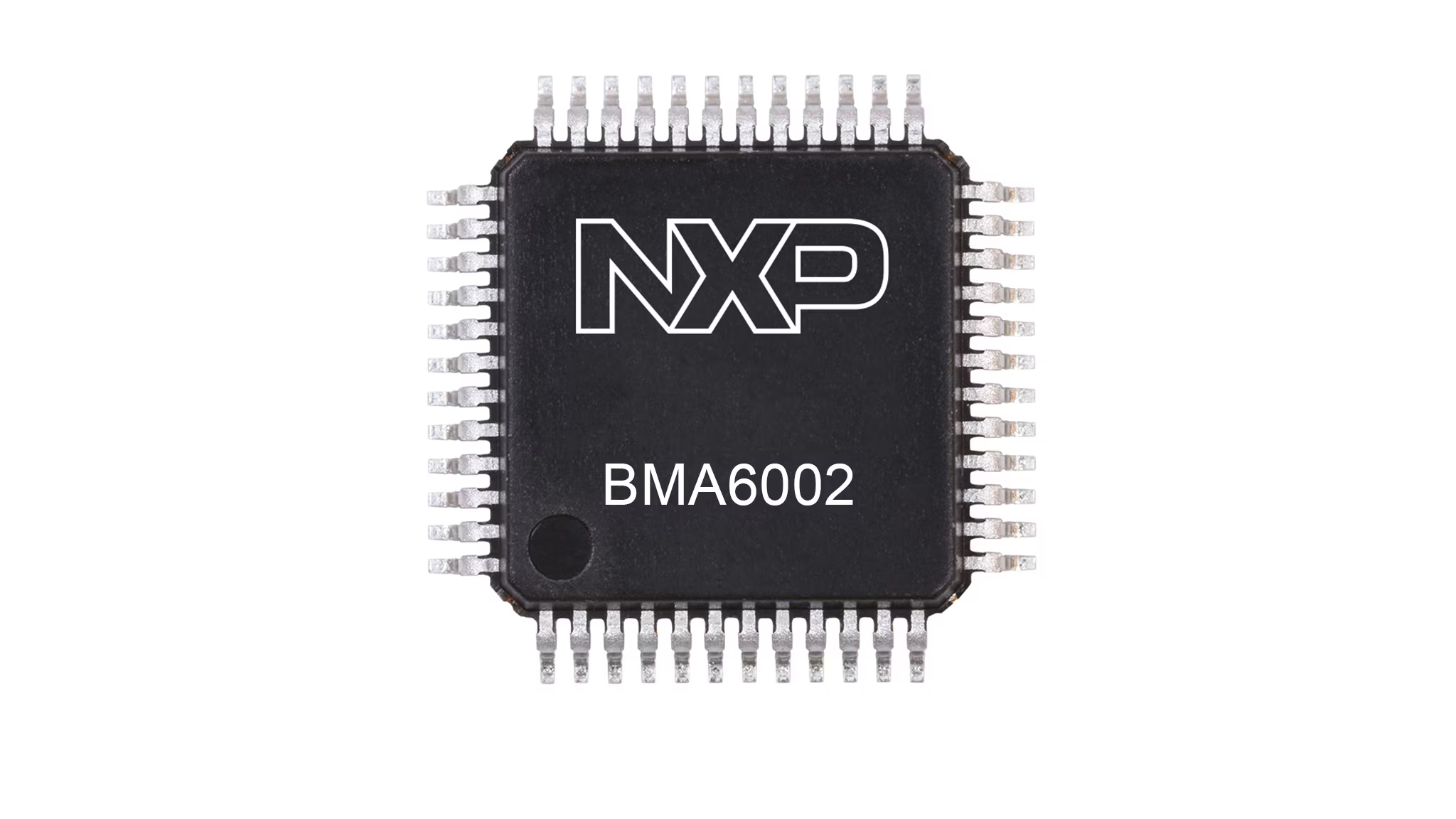
BMX6X02
The BMX6X02 is a high-performance, low-power 3-axis digital accelerometer manufactured by NXP Semiconductors. It features a wide measurement range of ±2g to ±16g, configurable through software, making it suitable for diverse motion-sensing applications. The device offers a high resolution of up to 12 bits and supports data rates from 1 Hz to 400 Hz, enabling precise detection of both slow movements and rapid vibrations.
This sensor incorporates an advanced MEMS (Micro-Electro-Mechanical Systems) structure with excellent linearity, repeatability, and long-term stability. It operates on a supply voltage ranging from 1.71 V to 3.6 V, which allows integration into battery-powered systems without compromising performance. The BMX6X02 also includes built-in self-test functionality for reliable diagnostics and ensures robust operation in harsh environments due to its industrial-grade temperature range of -40°C to +85°C.
Communication with the BMX6X02 is facilitated via I²C or SPI interfaces, providing flexibility in system design and compatibility with a wide range of microcontrollers. Its power-saving modes—such as sleep, wake-up, and low-power continuous mode—enable efficient energy management, particularly beneficial in portable and wearable devices. The device also supports embedded FIFO (First In, First Out) memory, capable of storing up to 32 samples, reducing CPU load during data acquisition.
Key features include programmable interrupt generation, threshold-based event detection, and orientation sensing capabilities, allowing the sensor to trigger actions based on motion events like tilt, shock, or free-fall. These features make the BMX6X02 ideal for use in consumer electronics such as smartphones, tablets, and smartwatches, where accurate motion tracking enhances user interaction and device functionality.
In industrial and automotive contexts, the BMX6X02 supports vibration monitoring, tilt sensing, and inertial navigation systems. Its compact QFN package (4 mm × 4 mm × 1 mm) facilitates space-constrained designs, while its compliance with RoHS and lead-free standards ensures environmental safety and manufacturability. With integrated signal conditioning and digital filtering, the sensor delivers clean, ready-to-use data, minimizing external circuitry requirements and simplifying system integration.
Related Parts
| Part # | Manufacturer | Description | Availability | Pricing | Quantity |
|---|---|---|---|---|---|
 MBMI6002CAAEBattery Management ICs | NXP Semiconductors | CAN gateway with two ETPL ports for industrial application. | In Stock | - | |
MBMA6002CAAER2Battery Management ICs | NXP Semiconductors | CAN gateway with two ETPL ports. | In Stock | - | |
MBMI6002SAAEBattery Management ICs | NXP Semiconductors | SPI gateway with two ETPL ports for industrial application. | In Stock | - | |
MBMI6002CAAER2Battery Management ICs | NXP Semiconductors | CAN gateway with two ETPL ports for industrial application. | In Stock | - | |
MBMA6002CAAEBattery Management ICs | NXP Semiconductors | CAN gateway with two ETPL ports. | In Stock | - | |
MBMA6002SAAER2Battery Management ICs | NXP Semiconductors | SPI gateway with two ETPL ports. | In Stock | - | |
MBMA6002SAAEBattery Management ICs | NXP Semiconductors | SPI gateway with two ETPL ports. | In Stock | - | |
MBMI6002SAAER2Battery Management ICs | NXP Semiconductors | SPI gateway with two ETPL ports for industrial application. | In Stock | - |





.png?x-oss-process=image/format,webp/resize,h_32)


