
 German
 Japanese
 Portuguese
 Korea
Korea
 Mexico
 Dutch
Dutch
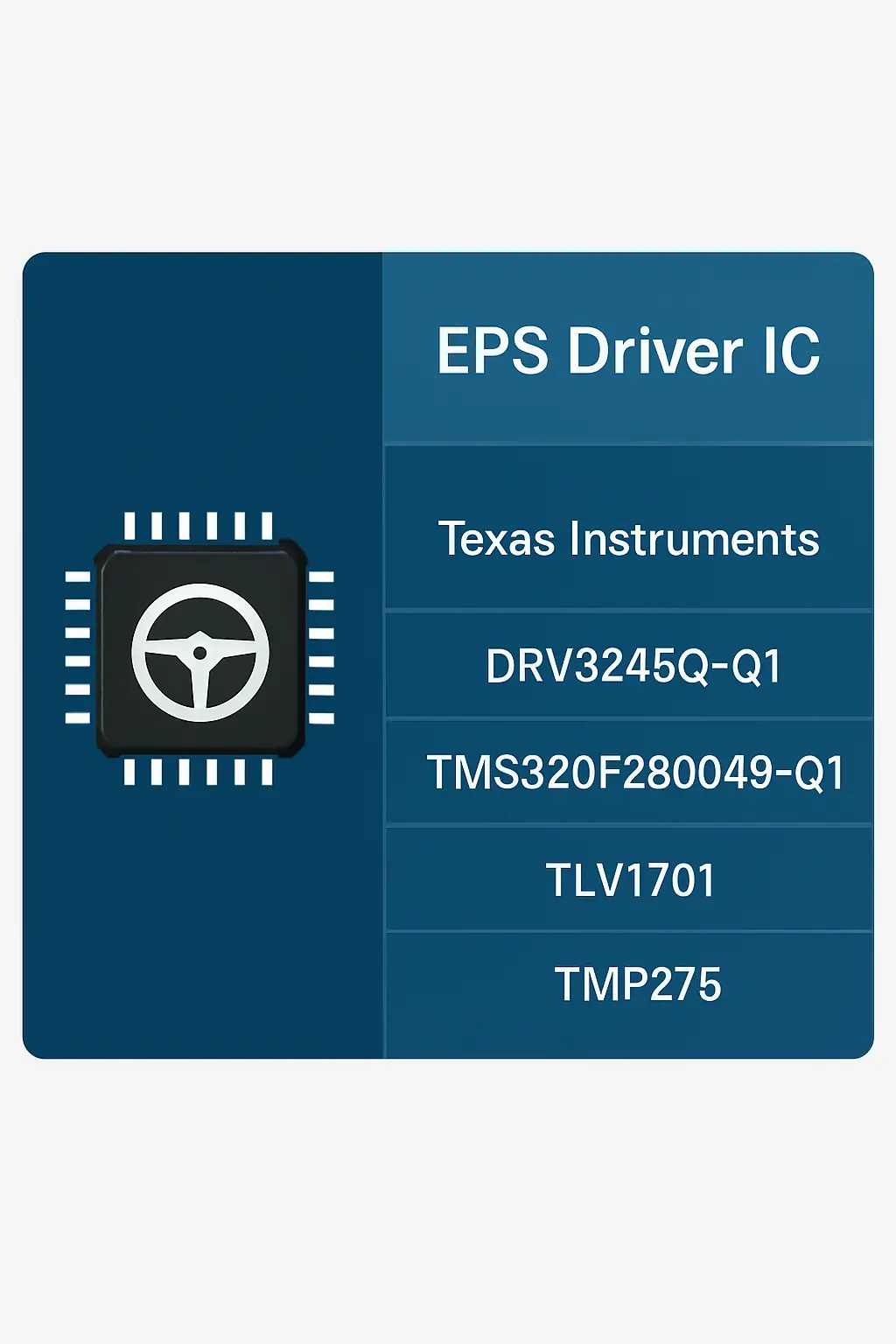
EPS Driver IC
The EPS Driver IC is a critical component in modern Electric Power Steering (EPS) systems, designed to enhance driving comfort, safety, and energy efficiency. As part of the Chassis & Vehicle Dynamics domain within Automotive Electronics, it plays a key role in managing the power assistance provided to the driver during steering operations.
The EPS Driver IC controls the motor that provides steering assist, ensuring precise and responsive handling. It receives input from the steering angle sensor and torque sensor, processes the data, and adjusts the motor's output accordingly. This enables smooth and accurate steering, especially at low speeds or during parking maneuvers.
This integrated circuit is widely used in various vehicle types, including passenger cars, commercial vehicles, and electric vehicles. It supports advanced driving features such as lane-keeping assist, adaptive cruise control, and autonomous driving functions by providing reliable and real-time steering assistance.
Designed for high reliability and durability, the EPS Driver IC operates under challenging environmental conditions, including extreme temperatures and electrical noise. It also contributes to energy savings by optimizing motor operation, which is particularly important in electric and hybrid vehicles.
In summary, the EPS Driver IC is an essential element in modern automotive electronics, enhancing vehicle performance, driver experience, and system efficiency. Its application across different vehicle segments makes it a vital component in the evolving landscape of smart and connected mobility.
Details
EPS Driver IC
Related Parts
| Series Name | Description | Manufacturer Name | Attribute Description |
|---|---|---|---|
| Texas Instruments | 32-bit ARM Cortex-R4F core, 180 MHz, 3MB Flash, 256KB RAM, ECC memory, 12-channel DMA, multiple CAN, SPI, UART, I2C interfaces, 12-bit ADC, safety-critical features, 1.2V/3.3V operation, 176-pin package. | ||
| Texas Instruments | 3.3V to 5.5V supply, analog output, high-precision Hall-effect sensor, ±1% sensitivity tolerance, 1.8V ratiometric output, AEC-Q100 qualified, low-power operation, wide air-gap support. | ||
| Texas Instruments | Dual operational amplifier with rail-to-rail output, single-supply operation from 2.7V to 16V, low supply current (120µA per amplifier), 1MHz gain bandwidth, low input bias current (1pA), unity-gain stable. | ||
| Texas Instruments | Dual operational amplifier with rail-to-rail output, single-supply operation from 2.7V to 16V, low supply current (380µA per amplifier), 1.2MHz gain bandwidth, low input offset voltage (±2mV), JFET input stage, low input bias current. | ||
| Texas Instruments | Comparator with open-drain output, 1.8V to 5.5V supply, 450ns response time, low input bias current, rail-to-rail input, small footprint package. | ||
| Texas Instruments | Quad voltage comparator with open-drain outputs, 2.7V to 36V supply, 1.5μs response time, low input bias current, wide operating temperature range. | ||
| Texas Instruments | 3.3V to 5.5V supply, 2.7V to 5.5V input, 800µA quiescent current, ±0.1% accuracy, 16-bit resolution, SPI interface, -40°C to 125°C operating temperature. | ||
| Texas Instruments | 2.7V to 5.5V supply, ±3.5A current sense range, 16-bit ADC resolution, integrated Hall sensor, 0.1% gain accuracy, SPI interface, -40°C to +125°C operating temperature. | ||
| Texas Instruments | 32-bit C2000™ MCU, 100-MHz CPU, 256KB flash, 16-bit PWM, 12-bit ADC, CAN, LIN, SPI, I2C, UART, supports real-time control, automotive-grade. | ||
| Texas Instruments | 3.3V/5V input, dual-output power supply with 2.5A buck converter and 150mA LDO; integrated FETs, spread-spectrum control, AEC-Q100 qualified for automotive applications. |






.png?x-oss-process=image/format,webp/resize,h_32)


