
 German
 Japanese
 Portuguese
 Korea
Korea
 Mexico
 Dutch
Dutch
Pulse Oximeter
A pulse oximeter is a medical device used to measure the oxygen saturation level in a patient's blood and their pulse rate. It is a non-invasive tool that provides quick and accurate readings, making it an essential instrument in both clinical and home healthcare settings. The device typically uses light sensors placed on a finger, toe, or earlobe to detect the amount of oxygen carried by hemoglobin in the blood.
Pulse oximeters are widely used in hospitals, clinics, and emergency care environments to monitor patients with respiratory conditions, such as COPD, asthma, or during post-surgery recovery. They are also beneficial for individuals with heart conditions, sleep apnea, or those undergoing high-altitude activities. In home healthcare, these devices help users manage chronic illnesses and track their health status effectively.
Integrated into modern medical electronic systems, pulse oximeters enhance patient monitoring capabilities, offering real-time data that supports timely medical decisions. Their portability and ease of use make them ideal for both professional and personal use. Whether in a critical care setting or at home, pulse oximeters play a crucial role in ensuring patient safety and improving health outcomes.
Details
Pulse Oximeter
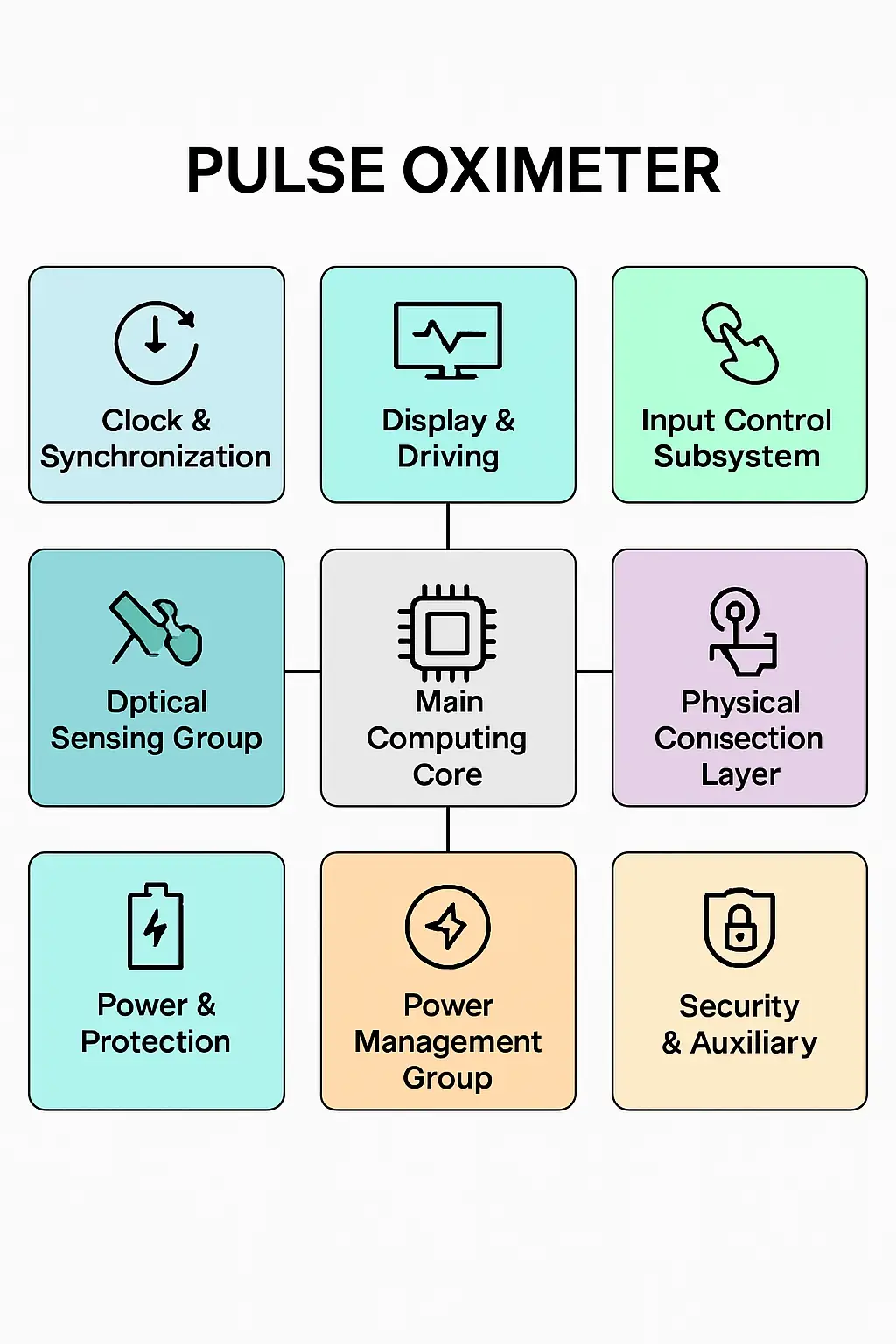
Related Parts
| Series Name | Description | Manufacturer Name | Attribute Description |
|---|---|---|---|
| Texas Instruments | Timer-controlled power management IC with 1.8V to 5.5V supply, ultra-low quiescent current (35nA), programmable delay from 100ms to 1000s, small SOT-23 package. | ||
| Texas Instruments | Low-power programmable timer with watchdog, 1.8V to 5.5V supply, 35nA typical standby current, open-drain output, supports periodic wake-up and system reset. | ||
| Texas Instruments | Low-power programmable timer, 1.8V to 5.5V supply, 35nA typical standby current, open-drain reset output, adjustable delay from 10ms to 7200s, small SOT-23 package. | ||
| Texas Instruments | 3-channel, 1-output clock generator, 1.8V to 3.3V supply, up to 200MHz output frequency, ±50ppm frequency stability, low jitter <1ps RMS, I²C programmable, integrated PLL, small 16-pin QFN package. | ||
| Texas Instruments | 1.8V to 3.3V supply voltage; 2 LVCMOS/LVTTL outputs; 65 ps max skew; 200 MHz max frequency; low jitter; 8-pin SOIC package; operates from -40°C to 85°C. |






.png?x-oss-process=image/format,webp/resize,h_32)


