
 German
 Japanese
 Portuguese
 Korea
Korea
 Mexico
 Dutch
Dutch
Communication Interface / CAN PHY
The Communication Interface / CAN PHY is a critical component within the Battery Management System (BMS) of Electrification & Battery Systems in Automotive Electronics. It serves as the communication link between the BMS and other vehicle systems, enabling real-time data exchange through the Controller Area Network (CAN) protocol. This interface ensures reliable and efficient communication, allowing the BMS to monitor and manage battery performance, state of charge, temperature, and other vital parameters.
In electric and hybrid vehicles, the CAN PHY plays a key role in transmitting battery data to the vehicle’s control units, such as the Powertrain Control Module (PCM) or the Energy Management System (EMS). This enables accurate energy management, fault detection, and system optimization, which are essential for vehicle safety and performance. The Communication Interface also supports diagnostics and software updates, enhancing the overall reliability and maintainability of the vehicle's powertrain.
This technology is widely used in modern electric vehicles (EVs), hybrid electric vehicles (HEVs), and advanced driver-assistance systems (ADAS). Its application extends to both passenger and commercial vehicles, supporting the growing demand for electrified transportation solutions. With the increasing complexity of automotive electronics, the role of the CAN PHY in ensuring seamless communication becomes even more crucial.
Designed for high durability and electromagnetic compatibility (EMC), the Communication Interface / CAN PHY meets industry standards for automotive environments. It contributes to the efficiency, safety, and performance of electrified vehicles, making it an essential element in the future of automotive technology.
Details
Communication Interface / CAN PHY
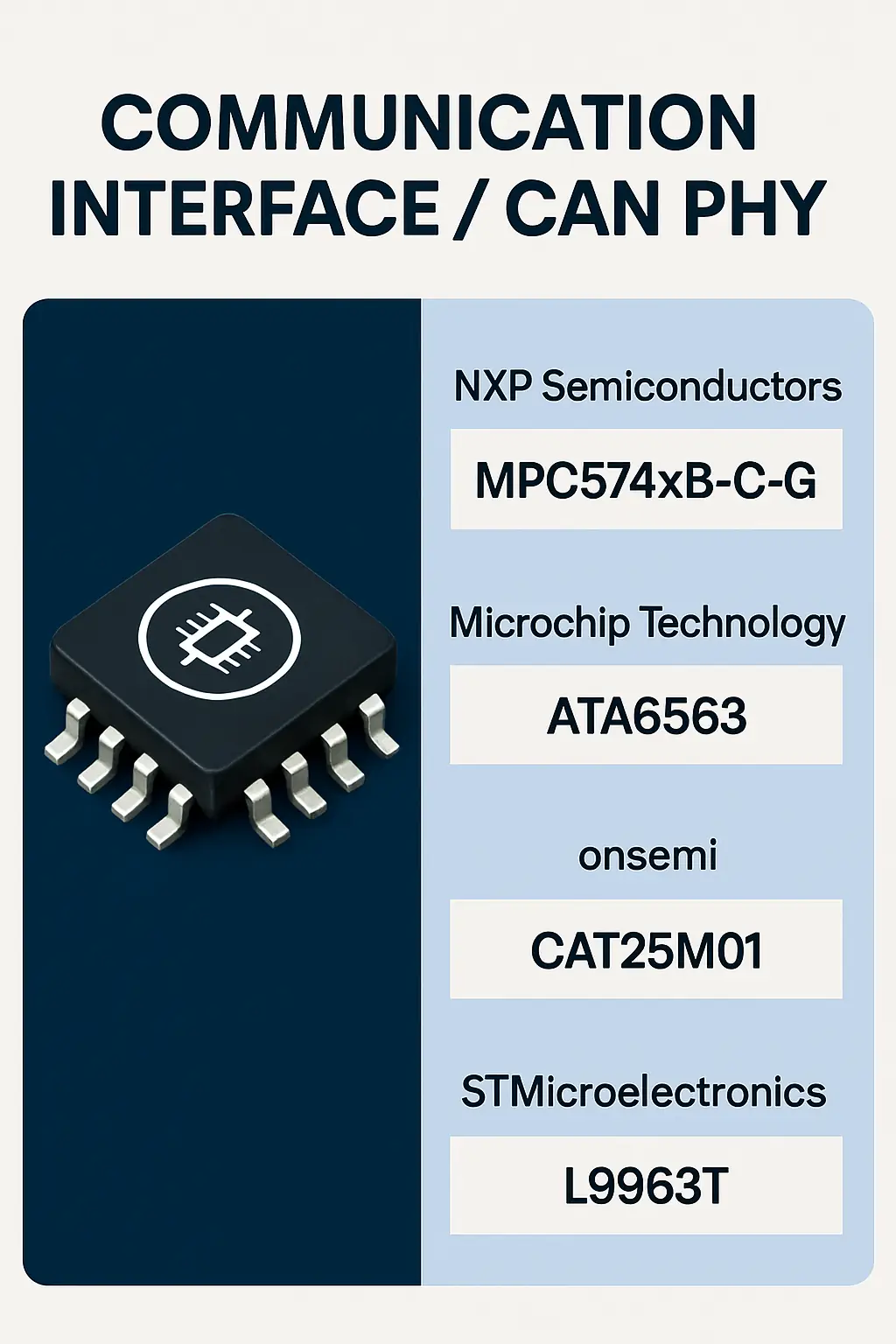
Related Parts
| Series Name | Description | Manufacturer Name | Attribute Description |
|---|---|---|---|
| NXP Semiconductors | 3-phase IGBT inverter module, 650V, 75A, low saturation voltage, integrated NTC sensor, high thermal performance, suitable for motor drives and inverters. | ||
| NXP Semiconductors | 5 V, 150 mA, Low-dropout voltage regulator, ultra-low quiescent current, high PSRR, stable with ceramic capacitors, small SOT-23 package. | ||
| NXP Semiconductors | 32-bit Power Architecture MCU, up to 300 MHz, 2.97–3.6 V, -40°C to 125°C, 2 MB Flash, 256 KB RAM, triple-core (2x e200z7, e200z4), CAN FD, Ethernet, FlexRay, 12-bit ADC. | ||
| Microchip Technology | 3.3V to 5.5V supply, 800µA typical operating current, 25Mbps data rate, fault-protected CAN transceiver with ±58kV ESD protection, high noise immunity, suitable for industrial and automotive applications. | ||
| Microchip Technology | 10/100 Mbps Ethernet PHY, 3.3V operation, low power, MII/RMII interface, integrated signal transformers, 48-pin LQFP, supports IEEE 1588, AEC-Q100 qualified for automotive applications. | ||
| Microchip Technology | 64 Kbit (8K x 8) SPI Bus Interface, 2.5V to 5.5V Operation, Low Power CMOS, 1 MHz Clock, 8-pin SOIC, TSSOP, or DFN Package | ||
| onsemi | 1Mb SPI Serial EEPROM, 3V to 5.5V supply, 8-pin SOIC package, up to 20MHz clock, byte and page write modes, hardware write protection, 100,000 write cycles, 200-year data retention. | ||
| STMicroelectronics | 36V, 1.5A half-bridge driver, 10V UVLO, 45V load dump, SPI interface, 64LQFP package, operates from -40°C to 150°C, integrated charge pump, fault protection, suitable for automotive battery management. | ||
| STMicroelectronics | 3-phase BLDC motor driver, 45V max supply, 1.5A output current, integrated pre-driver, SPI interface, fault protection, PWM frequency up to 20kHz, 48-pin QFN package, operating temp -40°C to 150°C. |






.png?x-oss-process=image/format,webp/resize,h_32)


