
 German
 Japanese
 Portuguese
 Korea
Korea
 Mexico
 Dutch
Dutch
Safety Breaker
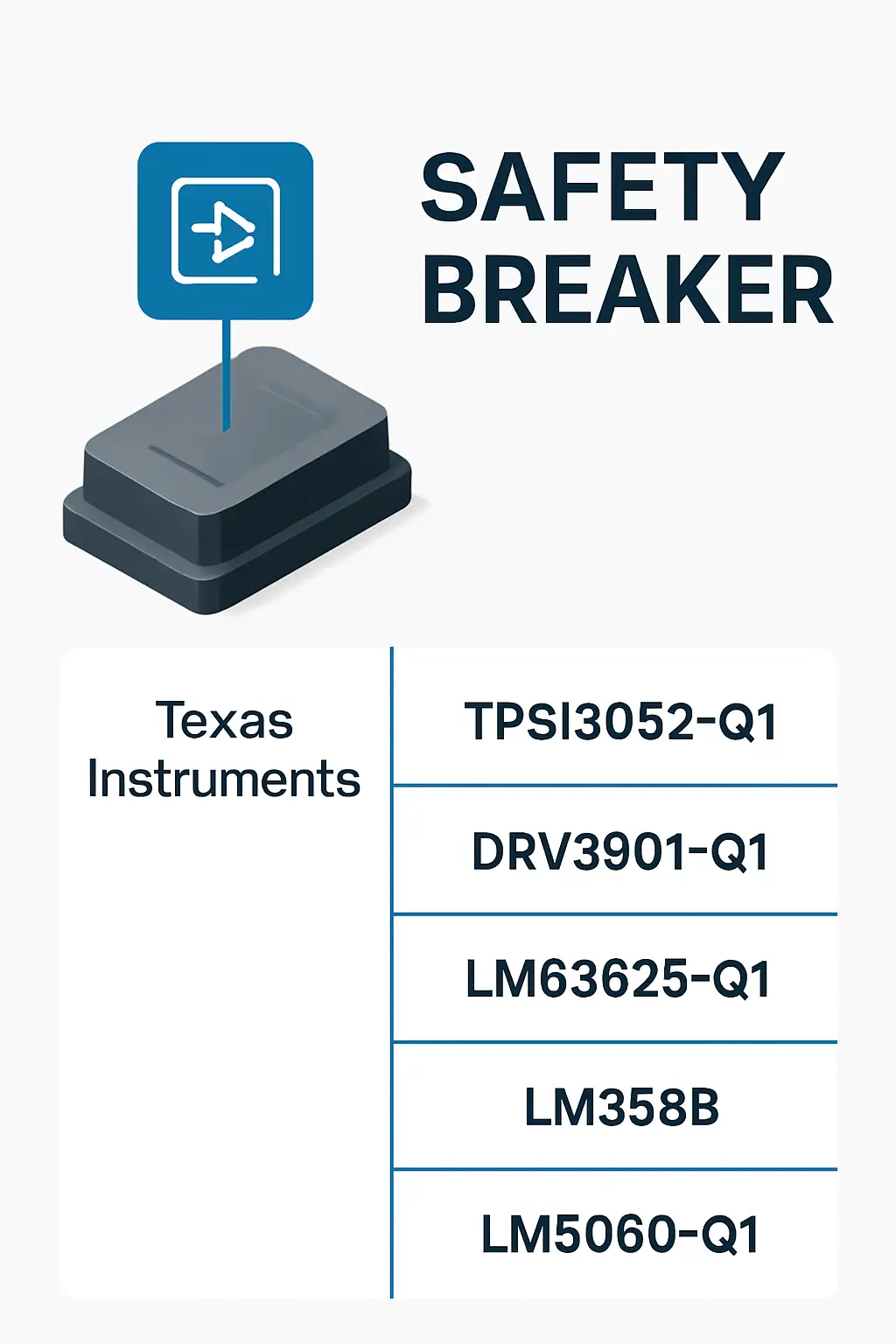
The Safety Breaker is a critical component within Battery Management Systems (BMS), which are essential in Electrification & Battery Systems of modern Automotive Electronics. It serves as a protective mechanism designed to disconnect the battery from the electrical system in case of overcurrent, short circuits, or other abnormal conditions, ensuring the safety and reliability of electric vehicles (EVs) and hybrid electric vehicles (HEVs).
In electric vehicles, the Safety Breaker plays a vital role in preventing electrical faults from escalating into hazardous situations. It rapidly interrupts the flow of current when a fault is detected, protecting both the vehicle's electrical components and the driver. This feature is particularly important in high-voltage battery systems, where even a small fault can lead to serious consequences.
The Safety Breaker is commonly used in various applications, including electric powertrains, energy storage systems, and onboard charging units. It is integrated into the BMS to monitor and control the electrical flow, ensuring optimal performance and system integrity. Its design allows for quick response times, making it an indispensable part of advanced automotive electronics.
By incorporating a Safety Breaker, automotive manufacturers enhance the overall safety and efficiency of their electrified vehicles. It supports the broader goals of the automotive industry in adopting cleaner, safer, and more reliable electric mobility solutions. The Safety Breaker is a key enabler in the transition toward sustainable transportation, offering robust protection and contributing to the longevity of battery systems.
Details
Safety Breaker
Related Parts
| Series Name | Description | Manufacturer Name | Attribute Description |
|---|---|---|---|
| Texas Instruments | 5.7kVrms isolation, 2.5kVRMS transient overvoltage, 100ns propagation delay, 5V supply, 10Mbps data rate, reinforced isolation, automotive-grade, 8-pin SOIC package. | ||
| Texas Instruments | 3.3V to 5.5V supply, 1A max output current, H-bridge driver, integrated MOSFETs, fault protection, thermal shutdown, 2.5MHz PWM, QFN package, automotive grade. | ||
| Texas Instruments | 6-channel LED driver, 3.3V to 5.5V supply, up to 150mA per channel, I2C interface, 12-bit PWM dimming, spread-spectrum clocking, fault detection, AEC-Q100 qualified for automotive applications. | ||
| Texas Instruments | Input voltage: 3.8V to 36V; Output current: 2.5A; Operating frequency: 2.1MHz; Efficiency: up to 92%; Operating temperature: -40°C to 150°C; Integrated synchronous rectifier; Low EMI. | ||
| Texas Instruments | Input voltage: 3.5V to 36V; Output current: 2A; Operating frequency: 440kHz/880kHz; Efficiency up to 95%; Integrated FET; Adjustable output voltage; Enable pin; Thermal shutdown protection. | ||
| Texas Instruments | Input voltage: 3.5V to 100V, Output current: up to 1A, Switching frequency: 100kHz to 1MHz, Efficiency: up to 95%, Operating temperature: -40°C to 150°C, Integrated high-side MOSFET, Current-mode control. | ||
| Texas Instruments | Input voltage: 3.0 to 18 V; Output voltage: up to 38 V; Switch current: 2.5 A; Efficiency: up to 90%; Operating temperature: -40°C to 125°C; Fixed 400 kHz switching frequency. | ||
| Texas Instruments | Input voltage: 1.8V to 5.5V; Output voltage: up to 28V; Switching frequency: 1.2MHz; Efficiency: up to 90%; Integrated 2.2A switch; Adjustable current limit; Small 2mm × 2mm WSON package. | ||
| Texas Instruments | 42V input, 1.2A peak current mode controller, 4-switch buck-boost converter, 2.2MHz switching frequency, supports 1-cell to 4-cell battery applications, automotive grade. | ||
| Texas Instruments | Input voltage: 4.5V to 65V, Output current: up to 1A, Switching frequency: 100kHz to 1MHz, Efficiency: up to 92%, Operating temperature: -40°C to 150°C, Integrated high-side switch. |






.png?x-oss-process=image/format,webp/resize,h_32)


