
 German
 Japanese
 Portuguese
 Korea
Korea
 Mexico
 Dutch
Dutch
Sensor Signal Conditioning
Automotive Electronics refers to the integration of electronic systems within vehicles, enhancing performance, safety, and user experience. As part of Electrification & Battery Systems, it plays a crucial role in managing electric powertrain components and energy storage. Sensor Signal Conditioning is an essential sub-system that ensures accurate data transmission from various vehicle sensors to control units, improving overall system reliability and efficiency.
Charging Infrastructure supports the development and implementation of efficient and safe charging solutions for electric vehicles (EVs). It includes hardware and software components that enable seamless communication between the vehicle and the charging station, ensuring optimal power transfer and battery health monitoring.
These technologies are widely applied in modern vehicles, particularly in hybrid and fully electric models. They support features such as regenerative braking, battery management, and real-time diagnostics. In autonomous driving systems, precise sensor signal conditioning is vital for processing environmental data, enabling safe and accurate vehicle operation.
The integration of these systems enhances vehicle performance, reduces emissions, and improves user convenience. They are essential for the future of sustainable mobility, supporting the transition to cleaner and smarter transportation solutions. By combining advanced electronics with reliable charging infrastructure, automotive manufacturers can deliver high-performance, eco-friendly vehicles that meet evolving consumer demands.
Details
Sensor Signal Conditioning
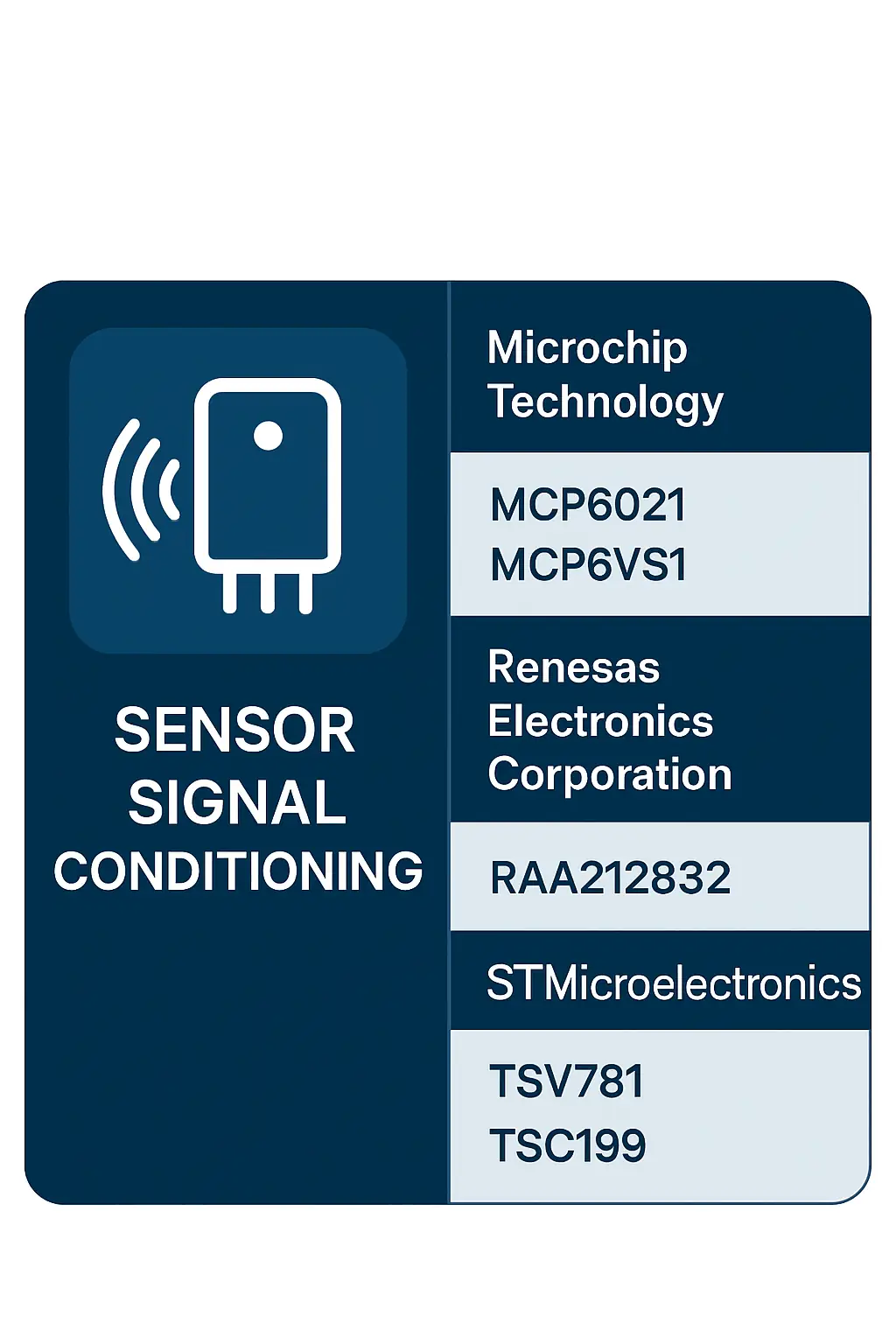
Related Parts
| Series Name | Description | Manufacturer Name | Attribute Description |
|---|---|---|---|
| Microchip Technology | Single-supply, rail-to-rail input/output operational amplifier, 10 MHz bandwidth, 5.7 V/μs slew rate, 8-pin package, low input bias current, unity gain stable, operating voltage 2.7V to 6V. | ||
| Microchip Technology | Zero-drift op-amp, 1.8V to 5.5V supply, 1.3µV offset, 0.005µV/°C drift, 1.25MHz GBW, 650µA quiescent current, rail-to-rail I/O, 106dB CMRR, -40°C to +125°C. | ||
| Microchip Technology | 64-channel capacitive touch controller, 3.3V operation, I2C interface, up to 2.5MHz, 1MHz max refresh rate, 16-bit resolution, supports multi-touch, gesture recognition, noise suppression, and liquid tolerance. | ||
| Microchip Technology | Capacitive touchscreen controller with multi-touch support, up to 10-point detection, I²C interface, supports gesture recognition, low power consumption, wide voltage operation (2.6V to 3.6V), built-in noise suppression. | ||
| Microchip Technology | 8M-bit (1M x 8) Serial Quad I/O Flash, 3V, 104MHz, 256-byte page, 4KB/32KB/64KB erase, SPI/QPI, 8-pin SOIC/TSSOP, embedded security, high reliability. | ||
| Renesas Electronics Corporation | Dual precision low-noise op-amp, 3.6V to 36V supply, 10MHz GBW, 5.5V/µs slew rate, low offset voltage, rail-to-rail output, wide temperature range, available in SOIC-8 package. | ||
| Renesas Electronics Corporation | 36V input, 3A synchronous buck controller; 100kHz–2.2MHz frequency; 0.8V reference; PWM/PFM mode; enables high efficiency, compact power solutions. | ||
| Renesas Electronics Corporation | 60V, 4A synchronous buck controller; 100kHz–2MHz adjustable frequency; integrated high-side and low-side drivers; supports voltage mode control; efficiency up to 95%. | ||
| STMicroelectronics | Rail-to-rail input/output, 1.8V to 5.5V supply, 1.3MHz bandwidth, 0.9V/µs slew rate, low power, CMOS technology, single supply, shutdown mode, low input bias current, unity gain stable. | ||
| STMicroelectronics | Dual operational amplifier, 2.7V to 12V supply, 1.3MHz bandwidth, 0.75V/µs slew rate, rail-to-rail I/O, low input bias current, unity gain stable, available in SO-8 package. |





.png?x-oss-process=image/format,webp/resize,h_32)


