
 German
 Japanese
 Portuguese
 Korea
Korea
 Mexico
 Dutch
Dutch
Gateway Processor
The Gateway Processor is a critical component in the Software-Defined Vehicle architecture, specifically within the Central Compute / Domain Control system. It serves as the communication hub that connects various vehicle domains, such as infotainment, driver assistance, and body control, ensuring seamless data exchange and system coordination.
In modern automotive electronics, the Gateway Processor manages the flow of information between different electronic control units (ECUs) and external networks, such as cellular, Wi-Fi, and vehicle-to-everything (V2X) systems. It ensures secure, reliable, and efficient communication, while also supporting over-the-air (OTA) updates and real-time data processing.
This component plays a key role in enabling advanced driver-assistance systems (ADAS), autonomous driving, and connected car services. It supports high-speed data transfer protocols like CAN FD, Ethernet, and LIN, allowing for faster and more complex vehicle functions.
The Gateway Processor is widely used in smart vehicles, where it enhances performance, safety, and user experience. It is essential for integrating software-defined features, improving system scalability, and reducing hardware complexity. Its application extends to both passenger and commercial vehicles, supporting the transition toward fully connected and autonomous driving solutions.
Details
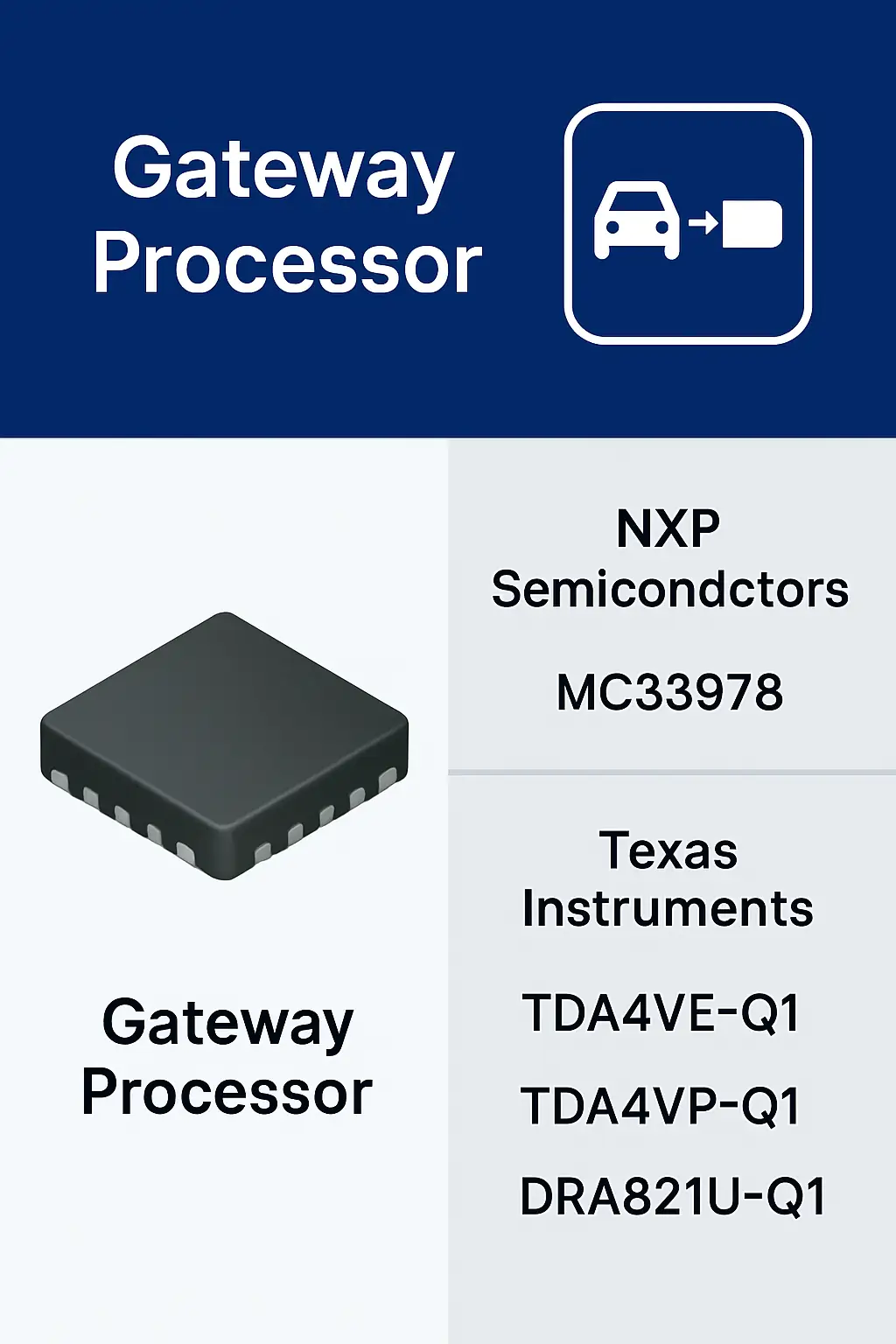
Gateway Processor
Related Parts
| Series Name | Description | Manufacturer Name | Attribute Description |
|---|---|---|---|
| NXP Semiconductors | 32-bit ARM Cortex-M4 core, 120 MHz, 512 KB flash, 64 KB RAM, 12-bit ADC, multiple communication interfaces (SPI, I2C, UART), CAN FD, 48-pin LQFP package, operating voltage 1.71–3.6 V, -40°C to 125°C temperature range. | ||
| NXP Semiconductors | 5V CAN FD controller, 16Mbps data rate, integrated 5V LDO, low EMI, high noise immunity, VIO interface, partial network, wake-up via CAN bus, -40°C to +125°C operating temperature. | ||
| NXP Semiconductors | 32V max supply voltage, 5V/3.3V regulator outputs, high-side/low-side drivers, CAN FD and LIN transceivers, watchdog timer, SPI interface, operating temperature -40°C to +150°C, 48-pin LQFP package. | ||
| Texas Instruments | Quad Arm® Cortex®-R5F @ 1.8GHz, dual Cortex-A72 @ 1.8GHz, 8MB L3 RAM, 4x 1.5GHz C7x DSP + MMA for AI, 8-lane MIPI CSI-2, 16GBps vision accelerator, automotive grade | ||
| Texas Instruments | Quad Arm® Cortex®-A72 @ 1.8GHz, 2x R5F @ 400MHz, C7x DSP @ 1.1GHz, MMA @ 8 TOPS, 8GB LPDDR4, 32-bit multimedia accelerator, 6x 1.4MP camera support, PCIe/USB/Ethernet interfaces | ||
| Texas Instruments | Dual-core Arm Cortex-R5F @ 400 MHz, 1x Cortex-A72 @ 800 MHz; 4MB flash, 2MB RAM; CAN FD, Ethernet, SPI, I2C; -40°C to 125°C junction temp; 0.65mm pitch BGA package. | ||
| Texas Instruments | Quad Arm® Cortex®-R5F @ 2.0 GHz, dual Arm® Cortex-A72 @ 1.8 GHz, 8 MB L3 RAM, 4x 4K @ 60 FPS, 8x 1080p @ 30 FPS, 2x 8 MP @ 30 FPS, supports ASIL-D, 12-channel ADC, PCIe/USB3.0/Ethernet. | ||
| Texas Instruments | Dual-core ARM Cortex-A15 MPCore, 1x Cortex-M4, PowerVR SGX544 GPU, up to 1.5GHz, 32-bit DDR3/LPDDR2/LPDDR3, integrated automotive interfaces, supports Android, Linux, QNX. | ||
| Texas Instruments | Quad-core ARM Cortex-A15 CPU, 2x Cortex-M4, 1x C66x DSP, up to 1.5GHz, 4GB DDR3/LPDDR2 support, integrated power management, automotive-grade, 600-pin BGA. |






.png?x-oss-process=image/format,webp/resize,h_32)


