German
 Japanese
 Portuguese
 Korea
 Mexico
 Dutch


Top Picks for CR1216 Battery Equivalent

What is the CR1216 Battery?
The CR1216 is a small, coin-shaped lithium manganese dioxide (Li/MnO2) battery, typically providing a nominal voltage of 3.0V and a capacity of about 25 mAh. Its dimensions are 12.5 mm in diameter and 1.6 mm in height. The battery operates within a temperature range of -20°C to +70°C, and it has a shelf life of up to 10 years when stored properly, with a self-discharge rate of about 1% per year.
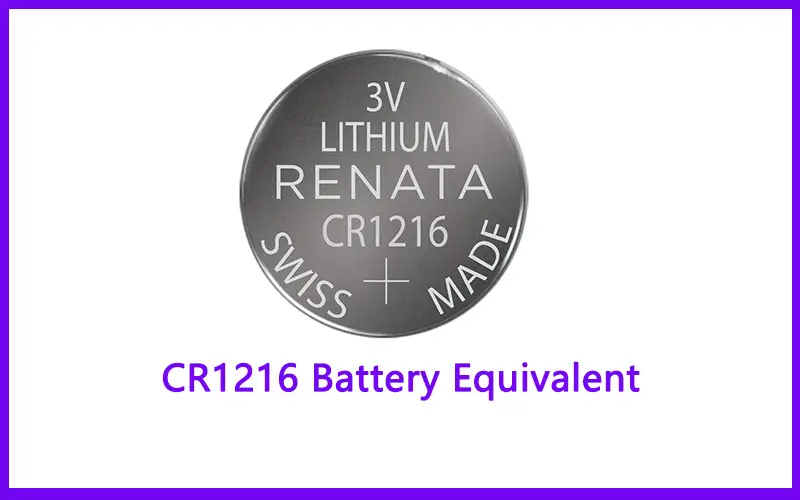
CR1216 batteries are commonly used in devices such as watches, calculators, remote controls, key fobs, glucose monitors, and heart rate monitors. Equivalent models include DL1216, ECR1216, BR1216, KCR1216, LM1216, and 5034LC134. Brands offering CR1216 batteries include Energizer, Duracell, Panasonic, Maxell, and Tenergy.
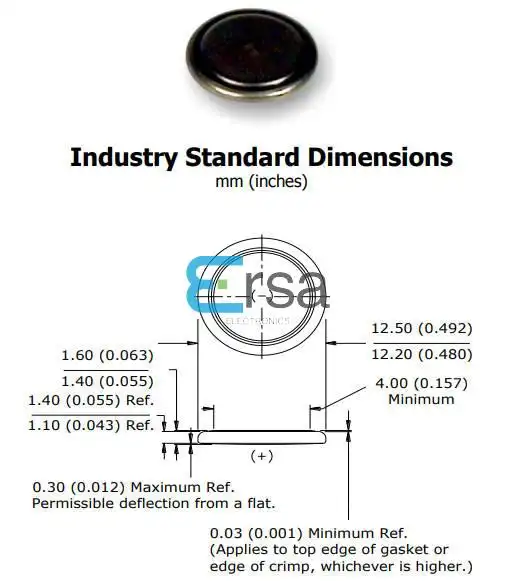
CR1216 Battery Dimensions
Primary Features of CR1216 Battery
The CR1216 battery is a non-rechargeable lithium manganese dioxide coin cell battery known for its compact size and reliable performance. Here are its primary features:
Chemistry: Lithium manganese dioxide (Li/MnO2).
Nominal Voltage: 3.0 volts.
Capacity: Typically around 25 mAh, though some specifications may list it as 30 mAh.
Dimensions: Diameter of 12.5 mm and height of 1.6 mm.
Operating Temperature: Generally ranges from -20°C to +70°C, depending on the brand.
Shelf Life: Can last up to 10 years when stored properly.
Self-Discharge Rate: Approximately 1% per year.
Discharge Current: Standard continuous discharge around 0.1 mA, with maximum pulse discharge currents up to 5 mA.
Stable Voltage Output: Provides consistent power, which is crucial for precision devices.
Compact Design: Ideal for small electronic devices where space is limited.
Reliable Performance: Suitable for devices requiring occasional bursts of energy, such as remote controls and medical devices.
CR1216 Battery Specifications
| Specification | Details |
| Chemistry | Lithium Manganese Dioxide (Li/MnO2) |
| Nominal Voltage | 3.0 Volts |
| Capacity | 25 mAh |
| Dimensions (Diameter) | 12.5 mm |
| Dimensions (Height) | 1.6 mm |
| Operating Temperature | -20°C to +70°C |
| Shelf Life | Up to 10 years (proper storage) |
| Self-Discharge Rate | Approximately 1% per year |
| Common Uses | Watches, calculators, remote controls, key fobs, glucose monitors, heart rate monitors |
| Equivalents | DL1216, ECR1216, BR1216, KCR1216, LM1216, 5034LC134 |
| Brands | Energizer, Duracell, Panasonic, Maxell, Tenergy |
CR1216 Battery Applications
The CR1216 battery is widely used in various applications due to its compact size, stable voltage output, and reliable performance. Here are some of its key applications:
Watches and Timekeeping Devices: Ideal for wristwatches, digital watches, and other timekeeping devices due to their small size and reliable performance.
Calculators and Electronic Gadgets: These are used in calculators, thermometers, handheld gaming devices, and digital thermometers.
Remote Controls: Commonly used in household and commercial remote controls for devices like TVs, DVD players, and air conditioners.
Key Fobs and Keyless Entry Systems: Essential for automotive key fobs and keyless entry systems, providing power for remote functions.
Medical Devices: Utilized in devices such as digital thermometers, glucose monitors, and hearing aids.
Small Electronic Gadgets: Powers handheld games, LED flashlights, and other small electronics.
Backup Power Sources: Used as backup power for memory backup circuits in electronic devices.
Industrial Applications: Employed in sensors, data loggers, and remote monitoring systems due to their robustness and wide temperature range.
Wearable Devices: These are used in fitness trackers and smartwatches for long-lasting power.
Environmental Monitoring Systems: Essential for weather monitoring, air quality measurement, and soil moisture monitoring systems.
CR1216 Battery Equivalent
| Equivalent | Voltage | Features | Common Uses | Notes |
| BR1216 | 2.8V | Low self-discharge rate, wide operating temperature range | Watches, remote controls, key fobs | Less common in recent years, lower voltage than CR1216 |
| DL1216 | 3.0V | Widely recognized, stable voltage output | Watches, calculators | A popular and reliable choice |
| ECR1216 | 3.0V | Stable voltage, long shelf life | Key fobs, remote controls | Excellent for devices requiring consistent voltage |
| KCR1216 | 3.0V | Compact design, consistent performance | Small electronic devices | Ideal for compact gadgets |
| LM1216 | 3.0V | Comparable to CR1216 in terms of specifications | Gadgets, small electronics | Reliable option for general replacements |
| L1216 | 3.0V | Meets power demands of small devices | Watches, medical devices | Suitable for low-power, small electronics |
| RFA-35 | 3.0V | Reliable for various devices, compact size | Watches, remote controls, medical devices | Versatile in usage, stable performance |
| 5034LC | 3.0V | Compact size, stable voltage output | CR1216 replacement in small gadgets | A great alternative for CR1216, particularly in small devices |
The CR1216 battery has several equivalent options, each with unique characteristics suited for different applications. While most alternatives, like DL1216, ECR1216, and LM1216, offer a voltage of 3.0V, others like BR1216 provide a slightly lower voltage of 2.8V. Factors such as self-discharge rate, operating temperature range, and shelf life vary among these equivalents, allowing users to select the best option for their specific device. It's important to consider compatibility, performance, and reliability when choosing an equivalent to ensure seamless operation in watches, remote controls, medical devices, and more.
Advantages of Using CR1216 Battery
The CR1216 battery offers several advantages that make it a preferred choice for various small electronic devices. Here are some of the key benefits:
1. Compact Design and Lightweight:
- Size: Measures 12.5 mm in diameter and 1.6 mm in height, making it ideal for devices with limited space.
- Weight: Lightweight, contributing to the overall portability of devices.
2. Stable Voltage Output:
- Provides a consistent nominal voltage of 3 volts, ensuring reliable performance in precision instruments and small electronics.
3. High Energy Density:
- Offers a high energy-to-size ratio, delivering ample power despite its compact size.
4. Long Shelf Life:
- Can retain its charge for up to 10 years when stored properly, making it suitable for devices used infrequently.
5. Low Self-Discharge Rate:
- Approximately 1% per year, which extends its usability and reduces the need for frequent replacements.
6. Wide Operating Temperature Range:
- Functions reliably from -30°C to +85°C, making it suitable for use in diverse environmental conditions.
7. Reliability and Consistency:
- Ensures consistent performance, which is crucial for devices like medical equipment and remote controls.
8. Easy Replacement:
- Widely available and easy to replace, minimizing downtime for devices.
9. Versatility in Applications:
- Used in a variety of devices, including watches, calculators, remote controls, medical devices, and industrial sensors.
Are CR1220 and CR1216 Interchangeable?
CR1220 and CR1216 batteries are not exact equivalents, although they share similar characteristics and can sometimes be used interchangeably in certain devices. Here's why they might not be fully interchangeable:
1. Size Difference:
- CR1216: Diameter of 12.5 mm and height of 1.6 mm.
- CR1220: Diameter of 12.5 mm and height of 2.0 mm.
- The 0.4 mm difference in height can cause fit issues in devices designed specifically for CR1220 batteries, potentially leading to unreliable contact or damage.
2. Capacity:
- CR1216: Typically has a capacity of about 25 mAh.
- CR1220: Offers a higher capacity, usually around 35-40 mAh.
- This means CR1220 batteries may last longer in devices, especially those requiring more power.
3. Performance:
- Both have a nominal voltage of 3 volts, but the CR1220 is better suited for high-drain applications due to its larger capacity.
In summary, while CR1216 might work in some devices designed for CR1220 if it fits and makes good contact, it may not last as long due to its smaller capacity. It's generally recommended to use the exact battery type specified for your device to ensure optimal performance and longevity.
Is CR1225 the same as CR1216?
CR1225 and CR1216 batteries are not the same, although they share some similarities. Here are the key differences:
1. Physical Dimensions:
- CR1216: Diameter of 12.5 mm and height of 1.6 mm.
- CR1225: Diameter of 12.5 mm and height of 2.5 mm.
- The CR1225 is thicker than the CR1216, which can affect compatibility in devices with tight space constraints.
2. Capacity:
- CR1216: Typically around 25 mAh.
- CR1225: Approximately 50 mAh.
- The CR1225 offers nearly double the capacity of the CR1216, making it suitable for devices requiring more power.
3. Applications:
- Both are used in small electronic devices, but the CR1225 is better suited for applications needing higher capacity, such as more complex remote controls or devices with higher power demands.
4. Compatibility:
- While they share the same diameter, the difference in height means that CR1216 batteries may fit into some CR1225 slots if they are not tightly fitted, but using the correct size is recommended to avoid potential issues.
In summary, while CR1225 and CR1216 batteries have similar voltage outputs, they differ significantly in size and capacity, making them non-interchangeable in many applications.

Related Articles
- ·Qualcomm PM8550 vs. PM8550B vs. PM8550VS: Features, Differences, Applications, and Selection Guide
- ·Qualcomm PM8350 vs. PM8350C: Architecture, Features, Applications, and Selection Guide
- ·Qualcomm PM8150 vs. PM8150B vs. PM8150L: Functions, Architecture, Applications, and Selection Guide
- ·SGM41541 vs. SGM6605: Battery Charger and Synchronous Boost Converter Comparison
- ·ADI LTM4630A vs. LT8645S: Power Module and Silent Switcher Regulator Comparison
- ·Richtek RT8206A vs. RT9013: Architecture, Specifications, Applications, and Design Considerations
- ·MPS MP2657, MPQ6610GJ-AEC1-Z, and MP2856: Identification, Functions, and Application Comparison
- ·TPS6594-Q1 vs. TPS65219-Q1 vs. TPS653860-Q1 vs. LP87745-Q1: TI Automotive PMIC Comparison
- ·Electronic Components Monthly Market Report
- ·MediaTek MT6369, MT6360, MT6365, and MT6375: Functions, Architecture, and Selection Guide
 FAQ