German
 Japanese
 Portuguese
 Korea
 Mexico
 Dutch


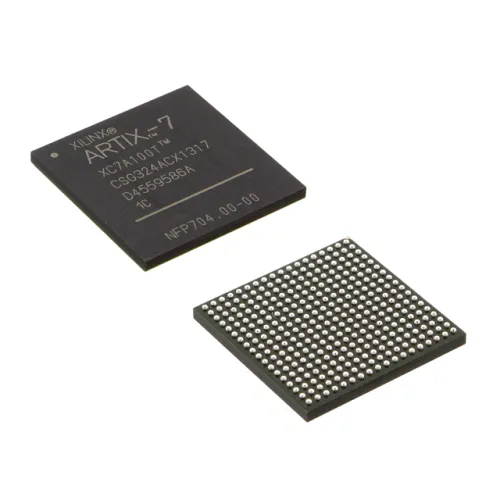
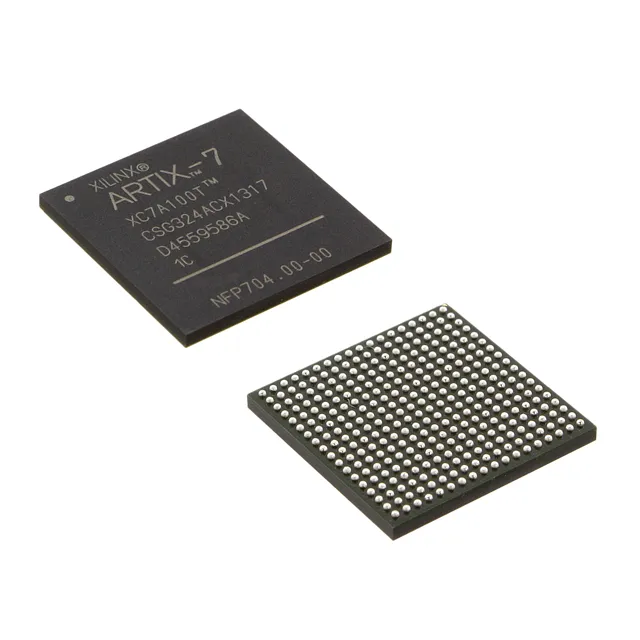
Images are for reference only. Product appearance may vary by batch. Refer to the product datasheet for exact specifications.



XC7A15T-2CSG324C Description
XC7A15T-2CSG324C
Key operational attribute: Mfr is verified at AMD under manufacturer standard test conditions.
Key operational attribute: Series is verified at Artix-7 under manufacturer standard test conditions.
Key operational attribute: Packaging is verified at Tray under manufacturer standard test conditions.
Key operational attribute: Part Status is verified at Active under manufacturer standard test conditions.
Key operational attribute: Number of LABs/CLBs is verified at 1300 under manufacturer standard test conditions.
Key operational attribute: Number of Logic Elements/Cells is verified at 16640 under manufacturer standard test conditions.
Key operational attribute: Total RAM Bits is verified at 921600 under manufacturer standard test conditions.
Key operational attribute: Number of I/O is verified at 210 under manufacturer standard test conditions.
Key operational attribute: Voltage - Supply is verified at 0.95V ~ 1.05V under manufacturer standard test conditions.
AMD's XC7A15T-2CSG324C is a high-performance Field Programmable Gate Array (FPGA) device that belongs to the Xilinx 7 Series. This device is designed to provide a high level of integration and flexibility for a wide range of applications, including embedded systems, communications, and industrial control.
Description:
The XC7A15T-2CSG324C is a mid-range FPGA device that features a high-density of programmable logic resources, making it suitable for a wide range of applications. The device is packaged in a 22x22mm Chip Scale Grid Array (CSGA) package, which is a compact and cost-effective form factor that is ideal for space-constrained applications.
Features:
Some of the key features of the XC7A15T-2CSG324C include:
- High-density programmable logic resources: The device features a large number of programmable logic elements (PLEs) and digital signal processing (DSP) blocks, which can be used to implement a wide range of digital logic functions.
- High-speed transceivers: The device includes a number of high-speed transceivers that can be used to interface with external devices and systems, including high-speed serial interfaces such as Gigabit Ethernet and PCI Express.
- On-chip memory: The device includes a large amount of on-chip memory, including block RAM (BRAM) and distributed RAM (DRAM), which can be used to store data and implement complex data processing algorithms.
- Integrated I/O: The device includes a wide range of integrated I/O functions, including support for a variety of industry-standard protocols and interfaces, such as USB, UART, and I2C.
- Low power consumption: The device is designed to operate with low power consumption, making it well-suited for battery-powered or energy-sensitive applications.
Applications:
The XC7A15T-2CSG324C is suitable for a wide range of applications, including:
- Embedded systems: The device's high-density of programmable logic resources and integrated I/O functions make it well-suited for use in embedded systems, where it can be used to implement a wide range of digital logic functions and interfaces.
- Communications: The device's high-speed transceivers and support for industry-standard protocols make it well-suited for use in communications systems, including network infrastructure, wireless base stations, and optical transport systems.
- Industrial control: The device's low power consumption and robustness make it well-suited for use in industrial control applications, where it can be used to implement complex control algorithms and interface with a wide range of sensors and actuators.
- Medical imaging: The device's high-speed transceivers and on-chip memory make it well-suited for use in medical imaging systems, where it can be used to implement complex image processing algorithms and interface with high-speed data acquisition systems.
Overall, the XC7A15T-2CSG324C is a versatile and high-performance FPGA device that is well-suited for a wide range of applications, including embedded systems, communications, and industrial control. Its high-density of programmable logic resources, integrated I/O functions, and low power consumption make it an attractive choice for designers looking for a flexible and cost-effective solution.