
 German
 Japanese
 Portuguese
 Korea
Korea
 Mexico
 Dutch
Dutch



Micron Technology
MT48LC8M16A2P-7E:G


Why Choose Us?
Professional Platform
B2B & B2C purchasingDelivery at full speed
1-2 days deliveryWide variety
Original manufacturers365 days guarantee
Responsible quality

.png)


Tech Specifications
MT48LC8M16A2P-7E:G Description
MT48LC8M16A2P-7E:G Description
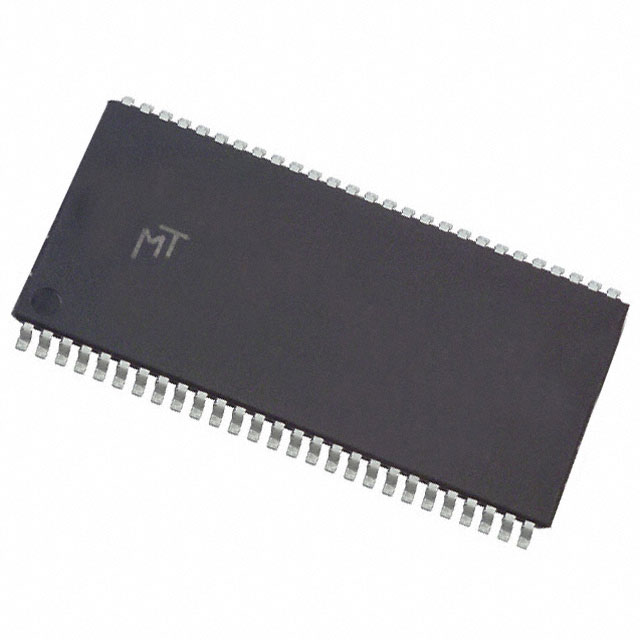
The MT48LC8M16A2P-7E:G is a 128Mbit (8M x 16) Synchronous DRAM (SDRAM) from Micron Technology, designed for high-performance applications requiring volatile memory with fast access times. Operating at a 133 MHz clock frequency, it delivers an access time of 5.4 ns and a write cycle time of 14ns, making it suitable for data-intensive systems. The device operates within a 3V to 3.6V supply range and is housed in a 54-pin TSOP II package, ensuring compatibility with surface-mount assembly processes. Although marked as Obsolete, it remains relevant for legacy designs due to its robust performance and ROHS3 compliance.
MT48LC8M16A2P-7E:G Features
- Memory Organization: 8M x 16 configuration, optimizing data throughput for 16-bit systems.
- High-Speed Performance: 133 MHz operation with 5.4 ns access time, ideal for real-time processing.
- Low Power Consumption: 3V–3.6V supply range balances speed and energy efficiency.
- Parallel Interface: Enables seamless integration with microcontrollers and processors.
- Industrial Reliability: Operates in 0°C to 70°C environments, suitable for commercial applications.
- Compliance: ROHS3 and REACH unaffected, meeting environmental standards.
MT48LC8M16A2P-7E:G Applications
This SDRAM is optimized for systems requiring high-speed, low-latency memory, including:
- Embedded Systems: Routers, switches, and industrial control units.
- Legacy Computing: Upgrades for older servers or workstations.
- Consumer Electronics: Set-top boxes, gaming consoles, and multimedia devices.
- Telecommunications: Buffer memory for network infrastructure.
Conclusion of MT48LC8M16A2P-7E:G
The MT48LC8M16A2P-7E:G offers a compelling blend of speed, reliability, and compatibility, making it a pragmatic choice for legacy and niche applications. While newer alternatives exist, its 5.4 ns access time and 133 MHz clock ensure it remains viable for systems prioritizing deterministic performance. Engineers working on upgrades or repairs of older hardware will find this SDRAM a dependable solution.
FAQ
Not available to buy online? Want the lower wholesale price? Please Send RFQ to get best price, we will respond immediately




.png?x-oss-process=image/format,webp/resize,h_32)


