
 German
 Japanese
 Portuguese
 Korea
Korea
 Mexico
 Dutch
Dutch
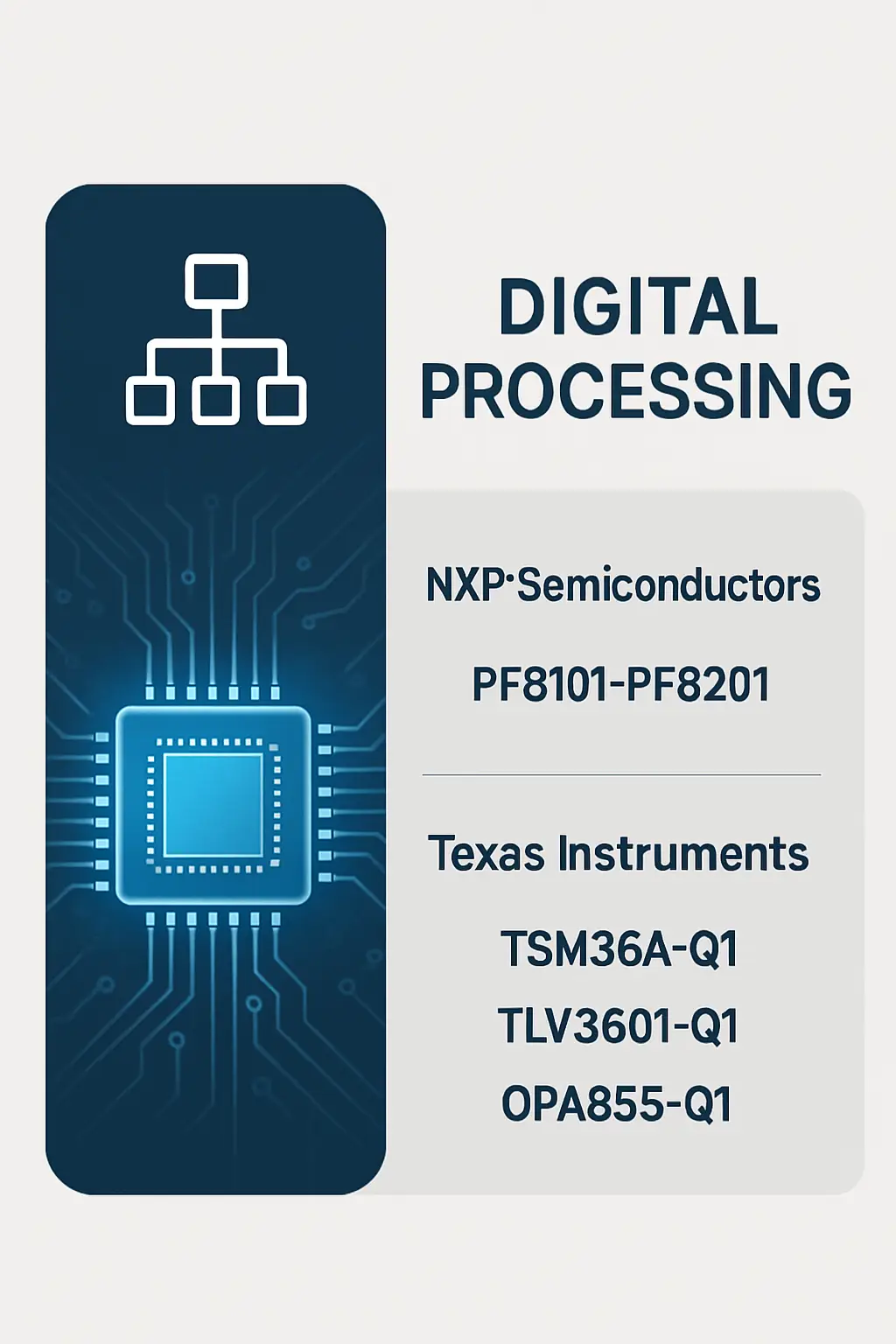
Digital Processing
The Automotive Electronics system is a critical component in modern vehicles, enabling advanced functionalities and enhancing driving safety and comfort. Within this domain, ADAS & Autonomous Driving plays a key role by integrating various sensors and processing units to assist drivers and eventually enable fully autonomous operation. Among these technologies, LiDAR Systems stand out for their high-precision 3D mapping capabilities, providing real-time environmental awareness. These systems use laser light to detect objects, measure distances, and create detailed spatial maps, which are essential for safe navigation.
The Digital Processing unit acts as the brain of the LiDAR system, analyzing the data collected from the sensors and making real-time decisions. This processing power enables features such as object detection, lane keeping, and adaptive cruise control. Together, these components form the backbone of next-generation automotive systems, supporting applications like autonomous driving, parking assistance, and collision avoidance.
LiDAR-based systems are widely used in both consumer and commercial vehicles, including self-driving cars, smart delivery robots, and advanced driver-assistance systems. Their accuracy and reliability make them ideal for challenging environments, ensuring safe and efficient vehicle operation. As automotive technology continues to evolve, the integration of these systems will play a vital role in shaping the future of mobility.
Details
Digital Processing
Related Parts
| Series Name | Description | Manufacturer Name | Attribute Description |
|---|---|---|---|
| NXP Semiconductors | Input voltage: 2.7V to 5.5V; Output current: up to 1.2A; Switching frequency: 3MHz; Efficiency: up to 95%; Operating temperature: -40°C to +125°C; Package: WLCSP-12. | ||
| Texas Instruments | AEC-Q101 qualified MOSFET, 36V VDS, 18A ID, 15mΩ RDS(on), N-channel, 1.8V logic level, suitable for automotive power management applications. | ||
| Texas Instruments | 32-bit, 4-channel, 125 MSPS ADC; SNR: 71 dB, SFDR: 88 dBc; input bandwidth: 500 MHz; low power: 1.8 V supply; JESD204B interface; internal calibration. | ||
| Texas Instruments | Single-pole double-throw analog switch, 1.65V to 5.5V supply, low on-state resistance, 2.3Ω typical, ESD protection, low power consumption, suitable for signal routing in automotive applications. | ||
| Texas Instruments | 8-channel, 4.8Ω on-resistance, ±15V supply, 2.7V to 5.5V logic, low leakage, ESD-protected analog multiplexer with break-before-make switching, suitable for data acquisition and signal routing. | ||
| Texas Instruments | Comparator with 40-ns response time, 2.7-V to 5.5-V supply, rail-to-rail input, open-drain output, low power, operating temperature: -40°C to 125°C. | ||
| Texas Instruments | Dual comparator, 2.7V to 5.5V supply, 4.3ns propagation delay, low power, open-drain output, operating temperature: -40°C to +125°C, available in small footprint packages. | ||
| Texas Instruments | Dual, 3.5MHz, low-noise, precision CMOS operational amplifier, 2.7V to 5.5V supply, 1.8mA per channel, GBW: 3.5MHz, offset voltage: 3mV, available in VSSOP-8. | ||
| Texas Instruments | Gain Bandwidth Product: 8.5 GHz; Slew Rate: 4000 V/µs; Input Noise: 2.1 nV/√Hz; Supply Voltage: 3.3 V to 5.5 V; Current Consumption: 90 mA; Operating Temperature: -40°C to +125°C. | ||
| Texas Instruments | 150MHz GBW, 40V/μs slew rate, low noise 3.9nV/√Hz, 2.7V to 5.5V supply, shutdown mode, rail-to-rail I/O, -40°C to +125°C. |






.png?x-oss-process=image/format,webp/resize,h_32)


