
 German
 Japanese
 Portuguese
 Korea
Korea
 Mexico
 Dutch
Dutch
Current Sense
Current Sense Sensors in Automotive Electronics
Current sense sensors play a vital role in automotive electronics, particularly within the powertrain and ICE (Internal Combustion Engine) management systems. These sensors are designed to accurately measure electrical current flowing through circuits, providing essential data for system monitoring, control, and protection.
In modern vehicles, current sensing is critical for optimizing performance, ensuring safety, and improving energy efficiency. Powertrain systems rely on precise current measurements to manage engine operations, fuel injection, ignition timing, and emissions control. By continuously monitoring current levels, these sensors help prevent overloads, detect faults, and support real-time adjustments for better vehicle performance.
Current sense sensors are widely used in various applications, including battery management systems, electric motor control, alternator regulation, and hybrid/electric vehicle (HEV/EV) power systems. They enable accurate power distribution, enhance diagnostic capabilities, and contribute to the overall reliability of automotive electronic systems.
These sensors are typically integrated into control units such as the Engine Control Unit (ECU), Battery Management System (BMS), and Motor Control Unit (MCU). Their high accuracy, fast response time, and robust design make them suitable for demanding automotive environments.
In summary, current sense sensors are essential components in automotive electronics, supporting efficient and safe operation of powertrain and ICE management systems. Their reliable performance makes them indispensable in both conventional and advanced vehicle technologies.
Details
Current Sense
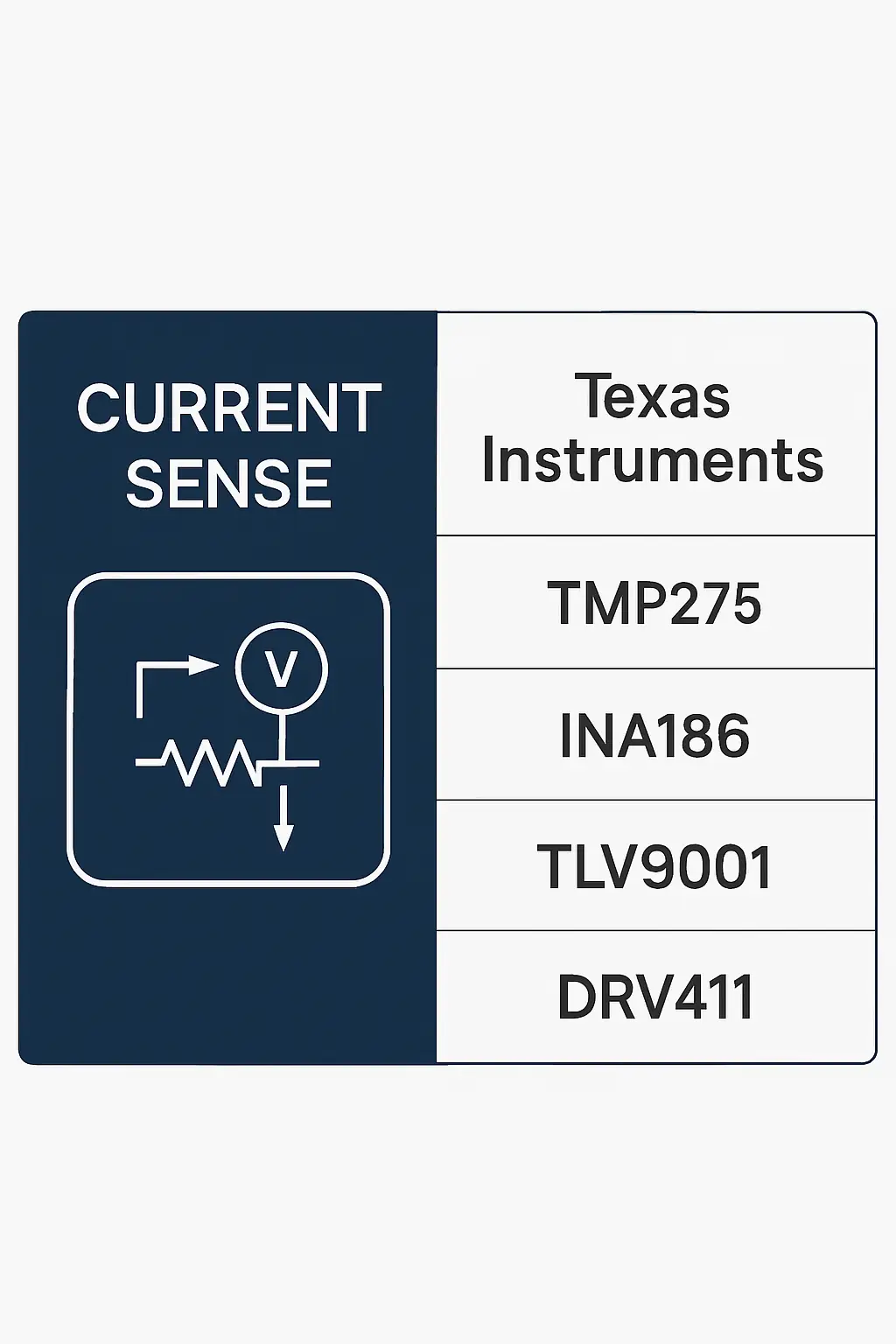
Related Parts
| Series Name | Description | Manufacturer Name | Attribute Description |
|---|---|---|---|
| Texas Instruments | 12-bit ADC, ±0.5°C accuracy, 2.7V to 5.5V supply, I2C interface, 8-pin SOIC package, operating range: -40°C to +125°C. | ||
| Texas Instruments | 3-channel, 16-bit, 64 kSPS, low-power delta-sigma ADC with SPI interface, integrated oscillator, and analog front-end for current/voltage sensing. | ||
| Texas Instruments | 24-bit delta-sigma ADC, 2kSPS, 4-channel multiplexer, low-noise PGA, integrated reference, UART/I2C interface, operates from 2.7V to 5.5V, -40°C to +125°C. | ||
| Texas Instruments | 24-bit delta-sigma ADC, 32 kSPS, 2-channel, low power, integrated PGA, SPI interface, wide supply range, high SNR, suitable for precision analog sensing applications. | ||
| Texas Instruments | Low-side/High-side current sense amplifier, 2.7V to 5.5V supply, 800kHz bandwidth, 1V/V to 100V/V gain options, ±0.5% gain error, 3μV/°C offset drift, SOT-23 package. | ||
| Texas Instruments | Single-channel, 1MHz bandwidth, 0.45V/μs slew rate, low-power operational amplifier with rail-to-rail input and output, operating on 1.8V to 5.5V supply. | ||
| Texas Instruments | High-performance analog front-end for current sensing, ±16V input range, 1.2MHz bandwidth, low offset voltage (±50µV), wide supply range (4.5V to 5.5V), supports isolated amplifier applications. | ||
| Texas Instruments | Input voltage: 4.5V to 65V, Output current: 600mA, Fixed output options: 3.3V, 5V, Adjustable from 1.215V, Efficiency up to 92%, 400kHz switching frequency, Small 8-pin SOIC package. |






.png?x-oss-process=image/format,webp/resize,h_32)


