German
 Japanese
 Portuguese
 Korea
 Mexico
 Dutch


All You want to Know About an AC Capacitor

What Is an AC Capacitor?
An electrical part intended for use in alternating current (AC) systems is called an AC capacitor. It follows the frequency of the AC power source by storing and releasing electrical energy cyclically. AC capacitors are essential in many applications, but electrical motors and HVAC systems require them most of all.
.jpg?x-oss-process=image/auto-orient,1/quality,q_70/format,webp)
Principal Features of AC capacitors:
Make effective use of alternating current.
have ratings for particular voltage and capacitance
designed to run continuously in AC circuits
usually non-polarized, enabling bidirectional current flow
AC Capacitors vs. DC Capacitors
The main distinctions between DC and AC capacitors are found in their construction, applications, and modes of operation. Because they are non-polarized and able to withstand varying voltage directions, AC capacitors are perfect for use in AC applications like power conditioning and motors. They are often made of polypropylene and are made to withstand repeated polarity reversals and significant voltage fluctuations.
| Feature | AC Capacitors | DC Capacitors |
| Purpose | Used in alternating current (AC) applications. | Used in direct current (DC) applications. |
| Polarity | Non-polarized; can operate with either polarity. | Polarized; must be connected with correct polarity. |
| Dielectric Type | Often polypropylene or oil as dielectric. | Commonly use electrolytic materials. |
| Construction | Designed to handle varying polarity and high voltage fluctuations. | Designed for constant voltage; robust construction to prevent reverse polarity damage. |
| Voltage Ratings | Lower voltage ratings compared to equivalent DC capacitors due to continuous voltage reversal. | Higher voltage ratings as they handle steady voltages. |
| Frequency Response | High-frequency response is suitable for power conditioning, signal coupling, and phase shifting. | Lower frequency response, used primarily for energy storage and filtering applications. |
| Applications | Used in motors, power conditioning, and AC signal coupling. | Commonly found in power supplies, DC circuits, and electronic devices. |
| Tolerance to Voltage | Can tolerate brief overvoltages better due to AC operation characteristics. | Less tolerant to overvoltages; exceeding voltage can lead to rapid deterioration or failure. |
DC capacitors, on the other hand, are mostly utilized in DC applications, such as power supply and electronic devices, and are polarized, meaning they must be linked with the proper polarity. These capacitors, designed to withstand steady voltage levels, frequently use electrolytic materials. However, they are more susceptible to damage from reverse polarity or sudden voltage spikes.
What Does an AC Capacitor Do?
AC capacitors perform several critical functions in electrical systems:
Power Factor Correction:
Improves system efficiency by reducing reactive power
Helps utilities maintain grid stability
Reduces electrical costs for industrial consumers
Motor Starting:
Provides initial energy boost for AC motor startup
Creates phase shift necessary for starting torque
Reduces inrush current during motor start
Run Capacitors:
Maintain motor operation by providing a continuous phase shift
Improve motor efficiency during normal operation
Reduce motor operating temperature
Voltage Regulation:
Help stabilize voltage in power distribution systems
Reduce voltage fluctuations in long transmission lines
Improve power quality for sensitive equipment
Noise Suppression:
Filter out electrical noise and interference
Protect sensitive electronics from power line disturbances
Improve signal quality in audio and communication systems
Types of AC Capacitors
Due to variations in material qualities and construction, AC capacitors belong to a type in a variety of capacitors, each suitable for a particular set of applications. Film capacitors have a high insulating resistance and low loss, making them popular in AC power applications because of their stability. In high-frequency applications like RF circuits, ceramic capacitors are popular due to their compact size and affordability.
| Image | Type | Material | Common Uses | Characteristics | Advantages | Limitations |
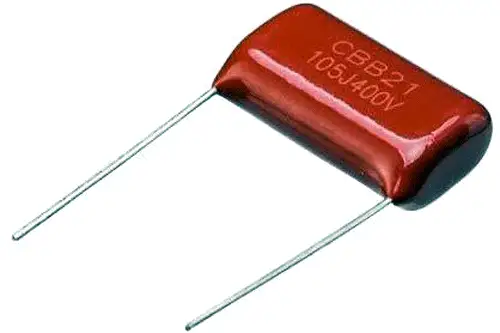 |
Film Capacitor | Polypropylene, Polyester | AC motors, lighting circuits, power factor correction. | Non-polar, stable, low loss, high insulation resistance. | Excellent frequency and temperature stability, low moisture absorption. | Larger size compared to ceramics for the same capacitance. |
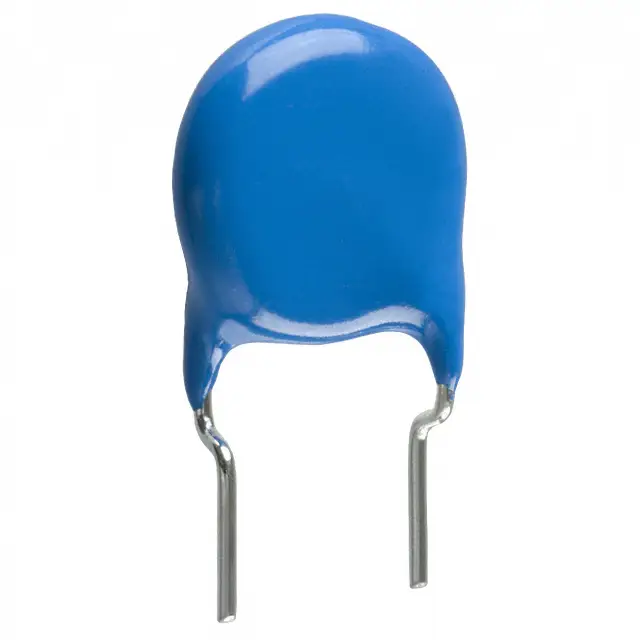 |
Ceramic Capacitor | Ceramic | Signal coupling, RF circuits, and audio equipment. | Non-polar, wide range of capacitance, high stability. | Compact, high-frequency response, cost-effective. | Lower voltage ratings, and potential non-linear behavior. |
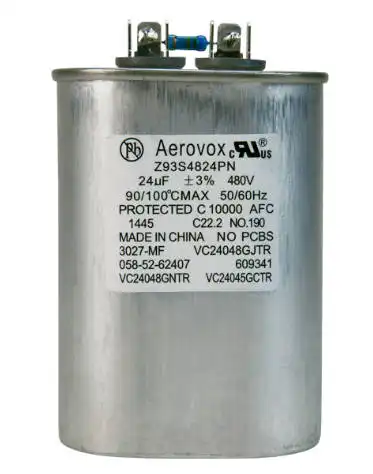 |
Oil Capacitor | Paper or film dielectric soaked in oil | High voltage applications, power transmission. | High voltage endurance, and self-healing properties. | Excellent for high voltage stability, and reliable performance in harsh conditions. | Bulky, potential environmental concerns with oil leaks. |
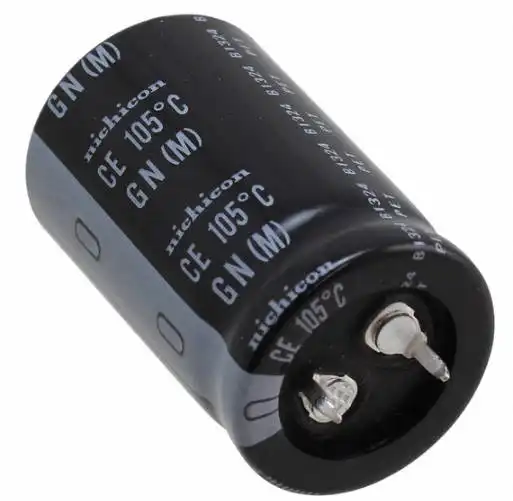 |
Electrolytic Capacitor | Aluminum, Tantalum | Power supplies, audio filters. | High capacitance values, polar, age over time. | High capacitance per volume, suitable for smoothing and filtering in power supplies. | Limited lifespan, sensitive to high temperatures. |
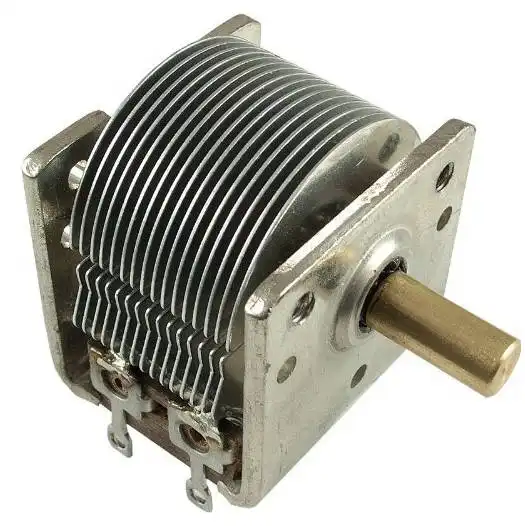 |
Air Capacitor | Air as dielectric | Radio tuning, transmitters. | Variable capacitance, low loss, highly stable. | Adjustable capacitance, very low dielectric losses. | Physically larger, limited capacitance range. |
Oil capacitors' resilience and self-healing qualities make them perfect for high-voltage applications. Despite their shorter lifespan and sensitivity to temperature, electrolytic capacitors are indispensable in power supply and audio filtering due to their high capacitance values. Finally, despite being larger and having a lower capacitance, air capacitors are utilized in situations requiring changing capacitance, such as radio tuning.
With this wide range, performance, size, and environmental factors are all balanced and a capacitor type is accessible for almost any AC application.
Types of Capacitors Used in AC Units
Turn on the capacitors:
Goal: Quickly boost the torque required to start a motor and enable fast on/off cycles.
Construction: To provide a significant energy surge during the startup phase, a larger capacitance rating is usually used.
Use Case: Occasionally used in the blower motor and during the compressor's startup phase.
Operate Capacitors:
Goal: Constantly modify the motor windings' phase shift or current to maximize torque and motor efficiency.
Construction: Rated for a lower capacitance than start capacitors, they are made for continuous duty.
Use Case: Used to keep the blower, fan, and compressor motors operating steadily and effectively.
Important AC Unit Features:
Material: Because of its superior electrical properties and resilience to voltage breakdown, polypropylene film is frequently utilized.
Voltage Rating: The capacitors in an AC unit must be rated for the motor voltage, which is normally between 370 and 440 volts.
Capacitance Value: The size and design of the motor determine the necessary capacitance value, which is expressed in microfarads, or µF. Motor failure or inefficient motor performance might result from incorrect capacitance levels.
Polarity: Because AC capacitors lack polarization, they can be connected to the circuit in any direction.
How AC Capacitors Work
The idea behind how AC capacitors work is that they store and release electrical energy in time with the alternating current:
Phase of charging: The capacitor stores electrical energy in its electric field when the voltage rises.
Phase of discharge: The capacitor returns the stored energy to the circuit when the voltage drops.
Cyclical operation: This procedure is repeated 50 or 60 times per second, depending on the frequency of the AC power source.
Start capacitors provide a phase change to produce starting torque in motor applications. To keep this phase shift going for effective motor running, run capacitors are used.
The Symptoms of A Bad AC Capacitor
A malfunctioning air conditioning capacitor might present multiple symptoms, all of which suggest possible problems with your air conditioning system. These indications can be anything from performance concerns like poor airflow and irregular cooling to operational problems like sudden shutdowns or inability to start. Unusual sounds, burning smells, and obvious damage to the capacitor itself are among the other warning indicators.
| Symptom | Description | Possible Consequences |
| AC won't start | The air conditioner fails to turn on when you set the thermostat. | No cooling; Increased energy bills due to repeated attempts to start. |
| Delayed start | The AC takes longer than usual to start after you turn it on. | Reduced efficiency; Increased wear on other components. |
| Humming noise | A persistent humming sound from the outdoor unit when the AC is on. | Noise pollution; Indication of impending failure. |
| AC turns off on its own | The air conditioner shuts down unexpectedly during operation. | Inconsistent cooling; Potential damage to other AC components. |
| Weak airflow | Reduced air output from the vents when the AC is running. | Insufficient cooling; Longer running times, leading to higher energy consumption. |
| Higher energy bills | Unexplained increase in electricity costs. | Financial strain; Reduced overall AC efficiency. |
| Burning smell | An odor is similar to burning plastic or electrical components. | Fire hazard; Potential damage to other AC parts. |
| Visible damage | Bulging, leaking, or other physical deformities on the capacitor. | Immediate need for replacement; Risk of complete system failure. |
| Irregular cooling cycles | AC cycles on and off more frequently than normal. | Inconsistent room temperature; Increased wear on the compressor. |
| Warm air blowing | The AC blows warm or room-temperature air instead of cold. | Discomfort; Ineffective cooling. |
| Tripped circuit breaker | The AC causes the circuit breaker to trip repeatedly. | Electrical hazard; Interruption of AC operation. |
| Clicking sounds | Repeated clicking noises from the outdoor unit. | Sign of capacitor struggling to start the compressor; Potential for complete failure. |
These problems could harm other AC components in addition to impairing your comfort and increasing energy usage and utility costs. It is essential to identify these signs early to avoid more significant issues and expensive repairs.
It is advised that you have your AC system examined by a skilled expert if you observe any of these symptoms in order to determine whether the capacitor needs to be replaced and to guarantee the general health of your air conditioning system. Your AC unit can be kept more efficient and have its lifespan extended with routine maintenance and quick reaction to these indications.
How to Replace AC Capacitor?
Step-by-step guide for replacing an AC capacitor:
| Step | Action | Details |
| 1 | Turn off the power | Ensure all power to the AC unit is completely shut off at the breaker and disconnect box to prevent electrical shock. |
| 2 | Access the capacitor | Remove the access panel on the condenser unit with a screwdriver to locate the capacitor. |
| 3 | Discharge the capacitor | Use an insulated screwdriver to bridge the terminals of the capacitor, discharging any residual power to prevent shocks. |
| 4 | Note connections and remove the capacitor | Take a photo or note the wiring connections for reference. Disconnect the wires using needle-nose pliers. Remove the faulty capacitor. |
| 5 | Install the new capacitor | Match the new capacitor to the old one in terms of specifications. Attach wires to the corresponding terminals based on your previous notes or photo. |
| 6 | Secure the new capacitor and close the access panel | Ensure the capacitor is securely mounted and that all connections are tight. Replace the access panel. |
| 7 | Restore power and test the system | Turn on the power at the breaker and the disconnect box. Start the AC unit to ensure it is operating correctly. |
One essential maintenance procedure that can help an air conditioner function and operate more efficiently is replacing the AC capacitor. In this procedure, the power is turned off, the old capacitor is accessed and safely discharged, the connections are noted, and a new capacitor with the appropriate specs is installed. Because capacitors may hold a charge even in the absence of electricity, handling them carefully is imperative. Before resuming power and testing the system, make sure all connections are made correctly and securely. By carrying out this task correctly, you can guarantee the unit's longevity and efficiency and stop future AC problems.
Applications of AC Capacitors
AC capacitors are used in various applications:
HVAC systems: For compressor and fan motors
Industrial motors: Power factor correction and motor starting
Power distribution: Voltage regulation and power factor improvement
Lighting systems: Ballasts for fluorescent and HID lamps
Renewable energy: In inverters for solar and wind power systems
Home appliances: Washing machines, refrigerators, and other motor-driven devices
Audio equipment: Crossover networks in speakers
Electrical noise suppression: In various electronic devices
Choosing the Right AC Capacitor
Things to think about while choosing an AC capacitor:
Voltage rating: This must equal or surpass the working voltage of the system.
Value of capacitance: Microfarads (μF), measured there, ought to correspond with the original specification.
Type: Start, run, or two capacitors, depending on what the application calls for
Dimensions: Needs to fit in the available area
Temperature rating: Must be appropriate for the conditions of operation
Dependability: For longevity, go with reliable brands.
Tolerance: Usually within ±5% or ±10% of the rated capacitance is the tolerance.
How Much Does AC Capacitor Replacement Cost?
Air conditioning capacitors are available in a range of styles and sizes. Certain capacitors are designed to work with specific heat pumps or AC systems. Although replacement costs vary due to these considerations, most capacitors are priced between $9 and $50. The HVAC contractor's labor cost, which usually ranges from $170 to $400, accounts for the largest amount of your total. An AC capacitor typically costs $180:
Low-end replacement cost: $120
Average replacement cost: $180
High-end replacement cost: $400
Other Factors of AC Capacitor Costs
Labor
Your capacitor replacement will probably cost between $60 and $200 from a local HVAC contractor. However, a lot of HVAC specialists bill between $120 and $250 for a one-time replacement.
Location
Cities and other highly populated places have higher average costs of living, which drives up the cost of HVAC services. More rural places typically have cheaper labor expenses.
Tools
Although changing an AC capacitor is not a straightforward do-it-yourself (DIY) task, you can attempt to reduce labor costs by doing the replacement yourself. If you haven't done a lot of research, have the right tools and safety equipment, and are familiar with electrical best practices and the inner workings of an AC system, you shouldn't try this repair.
How to Test an AC Capacitor with a Multimeter
Using a multimeter to test an AC capacitor is an essential diagnostic tool for air conditioning issues. The procedure calls for exact reading interpretation, multimeter setup, and cautious safety precautions. These procedures can help you ascertain whether a capacitor operates within its rated parameters or if a replacement is necessary.
| Step | Description | Action Details | Important Notes |
| 1 | Safety First | Turn off all power sources to the AC unit at the breaker. Then, safely discharge the capacitor. | Always discharge the capacitor to avoid electric shock. |
| 2 | Remove the Capacitor | Open the AC unit’s access panel and carefully remove the capacitor. | Note all connection points and terminal designations for reinstallation. |
| 3 | Set the Multimeter | Adjust the multimeter to measure capacitance, typically marked with 'F' for Farad. | Choose a capacitance range higher than the capacitor’s rated value to avoid damage to the multimeter. |
| 4 | Connect the Probes | Attach the multimeter probes to the respective terminals of the capacitor. | Ensure correct polarity for polarized capacitors to get accurate readings. |
| 5 | Read the Measurement | Observe and note the capacitance value displayed by the multimeter. | Allow the multimeter a few seconds to stabilize for an accurate reading. |
| 6 | Compared to the Rated Value | Compare the measured capacitance value to the manufacturer's rated value on the capacitor. | The acceptable tolerance is typically ±5% to ±10% of the rated value. |
| 7 | Check for Short Circuits | Switch the multimeter to resistance (Ohms) mode and measure resistance across the terminals. | A very low resistance reading indicates a potential short circuit in the capacitor. |
| 8 | Test for Open Circuits | Continue in resistance mode to check for an 'OL' (Over Limit) reading. | An 'OL' reading suggests an open circuit, indicating the capacitor is non-functional. |
| 9 | Assess the Results | Evaluate the test results to determine the condition of the capacitor. | Replace the capacitor if it shows readings outside tolerance or signs of short/open circuits. |
| 10 | Reinstall or Replace | Reinstall the original capacitor if it tests good, or replace it with a new one if faulty. | Ensure all connections are secure and correctly reassembled during installation. |
It's crucial to keep in mind that capacitors retain electrical charge even when they are detached, thus safe discharge is necessary. Capacitance measurement and an open circuit or short circuit check are the two main components of the test. In general, a capacitor is deemed satisfactory if it measures between 5 and 10% of its rated value and exhibits no indications of short circuits or open circuits.
To guarantee the best possible AC performance, the capacitor should be replaced if any of these tests reveal that it is defective. Even while do-it-yourselfers can do this test, it's always safer and more dependable to speak with a qualified HVAC specialist when in doubt.
How to Check AC Capacitor
An essential maintenance procedure that can assist in identifying and averting air conditioning issues is checking an AC capacitor. Both visual inspection and electrical testing are used in the procedure.
Because capacitors can retain an electrical charge even when the device is turned off, safety is of the utmost importance. The capacitor is carefully discharged after a careful visual assessment for any indications of physical damage.
| Step | Description | Action Details | Important Notes |
| 1 | Safety Precautions | Turn off power to the AC unit at the circuit breaker. | Ensure the unit is completely powered down before proceeding. |
| 2 | Locate the Capacitor | Find the capacitor in the outdoor AC unit, typically housed in a metal box near the compressor. | |
| 3 | Visual Inspection | Check for visible signs of damage such as bulging, leaking, or corrosion. | |
| 4 | Discharge the Capacitor | Use an insulated screwdriver to short the terminals. | This safely releases any stored charge. |
| 5 | Remove the Capacitor | Carefully disconnect and remove the capacitor. | Note the wire connections for later reinstallation. |
| 6 | Check Capacitance | Use a multimeter set to capacitance mode to measure the capacitor's value. | Compare the reading to the capacitor's rated value. |
| 7 | Test for Short Circuits | Set the multimeter to resistance mode and measure. | Very low resistance indicates a short circuit. |
| 8 | Test for Open Circuits | Keep the multimeter in resistance mode and look for an 'OL' reading. | An 'OL' reading suggests an open circuit. |
| 9 | Assess Physical Condition | Examine the capacitor's body closely for any deformities, leaks, or burnt areas. | |
| 10 | Evaluate Test Results | Determine if the capacitor is within specifications. | Replace if outside ±5-10% of rated value or failed other tests. |
| 11 | Reinstall or Replace | Put back the good capacitor or install a new one if necessary. | Ensure proper connection and secure mounting. |
| 12 | Restore Power | Turn the power back on at the circuit breaker. | Observe the AC unit for proper operation. |
You may measure the capacitance of the capacitor and look for open or short circuits using a multimeter. A good capacitor should not exhibit any internal flaws and measure between 5 and 10% of its rated value. The capacitor has to be changed if it shows physical damage or fails any of these tests. Although homeowners with some technical know-how can complete this operation, it's crucial to remember that working with electrical components poses risks.
It's usually safer to get advice from a qualified HVAC specialist if you're unclear about any process or don't have the necessary equipment. Your air conditioning system's durability and efficiency can be greatly increased by performing routine maintenance and promptly replacing any damaged capacitors.
AC Capacitor Wiring
The safe and effective operation of capacitors depends on proper wiring:
The terminals for the hermetic compressor are Herm (H), Fan (F), and Common (C).
Observe the manufacturer's diagrams: There may be unique wiring needs for every system.
Employ the proper wire gauge: Residential AC units typically have an AWG of 14 to 18.
safe connections Use the appropriate wire nuts or terminals to avoid loose connections.
Do not overtighten: able to harm capacitor terminals
Label the wires: aids in replacement or maintenance in the future
Keep cables away from rotating components: Avoid having fan blades or other parts break.
Apply cable ties: carefully fasten cables to avoid interfering with other components.

Related Articles
- ·Qualcomm PM8350 vs. PM8350C: Architecture, Features, Applications, and Selection Guide
- ·Qualcomm PM8150 vs. PM8150B vs. PM8150L: Functions, Architecture, Applications, and Selection Guide
- ·SGM41541 vs. SGM6605: Battery Charger and Synchronous Boost Converter Comparison
- ·ADI LTM4630A vs. LT8645S: Power Module and Silent Switcher Regulator Comparison
- ·Richtek RT8206A vs. RT9013: Architecture, Specifications, Applications, and Design Considerations
- ·MPS MP2657, MPQ6610GJ-AEC1-Z, and MP2856: Identification, Functions, and Application Comparison
- ·TPS6594-Q1 vs. TPS65219-Q1 vs. TPS653860-Q1 vs. LP87745-Q1: TI Automotive PMIC Comparison
- ·Electronic Components Monthly Market Report
- ·MediaTek MT6369, MT6360, MT6365, and MT6375: Functions, Architecture, and Selection Guide
- ·Southchip SC8547, SC8551, and SC89890: Charging Architecture, Key Differences, and Selection Guide
 FAQ