German
 Japanese
 Portuguese
 Korea
 Mexico
 Dutch


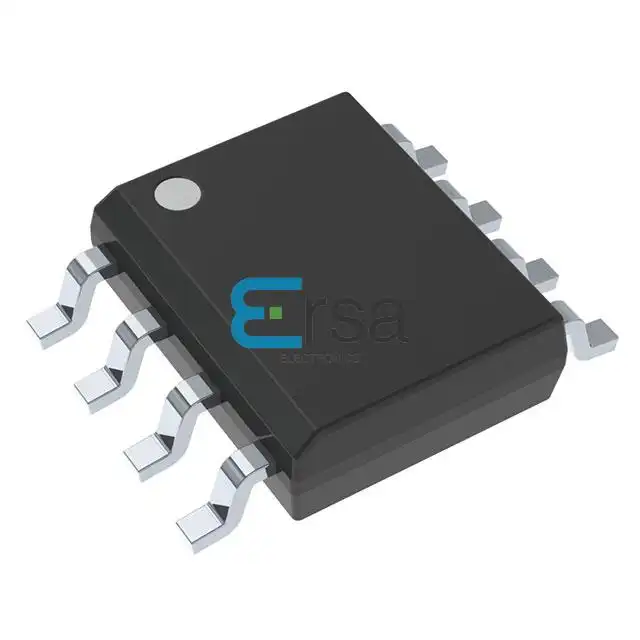
INA154UAG4: Description, Features, and Applications

What is INA154UAG4?
The INA154UAG4 is a precision operational amplifier (op-amp) that is popular in electronics due to its low voltage operation and low current usage. Texas Instruments designed this op-amp to function efficiently in systems that require low power consumption and excellent precision. It is widely employed in sensor signal conditioning, data acquisition, and instrumentation systems, where exact measurements are critical. The INA154UAG4 has a very low input offset voltage, which helps minimize errors in the measurement and amplification of weak signals, resulting in higher accuracy in a wide range of sensitive applications.
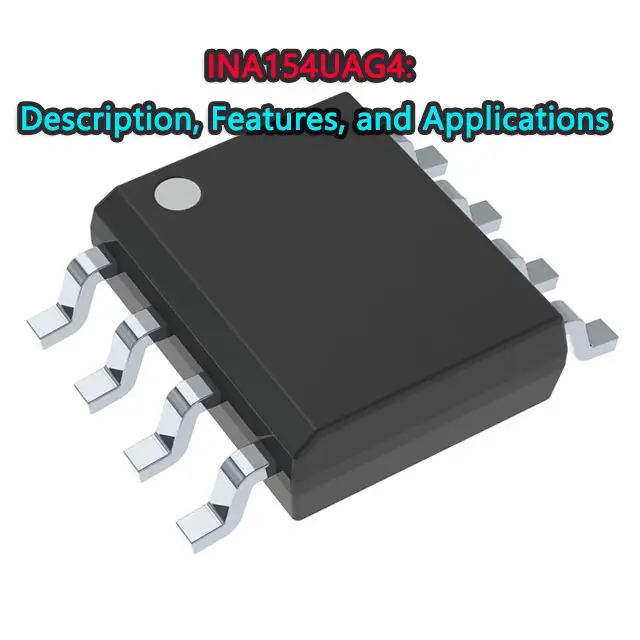
This operational amplifier is notable for its adaptable design, which provides a large supply voltage range while retaining steady performance under varying situations. Its applications include automotive, medical, consumer electronics, and industrial automation. The INA154UAG4 is a fantastic choice for battery-powered and low-noise applications, offering engineers a high-performance solution for a wide range of demanding jobs.
INA154UAG4 Pinout
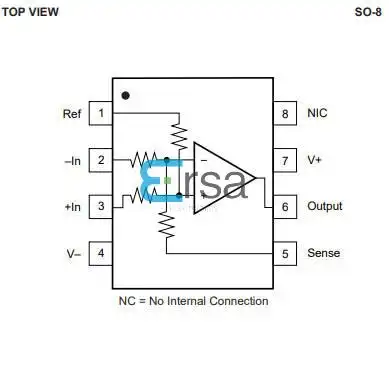
| Pin Number | Pin Name | Description |
| 1 | REF | Reference input for offset adjustment; typically grounded. |
| 2 | V- | Negative power supply connection (e.g., -4V to -18V). |
| 3 | V+ | Positive power supply connection (e.g., +4V to +18V). |
| 4 | IN- | Inverting input for the differential signal. |
| 5 | IN+ | Non-inverting input for the differential signal. |
| 6 | OUT | Output of the amplified differential signal. |
| 7 | NC | No connection (not used). |
| 8 | NC | No connection (not used). |
Key Features of INA154UAG4
The INA154UAG4 is a precision difference amplifier designed for various applications requiring high performance and accuracy. Below are its key features:
General Characteristics
Type: High slew rate, unity-gain difference amplifier.
Package: Available in an SO-8 surface-mount package.
Temperature Range: Operates over an extended industrial temperature range of −40°C to +85°C.
Performance Specifications
Low Offset Voltage: Maximum offset voltage of ±750 µV, with a typical value of ±100 µV.
Low Offset Drift: Drift is as low as ±2 µV/°C.
Gain Error: Low gain error of ±0.05% maximum.
Bandwidth: Wide bandwidth of 3 MHz.
Slew Rate: High slew rate of 14 V/µs, allowing fast signal response.
Settling Time: Fast settling time of 3 µs to 0.01%.
Input and Output Characteristics
Supply Voltage Range: Operates on a supply range from ±4V to ±18V.
Input Common-Mode Voltage Range: Can accurately measure differential signals beyond the power supply rails, with a common-mode voltage range extending from 2(V+) − 5V to 2(V−) + 5V.
Input Impedance: Differential input impedance is 50 k.
Applications
The INA154UAG4 is suitable for:
- Differential input amplifiers.
- Instrumentation amplifier building blocks.
- Unity-gain inverting amplifiers.
- Summing amplifiers and differential current receivers.
INA154UAG4 Specifications
The INA154UAG4 is a precision 2-channel instrumentation amplifier from Texas Instruments, ideal for high-speed and accurate signal processing in applications such as data acquisition systems, industrial controls, and automotive electronics. Its low supply current, wide operating voltage range, and high common mode rejection ratio (CMRR) make it highly suitable for precise measurement tasks. The amplifier also offers a fast slew rate and wide bandwidth, ensuring effective handling of dynamic signals in demanding environments.
| Category | Specification |
| Part Number | INA154UAG4 |
| Manufacturer | Texas Instruments |
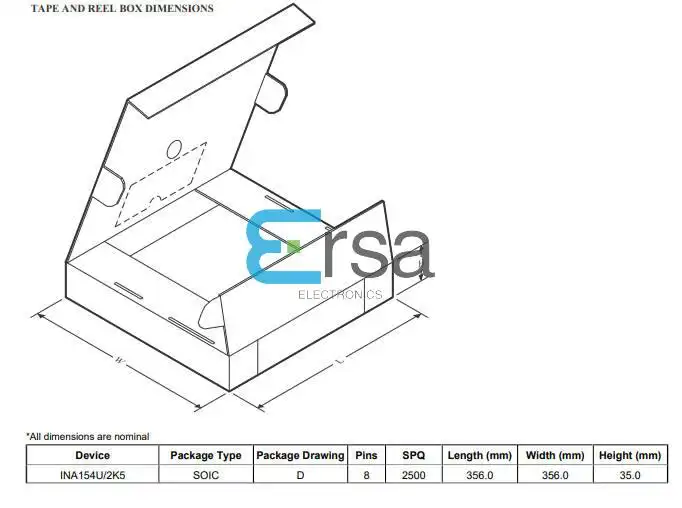
| Package Type | SOIC-8 |
| Channels | 2 Channel |
| Operating Temperature Range | -40°C to +85°C |
| Supply Voltage Range | Minimum: ±4V, Maximum: ±18V, Operating Range: 8V to 36V |
| Supply Current | 2.4 mA (typical) |
| Output Current per Channel | 60 mA |
| Input Offset Voltage | Initial: ±100 µV (typical), ±750 µV (max) |
| Input Offset Voltage Drift | ±2 µV/°C (typical) |
| Common Mode Rejection Ratio (CMRR) | 80 dB (min) |
| Gain Error | ±0.05% (max) |
| Slew Rate | 14 V/µs |
| Gain Bandwidth Product (GBP) | 3.1 MHz |
| 3 dB Bandwidth | 3.1 MHz |
| Input Impedance (Differential) | 50 kΩ |
| Input Impedance (Common Mode) | 50 kΩ |
| Common Mode Voltage Range (Positive Rail) | 2(V+) − 5 V |
| Common Mode Voltage Range (Negative Rail) | 2(V−) + 5 V |
| Moisture Sensitivity | Yes |
| Unit Weight | Approximately 0.002677 oz |
| Applications | Data acquisition systems, industrial control, audio devices, computer peripherals, automotive electronics |
Advantages of Using INA154UAG4
The INA154UAG4 offers several advantages that make it a preferred choice for precision signal amplification in various applications. Here are the key benefits:
High Precision and Accuracy
Low Offset Voltage: The INA154UAG4 features a low offset voltage of ±750 µV maximum, with a typical value of ±100 µV, ensuring accurate signal representation without significant error1.
Low Offset Drift: With an offset drift of ±2 µV/°C, the amplifier maintains its accuracy across varying temperatures, making it suitable for precision applications.
Excellent Performance
Wide Bandwidth: The amplifier provides a bandwidth of 3 MHz, allowing it to handle a wide range of frequencies effectively, which is crucial for high-speed applications.
High Slew Rate: A slew rate of 14 V/µs enables the INA154UAG4 to respond quickly to fast-changing input signals, reducing distortion in dynamic applications.
Versatile Operating Range
Wide Supply Voltage Range: It operates on a supply voltage range from ±4V to ±18V, making it adaptable to various circuit designs and power supply configurations.
Common Mode Voltage Range: The input common-mode voltage range extends beyond the supply rails, allowing for accurate measurement of differential signals even when they exceed the power supply limits.
Low Power Consumption
Low Quiescent Current: The device consumes only 2.4 mA of quiescent current, making it energy-efficient and suitable for battery-powered applications.
Cost-Effective Design
Integrated Resistor Network: The INA154UAG4 includes an on-chip precision resistor network that is laser-trimmed for accuracy, eliminating the need for external precision resistors and reducing overall system costs.
Robust Application Suitability
Versatile Applications: This amplifier is ideal for use in instrumentation amplifiers, summing amplifiers, differential current receivers, and other applications requiring precise signal processing.
These advantages make the INA154UAG4 a reliable choice for engineers and designers looking to implement high-performance analog signal processing in their systems.
INA154UAG4 Applications
The INA154UAG4 is a versatile instrumentation amplifier widely used in various applications due to its precision and performance characteristics. Here are some key applications:
1. Data Acquisition Systems
The INA154UAG4 is ideal for data acquisition systems, where accurate measurement of analog signals is crucial. Its low offset voltage and high common-mode rejection ratio (CMRR) enhance the fidelity of the captured data.
2. Industrial Control Systems
This amplifier is employed in industrial automation for monitoring and controlling processes. Its ability to handle differential signals makes it suitable for applications like sensor interfacing and signal conditioning.
3. Medical Devices
In medical instrumentation, the INA154UAG4 is used in devices such as ECG and EEG machines, where it amplifies bio-signals with high precision, ensuring reliable diagnostics and patient monitoring.
4. Audio Applications
The INA154UAG4 can be utilized in high-fidelity audio applications, providing low distortion and excellent signal integrity, which are essential for audio processing equipment.
5. Computer Peripherals
This amplifier finds use in various computer peripherals, including analog-to-digital converters and signal processing circuits, where accurate amplification of signals is required.
6. Automotive Electronics
In automotive applications, the INA154UAG4 is used for sensor interfacing, such as pressure sensors and temperature sensors, contributing to the functionality of safety systems like airbag deployment.
7. Precision Current Sensing
The amplifier is effective in precision current sensing applications, allowing for accurate measurement of current levels in various electronic systems.
8. Synchronous Demodulation
It can be used in synchronous demodulation circuits, enhancing the performance of communication systems by improving signal clarity and reducing noise.
The INA154UAG4's combination of low power consumption, high accuracy, and wide operating range makes it suitable for these diverse applications across multiple industries.
INA154UAG4 Equivalents
| Equivalent | Type | Key Features |
| INA199 | Current Sense Amplifier | Low offset voltage, high accuracy, suitable for low-side or high-side current sensing applications |
| INA210 | Current Sense Amplifier | Designed for high-side current sensing with a low offset voltage and a wide supply voltage range |
| INA190 | Current Sense Amplifier | Low supply current, optimized for battery-operated devices, high precision in current measurement |
| INA186 | Current Sense Amplifier | High precision, low offset voltage, and drift, suitable for various industrial applications |
The INA154UAG4 can be substituted with several alternatives, depending on the specific application requirements. INA199 and INA210 are current sense amplifiers suitable for high-precision current measurement in both low-side and high-side applications, with a focus on low offset voltage. The INA190 is optimized for battery-powered devices and provides high precision with low supply current. Lastly, the INA186 is well-suited for industrial applications with low offset voltage and drift, offering high precision. When selecting an alternative, it’s important to compare the components' datasheets to ensure compatibility with the intended application, particularly in terms of supply voltage, input range, and measurement accuracy.
Key Differences Between the INA154UAG4 and the INA199
The INA154UAG4 and INA199 are both precision amplifiers, but they serve different purposes and have distinct specifications. Here are the key differences:
1. Type of Amplifier
INA154UAG4: This is a precision difference amplifier designed for general-purpose applications, capable of amplifying differential signals.
INA199: This is a dedicated current sense amplifier, specifically designed to measure current through a shunt resistor with high accuracy.
2. Input Configuration
INA154UAG4: It has a differential input configuration, allowing it to amplify the difference between two input voltages.
INA199: It is optimized for low-side or high-side current sensing, taking a single-ended input from the shunt resistor and providing an amplified output proportional to the current flowing through it.
3. Gain Settings
INA154UAG4: The gain is typically set externally using resistors, providing flexibility in gain configurations.
INA199: It has a fixed gain of 50 V/V, making it straightforward to use for current sensing applications without additional components.
4. Common Mode Voltage Range
INA154UAG4: Offers a wide common-mode voltage range that extends beyond the power supply rails, allowing for accurate measurement of signals that may exceed the supply limits.
INA199: Designed with a lower common-mode voltage range, suitable primarily for applications where the common-mode voltage does not exceed the supply voltage.
5. Offset Voltage
INA154UAG4: Features a low input offset voltage of ±100 µV (typical), which contributes to its precision in amplifying small differential signals.
INA199: Also has low offset voltage characteristics but is specifically tailored for current sensing applications, which may have different requirements for offset performance.
6. Applications
INA154UAG4: Commonly used in data acquisition systems, industrial control systems, and medical devices where precise differential signal amplification is needed.
INA199: Primarily used in battery management systems, power monitoring applications, and other scenarios where accurate current measurement is essential.
Summary Table
| Feature | INA154UAG4 | INA199 |
| Type | Precision Difference Amplifier | Current Sense Amplifier |
| Input Configuration | Differential | Single-ended |
| Gain Settings | External resistor configurable | Fixed gain (50 V/V) |
| Common Mode Voltage Range | Extended beyond supply rails | Limited to supply voltage |
| Offset Voltage | ±100 µV (typical) | Low offset for current sensing |
| Typical Applications | Data acquisition, medical devices | Battery management, power monitoring |
Working Principle of INA154UAG4
The INA154UAG4 is a precision difference amplifier that operates based on the principles of differential amplification, utilizing a combination of operational amplifiers and an integrated resistor network. Here’s a detailed explanation of its working principle:
Differential Amplification
Input Configuration: The INA154UAG4 takes two input signals, V1 and V2, and amplifies the difference between them, which is given by the formula: Vout = G×(V1−V2) where G is the gain of the amplifier, typically set to unity (1) for this device.
Integrated Resistor Network
Precision Resistors: The INA154UAG4 includes an on-chip resistor network that is laser-trimmed for accuracy. This ensures that the gain and common-mode rejection ratio (CMRR) are maintained over various operating conditions, including temperature changes. The precision resistors help minimize errors in amplification, contributing to its low offset voltage and drift.
Common-Mode Voltage Range
Extended Range: One of the key features of the INA154UAG4 is its ability to accurately amplify signals with common-mode voltages that extend beyond the supply rails. This capability allows it to handle a wide range of input signals without distortion, making it suitable for applications where input signals may exceed the power supply limits.
High Slew Rate and Bandwidth
Performance Characteristics: The amplifier has a high slew rate of 14 V/µs and a bandwidth of 3 MHz, enabling it to respond quickly to fast-changing input signals. This is particularly important in applications requiring rapid signal processing.
Low Power Consumption
Quiescent Current: The INA154UAG4 operates with a low quiescent current of 2.4 mA, making it energy-efficient and suitable for battery-powered devices.
Applications
The INA154UAG4 can be used in various applications such as instrumentation amplifiers, differential current receivers, summing amplifiers, and voltage-controlled current sources. Its precision and versatility make it ideal for data acquisition systems and other circuits requiring accurate signal amplification.
INA154UAG4 Package
INA154UAG4 Datasheet
Conclusion of INA154UAG4
The INA154UAG4 is a precision operational amplifier that excels in situations that need low-noise, high-accuracy signal amplification. Its ability to function at low power makes it excellent for battery-powered devices, and its wide supply voltage range assures versatility across multiple systems. Whether employed in sensor signal conditioning, data acquisition, or instrumentation systems, the INA154UAG4 produces dependable and exact results, making it a valuable component for engineers and designers across sectors.

Related Articles
- ·Qualcomm PM8550 vs. PM8550B vs. PM8550VS: Features, Differences, Applications, and Selection Guide
- ·Qualcomm PM8350 vs. PM8350C: Architecture, Features, Applications, and Selection Guide
- ·Qualcomm PM8150 vs. PM8150B vs. PM8150L: Functions, Architecture, Applications, and Selection Guide
- ·SGM41541 vs. SGM6605: Battery Charger and Synchronous Boost Converter Comparison
- ·ADI LTM4630A vs. LT8645S: Power Module and Silent Switcher Regulator Comparison
- ·Richtek RT8206A vs. RT9013: Architecture, Specifications, Applications, and Design Considerations
- ·MPS MP2657, MPQ6610GJ-AEC1-Z, and MP2856: Identification, Functions, and Application Comparison
- ·TPS6594-Q1 vs. TPS65219-Q1 vs. TPS653860-Q1 vs. LP87745-Q1: TI Automotive PMIC Comparison
- ·Electronic Components Monthly Market Report
- ·MediaTek MT6369, MT6360, MT6365, and MT6375: Functions, Architecture, and Selection Guide
 FAQ