German
 Japanese
 Portuguese
 Korea
 Mexico
 Dutch


PCM2906CDBR USB Audio Codec: Description, Features, and Applications

What is the PCM2906CDBR?
The PCM2906CDBR, developed by Texas Instruments, is a USB stereo audio codec designed for use in portable, battery-powered devices. It features a single-chip design that integrates a USB-compliant full-speed protocol controller with audio processing capabilities. This codec supports stereo audio input and output at a 16-bit resolution, delivering reliable audio quality for consumer applications.
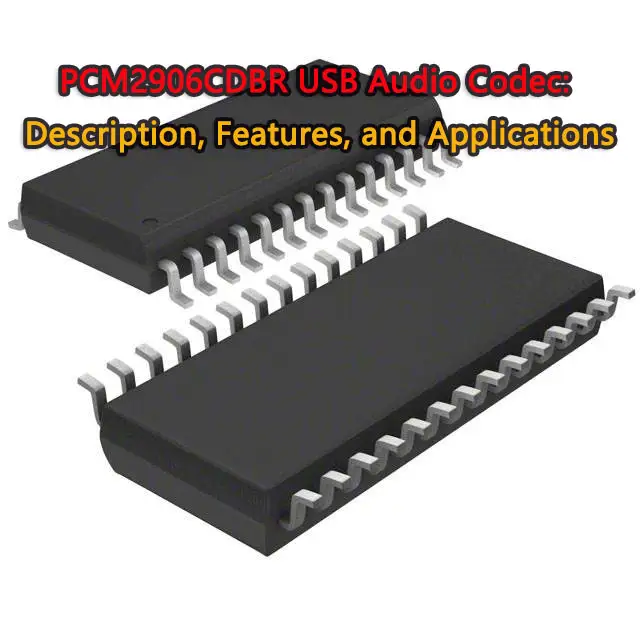
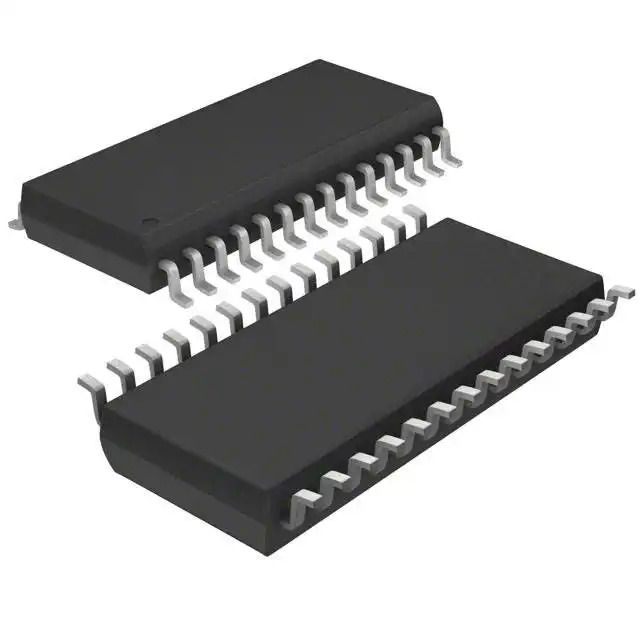
It is equipped with one ADC (Analog-to-Digital Converter) and one DAC (Digital-to-Analog Converter), and comes in a 28-pin SSOP package. With low power consumption and multiple programmable inputs/outputs, the PCM2906CDBR is ideal for applications such as audio playback, telephony, and general-purpose audio processing. Its combination of performance and efficiency makes it a suitable choice for developers seeking USB audio solutions.
PCM2906CDBR Pinout
The PCM2906CDBR pinout consists of 28 pins, each serving specific functions related to audio processing and USB interfacing. Below is a summary of the pin configuration:
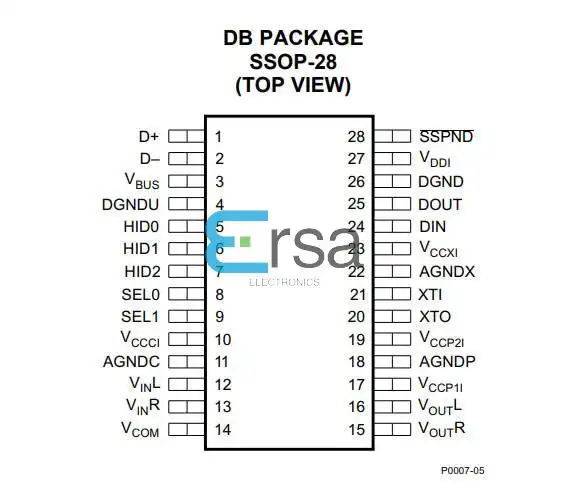
| Pin Number | Pin Name | Function Description |
| 1 | VBUS | USB power input (5V typical) |
| 2 | GND | Ground connection |
| 3 | S/PDIF_OUT | S/PDIF output for digital audio |
| 4 | S/PDIF_IN | S/PDIF input for digital audio |
| 5 | LINE_OUT | Line-level audio output |
| 6 | LINE_IN | Line-level audio input |
| 7 | ADC_CLK | Clock input for ADC |
| 8 | DAC_CLK | Clock input for DAC |
| 9 | USB_D+ | USB data positive |
| 10 | USB_D- | USB data negative |
| 11 | RESET | Reset pin |
| 12 | MUTE | Mute control |
| 13 | VOL_UP | Volume up control |
| 14 | VOL_DOWN | Volume down control |
| 15-28 | Various I/O | General purpose I/O and configuration pins |
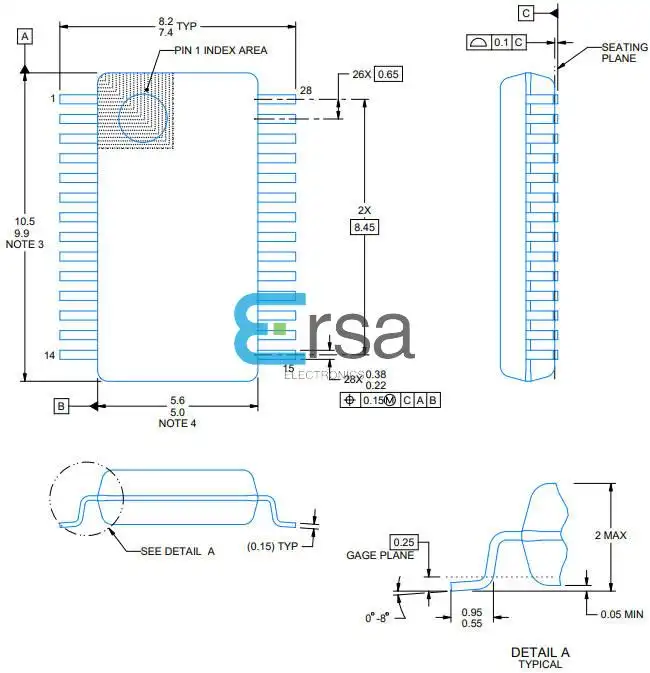
PCM2906CDBR Dimensions
Primary Features of PCM2906CDBR
The PCM2906CDBR is a stereo audio codec with a USB interface, manufactured by Texas Instruments. Below are its primary features:
USB Interface
- Fully compliant with USB 2.0 specification and certified by USB-IF.
- Supports USB adaptive mode for playback and USB asynchronous mode for recording.
- It operates as a bus-powered device and requires a typical 5V supply.
Additional Features
Integrated S/PDIF input and output for digital audio connectivity.
On-chip clock generator with a single 12-MHz clock source.
Includes digital filters:
- Decimation filter for ADC.
- Oversampling filter for DAC.
Analog filters:
- Antialiasing filter for ADC.
- Low-pass filter (LPF) for DAC.
Multifunctionality
- Human Interface Device (HID) functions for volume control and mute.
- Suspend flag functionality.
Package and Power
- Comes in a 28-pin SSOP package.
- Operating temperature range: -25°C to +85°C.
- Typical operating current: 67 mA.
PCM2906CDBR Specifications
| Specification | Details |
| Product Type | USB Audio CODEC |
| Manufacturer | Texas Instruments |
| Number of ADCs/DACs | 1 ADC (Analog-to-Digital Converter), 1 DAC (Digital-to-Analog Converter) |
| Audio Interface | Stereo audio input and output (supports stereo playback and recording) |
| Resolution | 16-bit audio resolution, suitable for consumer-grade audio quality |
| Package Type | 28-pin SSOP (Shrink Small Outline Package) |
| USB Interface | USB 2.0 Full-Speed (12 Mbps), USB-compliant protocol controller |
| Power Supply | 3.3V or 5V power supply |
| Power Consumption | Low power consumption, designed for battery-powered applications |
| Sampling Rate | 48 kHz (typical) |
| Signal-to-noise ratio (SNR) | 90 dB (typical), ensuring high-quality audio performance |
| Total Harmonic Distortion (THD) | 0.02% (typical) |
| Applications | Portable audio devices, telephony, USB audio applications, multimedia systems |
| Input/Output Features | Programmable audio input/output supports both microphone and speaker interfaces |
| Temperature Range | -40°C to 85°C operating temperature |
| Compliance | RoHS Compliant, CE certified, UL-recognized |
Advantages of Using PCM2906CDBR
The PCM2906CDBR offers several advantages that make it a preferred choice for various audio applications. Here are the key benefits:
1. USB Compliance
Full-Speed USB 2.0 Compatibility: The PCM2906CDBR is fully compliant with USB 2.0 specifications, ensuring reliable and high-speed data transfer for audio applications without the need for additional software code.
2. High-Quality Audio Performance
16-Bit Delta-Sigma ADC and DAC: This codec provides high-resolution audio with low Total Harmonic Distortion (THD+N), making it suitable for high-fidelity audio playback and recording.
Wide Sampling Rate Range: It supports a variety of sampling rates (up to 48 kHz for DAC and 44.1 kHz for ADC), allowing flexibility in audio quality and application requirements.
3. Integrated Features
On-Chip S/PDIF Interface: The inclusion of a digital audio interface simplifies connectivity with other digital audio devices, enhancing system integration.
Built-in Clock Generation: The integrated clock generator reduces the need for external components, simplifying design and reducing costs.
4. Power Efficiency
Bus-Powered Operation: The PCM2906CDBR operates on a single power supply (typically 5V) and is bus-powered, making it ideal for portable devices.
5. Versatility
Multiple Input/Output Options: With both analog and digital inputs/outputs, this codec can be used in a wide range of applications, from consumer electronics to professional audio equipment.
Human Interface Device (HID) Support: It includes HID functionality for volume control and mute features, enhancing user interaction.
6. Compact Design
28-Pin SSOP Package: The small footprint allows for easy integration into compact designs, making it suitable for space-constrained applications.
PCM2906CDBR Applications
The PCM2906CDBR is a versatile USB audio codec that finds applications in various audio-related fields. Here are some of its primary applications:
1. Consumer Electronics
USB Audio Interfaces: Used in devices that require high-quality audio input and output, such as external sound cards and USB microphones.
Portable Audio Devices: Ideal for portable speakers and headphones that connect via USB, providing enhanced audio quality and functionality.
2. Telephony
VoIP Systems: Integrated into Voice over Internet Protocol (VoIP) devices for clear audio communication.
Headsets: Utilized in headsets that combine analog and digital audio sources, allowing for seamless switching between devices like smartphones and computers.
3. Professional Audio Equipment
Mixers and Audio Interfaces: Employed in professional audio mixers and interfaces, enabling high-quality recording and playback.
Digital Audio Workstations (DAWs): Supports audio processing in DAWs by providing high-fidelity audio input/output capabilities.
4. Broadcasting
Radio Equipment: Used in broadcasting equipment to handle digital audio signals from various sources, including S/PDIF connections.
5. Gaming
Gaming Consoles and PCs: Integrated into gaming headsets and consoles for improved sound quality and immersive experiences.
6. Development Boards
Prototyping Platforms: These are commonly used in development boards for audio applications, allowing engineers to test and develop new audio technologies.
PCM2906CDBR Equivalents
| Equivalent Part | Manufacturer | Key Features | Audio Capabilities | Additional Notes |
| PCM2906C | Texas Instruments | USB stereo audio codec with integrated S/PDIF support | Stereo audio input/output, S/PDIF | Similar functionality with added S/PDIF support for digital audio transmission |
| TLC320AC01 | Texas Instruments | 14-bit audio codec for basic audio interfacing | 14-bit audio processing | Suitable for simpler audio applications requiring lower resolution |
| PCM1794A | Texas Instruments | High-performance DAC for professional audio applications with 24-bit resolution | 24-bit DAC | Ideal for high-quality audio systems requiring superior performance |
| WM8731 | Wolfson Microelectronics | Stereo audio codec with ADC and DAC functionalities | Stereo ADC/DAC, 24-bit resolution | Suitable for portable audio devices and general audio processing |
| CS4270 | Cirrus Logic | High-performance stereo audio codec supporting multiple audio formats and sampling rates | Stereo codec, multi-format support | Versatile codec suitable for high-performance audio applications |
The PCM2906CDBR has several alternatives that can be considered depending on specific application requirements. The PCM2906C from Texas Instruments is the closest match, offering similar features with the added benefit of S/PDIF support. The TLC320AC01 is a more basic 14-bit codec, suitable for applications with lower audio quality demands. For high-performance needs, the PCM1794A offers a superior 24-bit DAC resolution, ideal for professional audio systems. The WM8731 and CS4270 provide excellent audio processing capabilities for portable and high-performance applications, with versatile format support and multi-rate sampling, making them flexible alternatives for various audio projects. Always consult the datasheets of these components to ensure they meet the specific needs of your application.
PCM2906CDBR Compared to Other Audio Codecs in Terms of Performance
The PCM2906CDBR is a USB stereo audio codec that offers competitive performance compared to other audio codecs in the market. Here's a comparison based on key performance metrics:
Performance Metrics Comparison
| Feature/Codec | PCM2906CDBR | WM8731 | CS4270 | PCM1794A |
| ADC Resolution | 16 bits | 24 bits | 24 bits | 24 bits |
| DAC Resolution | 16 bits | 24 bits | 24 bits | 24 bits |
| SNR (ADC) | 89 dB | 100 dB | 100 dB | 120 dB |
| SNR (DAC) | 96 dB | 106 dB | 100 dB | 120 dB |
| THD+N (ADC) | 0.01% | 0.00% | 0.00% | 0.00% |
| THD+N (DAC) | 0.01% | 0.00% | 0.00% | 0.00% |
| Dynamic Range | 93 dB | 105 dB | 100 dB | 120 dB |
| Sampling Rates | Up to 48 kHz | Up to 96 kHz | Up to 192 kHz | Up to 192 kHz |
| Power Supply | Bus-powered (5V) | Single supply (3.3V-5V) | Single supply (5V) | Single supply (5V) |
Key Insights
Resolution and Dynamic Range: The PCM2906CDBR has a lower resolution compared to other codecs like the WM8731 and CS4270, which offer up to 24-bit processing, making them more suitable for high-fidelity applications.
Signal-to-Noise Ratio (SNR): While the SNR for the PCM2906CDBR is decent at 89 dB for ADC and 96 dB for DAC, competitors like the WM8731 and CS4270 provide higher SNRs, indicating better audio clarity.
Total Harmonic Distortion + Noise (THD+N): The PCM2906CDBR has higher THD+N values compared to some of its counterparts, suggesting that it may introduce more distortion in audio signals.
Sampling Rates: The PCM2906CDBR supports sampling rates up to 48 kHz, which is lower than the capabilities of the WM8731 and CS4270 that can handle rates up to 96 kHz and beyond.
The PCM2906CDBR is a solid choice for applications requiring basic USB audio functionality with reasonable performance metrics. However, for high-end audio applications where resolution, SNR, and THD are critical, alternatives like the WM8731 or PCM1794A may be more appropriate due to their superior specifications.
Working Principle of PCM2906CDBR
The PCM2906CDBR operates as a USB stereo audio codec, facilitating the conversion between analog audio signals and digital audio data. Here’s a detailed overview of its working principle:
USB Interface
Communication Protocol: The PCM2906CDBR uses a USB 2.0 interface, allowing it to connect to various devices while being bus-powered. The audio and control data are transmitted via the D+ and D- lines at full speed.
Device Descriptor: It contains information about the device, including its class, vendor ID, and product ID, enabling the host computer to recognize and interact with the codec.
Audio Processing
Analog-to-Digital Conversion (ADC): The device features a 16-bit Delta-Sigma ADC that converts incoming analog audio signals into digital format. It can handle multiple sampling rates (8 kHz to 48 kHz), allowing flexibility based on application needs.
Digital-to-Analog Conversion (DAC): Similarly, the PCM2906CDBR includes a 16-bit DAC that converts digital audio data back into analog signals for output. It supports sampling rates of 32 kHz, 44.1 kHz, and 48 kHz.
Signal Processing
Oversampling Digital Filters: The codec employs internal digital filters to enhance audio quality by reducing noise and distortion. This includes passband ripple and stop-band attenuation characteristics that help maintain signal integrity.
Low-Pass Filtering: An analog low-pass filter is integrated to smooth out the output signal from the DAC, further improving audio fidelity.
Power Management
Bus-Powered Operation: The PCM2906CDBR is designed to operate on a single power supply (typically 5V) sourced through the USB connection. This makes it suitable for portable applications where power efficiency is crucial.
Suspend Mode: It can enter a low-power suspend mode, significantly reducing power consumption when not in active use.
Multifunctionality
Human Interface Device (HID) Support: The codec includes HID functionality for user controls like volume adjustment and mute, which operate independently from the audio data streams.
PCM2906CDBR Datasheet

Related Articles
- ·Qualcomm PM8350 vs. PM8350C: Architecture, Features, Applications, and Selection Guide
- ·Qualcomm PM8150 vs. PM8150B vs. PM8150L: Functions, Architecture, Applications, and Selection Guide
- ·SGM41541 vs. SGM6605: Battery Charger and Synchronous Boost Converter Comparison
- ·ADI LTM4630A vs. LT8645S: Power Module and Silent Switcher Regulator Comparison
- ·Richtek RT8206A vs. RT9013: Architecture, Specifications, Applications, and Design Considerations
- ·MPS MP2657, MPQ6610GJ-AEC1-Z, and MP2856: Identification, Functions, and Application Comparison
- ·TPS6594-Q1 vs. TPS65219-Q1 vs. TPS653860-Q1 vs. LP87745-Q1: TI Automotive PMIC Comparison
- ·Electronic Components Monthly Market Report
- ·MediaTek MT6369, MT6360, MT6365, and MT6375: Functions, Architecture, and Selection Guide
- ·Southchip SC8547, SC8551, and SC89890: Charging Architecture, Key Differences, and Selection Guide
 FAQ