German
 Japanese
 Portuguese
 Korea
 Mexico
 Dutch


Top Picks for AG10 Battery Equivalent

What is AG10 Battery?
AG10 batteries, also known as LR54, LR1130, and 389A, are small, round alkaline button cells widely used in low-power electronic devices such as watches, calculators, toys, and laser pointers. With a voltage of 1.5 volts and a capacity ranging from 50 to 100 mAh, they are compact, lightweight, and operate within a temperature range of -20°C to +60°C.
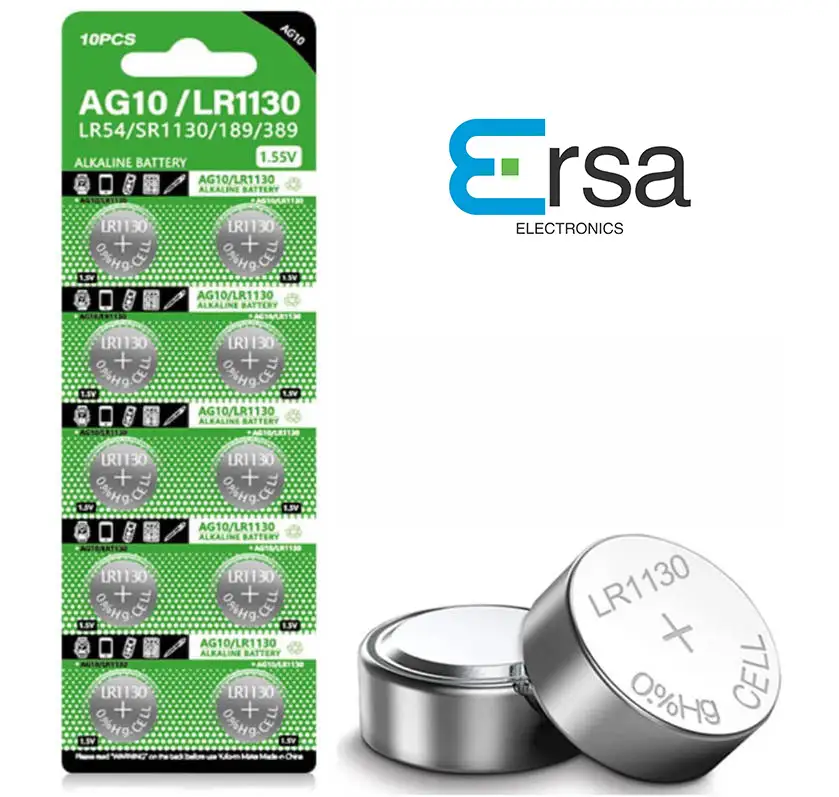
Known for their long shelf life of up to five years, they provide stable voltage output during discharge, typically between 1.1 to 1.3 volts. These non-rechargeable batteries are not intended for recharging, as doing so can lead to safety risks such as leakage or explosion. While generally safe when used properly, AG10 batteries should be kept out of reach of children to avoid choking hazards, and proper disposal is advised to prevent environmental contamination. Overall, AG10 batteries are reliable and long-lasting power sources for various small electronic devices.
For a complete overview of sampling, ENOB and interfaces, see our analog-to-digital converter hub .
AG10 Battery Features
AG10 batteries, also known as LR54, LR1130, and other equivalents, are alkaline button cell batteries widely used in small electronic devices. Here are the key features and specifications of AG10 batteries:
Key Features
Type: Alkaline button cell battery
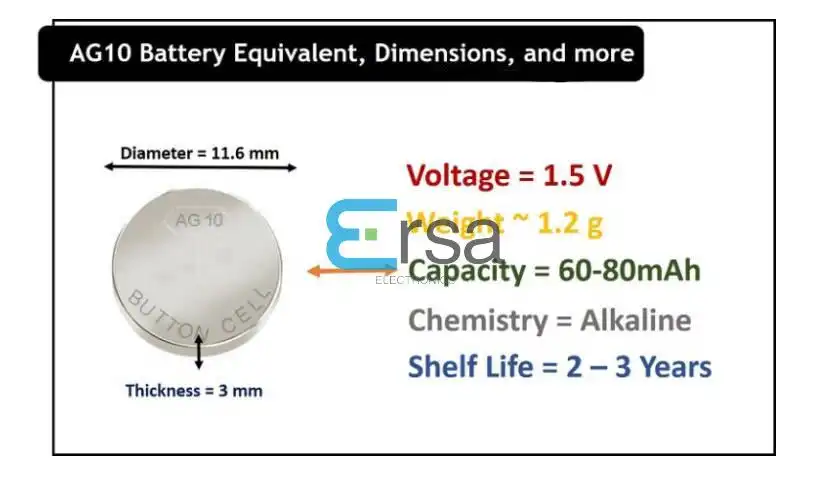
Voltage: 1.5 volts
Capacity: Typically ranges from 50 mAh to 100 mAh, depending on the specific variant and manufacturer.
Dimensions:
- Diameter: 11.6 mm (0.46 inches)
- Height: 3.1 mm (0.12 inches)
- Weight: Approximately 1 gram (0.035 ounces)
Resistance: About 15 kΩ
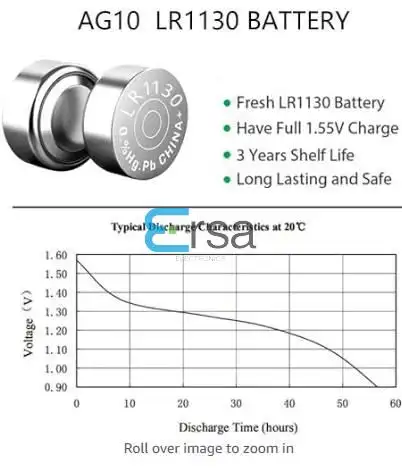
Discharge Characteristics: Continuous power output with a typical voltage drop to around 0.8 to 0.9 volts at end-of-life.
Benefits
Compact Size: The small form factor makes them ideal for portable devices.
Long Shelf Life: AG10 batteries can last up to five years when stored properly due to low self-discharge rates.
Stable Voltage Output: They maintain a consistent voltage throughout their discharge cycle, providing reliable performance for devices.
If you work with sensing or data acquisition, stable supply/reference behavior directly impacts ADC accuracy. For a complete overview of sampling, ENOB and interfaces, see our analog-to-digital converter hub .
Non-Rechargeable: Designed for single use, AG10 batteries cannot be recharged due to their alkaline chemistry, which does not support reversible chemical reactions necessary for recharging.
AG10 Battery Dimensions
AG10 Battery Specifications
AG10 batteries, also known as LR1130 or LR54, are small alkaline button cell batteries commonly used in various electronic devices. Here are the detailed specifications of the AG10 battery:
| Feature | Specification |
| Type | Alkaline button cell |
| Voltage | 1.5 volts |
| Capacity | Approximately 50 to 100 mAh |
| Diameter | 11.6 mm (0.46 inches) |
| Height | 3.1 mm (0.12 inches) |
| Weight | About 1 gram (0.035 ounces) |
| Composition | Zinc and manganese dioxide |
| Resistance | Approximately 15 kΩ |
| Discharge Rate | Continuous discharge |
| Operating Temperature Range | -20°C to +60°C (-4°F to +140°F) |
| Shelf Life | Up to 5 years |
| Appearance | Tablet disc-shaped |
AG10 Battery Applications
AG10 batteries, also known as LR1130 or LR54, are widely used in various low-drain electronic devices due to their compact size and reliable performance. Here are the primary applications of AG10 batteries:
Watches: These are commonly used in both analog and digital watches for timekeeping.
Calculators: Ideal for calculators, where low power consumption is essential.
Toys: These are frequently found in small electronic toys that require sound or movement functions.
Laser Pointers: Used in laser pointers for presentations and other applications.
Medical Devices: Powers devices such as digital thermometers and glucose monitors, where consistent power is crucial.
Remote Controls: Utilized in various remote controls for household electronics.
Flashlights: Some compact flashlights rely on AG10 batteries for illumination.
Security Systems: Provides backup power for alarm systems, ensuring functionality during outages.
Memory Backup: Used in devices that require memory retention, such as clocks and settings in electronics.
The AG10 battery's stable voltage output of 1.5 volts and low self-discharge rate make it suitable for these applications, ensuring reliable performance over time. Its small size allows it to fit into devices with limited space, making it a versatile choice across various consumer electronics.
AG10 Battery Equivalent
Comparison of AG10 Battery Equivalent
| Battery Type | Designation | Equivalent Battery Types | Voltage | Dimensions (mm) | Capacity (mAh) | Shelf Life | Common Applications | Performance Notes |
| Alkaline Equivalents | AG10 | LR54, LR1130, L1131, G10, 189, 390 | 1.5V | Diameter: 11.6, Height: 3.1 | 50-100 mAh | 2-5 years | Widely used in low-drain devices such as watches, calculators, toys, laser pointers, keychains, and other small electronics. |
Lower capacity compared to silver oxide, shorter shelf life, may experience voltage drop more quickly under high drain conditions. Suitable for low-drain applications. |
| Silver Oxide Equivalents | SR1130, SR54,SR1130W, SR1130SW | V389, D389, A389, 626, GP189, V10GA, RW89 | 1.55V | Diameter: 11.6, Height: 3.1 | 80-115 mAh | 3-7 years | Precision devices such as watches (especially analog and high-end models), hearing aids, medical devices, and some small electronics requiring stable power. |
Higher capacity and longer shelf life than alkaline, with more consistent voltage output, ideal for high-precision or continuous use. Performs better under load. |
| Other Designations | A389, GP189, RW89 | A389, 626, V10GA | 1.5V-1.55V | Diameter: 11.6, Height: 3.1 | 60-105 mAh | 2-5 years | Used in various small gadgets, toys, and some calculators, as well as devices requiring compact power sources. | Interchangeable with alkaline and silver oxide types, but always check compatibility with specific device requirements for voltage stability and battery life. |
Many of these devices digitize sensor signals through an ADC before processing. For a complete overview of sampling, ENOB and interfaces, see our analog-to-digital converter hub .
Key Differences Between Alkaline and Silver Oxide Equivalents
Voltage Output:
Alkaline (AG10): Outputs a nominal 1.5V, but the voltage decreases more significantly as the battery discharges, especially under higher drain conditions.
Silver Oxide (SR1130, V389): Outputs a nominal 1.55V, providing more stable voltage over time, especially in high-drain or precision devices. The voltage remains more consistent throughout the discharge cycle.
Capacity and Shelf Life:
Alkaline: Typically offers a lower capacity (50-100 mAh), and its shelf life ranges from 2 to 5 years. Its performance drops faster with higher drain.
Silver Oxide: These batteries generally have a higher capacity (80-115 mAh) and a longer shelf life, ranging from 3 to 7 years, depending on the specific model. They are better suited for applications requiring stable power over time.
Applications:
Alkaline Batteries (AG10, LR1130, etc.): Primarily used in low-drain devices like digital watches, toys, and calculators. They are affordable and readily available but may not perform well in devices that require high precision or long-lasting power.
Silver Oxide Batteries (SR1130, SR54, etc.): Commonly used in precision devices such as wristwatches (especially analog models), hearing aids, medical instruments, and other applications where a consistent voltage and longer battery life are critical.
Performance Under Load:
Alkaline Batteries: While suitable for low-drain devices, their voltage can drop quickly under heavy load, which may affect the performance of devices that require consistent voltage for accurate operation.
Silver Oxide Batteries: Maintain a stable voltage output throughout most of their discharge cycle, making them ideal for high-precision instruments and devices that cannot tolerate voltage drops.
Voltage stability under load doesn’t just affect runtime—it also influences measurement accuracy once signals are digitized. For a complete overview of sampling, ENOB and interfaces, see our analog-to-digital converter hub .
What is AG10 Battery Equivalent to Duracell?
The AG10 battery is equivalent to several other battery types, including Duracell's LR1130 and LR54. Here are some common equivalents:
| Equivalent Battery | Description |
| LR1130 | Same size and capacity (1.5V, ~85-90mAh). Used interchangeably with AG10. |
| LR54 | Slightly larger but can be used as a replacement. |
| 189 | Another direct replacement option. |
| G10A | Compatible with devices requiring AG10 batteries. |
These batteries are commonly used in low-drain devices like calculators and watches, ensuring reliable performance.
LR1130 Battery: A Viable Equivalent to AG10 Battery
The LR1130 battery is indeed a viable equivalent to the AG10 battery, sharing similar specifications and compatibility.
Key Comparisons:
| Feature | LR1130 Battery | AG10 Battery |
| Type | Alkaline button cell | Alkaline button cell |
| Dimensions | 11.6 mm diameter x 3.1 mm height | 11.6 mm diameter x 3.1 mm height |
| Nominal Voltage | 1.5V | 1.5V |
| Capacity | 50-80 mAh | 70-90 mAh |
Other Equivalent Names for LR1130 Battery
In addition to AG10 and LR1130, this type of button cell battery is also known by several other model numbers. These include:
- LR54
- 189
- G10A
- SR1130 (a silver oxide variant, which has a slightly higher voltage of 1.55V)
Interchangeability of LR1130/AG10 Equivalents
These various battery names represent essentially the same physical battery, with minor differences primarily related to the chemistry used in the battery and the voltage it provides. Here’s a breakdown:
LR54 / 189 / G10A: These are all alkaline variants of the LR1130 battery. They share the same size (11.6mm in diameter and 3.05mm in thickness) and typically provide a voltage of 1.5V. As a result, they are electrically interchangeable in devices designed to use LR1130 or AG10 cells. These alkaline batteries are commonly used in devices like watches, calculators, hearing aids, and small toys.
SR1130: The SR1130 is a silver oxide variant of the LR1130. It has the same physical size and shape as the LR1130, but its voltage is slightly higher—1.55V compared to the 1.5V provided by the alkaline versions. While the SR1130 offers longer-lasting power and more stable performance over time, the slight difference in voltage is generally not significant enough to cause issues in most devices. However, for devices that are sensitive to voltage differences, it’s always a good idea to check the manufacturer's specifications before substituting one for the other.
Advantages of Using AG10 Battery
AG10 batteries offer several advantages that make them a popular choice for a variety of electronic devices. Here are the key benefits:
Compact Size: The AG10 battery has a small form factor (11.6 mm diameter and 3.1 mm height), making it ideal for use in compact devices such as watches, calculators, and small toys.
Stable Voltage Output: With a nominal voltage of 1.5V, AG10 batteries provide consistent power throughout their lifespan, ensuring reliable performance for devices that require steady energy supply.
Long Shelf Life: These batteries have a low self-discharge rate, allowing them to retain their charge for extended periods. When stored properly, AG10 batteries can last up to three years without significant loss of capacity.
High Energy Density: AG10 batteries store more energy in a smaller volume compared to other battery types, making them efficient for low-power applications.
Wide Temperature Range: They perform well within a temperature range of -20°C to +60°C, which enhances their versatility across different environments.
Cost-Effective: AG10 batteries are generally affordable and widely available, making them an economical choice for consumers and manufacturers alike.
Easy to Replace: The button cell design allows for straightforward installation and replacement in various devices, ensuring convenience for users.
Minimal Maintenance: Being non-rechargeable alkaline batteries, AG10s require no maintenance or special care, simplifying their use in everyday electronics.
Safety: AG10 batteries are designed with safety features that prevent leakage and other hazards when used correctly, contributing to their reliability in sensitive applications like medical devices.
These features make AG10 batteries an excellent choice for powering a wide range of small electronic devices, ensuring they remain a staple in the market.
Discharge Characteristics of AG10 Battery
Main Differences Between AG10 and LR44 Batteries
The AG10 and LR44 batteries are both alkaline button cell batteries commonly used in small electronic devices, but they have distinct differences that affect their compatibility and performance:
When comparing AG10 and LR44 batteries, capacity difference can directly affect runtime, especially in toys, calculators, medical devices, and other small electronics. If you want to estimate how long a battery may power your device, you can use this battery life calculator to compare battery capacity, voltage, load current, and expected operating time before choosing a replacement cell.
Key Differences Between AG10 and LR44 Batteries
| Feature | AG10 | LR44 |
| Diameter | 11.6 mm | 11.6 mm |
| Thickness | Approximately 3.1 mm | Approximately 5.4 mm |
| Nominal Voltage | 1.5 V | 1.5 V |
| Typical Capacity | 50-90 mAh | 150 mAh |
| Weight | About 1 gram | About 2 grams |
| Chemistry | Alkaline (Zinc/MnO2) | Alkaline (Zinc/MnO2) |
| Common Applications | Watches, calculators, toys | Toys, medical devices, cameras |
When comparing AG10 and LR44 batteries, capacity difference can directly affect runtime, especially in toys, calculators, medical devices, and other small electronics. If you want to estimate how long a battery may power your device, you can use this battery life calculator to compare battery capacity, voltage, load current, and expected operating time before choosing a replacement cell.
Detailed Comparison
Size and Thickness: The most significant difference is in thickness; the AG10 is thinner (3.1 mm) compared to the LR44 (5.4 mm). This size difference affects compatibility, as an AG10 may fit into a device designed for an LR44 but may not make proper contact, leading to unreliable performance.
Capacity: The LR44 typically has a higher capacity (around 150 mAh) compared to the AG10 (50-90 mAh). This means that the LR44 can provide power for a longer duration in devices that require more energy.
Applications: While both batteries are used in similar devices, the AG10 is more commonly found in low-drain applications like watches and small toys, whereas the LR44 is often used in higher-drain devices such as cameras and medical instruments due to its greater capacity34.
Interchangeability: Although they share the same diameter, they are not directly interchangeable due to the difference in thickness and capacity. Using an AG10 in place of an LR44 may result in poor performance or short battery life.
In summary, while both batteries serve similar functions, their differences in size, capacity, and specific applications make it essential to use the correct type for optimal performance.
Are AG10 and 357 batteries the Same?
The AG10 and 357 batteries, while similar in some aspects, are not the same and are not directly interchangeable due to key differences. The AG10 is an alkaline battery with a nominal voltage of 1.5V, a capacity of about 50-90 mAh, and a size of 11.6 mm in diameter and 3.1 mm in height. It is commonly used in devices like watches, calculators, and toys.
In contrast, the 357 battery is a silver oxide battery with a slightly higher voltage of 1.55V and a significantly larger capacity of 150-170 mAh. It has the same diameter (11.6 mm) but is thicker, measuring 5.4 mm in height. The 357 is typically used in watches, medical devices, and cameras. Due to differences in chemistry, voltage, capacity, and size, these batteries are not interchangeable in devices designed for one or the other.
Are AG10 and AG13 batteries the Same?
The AG10 and AG13 batteries, though similar in some respects, are not the same and are not interchangeable. Both are alkaline batteries with a 1.5V voltage, but they differ primarily in size, capacity, and applications. The AG10 is thinner, with a height of 3.1 mm, while the AG13 is thicker, measuring 5.4 mm in height. This size difference means they cannot be used interchangeably in devices designed for one or the other.
In terms of capacity, the AG13 offers a higher energy output, with a typical capacity of 150-170 mAh, compared to the AG10's 50-90 mAh, making the AG13 better suited for higher-power devices such as cameras and medical equipment. Meanwhile, the AG10 is commonly used in low-drain devices like watches, calculators, and toys. Despite having the same diameter, the differences in thickness, capacity, and usage make the AG10 and AG13 distinct and not interchangeable in most applications.
Related Articles:
Top Picks for LR1130 Battery Equivalent
Top Picks for AG13 Battery Equivalent
LR41 Battery Equivalent: A Complete Guide
LR44 vs 357: Comparing Battery Performance and Suitability
When device behavior depends on precise voltage measurement, the ADC and its front end matter as much as the cell you choose. For a complete overview of sampling, ENOB and interfaces, see our analog-to-digital converter hub .

Related Articles
- ·Qualcomm PM8550 vs. PM8550B vs. PM8550VS: Features, Differences, Applications, and Selection Guide
- ·Qualcomm PM8350 vs. PM8350C: Architecture, Features, Applications, and Selection Guide
- ·Qualcomm PM8150 vs. PM8150B vs. PM8150L: Functions, Architecture, Applications, and Selection Guide
- ·SGM41541 vs. SGM6605: Battery Charger and Synchronous Boost Converter Comparison
- ·ADI LTM4630A vs. LT8645S: Power Module and Silent Switcher Regulator Comparison
- ·Richtek RT8206A vs. RT9013: Architecture, Specifications, Applications, and Design Considerations
- ·MPS MP2657, MPQ6610GJ-AEC1-Z, and MP2856: Identification, Functions, and Application Comparison
- ·TPS6594-Q1 vs. TPS65219-Q1 vs. TPS653860-Q1 vs. LP87745-Q1: TI Automotive PMIC Comparison
- ·Electronic Components Monthly Market Report
- ·MediaTek MT6369, MT6360, MT6365, and MT6375: Functions, Architecture, and Selection Guide
 FAQ