
 German
 Japanese
 Portuguese
 Korea
Korea
 Mexico
 Dutch
Dutch


Battery-Friendly ICs for Low-Power Applications

Introduction: What Are Battery-Friendly ICs?
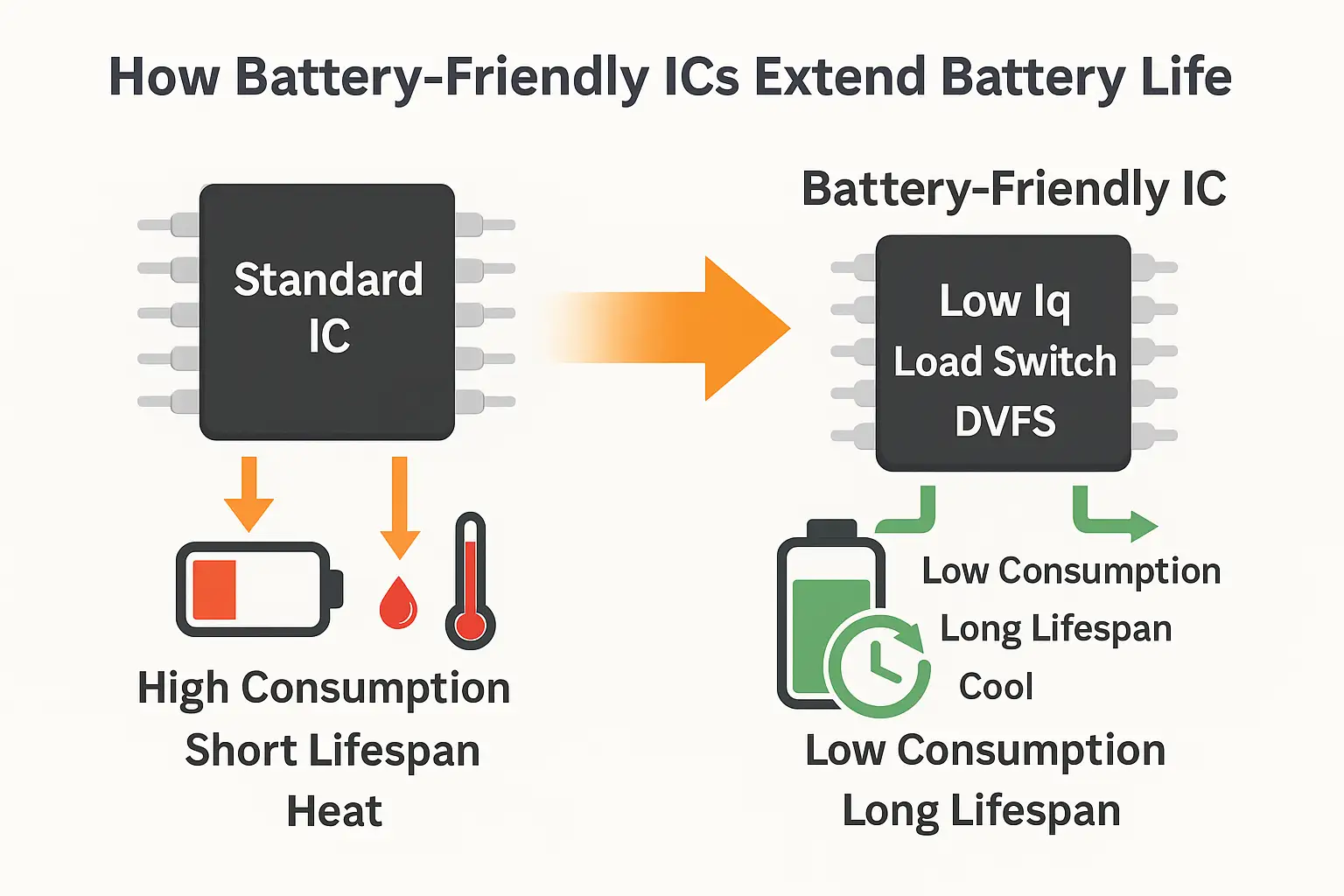
Battery-friendly integrated circuits (ICs) are specially designed components optimized to minimize energy consumption, particularly in battery-powered devices. These ICs are engineered to operate efficiently under limited power budgets by using features like low quiescent current, load control, and intelligent power gating.
They are essential in compact and portable electronics such as:
-
Wearables (smartwatches, fitness bands)
-
IoT nodes (remote sensors, trackers)
-
Coin cell-powered devices (key fobs, hearing aids, medical patches)
Because these devices rely on small batteries that are often difficult or costly to replace, the ICs inside must help extend battery life as much as possible.
👉 In short:
Battery-friendly ICs maximize battery life by reducing standby power consumption and optimizing how current flows through the system.
Key Characteristics of Battery-Friendly ICs
Designing for battery efficiency means optimizing every microamp. Battery-friendly ICs integrate several critical features that collectively reduce power consumption and extend operational lifespan.
🔸 Low Quiescent Current (I<sub>q</sub>)
This refers to the minimal current consumed by the IC in idle mode. ICs with ultra-low I<sub>q</sub>—as low as nanoamps—are essential in coin-cell-powered or standby-heavy designs like remote sensors and real-time clocks (RTCs).
🔸 Dynamic Voltage & Frequency Scaling (DVFS)
DVFS enables real-time adjustment of supply voltage and clock frequency based on performance needs. This reduces dynamic power draw during low-processing periods, useful in wearables and BLE-based devices.
🔸 Power Path Optimization
Battery-efficient systems often use intelligent power path control to direct energy flow from USB, solar, or battery sources efficiently—especially in hybrid power supply designs.
🔸 Integrated PMICs
Power Management ICs consolidate multiple regulators, switches, and monitoring functions into a single chip—reducing footprint, quiescent current, and switching losses.
🔸 Selective Power Gating / Load Switch
These features allow selective shutdown of unused blocks, minimizing leakage. Load switches with quick turn-on/off and reverse blocking are especially battery-friendly.
🔸 Energy Harvesting Support (Optional)
Some battery-optimized ICs support energy harvesting interfaces, such as rectifiers and boost converters, useful for self-powered IoT devices using solar or vibration energy.
🔸 Wide VIN Tolerance
Wide input voltage support allows flexible use of varied battery chemistries, ensuring stable operation as voltage drops over discharge cycles.
Typical Application Scenarios for Battery-Friendly ICs
Battery-friendly ICs are essential in numerous modern low-power devices. Below are some common application scenarios and the typical ICs that support them:
🕒 RTCs in Battery-Powered Clocks or Smart Meters
Real-Time Clocks (RTCs) require ultralow I<sub>q</sub> LDO regulators to maintain timekeeping with minimal battery drain during standby.
Example: TPS7A02 – A nanoamp-class quiescent current LDO from TI ideal for RTC domains.
📡 Wireless MCUs in Zigbee / LoRa Sensors
Wireless sensor nodes often rely on load switches and PMICs to manage power delivery efficiently and enable selective domain shutdown.
Example: NXP PCA9420 + TI TPS22919 – Combo providing dynamic voltage regulation and on/off control.
🏥 Coin Cell-Powered Medical or Wearable Devices
These applications prioritize low leakage, ESD protection, and analog signal integrity.
Example: TPD1E04U04 (TI ESD diode) + LM321 (low-power op-amp) support robust sensing with minimal draw.
🧸 Battery-Operated Consumer Products
Toys, LED gadgets, or thermometers often use simple analog ICs (e.g., op-amps, comparators, logic gates) that function well at low voltage and intermittent use.
🚗 Backup Domains in Automotive ECUs
In cars, subsystems like memory retention or RTCs rely on battery domains that demand highly efficient standby circuits.

Recommended IC Types by Function
In battery-powered systems, selecting the right type of IC can significantly impact overall energy efficiency and product longevity. Below are some key categories of battery-friendly ICs, their characteristics, example models, and CTA links to relevant product pages.
✅ Ultralow-Iq LDOs
Why they matter:
These low dropout regulators are optimized for minimal standby current—sometimes as low as < 50nA—making them ideal for powering real-time clocks (RTCs), always-on sensors, or sleep-mode subsystems.
Example Models:
-
TPS7A02, TPS7A05 (Texas Instruments)
-
NCP4681 (onsemi)
🔗 Explore Power Management ICs »
✅ Load Switches with Quick Turn-Off
Why they matter:
Load switches allow selective power delivery to sub-circuits, enabling on-demand activation and fast power cut-off to prevent leakage during standby.
Example Models:
-
TPS22919, TPS22918 (TI)
✅ Battery Management ICs
Why they matter:
These integrate power paths, chargers, and even regulators for single-/multi-cell battery systems. Especially useful for coin cell, Li-ion, or wearable applications.
Example Models:
-
bq24250 (TI)
-
MAX17260 (Analog Devices)
-
PCA9420 (NXP)
🔗 Explore Battery Management ICs »
✅ Voltage Detectors / Supervisors
Why they matter:
Supervisory ICs detect low-voltage conditions and can trigger resets or wake-up events. Perfect for low-power systems requiring reliability under voltage fluctuations.
Example Models:
-
TPS3808 (TI)
-
MCP1316 (Microchip)
🔗 Explore Voltage Supervisors »
✅ Real-Time Clock (RTC) ICs
Why they matter:
RTCs maintain accurate timekeeping even in deep sleep or when primary power is cut. They must operate on ultra-low standby current.
Example Models:
-
ISL1208 (Renesas)
-
PCF2127 (NXP)
-
BQ32002 (TI)

Comparison Table: Battery-Friendly ICs vs. Standard ICs
Battery-friendly ICs are specifically engineered for applications where energy conservation is critical. The following table highlights the key differences compared to standard ICs:
| Feature | Battery-Friendly ICs | Standard ICs |
|---|---|---|
| I<sub>q</sub> standby current | 10–100 nA | 100 µA – 1 mA |
| Vin range | 0.8–5.5V | 1.8–3.3V |
| Load switch capability | Yes | Often missing |
| Energy-saving modes | Yes (DVFS, gating, etc.) | Partial or none |
| Suitability for coin cell | Excellent | Risk of fast drain |
🧠 Why This Matters:
This side-by-side comparison helps engineers make informed purchasing decisions when designing for wearable, portable, or IoT products. It also serves as structured, indexable data that search engines favor for rich snippet results.

Product Selector (CTA)
To help you quickly identify and source battery-optimized ICs, here are some hand-picked products widely used in low-power designs. Each is linked to a dedicated product page on your site.
| Featured IC | Function | Product Link |
|---|---|---|
| TPS7A02 | Ultralow-Iq LDO Regulator (Vin down to 0.8V) | → View Product |
| TPD1E04U04 | ESD Protection Diode with Nanoamp Leakage | → View Product |
| PCA9420 | PMIC for Battery MCUs (NXP) | → View Product |
| MAX17260 | Fuel Gauge with Integrated Charger | → View Product |
| TPS22919 | Nano Load Switch with Quick Shutdown | → View Product |
FAQ: Battery-Friendly ICs
What makes an IC battery-friendly?
Battery-friendly ICs are designed to consume minimal power, especially during standby. They feature low quiescent current (as low as 10nA), operate over wide voltage ranges, and often support power gating or dynamic scaling to conserve energy.
Can I use standard regulators in battery-powered circuits?
You can, but standard regulators often have higher standby current (I<sub>q</sub>)—typically over 100µA—leading to faster battery drain. For long-life or coin-cell devices, ultra-low I<sub>q</sub> LDOs are strongly recommended.
What’s the lowest quiescent current for an LDO?
Some ultra-low-power LDOs, such as TI’s TPS7A02, offer quiescent current as low as 25nA, making them ideal for RTCs, sensors, and coin cell applications.
What ICs work well with LR44 or 1/3N coin cell batteries?
You’ll want ICs with wide Vin (0.8–3V), extremely low I<sub>q</sub>, and stable operation under declining voltage. Examples include:
-
TPS7A02 – Ultralow LDO
-
TPD1E04U04 – ESD protection
-
LM4040 – Low-Iq voltage reference
Is there a PMIC for small Li-Ion battery projects?
Yes. NXP’s PCA9420 and Analog’s MAX17260 are tailored for compact battery-powered systems. They integrate charger, voltage regulation, and power sequencing in a single IC.
Conclusion
Battery-friendly ICs are critical components in modern low-power and portable electronics. Whether it’s a wearable, a sensor node, or a coin-cell-powered medical device, choosing the right ICs can significantly extend battery life, reduce maintenance, and improve power efficiency.
Smart design begins with smart components.
👉 Explore All Battery-Powered ICs →

Related Articles
- ·What Are the Advantages of Micron Technology in Global HBM Memory Competition?
- ·Micron HBM and Advanced Memory: Can It Challenge Samsung and SK Hynix?
- ·AI Demand, HBM Growth, and Memory Market Trends
- ·The Significance of Memory and Storage for AI
- ·Why Memory Capacity Is a Performance Bottleneck for AI Applications
- ·HBM3 vs. HBM3E: Complete Technical Comparison for AI, HPC, and Global Component Procurement
- ·How Large Language Models Work
- ·SK Hynix & Samsung: The Unprecedented HBM Expansion Race
- ·Micron 6600 ION 245TB Redefines Data Center
- ·Why Memory and Storage Define the Next Decade




.png?x-oss-process=image/format,webp/resize,h_32)


