
 German
 Japanese
 Portuguese
 Korea
Korea
 Mexico
 Dutch
Dutch


Multi-Rail Intelligence for Centralized Power Control

PMBus/SMBus power system managers act as the central orchestrator and evidence hub for complex multi-rail boards. They consolidate sequencing, fault trees, black-box logging, and telemetry into one controllable surface, enabling repeatable validation, remote diagnostics, and safer fail-states. Choose them when rail count and traceability exceed the comfort zone of ad-hoc logic—especially in servers, AI/FPGA cards, telecom, and industrial motherboards.
Quick-Browse Table of Contents
Answer Box (Decision Points)
PMBus/SMBus power system managers are the multi-rail orchestration and observability hub: they coordinate power-up/down sequencing, fault trees, black-box logging, centralized telemetry, and scriptable control across complex boards.
Where it fits
- Servers
- AI accelerator cards
- Telecom & industrial motherboards
- Complex SoC + FPGA multi-rail systems
Buyer’s checklist
- Rail count & dependency complexity: do you need deterministic sequencing/interlocks across 6–32+ rails?
- Telemetry accuracy / sample rate / bandwidth: can V/I/T precision and sampling windows capture fast transients?
- Fault-tree granularity & interlocks: support for parent/child/peer propagation, debounce, backoff, and retry limits.
- NVM log depth & ride-through: event capacity, timestamps, and power-loss flush paths for black-box evidence.
- Toolchain & mass-production reproducibility: GUI/script export, EEPROM images, version locking, and CRC/PEC.
Deployment takeaway: When you have ≥ 6 rails and require traceability / remote diagnostics, a PMBus/SMBus power system manager materially reduces integration risk and validation time.
What is it
A PMBus/SMBus power system manager is a supervisory IC that centralizes multi-rail sequencing, fault-tree control, black-box logging, and telemetry orchestration over the PMBus/SMBus interface. It connects to PoL regulators and measurement front-ends to deliver board-level observability, traceability, and scriptable control for complex PDNs.
Scope boundaries
- Focus on system-level managers that provide centralized sequencing, logging, fault trees, and telemetry.
- Include PMBus/SMBus addressing, ALERT/INT handling, CRC/PEC, and NVM storage considerations.
- Exclude pure voltage monitors, standalone sequencers, and PG aggregators (covered elsewhere in the matrix).
Common building blocks
- Multi-channel ADC with MUX and calibration hooks for V/I/T telemetry.
- NVM for configuration images and time-stamped event logs.
- Script engine for power-up/down, margining, and production test flows.
- Dedicated GPIO/PG/ALERT lines and write-protect pins.
- CRC/PEC support on PMBus/SMBus transactions; master or slave role options.
Terminology
| Term | Definition |
|---|---|
| PMBus | A power-focused command set over SMBus/I²C physical layer. |
| SMBus | Two-wire serial bus derived from I²C with timing and protocol rules. |
| OPERATION | PMBus command that controls on/off state and behavior. |
| ON_OFF_CONFIG | PMBus config for how enables and commands interact. |
| PG (Power-Good) | Signal indicating a rail is within regulation limits. |
| ALERT# | Interrupt line signaling a fault or status change on the bus. |
| Margining | Controlled Vout adjust for test/calibration/derating. |
| Fault tree | Propagation rules across rails (parent/child/peer interlocks). |
| Black-box log | Time-stamped event snapshots preserved in NVM. |
| PEC/CRC | Packet error checking to ensure data integrity. |
| NVM | Non-volatile memory for configs and event history. |
| Kelvin sense | Four-wire measurement minimizing IR drop errors. |
| Backoff | Retry strategy with increasing delay to avoid oscillation. |
Role in the power architecture
The manager acts as the system brain for power: it executes dependency graphs and timing, consolidates telemetry into a unified register map, applies fault-tree policies, and records evidence to NVM. PoL converters retain their local regulation loops and compensation, while the manager coordinates enables, PG, ALERT, and PMBus transactions to close the system-level control/observe/log loop.
Centralized manager vs. discrete sequencing/monitoring
| Dimension | Centralized PMBus/SMBus manager | Discrete sequencing/monitoring |
|---|---|---|
| Start/stop sequencing | Deterministic dependency graphs with timeouts and interlocks. | Local PG gating; limited cross-rail awareness. |
| Fault propagation | Configurable parent/child/peer rules with debounce/backoff. | Point-to-point signals; hard to scale safely. |
| Telemetry granularity | Multi-channel V/I/T with timestamp alignment. | Basic thresholds; sparse sampling. |
| Event logging | NVM black-box with snapshots and time correlation. | Limited or absent; external tools required. |
| Mass production | Script/EEPROM images, version locking, CRC/PEC. | Manual fit-up; hard to reproduce at scale. |

Working Principle (Overview & System Block)
The PMBus/SMBus power system manager is the control–observe–log hub for multi-rail PDNs. It speaks PMBus on the I²C physical layer (addressing, pull-ups, timing), executes deterministic sequencing with interlocks and slopes, consolidates telemetry (V/I/T) with timestamp alignment, records black-box logs under OV/UV/OC/OT/Watchdog triggers, and runs scripts for power-up, margining, and production.

PMBus/SMBus stack & ALERT arbitration
PMBus rides on the I²C physical layer with device addressing, SCL/SDA pull-ups and bus timing/capacitance limits. Packet Error Checking (PEC/CRC) protects transactions. The shared ALERT# line fans into the host/BMC to signal faults, while optional FAULT# lines provide hard interrupts for critical events.
| Device | Example Address | Notes |
|---|---|---|
| Power system manager | 0x5A (example) | ALERT# asserted on fault/status change; PEC recommended. |
| PoL regulator | 0x40–0x4F | Read V/I/T; margining via VOUT_COMMAND if supported. |
| Telemetry sensor (current/temperature) | 0x48–0x4B | Calibrate per shunt value/reference; verify timing budget. |
Sequencer state machine
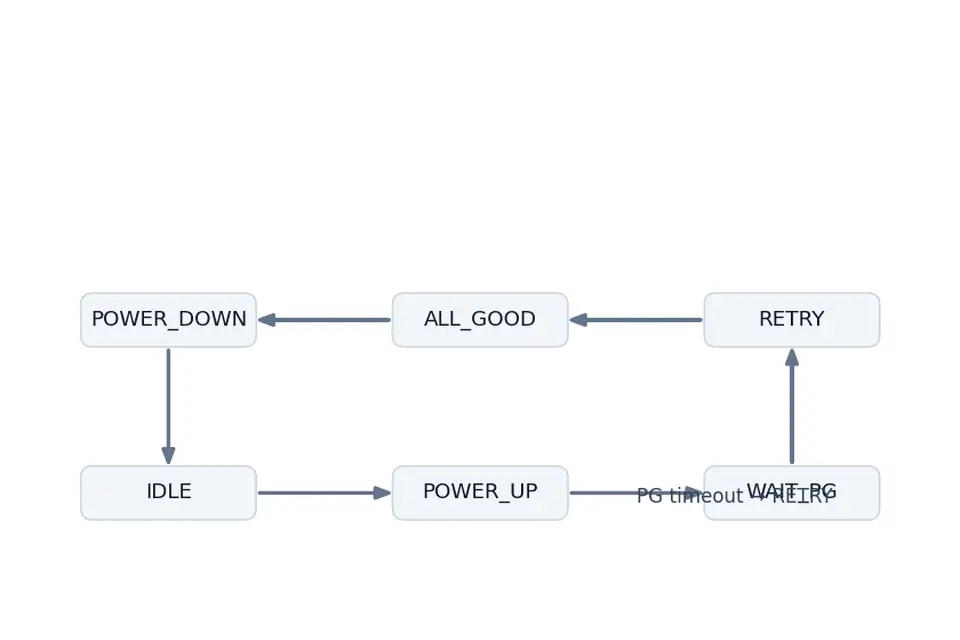
The sequencer drives Enable pins per dependency graph, enforces ramps/delays, waits for PG windows, and handles timeout/auto-retry. A canonical flow is: IDLE → POWER_UP → WAIT_PG → ALL_GOOD → (fault) → POWER_DOWN/RETRY.
- Model dependencies as an acyclic graph; mark inverted PG and AND/OR group guards.
- Coordinate slopes/soft-starts with PoLs to avoid inrush stacking; add guard times.
- Use debounce on PG/ALERT; implement backoff on retries to prevent oscillation.
Telemetry sampling chain
Rails feed a MUX and ADC; results populate a register map aligned by a common timestamp base. Digital averaging and windowing smooth noise without masking transients. Hooks exist for offset/gain calibration and reference checks.
- Choose sample rate and averaging window per rail dynamics; align to load-step or sync pulses if needed.
- Use Kelvin sense and analog-ground hygiene to minimize IR-drop/EMI coupling into V/I measurements.
- Track reference accuracy and drift vs. temperature; store per-rail calibration coefficients.

Black-box logger write path
Events (OV/UV/OC/OT/Watchdog) trigger snapshots with Rail ID, V/I/T, PG state, current script step, and retry counters. Entries are buffered then committed to NVM with power-loss flush and retention safeguards; wear-leveling protects endurance.
- Pick immediate vs. batched commits based on criticality and endurance targets.
- Use a monotonic timestamp base; include host time correlation if available.
- Guard with write-protect pin; cap total entries and define rollover policy.

Scripting & configuration images
Script sets automate bring-up, margining, and regression. The configuration image strategy separates a locked golden image from a modifiable user page, both versioned with CRC. Write-protect pins and unlock sequences gate critical updates.
| Image/Script | Purpose | Locking/Integrity |
|---|---|---|
| Golden image | Production-grade sequencing, policies, and defaults. | Version & CRC locked; write-protect asserted. |
| User page | Field updates, calibration trims, feature toggles. | Signed update; unlock window with timeout. |
| Regression scripts | Repeatable power-up/down, margin sweeps, fault injection. | Stored read-only; hash-pinned for traceability. |
Technical Breakdown
Sequencing / Interlock subsystem
- Dependency modeling: AND/OR groups, inverted PG, timeout gates; ensure DAG (no cycles).
- Waveform order: VCORE → VIO → VMEM; coordinate PoL soft-starts and ramp slopes.
- Inrush control: staggered enables, guard delays, maximum concurrent rail count.
| Rail | Delay / Slope | PG condition | Interlocks |
|---|---|---|---|
| VCORE | t0 + 0 ms / 1 mV/μs | PG within 5% | Enable VIO only after VCORE PG |
| VIO | t0 + 10 ms / 0.8 mV/μs | PG within 5% | Gate VMEM if VIO not PG |
| VMEM | t0 + 20 ms / 0.6 mV/μs | PG within 5% | Hold peripherals until ALL_GOOD |
Fault-tree engine
- Event classes: transient vs. sustained; suppressible vs. shutdown.
- Propagation: parent→child, child→parent, peer fan-out; debounce and backoff.
- Stability: safe shutdown vs. limited retries with oscillation protection.

Telemetry / ADC
- Front-end: channel MUX, sample-and-hold, reference source, offset/gain/linearity calibration.
- Noise hygiene: Kelvin sense, analog ground isolation, routing to minimize coupling.
- Sync sampling: align to load steps/clock/sync pulses for comparable cross-rail data.
| Channel | Sample/Average | Calibration |
|---|---|---|
| VOUT (rail) | 2–5 ksps / 4–8× avg | Offset/gain vs. ref |
| IOUT (shunt + CSA) | 2–5 ksps / 8–16× avg | Shunt value & temp drift |
| TEMP (NTC/digital) | 0.5–2 ksps / 4× avg | Sensor linearization |
Black-box logging
- Granularity: include Rail ID, V/I/T, PG, script step, retries, and fault classifier.
- Timestamps: monotonic counter and optional host correlation.
- Endurance: write-through for criticals; batched write-back for routine events; wear-leveling.
PMBus command subset (manager-centric)
Read
READ_VOUT,READ_IOUT,READ_TEMPERATURE_xSTATUS_xx(fault/status register set)
Write
OPERATION,ON_OFF_CONFIGVOUT_COMMAND(margining)MFR_FAULT_RESPONSE
Maintenance
STORE_USER_ALL,RESTORE_USER_ALLWRITE_PROTECT(pin & command)
Practice
- Enable PEC/CRC; separate vendor pages.
- Lock images post-production; version & CRC tag.
Key Metrics
Compare PMBus/SMBus power system managers by rail capacity & sequencing complexity, telemetry fidelity, fault & logger robustness, and operations/tooling maturity—all scoped strictly to the system manager itself.

| Model | Rails (max) | PMBus/SMBus Rate • PEC/CRC | Voltage Telemetry (res/err) | Current Telemetry (res/err) | Temp Telemetry (res/err) | Log Depth (events • bytes/entry) | Fault Response (HW μs • script ms) | Margining (±% • step) | Supply/Standby (mA • μA) | Temp • Package • ESD | Tooling & Export |
|---|---|---|---|---|---|---|---|---|---|---|---|
| Manager A | 16 | 100/400 kHz • Yes | 16-bit • ±0.5% @25 °C | 12–14-bit equiv • ±1.0% | 0.25 °C • ±1.0 °C | 512 • 48 B | <10 • 5–20 | ±10% • 5 mV | 6.5 • 15 | –40…+105 °C • QFN-40 • HBM 2 kV | GUI/CLI • CSV • EEPROM image • CRC lock |
| Manager B | 8 | 100/400 kHz • Yes | 14–16-bit • ±0.8% | 12–13-bit equiv • ±1.2% | 0.5 °C • ±1.5 °C | 256 • 40 B | <15 • 8–25 | ±8% • 10 mV | 5.0 • 10 | –40…+105 °C • QFN-32 • HBM 2 kV | GUI • CSV • Image export • Write-protect |
| Manager C | 32+ | 400 kHz • Yes | 16-bit • ±0.4% | 14–16-bit equiv • ±0.8% | 0.25 °C • ±0.8 °C | 1024 • 64 B | <8 • 3–15 | ±12% • 5 mV | 8.0 • 20 | –40…+125 °C • QFN-48 • HBM 4 kV | GUI/CLI • CSV/EEPROM • Version/CRC lock |
| Footnotes — Conditions for comparison: VIN nominal; ambient 25 °C unless noted; same averaging window and sample rate per rail; same shunt value and CSA gain for current; PEC/CRC enabled; identical PG thresholds. | |||||||||||
Design Guidelines
Ten field-proven rules to integrate the manager and its immediate peripherals right on the first spin.
Model the dependency graph first
Kill hidden cycles and deadlocks before wiring.
- Build a Rail-Graph (AND/OR, inverted PG, timeouts); lint for DAG & fan-in/out.
- Deliverable:
rail_graph.json+ rendered preview.
Plan addresses before wiring
- Avoid PoL conflicts; reserve a dedicated debug address.
- Enable PEC/CRC; document ALERT fan-in.
- Deliverable:
address_map.csv.
Engineer I²C integrity
- Budget bus capacitance → compute pull-ups; buffer long segments; keep stubs short.
- Deliverable:
bus_budget.xlsx(Cbus, Rp, segment length).
Hard-path Alert/PG redundancy
- Critical faults: HW FAULT# → cutoff; firmware for reset/log only.
- Deliverable: netlist diff showing hard interlock.
ADC front-end hygiene
- Kelvin picks, small RC, ESD/surge at inputs; analog-ground island with single-point tie.
- Deliverable: annotated layout + BOM callouts.
Margining & calibration at the jig
- Perform “golden calibration” once; burn trims into a read-only page.
- Deliverable:
golden_image.eep+ CRC.
Fault-tree anti-oscillation
- Exponential backoff; retry caps; power-up mute window to ignore early glitches.
- Deliverable: policy snippet in config.
Black-box commit strategy
- Critical events = immediate write-through; routine = batched; add power-loss flush.
- Deliverable: log schema + retention math.
Script version control
- Keep configs/scripts in Git; embed version + CRC; prod/repair from the same branch.
- Deliverable: release checklist + CRC report.
EMC & thermal awareness
- Place manager near sense nodes, far from dv/dt; map hot parts to TEMP channels.
- Deliverable: thermal photo + TEMP channel map.


Troubleshooting Matrix
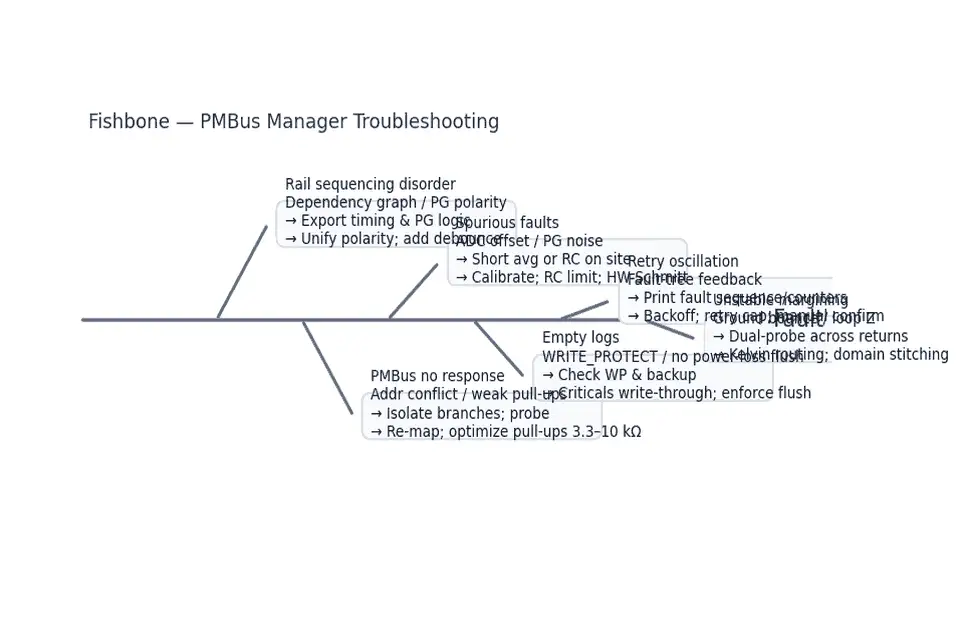
Use this manager-focused matrix to go from symptom to fix in minutes. Verify address mapping, enable PEC/CRC, and check pull-ups before deep dives.
| Phenomenon | Root-cause clues | Quick on-site checks | Permanent fix |
|---|---|---|---|
| Rail sequencing disorder | Dependency graph error / PG polarity inversion | Export timing waveforms and PG logic | Unify polarity; add debounce delays |
| PMBus not responding | Address conflict / pull-ups too large | Isolate branches and probe one by one | Re-map addresses; optimize pull-ups (3.3–10 kΩ) |
| Spurious fault triggers | ADC offset / PG noise coupling | Short-term averaging or RC at the pin | Calibration + RC limiter; HW Schmitt on PG |
| Log memory stays empty | NVM write-protect / power-loss not flushed | Check WRITE_PROTECT and backup source | Critical events = immediate commit; enforce power-loss flush |
| Retry oscillation | Fault-tree feedback loop | Print fault sequence and retry counters | Add backoff; cap retries; require manual confirm if needed |
| Unstable margining | Ground bounce / loop impedance | Dual-probe across returns with scope | Kelvin routing; domain stitching for returns |
Applications & Schematics
Block/port-level integration patterns for the manager and its immediate peripherals only: PoL EN/PG, SDA/SCL + ALERT#, shunt + CSA inputs, and TEMP channels.
FPGA/AI Accelerator Card (12–20 rails)
- Ports & bindings: EN/PG for all PoLs; SDA/SCL + ALERT# to BMC; READ_VOUT/IOUT/TEMP; address map (0x40–0x4F PoLs; manager 0x5A); PEC ON.
- Policy: ALL_GOOD gate for SerDes; DDR muted until VTT PG; logger write-through for OV/OC; margining script for DVFS validation.

Telecom Base-Station Board (Hot-swap)
- Ports & bindings: EN/PG interlocked with hot-swap GOOD; FAULT# hard path to cutoff; isolated I²C bridge to shelf controller; ALERT fan-in.
- Policy: power-up mute window; backoff with retry cap; NVM wear-leveling; shelf ID in snapshots.

Industrial Motherboard (–40…+125 °C)
- Ports & bindings: multiple TEMP channels (NTC + digital); shunt/CSA on high-current rails; ALERT to MCU; address DIP exposed; write-protect enforced.
- Policy: cold-start slope easing; temperature-graded PG thresholds; periodic calibration self-check; logger retention via supercap (keep-alive only).

Reference ICs & Equivalents
Choose a true multi-rail system manager (not a simple monitor or sequencer). Start with rail count and black-box logging, then lock telemetry fidelity and toolchain fit.

| Vendor | Part number | Rails (typ. max) | Telemetry / ADC | NVM / Logging | Toolchain (export) | Package | Temp grade | Notes |
|---|---|---|---|---|---|---|---|---|
| Analog Devices | LTC2977 | 8 | V/I/T, up to ~16-bit (typ.) | Event log (black-box) | LTpowerPlay (CSV / project) | QFN (family-dependent) | –40…+105 °C (typ.) | Datacenter/FPGA boards |
| Analog Devices | LTC2975 | 4 | V/I/T telemetry (high precision) | Log + NVM policies | LTpowerPlay | QFN | –40…+105 °C (typ.) | Input energy telemetry variant available |
| Analog Devices | LTM2987 | 16 (µModule) | V/I/T, calibrated network (typ.) | Event logging supported | LTpowerPlay (golden image) | BGA µModule | –40…+105 °C (typ.) | High-rail-count compact builds |
| Texas Instruments | UCD90320 | 32 | V/I/T, PMBus readout (typ.) | Black-box event log | Fusion Digital Power (CSV/script) | BGA/QFP (family-dep.) | –40…+105 °C (typ.) | Large multi-rail backplanes |
| Texas Instruments | UCD90240 | 24 | V/I/T telemetry (typ.) | Black-box / NVM policies | Fusion Digital Power | Package family-dep. | –40…+105 °C (typ.) | Datacenter/telecom common |
| Texas Instruments | UCD9090A | 10 | Voltage/PG + status (typ.) | Event record (family-dep.) | Fusion GUI/CLI | QFN/QFP (family-dep.) | –40…+105 °C (typ.) | Mid-rail systems |
| Maxim Integrated (ADI) | MAX34451 | 16 monitor / ~12 seq. | Multi-rail V/I + sequencing | Log/NVM (family-dep.) | Eval GUI (CSV) | QFN/TQFN (family-dep.) | –40…+105 °C (typ.) | Dense monitor + sequence combo |
| Maxim Integrated (ADI) | MAX34461 | ~16 | V/I telemetry + PG control | Event record (family-dep.) | Eval GUI (CSV) | Package family-dep. | –40…+105 °C (typ.) | Pairs with high-accuracy CSAs |
| Lattice Semiconductor | ispPAC-POWR1220AT8 | 12 | Comparators + I²C/SMBus status | On-chip NVM (config) | PAC-Designer (scripts) | TQFP/QFN (family-dep.) | –40…+105 °C (typ.) | Programmable interlocks/margining |
| Lattice Semiconductor | ispPAC-POWR1014A | 10 | Comparators + PG logic + I²C | On-chip NVM (config) | PAC-Designer | TQFP/QFN (family-dep.) | –40…+105 °C (typ.) | Glue-logic friendly |
| Infineon | IRPS5401 | 5 (integrated PMIC) | PMBus telemetry per rail (typ.) | Host-side log (device-dep.) | Infineon GUI (CSV) | QFN/BGA (device-dep.) | –40…+105 °C (typ.) | Space-constrained cards |
| Vicor | D44TL1A0 | System supervisor | PMBus/telemetry for Vicor modules (dep.) | Host-oriented logging (dep.) | Vicor suite (CSV) | Module-dep. | –40…+105 °C (typ.) | Native to Vicor ecosystems |
| Renesas | ISL70321SEH / ISL73321SEH | 4 (sequencer/monitor) | I²C status/telemetry (device-dep.) | Event record (host-side) | Renesas GUI (project) | Ceramic/QFP (family-dep.) | Wide temp / rad-tolerant (SEH) | High-rel / aerospace |
| Notes — Specs shown at a high level (typical family values). Confirm exact ADC resolution/accuracy, log depth, packages and temperature ranges in each device’s datasheet; normalize comparisons by test window, shunt/gain, and PEC/CRC settings. | ||||||||
Validation & Production
Treat the manager configuration as firmware—version it, regress it, and ship it with evidence.
Engineering bundle
- Project sources: LTpowerPlay / TI Fusion / Lattice PAC-Designer.
- EEPROM images &
STORE_* / RESTORE_* / WRITE_PROTECTscripts (with CRC). - CSV register map: thresholds, delays, slopes, fault actions.
- Golden calibration trims (date-stamped); post-program readback + hash.
Regression scripts
- Power-up DAG enforcement; timestamp capture; ALERT# latency.
- Fault injection: OV/UV/OC/OT & watchdog; fault-tree action + retries/backoff.
- Telemetry sanity @ 0/50/100% load; mean/peak/jitter windows.
- NVM policy: immediate vs batched; power-fail flush check.
- Version & CRC gate: block any drift from the golden image.
Report templates
- Sequencing waveforms (expected vs measured) & skew budget.
- Telemetry stats per rail (mean/peak/jitter).
- Fault matrix: trigger → response time → interlock result.
- NVM wear estimate & write policy audit.
- Traceability: SN/board ID → config version → log file hash.

Security & Safety
A power system manager must be immutable when shipped, fail-safe when isolated, and well-protected on its I/O front-ends. Treat it as the evidence orchestrator, not the primary safety mechanism.
Config Integrity
- Write-Protect (WP) via hardware pin + register policy.
- Read-only pages for golden image; controlled user page scope.
- Signed version with CRC/hash embedded; export
config.json. - Change control through Git; production & repair from the same branch.
Fail-Safe Runtime
- Host heartbeat/keep-alive; watchdog timeout triggers safe shutdown.
- Critical rails: hardware FAULT# route to cutoff; firmware logs & resets only.
- Power-up mute window and debounce to avoid chatter.
- Degraded, read-only mode when the host goes missing.
Front-End Protection
- I²C lines: ESD clamps to GND/rail as appropriate, correct pull-ups, bus-cap budget, segment buffers when long.
- ADC inputs: Kelvin sense, small RC to limit bandwidth, ESD diodes, analog-ground island with single-point tie.
- Clear surge paths and UVLO/OV handling on supply pins.
Configuration immutability & signature
- Default to WRITE_PROTECT after programming & verification.
- Golden image stored on read-only page;
RESTORE_USER_ALLprovides rollback. - Embed config version, build date, and CRC/hash; export a verify report with each unit.
Watchdog & host-loss behavior
- Heartbeat polling or writes at a fixed cadence; missing beats trigger bounded retries and exponential backoff.
- Hardwired FAULT# path overrides scripting for critical rails.
ESD/Surge on bus & analog front-ends
- Choose pull-ups from the bus-cap budget; keep stubs short; buffer long branches.
- Place RC/ESD close to the pins; shield sensitive traces; maintain AGND island with single-point tie.
Functional-safety stance
- Use the manager as a logger and coordinator; primary safety remains with certified devices and hard interlocks.
- Unify timebase; commit critical events immediately; force flush on power-loss detection.
Hardening Checklist
| Control | Why it matters | Implementation |
|---|---|---|
| WP high by default | Prevents field drift | Hardware WP pin + lock register after verify |
| Read-only golden page | Immutable reference | Config on RO page; user page limited scope |
| Config signature & CRC | Tamper detection | Embed version/hash; verify at boot/test |
| Git-based change control | Traceability | Tag releases; archive verify dumps |
| Heartbeat watchdog | Host-loss safety | Timeout → safe shutdown; bounded retries |
| Hardware cutoff path | Deterministic stop | FAULT# → latch-off on critical rails |
| Power-up mute window | Avoid false trips | Delay PG evaluation & add debounce |
| I²C pull-up sizing & buffers | Signal integrity | Compute Rp from Cbus; segment long lines |
| ADC RC + ESD + Kelvin | Noise immunity | Small RC, ESD clamps, Kelvin to shunt pads |
| Immediate commit for critical events | Evidence survivability | Write-through; power-loss flush hook |
| RMA export bundle | Faster triage | Logs + config hash + timeline report |
| Read-only remote access | Attack surface reduction | Disable field writes; enable only in service mode |
FAQ
Manager-focused questions only—sequencer-only or monitor-only topics are intentionally out of scope.
PMBus vs. SMBus: core differences and compatibility?
How to centralize sequencing & telemetry without replacing PoLs?
How to merge power-up scripts with production calibration and lock them?
How do logs survive power loss?
How to plan addresses and bandwidth in multi-board/multi-domain systems?
How to prevent fault-tree retry oscillation?
How to send manager logs to a BMC or the cloud?
Which Alert/PG latencies matter, and how to measure them?
How to calibrate voltage/current/temperature telemetry for production?
How to mitigate ground-bounce that destabilizes margining/measurements?
How to prevent unauthorized field reconfiguration?
How to choose between a high-rail manager and an integrated digital PMIC?
Can multiple managers share one bus and still keep logs consistent?
What should an RMA triage include for the manager?

Related Articles
- ·HBM3 vs. HBM3E: Complete Technical Comparison for AI, HPC, and Global Component Procurement
- ·How Large Language Models Work
- ·SK Hynix & Samsung: The Unprecedented HBM Expansion Race
- ·Micron 6600 ION 245TB Redefines Data Center
- ·Why Memory and Storage Define the Next Decade
- ·How Artificial Intelligence Acquires “Knowledge”
- ·How DRAM Will Change the World
- ·Why SSD Write Cache Is Crucial for AI Applications
- ·DRAM Product, Technology & Application Guide
- ·HBM4 compared to HBM4E








.png?x-oss-process=image/format,webp/resize,h_32)


