
 German
 Japanese
 Portuguese
 Korea
Korea
 Mexico
 Dutch
Dutch


Power Bus Isolators & Protection Helpers

Quick Browse
Answer Box (Decision-Ready)
Problems to Solve
- Isolation: Provide high-CMTI, fail-safe galvanic isolation for PMBus/SMBus/GPIO/PG/Alert to prevent control/telemetry faults under GPD, surge, and hot-plug.
- Protection: Stop reverse polarity and backfeed (“ghost power”) using back-to-back MOSFETs with ideal-diode control.
- Controlled Startup: UVLO/OVLO windowing + slew-limited dV/dt + PG/Alert alignment for deterministic bring-up and traceability.
Targeted Solutions
- High-CMTI isolation + fail-safe: bidirectional open-drain reconstruction; predictable idle on cold start.
- Back-to-back MOSFETs + ideal-diode control: reverse differential shuts off; low forward drop with measurable leakage.
- Startup governance: UVLO/OVLO gating, controlled dV/dt, and PG/Alert cadence alignment with timestamps.
Selection Triplet
- CMTI ≥ 50–100 kV/µs with proven I²C Fast-mode Plus (1 MHz) timing margins.
- Back-to-back MOSFET RDS(on) × thermal path passes i²t and SOA checks.
- UVLO hysteresis 3–5% + debounce ≥ 1–5 ms; no backfeed on power-down.
Risk Alerts
- Isolation delay + large cold pull-ups → Fm+ timing edge.
- Protection not latched off on reverse → thermal shock.
- Wrong power-up sequence → stuck bus / false PG.

What is it | Definition & Boundary
Definition
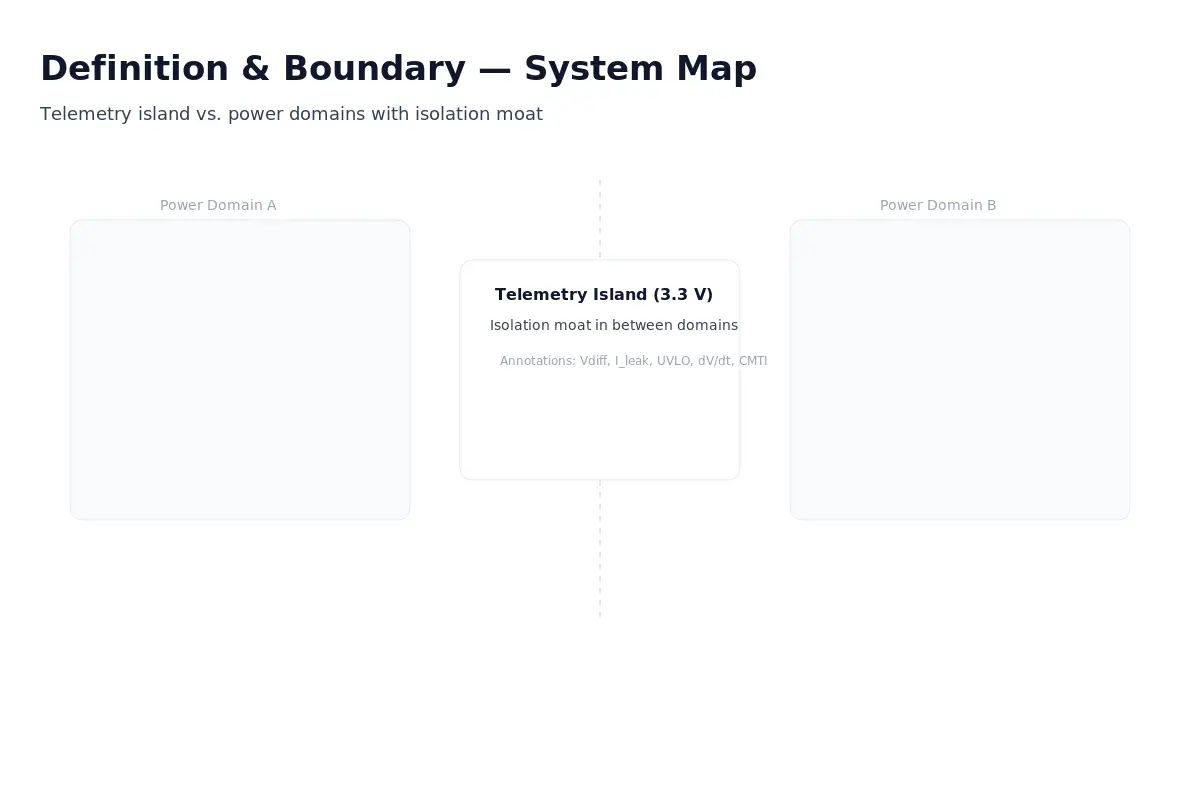
A device family focused on galvanic isolation, reverse/backfeed protection, and controlled startup for PMBus/SMBus/I²C/GPIO/PG/Alert. It keeps the control/telemetry island usable, trustworthy, and auditable through ground-potential differences, EMC/ESD events, hot-plug, and power ramps.
Objects
- Buses: I²C/SMBus/PMBus (SDA/SCL/ALERT).
- Alerts/Status: PG, Fault, GPIO.
- Power clamping: reverse polarity & backfeed blocking; ideal-diode behavior.
- Deterministic startup: UVLO/OVLO windows, controlled dV/dt, PG/Alert alignment.
Scope: interfaces/protection/startup determinism only. It does not cover power-conversion topologies, active decoupling, sequencing, or voting.
When to Use
- Multi-board or long interconnects with GPD risks.
- High dv/dt surroundings requiring higher CMTI.
- Frequent hot-plug, live service, complex power-down paths.
- Need for forensics: reverse/backfeed logs; PG/Alert timestamp reconstruction.
Fail-Safe Logic
- Define idle-high or Hi-Z for power-up/down/brown-out/single-side loss.
- Independent pull-ups on both sides to maintain open-drain behavior and rise-time budgets.
- Clock-stretching preserved across isolation.
- No backfeed on power-down: reverse shut-off, measurable off-leakage, event logging.
Working Principle
Isolation Channel
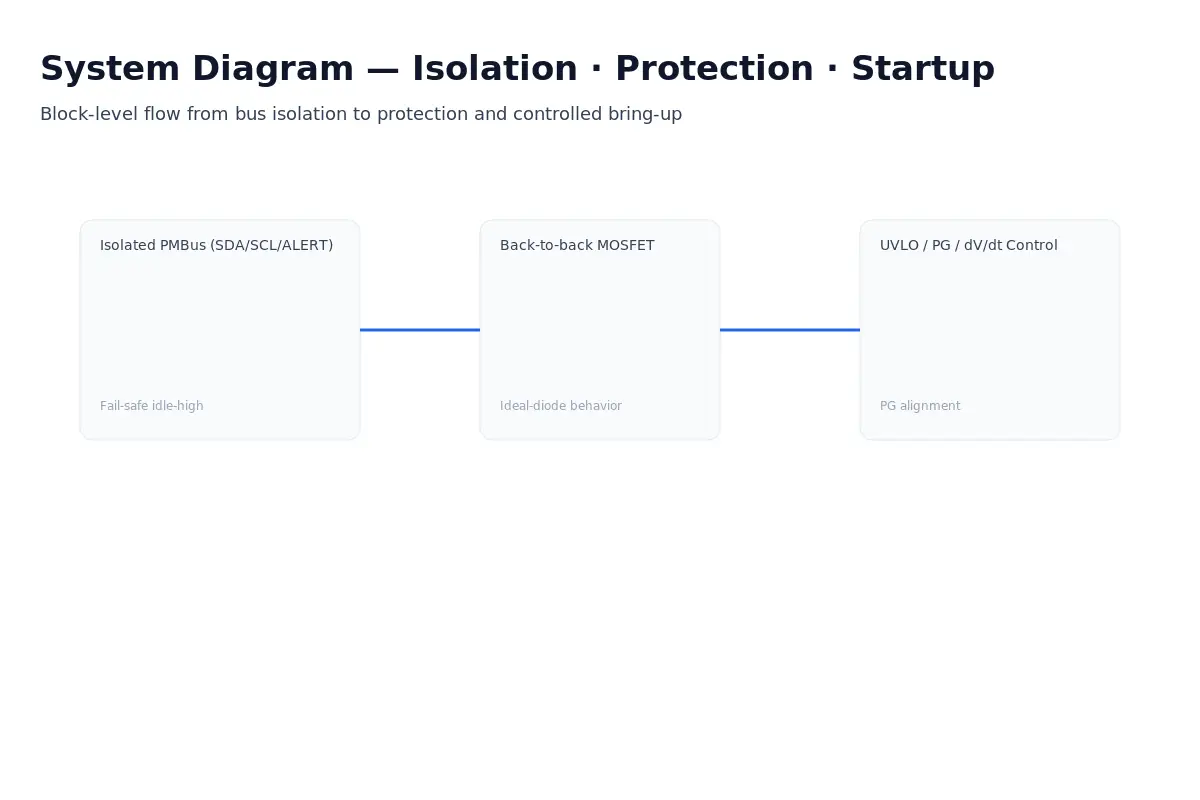
Bidirectional open-drain reconstruction preserves I²C semantics across isolation. SDA/SCL are rebuilt with threshold/edge sensors; ALERT/PG are typically unidirectional. Independent pull-ups on both sides ensure predictable idle and cold-start behavior with high CMTI.
- Tunable: pull-ups per side, bus capacitance budget, channel delay/power trade.
- Measure: tPLH/tPHL, rise/fall, CMTI, off-leak.
- Pitfall: large cold pull-ups + accumulated delay → Fm+ timing edge.
Reverse/Backfeed Blocking
Back-to-back MOSFETs with ideal-diode control shut off on reverse differential Vdiff and minimize forward drop. Validate off-leakage, reverse shut-off time, and i²t against SOA; verify connector-side paths for hidden backfeed.
- Tunable: FET RDS(on), controller thresholds/hysteresis, copper/through-vias for heat.
- Measure: Vdiff, Ileak(off), reverse shut-off time, i²t.
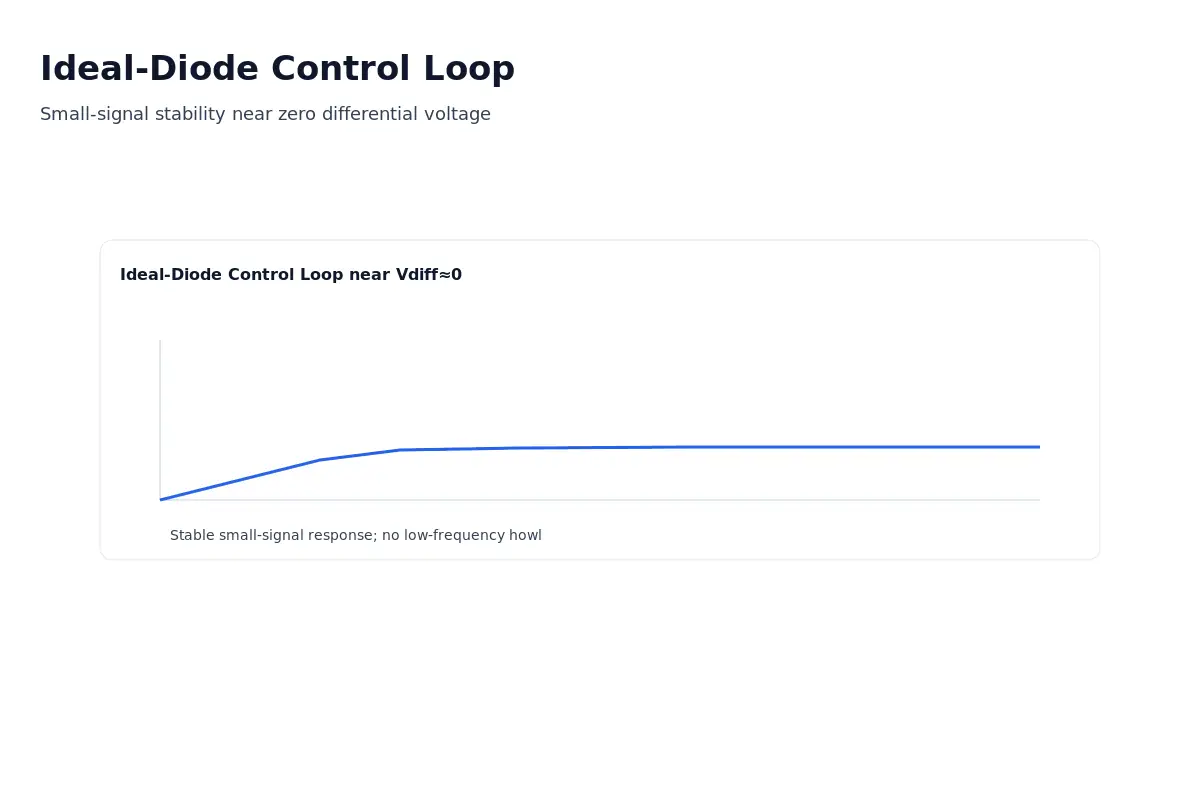
- Pitfall: near-zero Vdiff loop instability → low-frequency howl.
Controlled Startup
UVLO/OVLO windows with 3–5% hysteresis, slew-limited ramps, and PG/Alert alignment produce deterministic bring-up and auditable logs. Widen narrow PG pulses if upper layers require minimum width.
- Tunable: UVLO/OVLO thresholds, hysteresis & debounce (≥1–5 ms), ramp dV/dt, PG delay/width.
- Measure: UVLOhi/lo, dV/dt, PG delay, Alert alignment.
- Pitfall: mis-coordinated ramp vs isolator delay → false PG.
Failure Modes & Mitigation
- Single-sided power loss → define fail-safe (Hi-Z or idle-high).
- ESD-induced sticky-low → recovery path + watchdog; staged pull-ups if needed.
- CMTI false triggers → guard traces/return reference/common-mode choke; run injection tests.
- Hidden backfeed paths → audit connectors, aux supplies, debug ports.
Technical Breakdown


Isolation Physics
Capacitive/magnetic/optical coupling; VIORM/VISO/Surge classes; lifetime and drift vs temperature. Prefer higher CMTI with lower delay and leakage; validate at temperature corners.
- Compliance: creepage/clearance, pollution level, altitude derating.
- Verify: dielectric withstand, CMTI injection, delay-vs-temp curves.
I²C Bidirectionality
Honor timing windows and clock-stretching; budget rise-time per side with independent pull-ups. Validate at 100/400/1M across cold/hot/long-trace/high-cap loads.
| Mode | Rise/Fall Budget | tPLH/tPHL Target | Stretch Behavior |
|---|---|---|---|
| Standard/Fast | Per-side pull-ups sized for bus C | Keep margins vs spec min/max | Transparent across isolation |
| Fm+ (1 MHz) | Minimize RC; avoid overshoot/ringing | Aggregate delay < timing edge | No spurious holds on cold start |
Fail-Safe Matrix
Define outputs for power-up, power-down, brown-out, and single-sided loss: idle-high or Hi-Z. Document and verify; forbid ambiguous states that can create false PG.
- Idle policy: explicit and testable.
- Separate pull-ups avoid cross-domain contention.
Reverse/Backfeed Loop
Control law from Vdiff to FET gate requires phase margin near zero differential. Sweep/step the loop; measure reverse shut-off, off-leak, and i²t; correlate with thermal Zth.
Controlled Startup
Set UVLO thresholds with 3–5% hysteresis and 1–5 ms debounce; shape ramp dV/dt; align PG/Alert to the system cadence; widen PG pulses if required by the supervisor.
Safety & Layout
Honor creepage/clearance, pollution level, altitude rules. Keep isolation slots clean; prohibit return currents bridging the moat; avoid stitching vias across the gap.
Immunity
CMTI injection (10–20 ns edges), ESD/surge discharge paths, guard traces, return reference, and common-mode chokes. Track CMTI_error_cnt and false alerts; provide mitigation if any recurrence.
Key Metrics
| Metric | Measurement Script | Pass Gate |
|---|---|---|
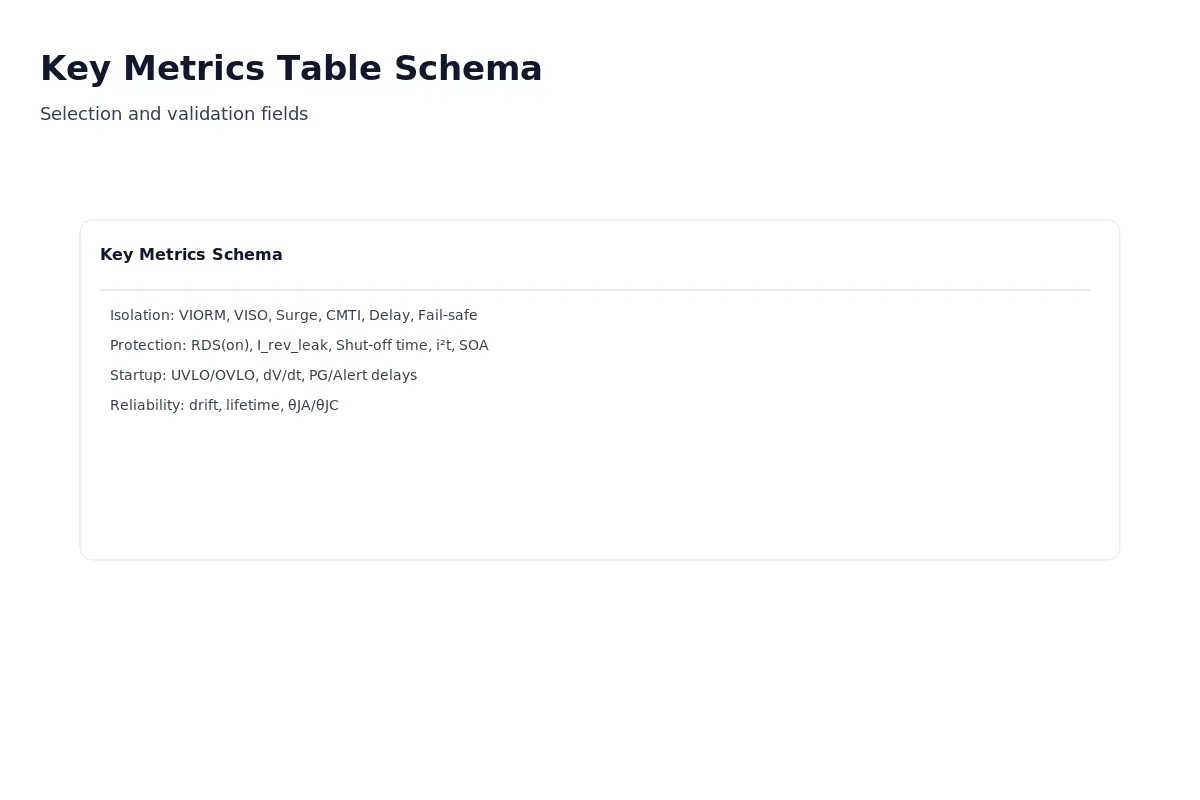
| Isolation.VIORM_working_V | Reference datasheet working isolation voltage; verify with dielectric withstand at temp corners. | Meets declared VIORM across temp; no partial discharge. |
| Isolation.VISO_withstand_V | Apply specified isolation test per standard; record leakage & breakdown. | No breakdown; leakage ≤ spec. |
| Isolation.Surge_kV | Surge test per applicable level; count failures, log waveforms. | Pass declared surge class; zero latent faults. |
| Isolation.CMTI_kVus (primary KPI) | Fast dv/dt injector (10–20 ns edges) across isolator; monitor false alerts/bit errors; sweep amplitude. | Target ≥ 100; Pass ≥ 50 kV/µs (full temp). |
| Isolation.Delay_tPLH_ns | Propagate low→high across isolation; oscilloscope time delta @ Fm+ load. | Each path ≤ 120 ns (keeps 1 MHz margins). |
| Isolation.Delay_tPHL_ns | Propagate high→low across isolation; same fixtures as above. | Each path ≤ 120 ns. |
| Isolation.I2C_mode_support (Std/Fm/Fm+) | Run 100/400/1M across cold/hot/long-C; verify stretch transparency and duty. | All modes pass with margins; no spurious holds at cold. |
| Isolation.Fail_safe_mode (idle-high/Hi-Z) | Ramp up/down & single-side-off; confirm defined idle on both sides with independent pull-ups. | No stuck bus / false PG under any ramp. |
| Protection.RDSon_mOhm_perFET (×2 for back-to-back) | 4-wire measure at operating temp; include PCB copper heating in model. | Target 2–6 mΩ (per FET), thermally verified. |
| Protection.I_rev_leak_off_uA | Power-down; bias reverse; measure off-leak at connector and local rails. | Pass ≤ 10–50 µA (per voltage class). |
| Protection.Reverse_shutoff_us | Apply −V step; capture Vdiff and channel current; measure shut-off to safe region. | Pass ≤ 2–10 µs (no overshoot). |
| Protection.i2t_pulse_A2s | Compute ∫I²dt for worst pulses; correlate with thermal Zth and camera. | Within SOA at ambient and corner temps. |
| Protection.SOA_crossing_point | Overlay operating/abuse pulses on SOA; flag crossings. | No SOA crossing under specified events. |
| Protection.Vdiff_trip_mV | Sweep small Vdiff; find trip & hysteresis; ensure stability near 0 mV. | Predictable trip; no low-freq howl. |
| Startup.UVLO_hi_V / UVLO_lo_V | Soft-ramp; timestamp hi/lo crossing; compute hysteresis %. | Within spec; consistent across temp/lot. |
| Startup.UVLO_hysteresis_pct | From hi/lo; validate during repeated ramps with noise injected. | Pass 3–5% (with debounce). |
| Startup.Debounce_ms | Hold off time around threshold; verify no chatter PG. | Pass ≥ 1–5 ms. |
| Startup.dVdt_V_per_ms | Program ramp slope; measure overshoot & settling; log PG timing. | Within window; no false PG/Alert. |
| Startup.PG_delay_ms | Δt from UVLO_hi to PG assert at target dV/dt. | Inside spec window (e.g., 5–50 ms). |
| Startup.Alert_align_ms | Resample to 1 kHz cadence; compare PG/Alert timestamps. | Alignment within ±1–2 ms; no micro-glitches. |
| Reliability.Delay_drift_ppm_perC | Sweep temperature; fit delay vs °C; record ppm/°C. | Within timing budget across temp. |
| Reliability.CMTI_drift_pct_over_temp | Re-run CMTI at temp corners; compare margin. | No catastrophic drop; remains ≥ pass level. |
| Reliability.Theta_JA_C_per_W | Steady dissipation test; correlate board stack-up to θJA. | Meets thermal budget at max power. |
| Reliability.Theta_JC_C_per_W | Package-to-case characterization; confirm heatsinking path. | Consistent with datasheet & model. |
| Reliability.Lifetime_FIT_or_hours | Use vendor reliability data; map to mission profile. | Meets program target FIT/hours. |
| Reliability.Humidity_Salt_factor (if applicable) | Run humidity/salt-fog as required; verify no leakage drift or corrosion paths. | No abnormal drift; passes visual/ESD retest. |
Design Guidelines
Use independent pull-ups per side
Preserve open-drain semantics and rise-time budgets across isolation.
- Quick Check: verify SDA_rise_ns at 100/400/1M.
- Fields: tPLH/tPHL, SDA_rise_ns.
Validate stretch and jitter at 100/400/1M
Fm+ margins are delay-critical, especially at cold and with large C loads.
- Quick Check: scope clock-stretch transparency and duty.
- Fields: tPLH/tPHL, I2C_mode_support.
Document fail-safe states
Define outputs for power-up/down, brown-out, and single-sided loss (idle-high or Hi-Z).
- Quick Check: simulate ramps; confirm no stuck bus / false PG.
- Fields: Fail_safe_mode, Sticky_low_events.
UVLO with 3–5% hysteresis + 1–5 ms debounce
Suppress threshold chatter and de-glitch PG/Alert during ramps.
- Quick Check: log UVLO_hi/lo; verify PG stability.
- Fields: UVLO_hysteresis_pct, Debounce_ms.
Thermal & SOA for back-to-back FETs
Pulse heating dominates during reverse events; verify i²t and Zth.
- Quick Check: correlate IR camera with model.
- Fields: RDSon_mOhm_perFET, i2t_pulse_A2s.
Stabilize the ideal-diode loop near Vdiff≈0
Ensure phase margin to avoid low-frequency howl or ringing.
- Quick Check: small-signal sweep; reverse shut-off time.
- Fields: Vdiff_mV, Reverse_shutoff_us.
Honor isolation slots and return paths
Keep the moat clean; forbid stitching vias or cross-slot returns.
- Quick Check: visual DRC of slot integrity and guards.
- Fields: CMTI_kVus.
CMTI hardening near switching nodes
Use guard traces, reference returns, and common-mode chokes; run dv/dt injection.
- Quick Check: track CMTI_error_cnt.
- Fields: CMTI_kVus, CMTI_error_cnt.
Align PG/Alert to a common cadence
Resample to 1 kHz (example) for deterministic bring-up and unified logs; widen narrow pulses.
- Quick Check: PG_delay_ms, Alert_align_ms within window.
- Fields: PG_delay_ms, Alert_align_ms.
DFM/Test hooks for evidence
Provide loopback across isolation, VDS/VGS pads, and reverse-event counters for field forensics.
- Quick Check: hooks reachable; logging fields mapped.
- Fields: Backfeed_event_cnt, I_leak_off_uA.

Troubleshooting Matrix
| Symptom | Observable Fields | Remedy |
|---|---|---|
| I²C sporadic NACK at cold | SDA_rise_ns, tPLH_ns, tPHL_ns, I2C_mode_support | Tune independent pull-ups both sides (reduce RC/overshoot), verify aggregated delay vs Fm+ margins, re-test clock-stretch transparency at cold. |
| Bus stuck low on power-up | Sticky_low_events, UVLO_hysteresis_pct, Debounce_ms | Document fail-safe states; increase UVLO hysteresis (3–5%) and debounce (≥1–5 ms); consider staged pull-ups or bring-up order. |
| Device heating after reverse event | Vdiff_mV, I_leak_off_uA, Reverse_shutoff_us, i2t_pulse_A2s, Tj_C | Shorten reverse shut-off; verify i²t vs SOA; add copper/thermal vias; select lower RDS(on) FETs or spread heat path. |
| Ghost voltage after power-down (backfeed) | I_leak_off_uA, Backfeed_event_cnt | Audit connector/aux supply/debug-port paths; place ideal-diode controller at connector; minimize off-leak; speed up reverse shut-off. |
| Startup oscillation / PG chatter | UVLO_hi_V, UVLO_lo_V, UVLO_hysteresis_pct, dVdt_Vms, PG_delay_ms | Set 3–5% UVLO hysteresis + 1–5 ms debounce; limit dV/dt; widen PG pulses and align to system cadence. |
| False alert under CMTI injection | CMTI_kVus, CMTI_error_cnt | Add guard traces/return reference/CM choke; route away from fast dv/dt; validate to target CMTI class. |
| Lost alarm across isolation | tPLH_ns, tPHL_ns, Alert_align_ms | Confirm channel direction (ALERT/PG often unidirectional); unify time base (e.g., 1 kHz); widen narrow pulses. |
| Excess thermal rise on protection FETs | Theta_JA_C_per_W, Tj_C, i2t_pulse_A2s | Increase copper/thermal vias; check SOA crossing; distribute current; select lower RDS(on). |
| PG jitter vs I²C activity | PG_delay_ms, SCL_duty_pct, tPLH_ns, tPHL_ns | Decouple PG harness from I²C; retune pull-ups and RC; align timing base across domains. |
| Connector hot-plug resets telemetry | Vrail_dVdt, UVLO_hysteresis_pct, CMTI_error_cnt | Limit dV/dt; increase UVLO debounce; add connector-side ideal-diode + TVS; route away from switching edges. |
| Long-cable ringing affects Fm+ | SDA_rise_ns, SCL_duty_pct, tPLH_ns, tPHL_ns | Increase series damping or tweak pull-ups; verify eye window at 1 MHz; keep isolation slot and returns clean. |
| Alert polarity mismatch across domains | Alert_align_ms, tPLH_ns | Normalize polarity at the receiver; confirm one-way channel mapping; apply pulse stretcher if needed. |
| Brown-out on one side only; inconsistent fail-safe | UVLO_hi_V, UVLO_lo_V, Fail_safe_mode | Define explicit idle-high/Hi-Z; tighten UVLO window; isolate pull-ups to avoid cross-domain contention. |
| Reverse leakage wakes upstream PMIC | I_leak_off_uA, Backfeed_event_cnt | Reduce off-leak path; re-locate ideal-diode controller; add bleed/load gating; verify no backfeed through debug/aux lines. |

Applications & Reference Schematics
A. Isolated PMBus Island
3.3 V both sides with independent pull-ups; ch0/1 → SDA/SCL (bidirectional), ch2 → ALERT (unidirectional); UVLO=3.05 V, hysteresis=120 mV, PG delay≈5 ms.

- Key parameters: I2C_mode_support 100/400/1M; UVLO window with debounce; PG delay ≈ 5 ms.
- Test points: SDA_rise_ns, tPLH/tPHL, Alert_align_ms (cold/hot/long-trace).
- Log fields: Sticky_low_events, PG_delay_ms, Alert_align_ms.
B. Reverse/Backfeed-Protected Telemetry Rail
12 V rail with back-to-back MOSFETs (≤5 mΩ × 2) and ideal-diode controller; connector-side placement with thermal spreaders.
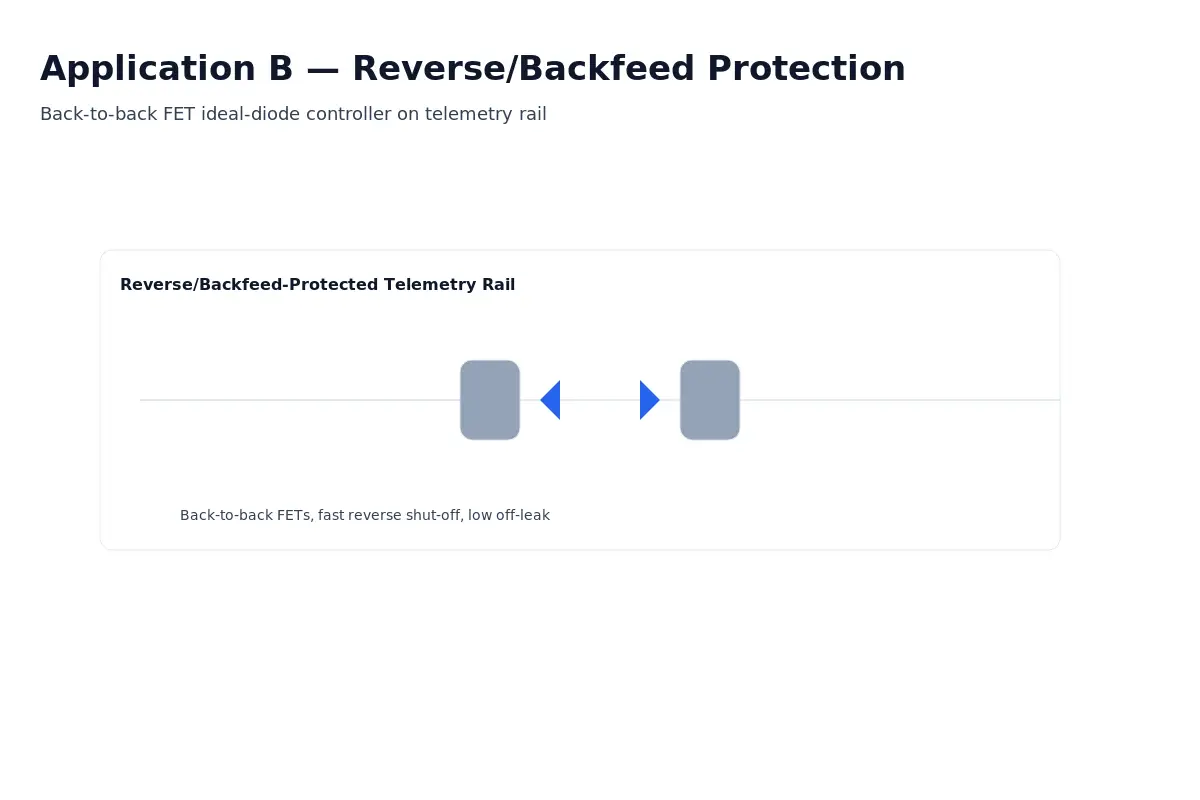
- Key parameters: Reverse_shutoff < 1 µs; I_leak(off) < 5–10 µA; controlled start dV/dt ≈ 0.5 V/ms.
- Test points: Vdiff_mV, I_leak_off_uA, Reverse_shutoff_us, i2t_pulse_A2s; correlate with thermal Zth.
- Log fields: Backfeed_event_cnt, Tj_C.
C. Backfeed-Free Multi-Board Connector
Place ideal-diode controller at the connector; add thermal pads; audit cross-board backfeed paths; count events locally.

- Key parameters: I_leak(off) within class; no overheating on fast reverse; PG/Alert intact.
- Test points: TP_Vdiff, TP_PG, Reverse_shutoff_us, Alert_align_ms.
- Log fields: Backfeed_event_cnt, CMTI_error_cnt.
Reference ICs & CTA
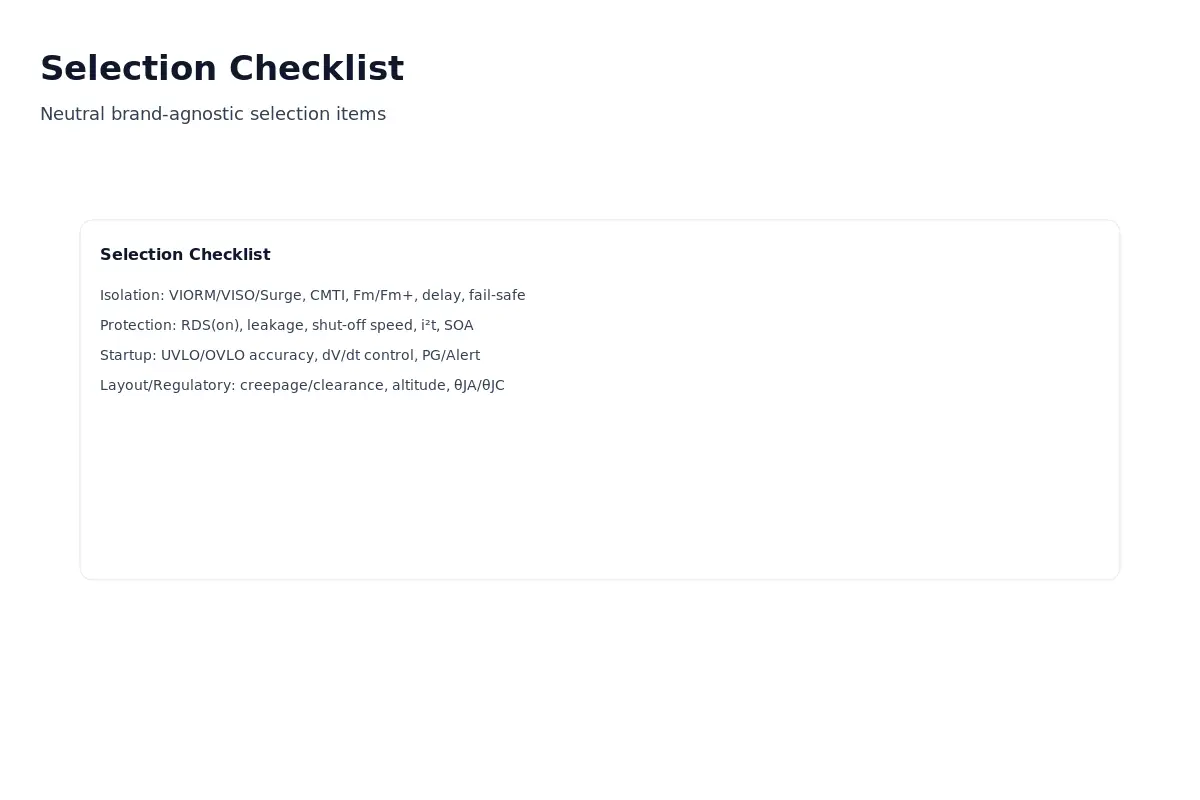
Neutral checklist for datasheet cross-check
Use this to compare candidates for isolation, reverse/backfeed blocking, and controlled startup. Keep scope strictly to this subpage—no cross to siblings.
Isolation (I²C/SMBus/PMBus/GPIO)
- VIORM / VISO, surge class, CMTI
- Bidirectional I²C support, fail-safe behavior
- Channel delay / jitter, Fm+ (1 MHz) capability
- Channels, package, quiescent power
Reverse / Backfeed Blocking
- Reverse shut-off time, off-leak current
- Threshold accuracy, Vdiff control
- External FET RDS(on), i²t vs SOA
Controlled Startup
- UVLO/OVLO range & accuracy, hysteresis
- dV/dt control window
- PG/Alert logic & alignment
Safety / Layout / Reliability
- Creepage/clearance, pollution level, altitude
- Package pitch, θJA/θJC
- Validation: timing/eye, CMTI injection, reverse events, thermography
A) I²C Isolators (bidirectional open-drain)
Prefer parts that maintain I²C semantics across isolation with predictable fail-safe and Fm+ headroom.
Analog Devices ADuM2250 / ADuM2251
I²C-specific isolation; bidirectional SDA/SCL; variants compatible with up to 1 MHz; strong CMTI class options.
Texas Instruments ISO1640 / ISO1641 (incl. Q1)
Enhanced EMC I²C isolators; 1640 supports bidirectional clock; 1641 with defined direction; options for 3–5 kVrms isolation.
Texas Instruments ISO1540 / ISO1541
Proven low-power I²C isolators for SMBus/PMBus with stable timing and clear power-up behavior.
Skyworks (ex-SiLabs) Si8600 / Si8602 / Si8605 / Si8606
I²C-focused isolators with strong CMTI; some AEC-Q100 options; wide supply combinations.
B) Reverse / Backfeed Blocking (ideal-diode & controllers)
Choose parts that cut reverse current quickly, minimize off-leak, and support low total RDS(on) with external MOSFETs.
Analog Devices LTC4357
High-voltage ideal-diode controller for N-MOS ORing and backfeed blocking.
Analog Devices LTC4359
Ideal-diode controller with reverse input protection; robust at light load.
Analog Devices LT8672
Active rectifier targeting reverse protection with rapid response to negative inputs.
Analog Devices LTC4368-1 / LTC4368-2
Bidirectional e-switch controller with UV/OV thresholds and reverse blocking using back-to-back MOSFETs.
Texas Instruments LM5050-1 / LM5050-2
High-side ORing FET controllers (5–75 V) with fast reverse current cutoff.
C) Controlled Startup (UVLO/OVLO + dV/dt + PG)
Focus on programmable UVLO/OVLO accuracy, ramp shaping, and clean PG/Alert alignment.
Analog Devices LTC4365
OV/UV protector with reverse guarding; wide tolerance to input transients; clean enable gating.
Analog Devices LTC4367
Low-IQ surge/OV/UV protection; withstands large input transients while maintaining controlled startup.
Texas Instruments TPS25982
Smart eFuse with programmable dV/dt, UV/OV thresholds, and PG—use as a reference for small telemetry rails.
Maxim Integrated (ADI) MAX17612A/B/C
4.5–60 V protection switch with programmable current limit and UV/OV—good for controlled bring-up on aux rails.
Get the multi-brand equivalence map & validation scripts
Send your short-list and BOM. We’ll return a checklist→scripts→pass-gate bundle, including Fm+ timing windows, CMTI injection steps, reverse shut-off/i²t templates, and PG alignment macros.
Validation & Measurement Plan
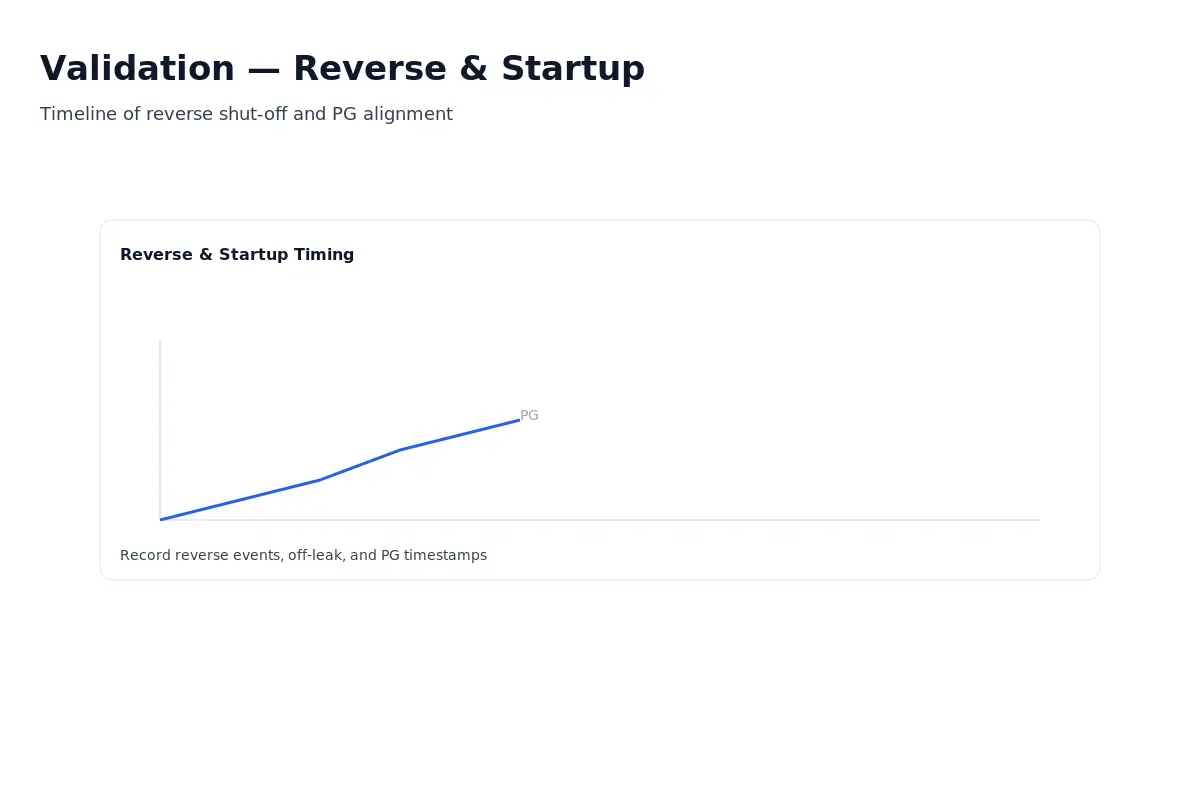
10.1 I²C side
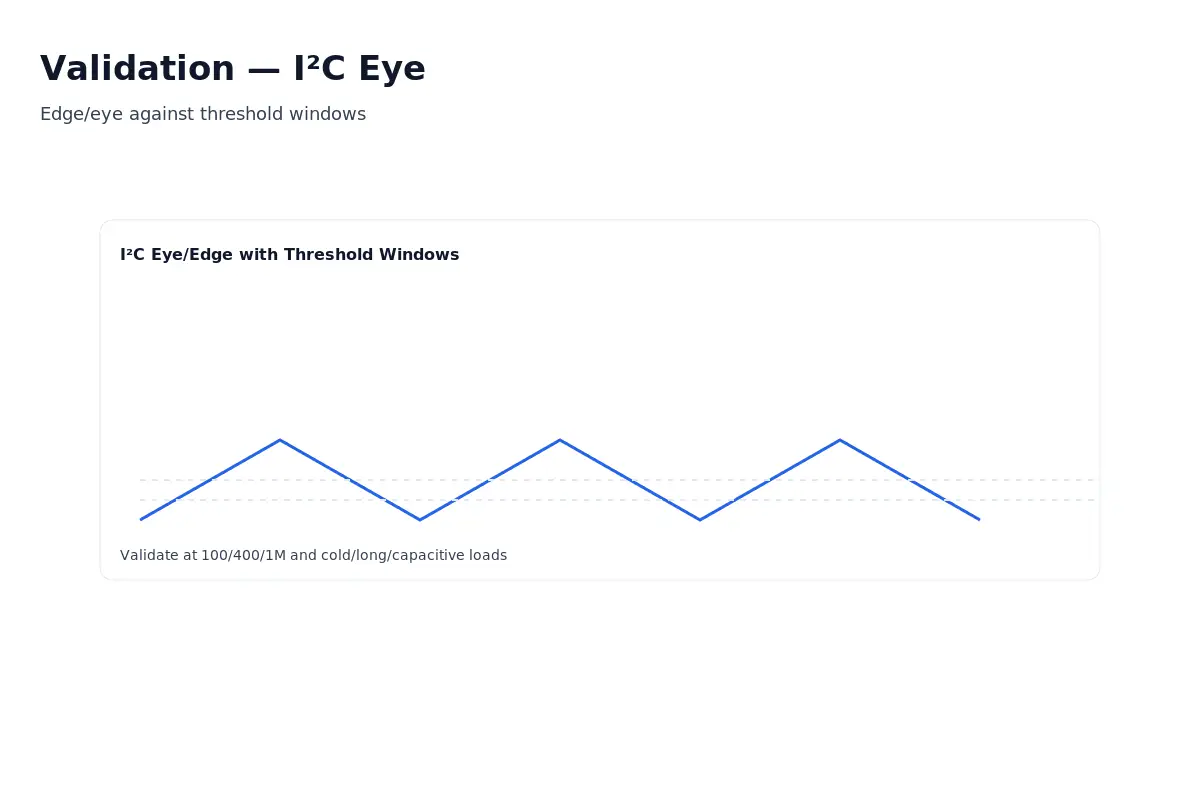
Scope I²C semantics through isolation at 100/400/1 MHz with cold/hot/long-trace/large-C extremes.
Equipment
- ≥500 MHz oscilloscope + logic analyzer
- Programmable pull-up array (2–10 kΩ)
- Thermal chamber (−40 °C / +85 °C)
Steps & Pass
Sweep pull-ups and cable C; log tPLH/tPHL, rise/fall, SCL duty, and stretch transparency. Pass: Fm+ eye/timing margins hold; no stuck-low.
10.2 CMTI injection
Use a fast dv/dt neighbor board (10–20 ns edges) to inject common-mode transients and track false activity.
Fixture & Steps
- Place injector parallel to isolated harness
- Sweep amplitude & edge; record errors
- Repeat at temp corners
Log & Pass
Log: CMTI_kVus, CMTI_error_cnt, Sticky_low_events. Pass: Target CMTI level (≥50–100 kV/µs) without false alerts.
10.3 Reverse / backfeed
Apply negative step to the 12 V telemetry rail; measure shut-off dynamics and leakage under room/hot conditions.
Steps
- Capture Vdiff and channel current
- Measure Reverse_shutoff_us & I_leak_off_uA
- Thermal camera vs Zth model
Pass
Reverse shut-off < 1 µs, off-leak < 5–10 µA, no “ghost” wake-ups; i²t within SOA.
10.4 Controlled startup
Program UVLO_hi/lo and hysteresis (3–5%); scan ramp slope; time-align PG/Alert to the system cadence.
Steps
- Set UVLO thresholds & debounce (≥1–5 ms)
- Program dV/dt; capture PG_delay_ms & Alert_align_ms
- Verify no oscillation near thresholds
Pass
PG/Alert aligned (±1–2 ms) to the chosen cadence; no chatter; no backfeed on power-down.
10.5 Thermal & SOA
Exercise 10 ms → 1 s pulses and correlate junction rise with Zth curves; verify i²t margins.
Steps
- Pulsed load sweep (amplitude × duration)
- Record Tj_C and map to Zth(j-a)
- Check SOA crossings; adjust copper/vents
Pass
Worst-case Tj below limit; no SOA violations; thermal camera consistent with model.
| Field | Description | Notes |
|---|---|---|
| tPLH_ns / tPHL_ns | Propagation delays across isolation | Record per direction and temperature |
| SDA_rise_ns, SCL_duty_pct | Rise time and duty cycle under chosen pull-ups | Note cable C and mode (100/400/1M) |
| CMTI_kVus, CMTI_error_cnt | dv/dt level and false-event counter | Log injector edge ns and amplitude |
| Reverse_shutoff_us, I_leak_off_uA, Vdiff_mV | Reverse blocking dynamics and leakage | Room/hot; connector-side paths audited |
| UVLO_hi_V / UVLO_lo_V / UVLO_hysteresis_pct | Bring-up thresholds and hysteresis | Debounce ≥ 1–5 ms |
| dVdt_Vms, PG_delay_ms, Alert_align_ms | Ramp slope, PG delay and Alert alignment | Align to system cadence (e.g., 1 kHz) |
| Backfeed_event_cnt, Theta_JA_C_per_W, Tj_C | Backfeed statistics and thermal margins | Cross-check with i²t & Zth |
FAQ

Related Articles
- ·Beyond Capacity: Why Bandwidth and Power Efficiency Now Define Memory Value
- ·Understanding Memory Price Cycles: Key Drivers Behind Supply and Demand Shifts
- ·DRAM vs. NAND: How AI Demand Is Reshaping the Memory Industry
- ·HBM Explained: Why High-Bandwidth Memory Is Critical for AI Accelerators
- ·Beyond Capacity: Why Bandwidth and Power Efficiency Now Define Memory Value
- ·Understanding Memory Price Cycles: Key Drivers Behind Supply and Demand Shifts
- ·DRAM vs. NAND: How AI Demand Is Reshaping the Memory Industry
- ·Memory Chip Market Outlook: What Buyers Should Watch Heading into Q4
- ·EMI and EMC in Electronics Design: How to Prevent Problems Before Testing
- ·USB-C Power Delivery Explained: What Engineers Need to Know About EPR






.png?x-oss-process=image/format,webp/resize,h_32)


