PG Aggregators & Voters for Clean, Reliable SYS_PG

November 04 2025
Ersa

AND/OR/majority voting of multi-rail PG/alert lines with deglitch, delay, veto, and strong drive for clean, reliable system-ready signaling.

PG Aggregators & Voters condense many Power-Good/alert (PG/FAULT) lines into one trustworthy “system-ready” or “any-fault” signal for multi-rail power systems, reducing MCU/SoC timing complexity.

By unifying polarity/levels and applying deglitch, delay/hold, and AND/OR/N-of-M majority decisions—then driving with push-pull or open-drain buffers—these helpers harden long, noisy buses and deliver consistent interlocks without crossing into sequencers or ADC monitors.

Quick Browse

Browse sections

Answer Box (Decision Snapshot)

PG aggregator quick picks: AND/OR/Majority with deglitch, delay and driver sliders
Cover card: three micro-circuits (All-Good / Any-Fault / 2-of-3 Majority) + parameter sliders.

Positioning: Consolidate multiple PG/Alert lines into a single trustworthy system-ready or fault signal to simplify MCU/SoC timing and interlocks.

  • Systems with 2–20 PG/Alert lines requiring All-Good (AND) or Any-Fault (OR).
  • Redundant/forgiving designs that need N-of-M majority voting (e.g., 2-of-3, 3-of-5).
  • Cross-board or long-trace wiring where bus edges are slow/noisy → add deglitch, delay, and strong drive.

✅ All-Good (Power-Up Ready)

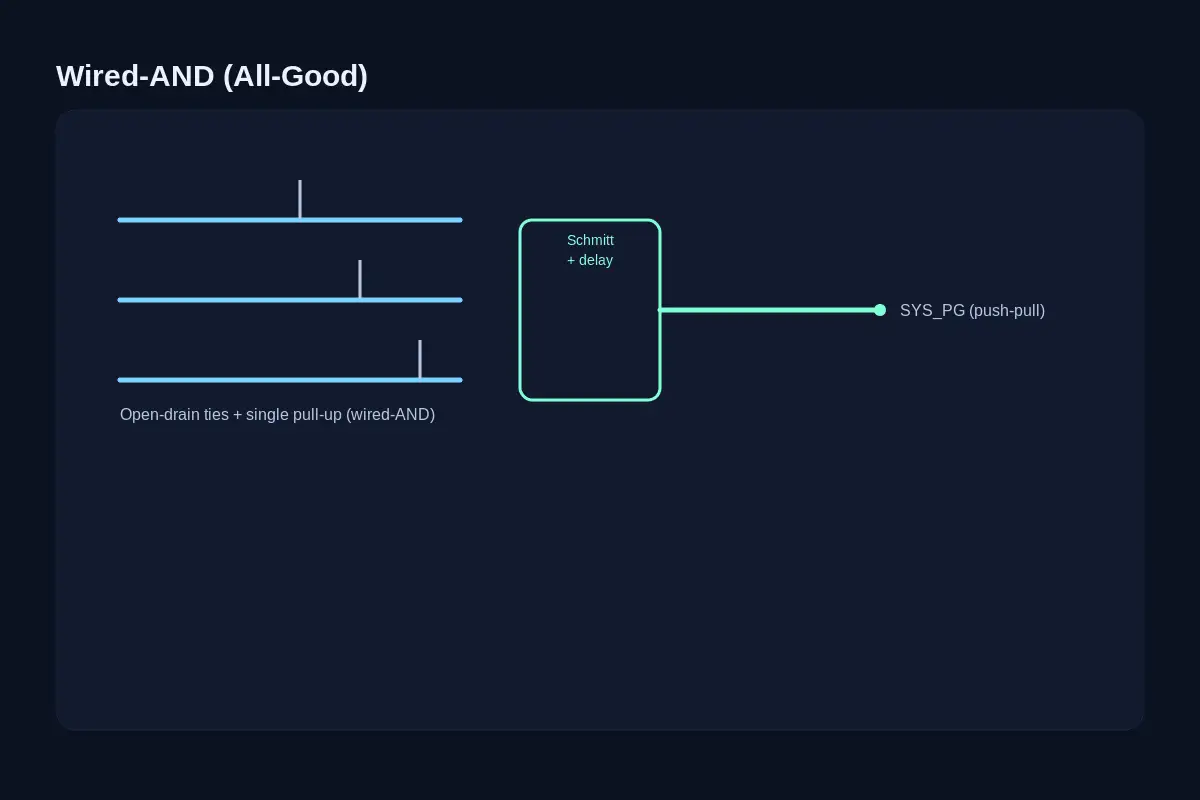
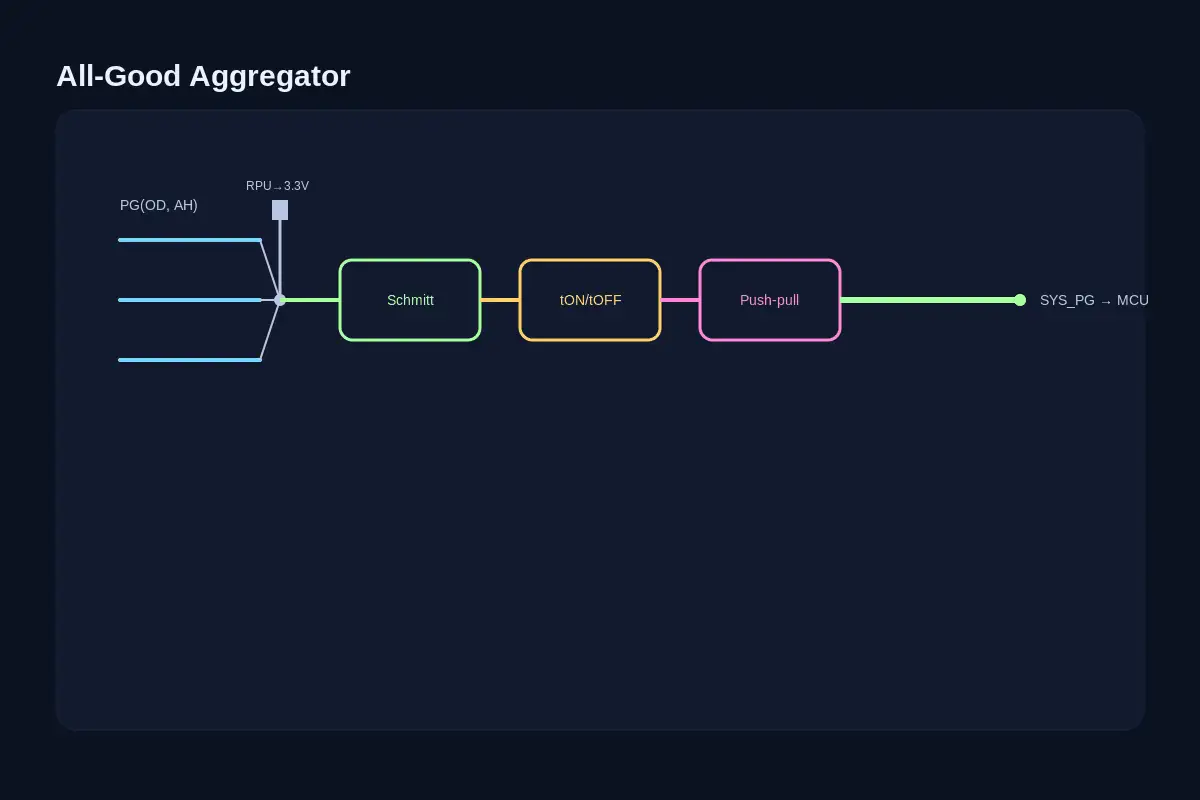
Open-drain PG wired-AND + single pull-up → Schmitt buffer → power-up/down delay → push-pull output.

Wired-AND Schmitt Delay Push-pull

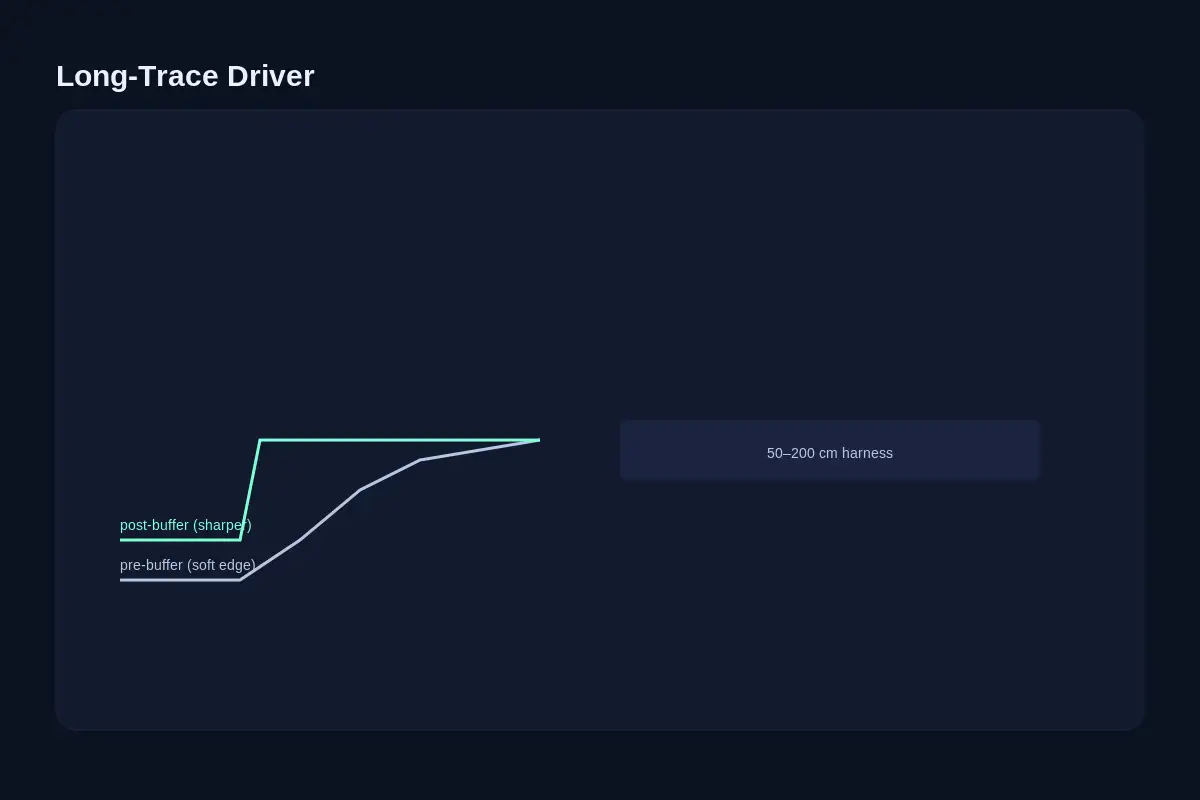
Long traces/heavy bus capacitance → add a post-merge driver or retimer.

✅ Any-Fault (Immediate Alert)

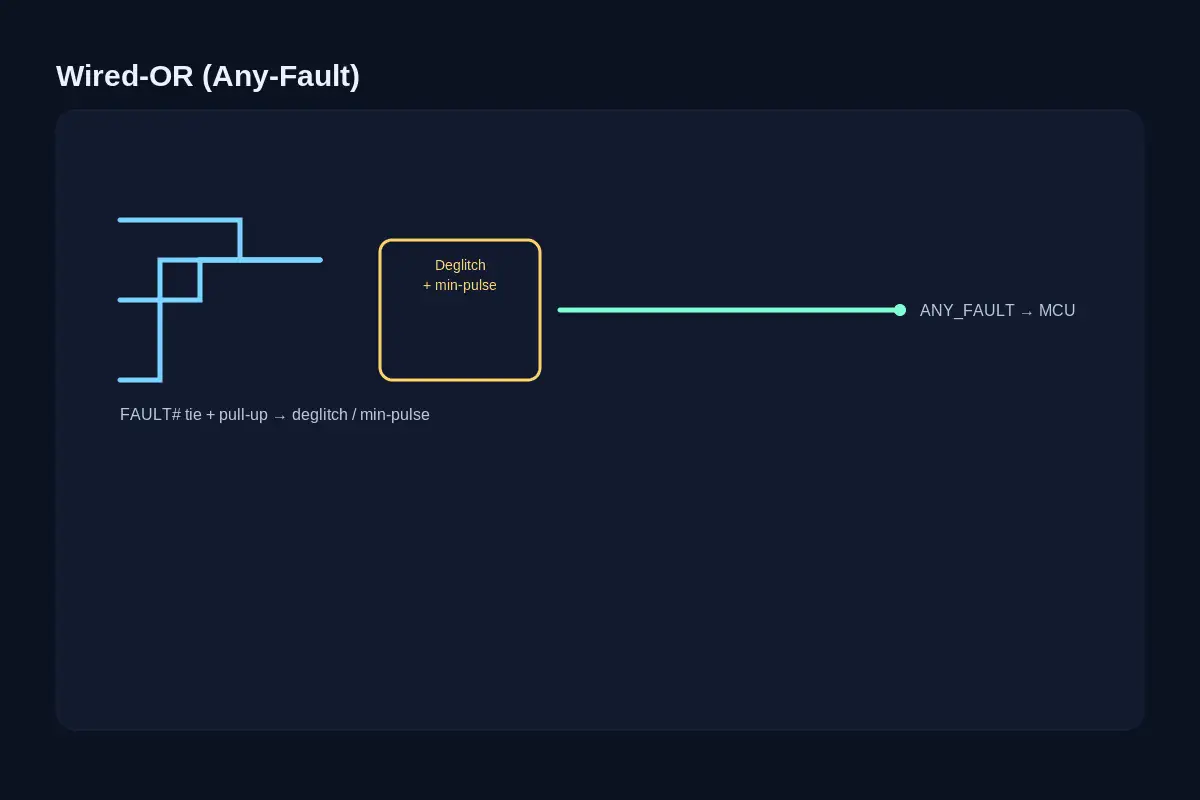
FAULT# wired-OR (tie + pull-up) → deglitch/min-pulse → push-pull or open-drain output.

Wired-OR Deglitch Min-pulse

Stretch short faults so the MCU can reliably capture the interrupt.

✅ N-of-M Majority (2-of-3 / 3-of-5)

Small LVC logic; or star-resistor summing + comparator + VREF (supports weighting/masking).

N-of-M Comparator VREF Mask/Weight

Budget tolerance/thermal drift; keep a VETO path for lethal faults.

What is it (Definition & Scope)

Definition: A PG Aggregator & Voter unifies multiple PG/Power-Good/Alert lines by normalizing polarity and logic levels, applying deglitch and delay, and performing logical voting (AND/OR/N-of-M) to output a single reliable system-ready or fault signal.

Input forms

  • Open-drain/open-collector or push-pull; Active-High PG vs Active-Low FAULT#.
  • Mixed logic domains (1.2/1.8/3.3/5 V): level align and unify polarity before voting.
  • Prefer Schmitt inputs for better noise immunity and stable thresholds.
PG/FAULT input map: polarity (Active-High/Active-Low) vs driver (OD/PP) with mini waveforms and interface

Output forms

  • Push-pull: best for long-trace robustness and fast edges.
  • Open-drain: convenient for wired logic or shared low-true lines.
  • Define known power-up state; respect UVLO/ESD limits within the chosen logic domain.
Output choice: open-drain for wired logic vs push-pull for long-trace robust edges

Boundary (non-overlap with sibling pages)

  • No multi-rail telemetry/ADC sampling (covered elsewhere).
  • No full power-up/down sequencing trees (covered elsewhere).
  • No event logging/thermal/EMI topics (covered elsewhere).

Working Principle

Input Qualifier
Polarity unify; level align (1.2/1.8/3.3/5 V); Schmitt + RC or digital counter deglitch.
Voter Core
AND / OR, N-of-M, optional weighting/masking; VETO high-priority override.
Timing Domain
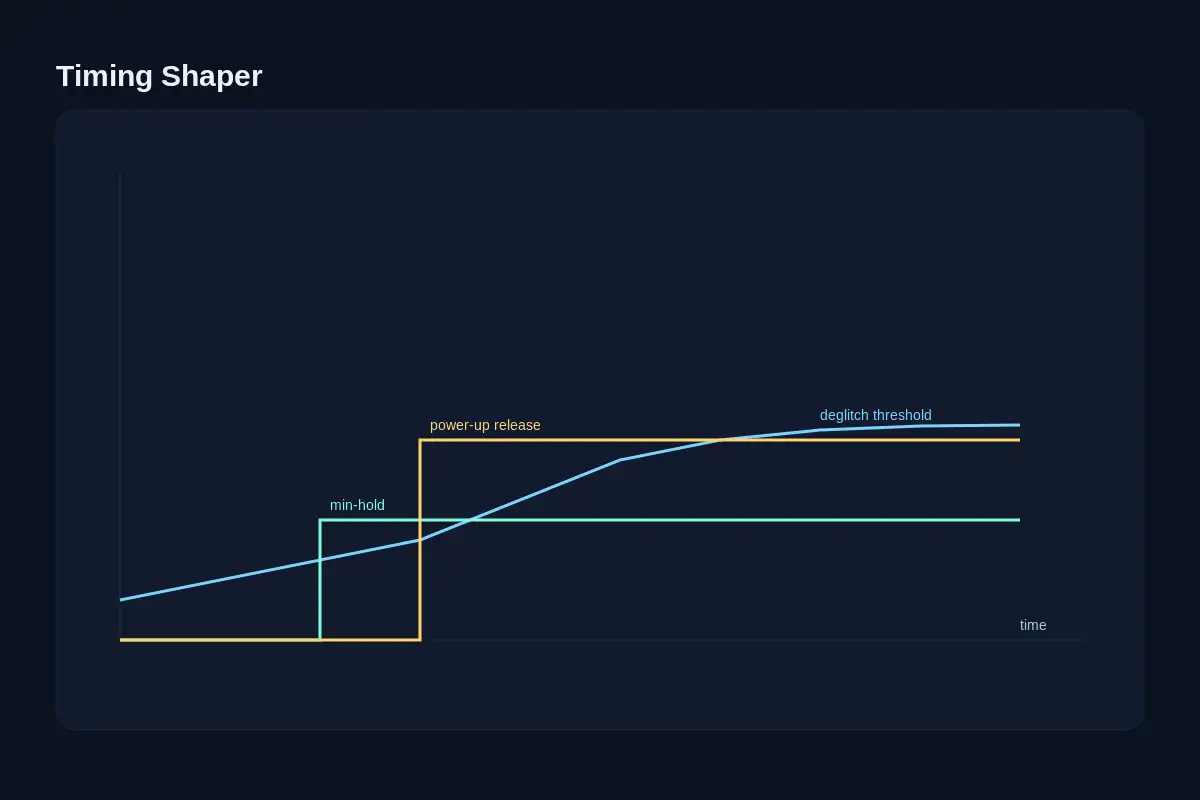
Deglitch window, min-hold, power-up/down delay, pulse stretch.
Output Driver
Push-pull (long trace, fast edges) or open-drain (wired logic); deliver SYS_PG / ANY_FAULT to MCU/SoC.
RC deglitch (rising edge)
V(t) = VDD(1 − e−t/τ)
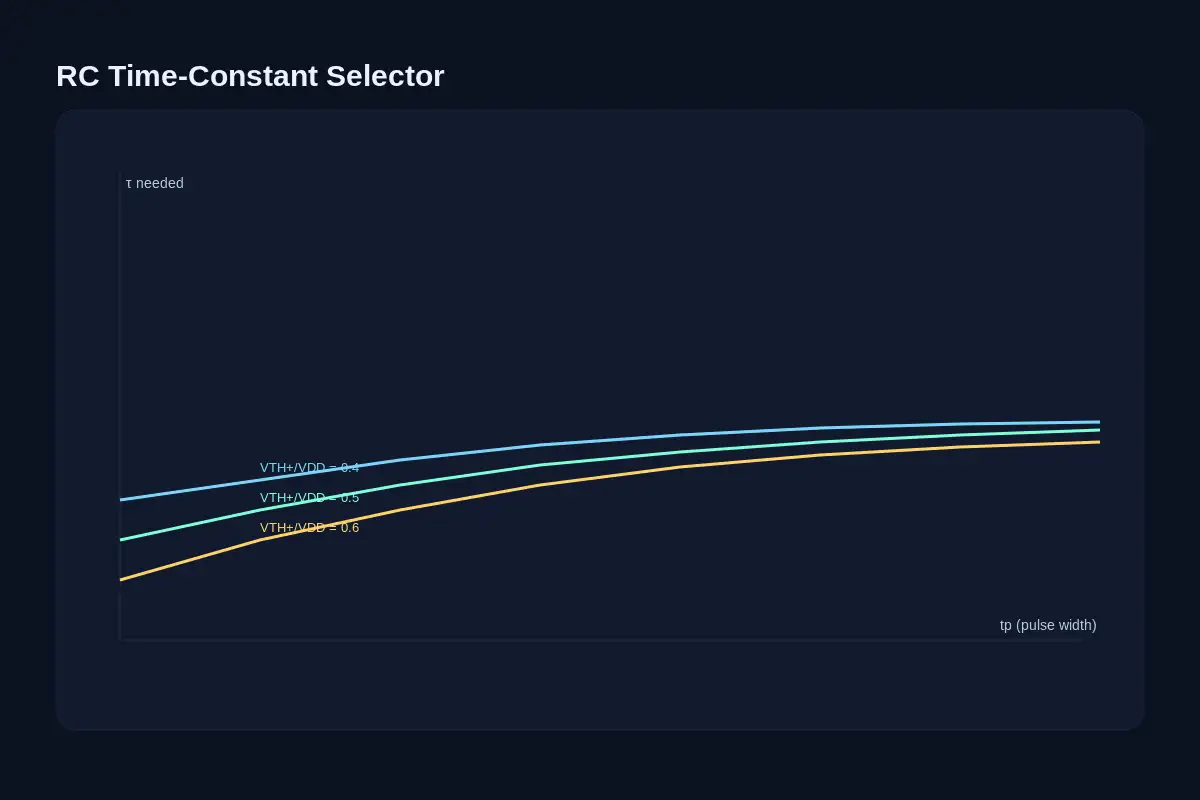
Reject a pulse width tp if: V(tp) < VTH+ ⇒ τ > tp / ln( 1 / (1 − VTH+/VDD) ).
Use Schmitt inputs with RC for robust thresholds and hysteresis.
Wired bus edge (AND/OR)
tr ≈ 2.2 · RPU · CBUS
Long traces and multiple ties increase CBUS → use stronger pull-up or add a buffer/retimer.
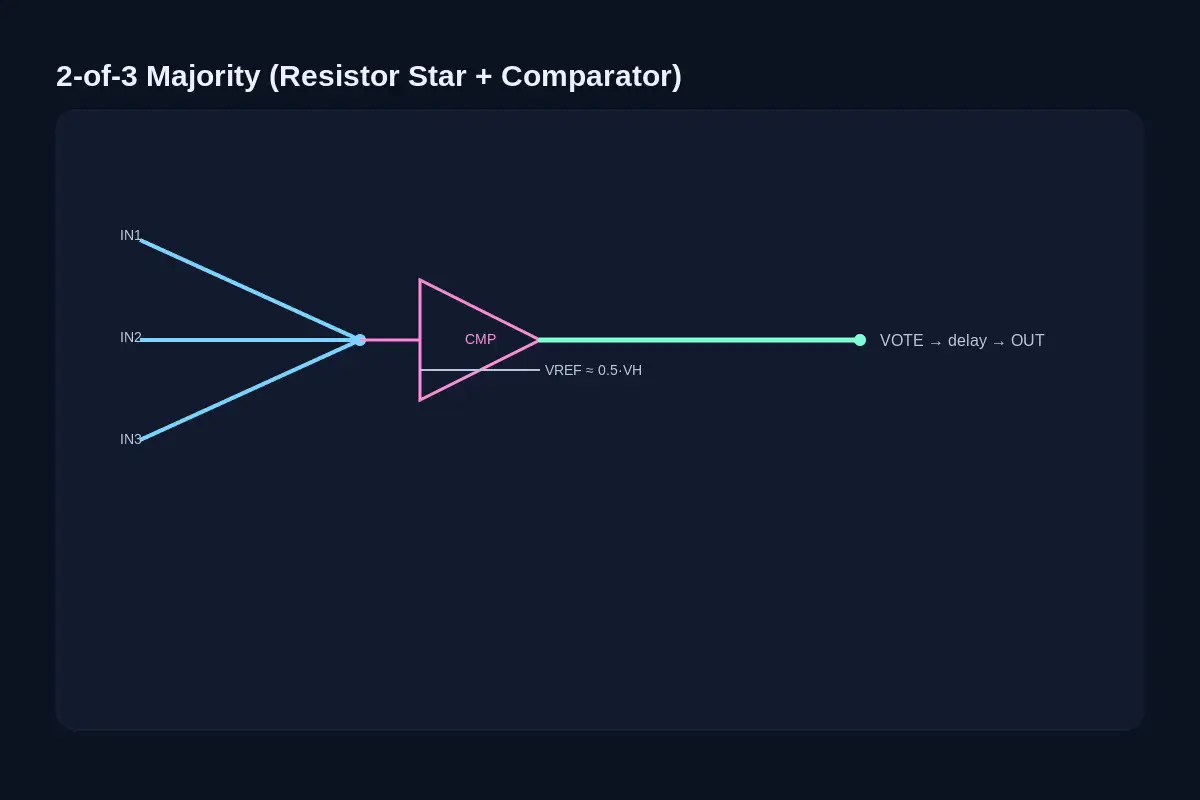
2-of-3 majority (resistor star + comparator)
V+ = (nHIGH/3) · VH, choose VREF = 0.5 · VH → pass only when 2/3 are high.
Noise margin = (1/6) · VH.
Extend to N-of-M via weighting (resistor ratios/current sources) and per-channel masking.
Wired-AND All-Good: multiple open-drain PG, single pull-up, Schmitt buffer, push-pull output
Fig. 3A — Wired-AND (All-Good)
Wired-OR Any-Fault: FAULT# ties with pull-up, deglitch window, MCU capture
Fig. 3B — Wired-OR (Any-Fault)
2-of-3 majority by resistor star and comparator; VREF around half of VH; optional delay
Fig. 3C — 2-of-3 Majority
Timing shaping: deglitch threshold, minimum hold, power-up release overlays
Fig. 3D — Timing Shaper
Long-trace driver: post-merge buffer yields sharper edges over 50–200 cm harness
Fig. 3E — Long-Trace Driver

Technical Breakdown

Input Qualifier

  • Polarity unify: choose “logic-true = good” or the opposite and stick to it.
  • Level align: clamp/translate between 1.2/1.8/3.3/5 V; normalize before voting.
  • Deglitch: RC + Schmitt (simple, robust) or digital counter/monoflop (programmable min-pulse).
Typical: 0.5–5 ms window based on upstream ripple & POR needs.

Voter Core

  • AND/OR: LVC gates (prefer Schmitt variants) or small programmable logic; OD buses can wired-AND/OR.
  • N-of-M: small M (≤4) via gates; scalable via resistor-sum + comparator + adjustable VREF.
  • Mask/weight: per-channel bypass; weighting by resistor ratios or current sources.
  • VETO: lethal faults override majority and force fail-safe low.

Timing Domain

  • Power-up delay: release after all rails finish soft-start (add margin; typ. 1–20 ms).
  • Power-down delay: avoid repeat resets on brief droops (0.5–5 ms).
  • Min-hold: meet reset/POR width; stretch short alerts for MCU sampling.
Test with slow-ramp, short-drop, and ripple playback; watch for “reset storms”.

Output Driver

  • Push-pull for cross-board runs and sharp edges; open-drain for shared wired logic.
  • Edge control: tr ≈ 2.2·RPU·CBUS; larger CBUS → stronger pull-up or buffer/retime.
  • Drive budget: ≥ ±8 mA (long trace: ≥ ±24 mA). Define power-up state; respect UVLO/ESD of the chosen domain.
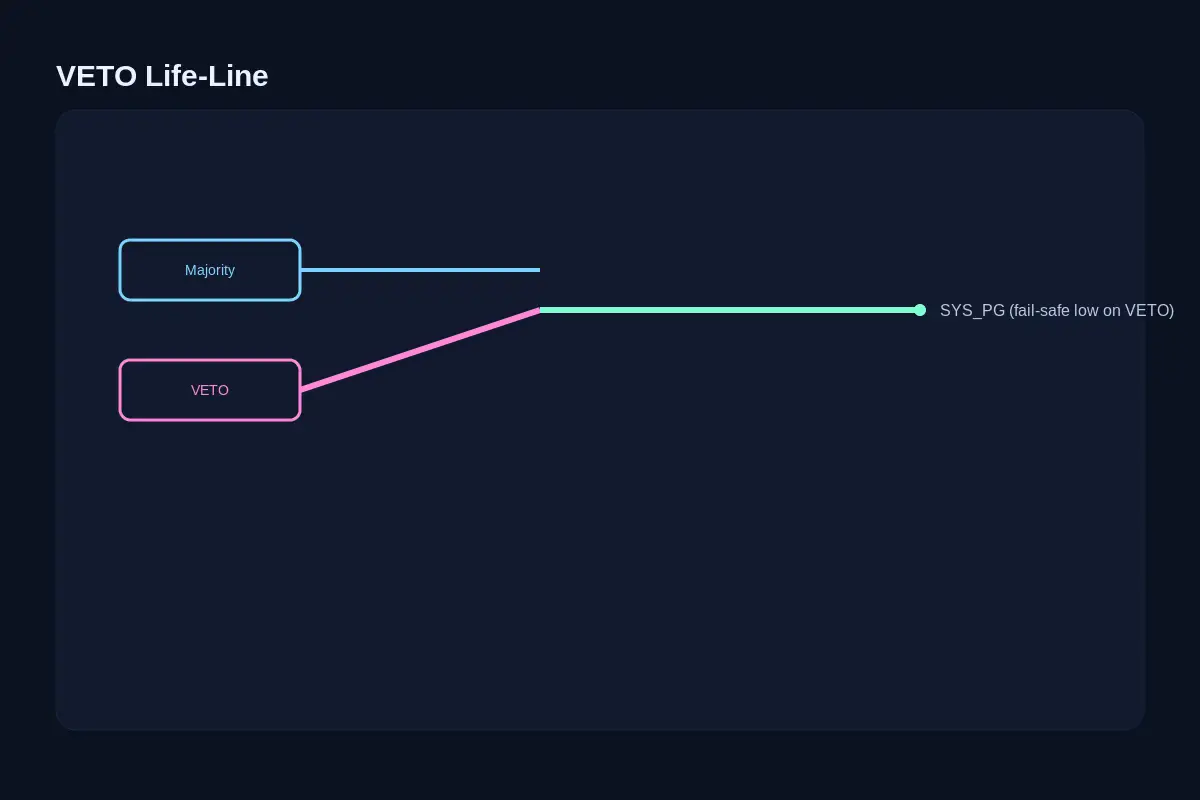
VETO path overrides majority: any lethal alert forces SYS_PG low immediately
Fig. 4 — VETO life-line (override majority)
RC selector: required time constant vs pulse width tp for several VTH/ VDD ratios
Fig. 5 — RC time-constant selector

Key Metrics

Use this template to capture per-design values. Keep units consistent, and record the target logic domain for each input.
Category
Input compatibility
Field
Type / Polarity
Typical / Recommended
OD/PP; unify H/L before voting; record each rail’s logic domain.
Notes
Normalize to “logic-true = good”. Level-shift across 1.2/1.8/3.3/5 V first.
Category
Threshold / Hysteresis
Field
VIL / VIH, ΔVHys
Typical / Recommended
Prefer Schmitt inputs; ΔVHys ≈ 0.1–0.2 · VIO.
Notes
Hysteresis resists ripple and mid-level chatter on slow edges.
Category
Deglitch
Field
tDEGLITCH
Typical / Recommended
0.5–5 ms (tune vs ripple/noise and POR needs).
Notes
Use RC + Schmitt or digital counter; reject narrow spikes reliably.
Category
Delays
Field
tON / tOFF
Typical / Recommended
1–20 ms / 0.5–5 ms (align with POR and upstream soft-start).
Notes
Prevent “reset storms” on brief droops; release only when rails are stable.
Category
Majority voting
Field
N-of-M / Weights
Typical / Recommended
2-of-3, weights = 1 (mask/weight per channel as needed).
Notes
Keep a VETO path for lethal faults to override majority.
Category
Reference threshold
Field
VREF (majority)
Typical / Recommended
Midpoint ≈ 0.5 · VH (keep within (1/3, 2/3) · VH).
Notes
Gives symmetric noise margin for 2-of-3 voting.
Category
Output
Field
Mode / Drive
Typical / Recommended
Push-pull ±8–24 mA (prefer for long traces); OD for wired logic.
Notes
Edge estimate for OD: tr ≈ 2.2 · RPU · CBUS.
Category
Timing quality
Field
Minimum hold
Typical / Recommended
≥ 100 µs (meet POR/reset width; stretch short alerts).
Notes
Prevents edge-case false decisions at the boundary.
Category
Reliability
Field
UVLO / ESD / Temp
Typical / Recommended
Industrial / automotive grades; power-up known state.
Notes
Respect domain UVLO/ESD limits; verify across temperature.
Category
Layout
Field
Pull-up placement
Typical / Recommended
Place near aggregation node; keep the bus short and loop-closed.
Notes
Use a continuous return plane; via pairs across splits; VREF close to comparator.
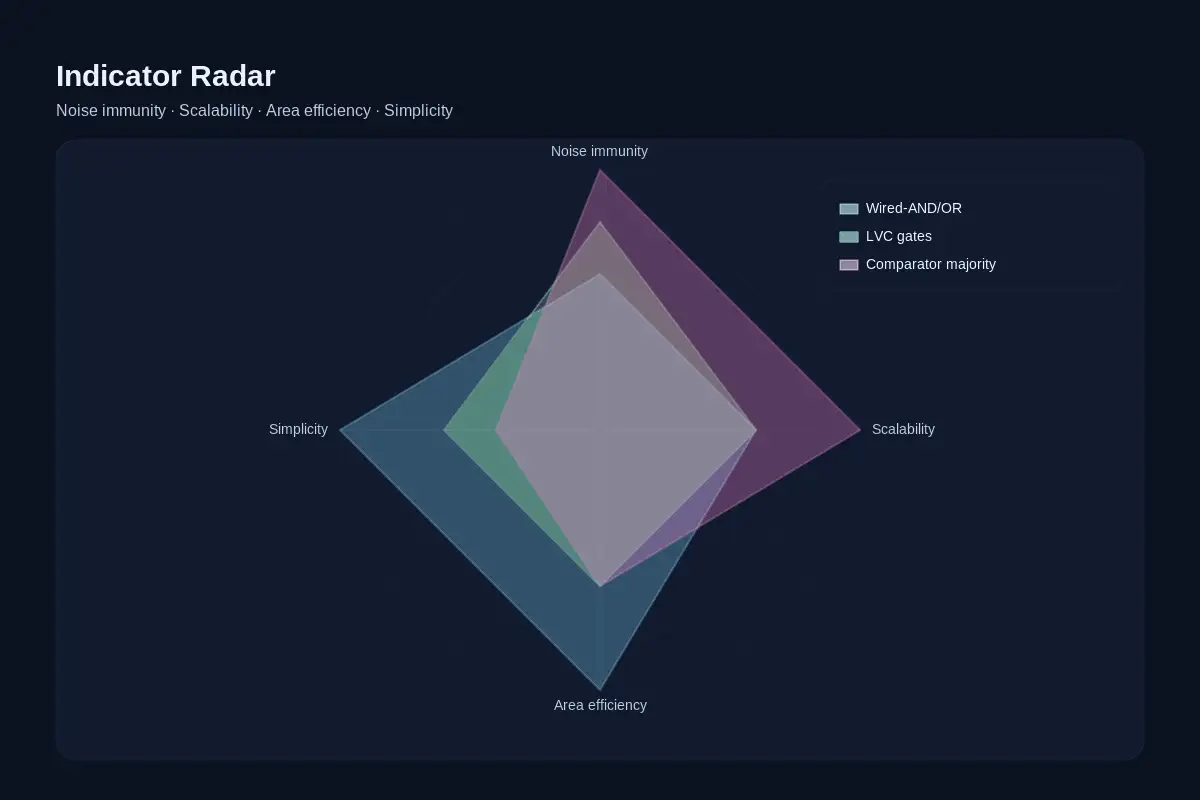
Radar of noise immunity, scalability, area, and complexity across wired-logic, LVC gates, and comparator majority
Fig. 6 — Indicator radar: wired-AND/OR, LVC gates, comparator-based majority.

Design Guidelines

Separate outputs for All-Good and Any-Fault
Why: Clearer logic and isolation between ready and fault paths.
How: Export both SYS_PG and ANY_FAULT; let MCU build the state machine.
Pitfall: Merging into a single wire complicates debug and traceability.
Unify polarity & level before voting
Why: Reduces combinational complexity and corner cases.
How: Normalize to “logic-true = good”. Translate 1.2/1.8/3.3/5 V into the voter’s domain.
Pitfall: Mixing AH/AL or domains on a shared bus.
Prefer Schmitt + RC for deglitch; add digital min-hold if needed
Why: Handles both slow edges/ripple and narrow spikes.
How: Set 0.5–5 ms deglitch; ensure ≥100 µs minimum hold or pulse-stretching.
Pitfall: RC without hysteresis leads to threshold chatter.
Buffer after aggregation for long traces
Why: Wired buses increase CBUS, slowing edges.
How: Use push-pull buffer/retimer; budget ≥ ±24 mA for long harnesses.
Pitfall: Slow edges cause mis-sampling and spurious faults.
2-of-3 majority: comparator + star resistors; set VREF ≈ 0.5·VH
Why: Symmetric noise margin with graceful fault tolerance.
How: Equal resistors to CMP+; mask/weight channels as needed; keep a direct VETO path.
Pitfall: VREF too close to 1/3 or 2/3 reduces margin.
VETO overrides everything
Why: Lethal faults must force fail-safe low immediately.
How: Route VETO in parallel with the voter to the output OR; latch/hold as required.
Pitfall: Treating VETO as just another vote hides critical failures.
Align tON/tOFF with upstream rails & POR
Why: Avoid reset storms and false-ready conditions.
How: tON ≥ upstream soft-start + margin; tOFF filters brief droops.
Pitfall: Ignoring remote load plug-in/out and soft-start variance.
Exercise injection tests per channel
Why: Boundary conditions expose real-world issues.
How: Inject slow-ramp, short-drop, stuck-low, stuck-high; sweep N-of-M combinations.
Pitfall: Testing only all-good/all-bad misses critical edges.
Log timing evidence for production
Why: Ensures consistency and traceability across units.
How: Capture key waveforms for each PG and SYS_PG; store with parameter snapshots.
Pitfall: Relying only on MCU logs without scope evidence.
Layout close-loop: pull-ups & VREF near the node
Why: Minimizes parasitics and crosstalk; improves timing determinism.
How: Keep a continuous return plane; use via pairs across splits; place pull-ups/VREF near the aggregator.
Pitfall: Scattered pull-ups across boards cause uncontrollable timing.

Troubleshooting Matrix

Close the loop for each symptom: Phenomenon → Possible Cause → Observation → Quick Fix.
Phenomenon
SYS_PG chatter
Possible cause
Slow bus edge / spikes: large CBUS, pull-up too weak, crosstalk.
Observation
Shared-node waveform, estimate CBUS, pre/post-buffer edge rate.
Quick fix
Add push-pull buffer/retimer; reduce RPU; widen deglitch window.
Phenomenon
Intermittent reset storm
Possible cause
tOFF too short; missing minimum hold/pulse stretch.
Observation
POR pulse width; relative timing of SYS_PG vs per-rail PG.
Quick fix
Increase tOFF; add pulse stretcher ≥ 100 µs.
Phenomenon
Majority decision error
Possible cause
VREF bias/tolerance, unequal star resistors, comparator input leakage.
Observation
CMP +/− levels; VH accuracy; stability of VREF.
Quick fix
Tune VREF ≈ 0.5·VH; use 0.5% resistors; revise weighting/mask.
Phenomenon
Wired-bus high level too low
Possible cause
RPU too large; leakage; excessive CBUS.
Observation
Bus DC level, rise time, sink/source current.
Quick fix
Reduce RPU (e.g., 10 kΩ → 4.7/2.2 kΩ); buffer at aggregation node.
Phenomenon
Long-run false triggers
Possible cause
Crosstalk, ground bounce, discontinuous return paths.
Observation
Far-end waveform, coupling to neighbors, plane splits.
Quick fix
Twist/shield; close the return loop; use push-pull driver or retime.
Phenomenon
Power-up “false ready”
Possible cause
tON margin too small; rails not settled.
Observation
Phase of rail PG vs SYS_PG; slow-ramp playback.
Quick fix
Increase tON to exceed the slowest soft-start by 1–5 ms.
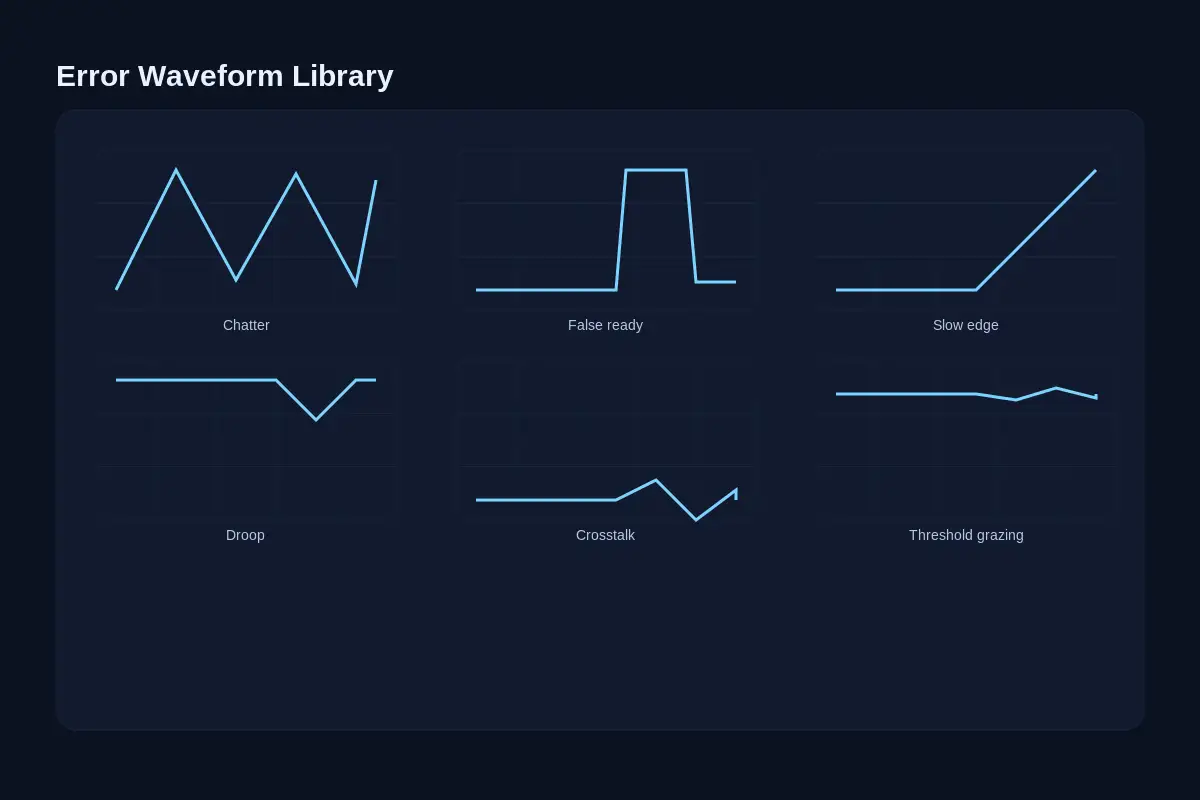
Oscilloscope snippets of six typical PG issues: chatter, false-ready, slow edge, droop, crosstalk, threshold grazing
Fig. 7 — Error waveform library: chatter, false-ready, slow edge, droop, crosstalk, threshold grazing.

Applications & Schematics

A. Single-board All-Good (wired-AND + buffer)

Multiple PG (OD, active-high) → wired-AND with pull-up to 3.3 V → Schmitt buffer → tON/tOFF shaping (RC or monostable) → push-pull driver → MCU SYS_PG.

  • Reference values: RPU=4.7 kΩ; RC = 100 kΩ // 47 nF (≈ 4.7 ms); drive ≥ ±8 mA (long run ≥ ±24 mA).
BOM (example MPNs)
  • Schmitt buffer (non-inverting): SN74LVC1G17DBVR (TI)
  • Open-drain buffer (optional isolation): SN74LVC1G07DBVR (TI)
  • Push-pull gate/buffer: SN74LVC1G125DBVR (TI)
  • Pull-up: RC0603FR-074K7L (Yageo, 4.7 kΩ)
  • RC (deglitch): CRCW0603100KFKEA (Vishay, 100 kΩ) + GRM188R71C473KA01 (Murata, 0.047 µF)
Validation checklist
  • Soft-start aligned: release after all rails are stable + 1–5 ms.
  • Minimum hold ≥ 100 µs.
  • Edge rate within MCU input limits.
All-Good aggregator: OD PG bus with pull-up, Schmitt buffer, delay, push-pull SYS_PG
Fig. 8A — All-Good aggregator schematic.

B. Any-Fault global alarm (wired-OR)

Multiple FAULT# (OD, active-low) → wired-OR with pull-up → deglitch + minimum-pulse shaping → MCU interrupt.

  • Reference values: tDEGLITCH=0.5–5 ms; pulse-stretch to 1–5 ms for MCU capture.
BOM (example MPNs)
  • Dual open-drain combiner: SN74LVC2G07DBVR (TI)
  • Schmitt buffer (deglitch): SN74LVC1G17DBVR (TI) or inverting SN74LVC1G14DBVR
  • CMOS timer (monostable): TLC555CD (TI)
  • Pull-up: RC0603FR-072K2L (Yageo, 2.2 kΩ)
  • RC (deglitch): 100 kΩ + 47 nF (see 8A parts)
Validation checklist
  • Short-fault injection (10–200 µs) → 100% IRQ capture rate.
  • Rise-time matches estimate tr ≈ 2.2 · RPU · CBUS.
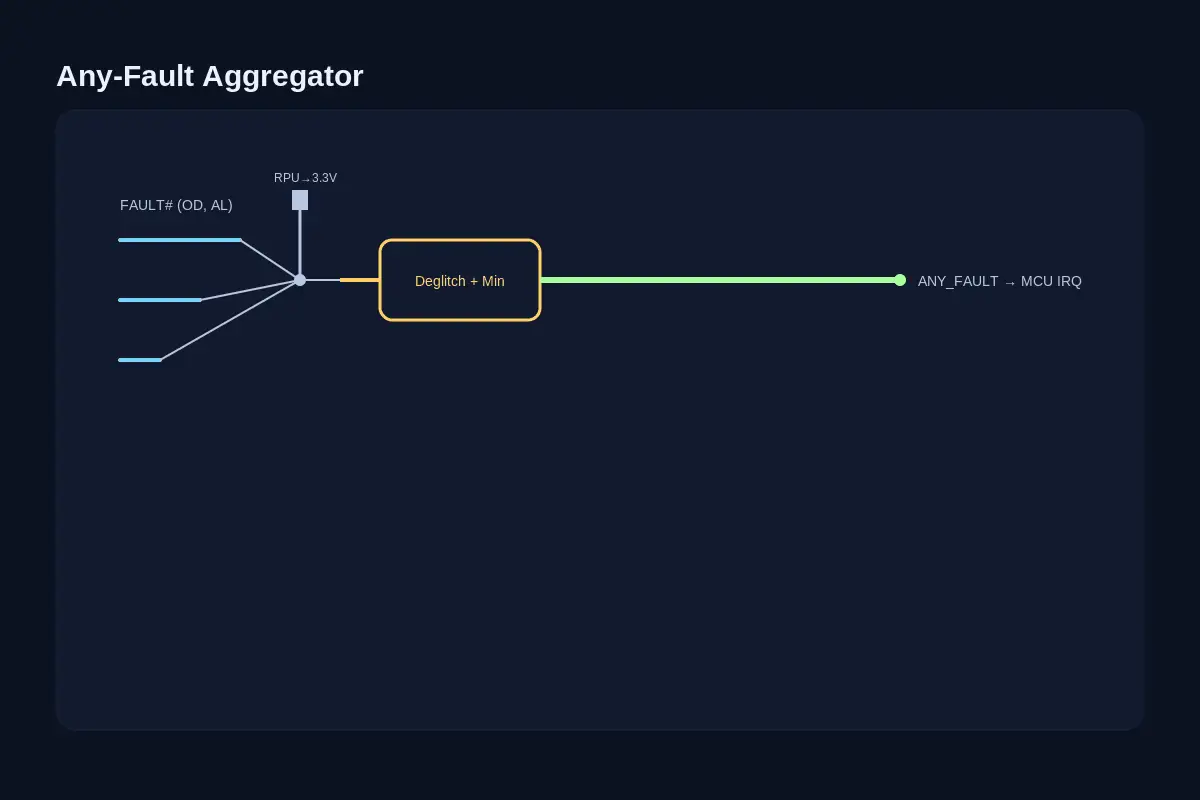
Any-Fault aggregator: FAULT# wired-OR with pull-up, deglitch and min-pulse to MCU interrupt
Fig. 8B — Any-Fault aggregator schematic.

C. 2-of-3 redundant-supply majority voter

Three PG (active-high) → 3× equal resistors (star) → comparator +; at VREF ≈ 0.5·VH → delay → push-pull output.

  • Reference values: Star R = 100 kΩ ×3; VREF by 2×100 kΩ divider; tON=5–10 ms.
BOM (example MPNs)
  • Comparator (open-drain): LMV331IDBVR or TLV7041IDBVR (TI)
  • Comparator (push-pull alt.): TLV3201AIDBVR (TI)
  • Precision reference (optional): TLV431AIDBZR (TI)
  • Precision resistors: ERA-3AEB1003V (Panasonic, 100 kΩ, 0.1%) ×5
  • Delay RC: CRCW0603100KFKEA (100 kΩ) + GRM188R71C103KA01 (0.01 µF)
  • Output buffer (long run): SN74LVC1G17DBVR / SN74LVC1G125DBVR (TI)
Validation checklist
  • Exhaustive 8-state sweep: output passes only when ≥2 inputs are high.
  • Temperature sweep (−40…+85 °C): threshold drift within margin.
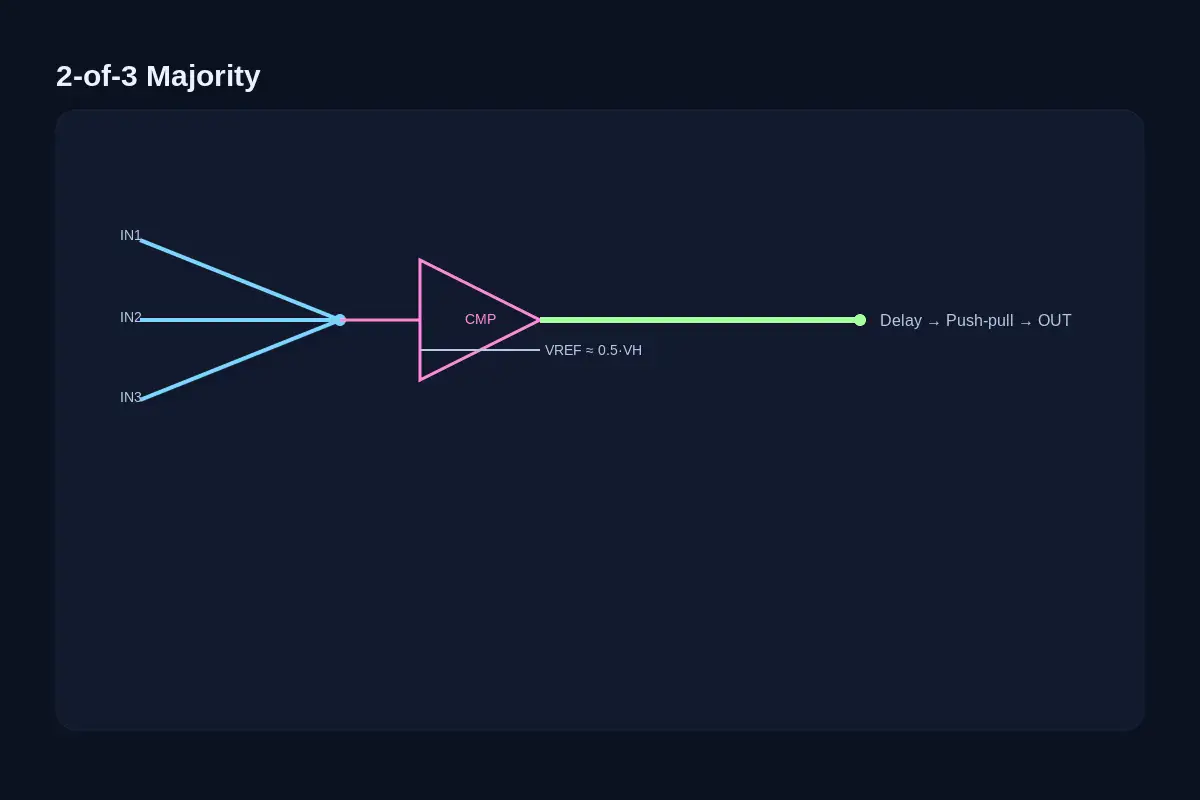
2-of-3 majority: three equal resistors to comparator plus, VREF at half VH, delayed push-pull output
Fig. 8C — 2-of-3 majority voter schematic.

Reference Implementations

Glue-class parts only (no sequencers, ADC monitors, or black-box recorders). Focus: polarity/level unification → voting → timing → drive.

Configurable single-gate logic (with Schmitt) — 1G97/1G98 class

1.65–5.5 V universal building blocks to realize AND/OR/NAND/NOR/INV by pin configuration. Schmitt inputs improve slow-edge immunity.

  • Use cases: compact All-Good/Any-Fault logic; small N-of-M (≤4) via multiple gates.
  • Example MPNs: SN74LVC1G97, SN74LVC1G98 (TI); 74AUP1G97 (Nexperia).
  • Tips: normalize polarity first; keep ΔVHys on inputs.

Push-pull buffers / inverters — LVC/HCS single-gates

Strong drive (±8–24 mA) for aggregation-point re-timing and long harnesses; Schmitt options for robust edges.

  • Example MPNs: SN74LVC1G17 (non-inverting Schmitt), SN74LVC1G14 (inverting Schmitt), SN74LVC1G125 (3-state).
  • When to use: wired buses with large CBUS, cross-board signaling, noisy environments.

General-purpose comparators (for majority voters)

Star-resistor summing + comparator implements 2-of-3 / 3-of-5. Pick OD or push-pull outputs to match downstream drive.

  • Example MPNs: LMV331 / TLV7041 (OD, low power), TLV3201 (push-pull).
  • Reference options: TLV431 (programmable reference), or 0.1% divider for VREF.

Passives — pull-ups, star resistors, RC deglitch

  • Pull-up R: 2.2–10 kΩ (size via tr ≈ 2.2·RPU·CBUS).
  • Star resistors: 10–100 kΩ, 0.1–1% (match & thermal budget).
  • RC deglitch: 10–100 nF with 47–200 kΩ → 0.5–5 ms window.
  • Example MPNs: ERA-3A/ERA-6A (Panasonic 0.1%), CRCW0603 (Vishay 1%), GRM188 (Murata).

Three reference builds (minimal BOM)

R-1
All-Good (wired-AND + Schmitt + delay + push-pull)

PG(OD, AH) bus → pull-up 3.3 V → Schmitt buffer → tON/tOFF → push-pull → MCU SYS_PG.

Reference values
  • RPU=4.7 kΩ; RC=100 kΩ // 47 nF (≈4.7 ms).
  • Drive ≥ ±8 mA (long run ≥ ±24 mA).
Example BOM
  • SN74LVC1G17, SN74LVC1G125; optional SN74LVC1G07 (OD).
  • RC0603FR-074K7L; CRCW0603100KFKEA; GRM188R71C473KA01.
Validation
  • Release after all rails stable + 1–5 ms.
  • Min hold ≥ 100 µs; edges meet MCU spec.
R-2
Any-Fault (wired-OR + deglitch + minimum-pulse)

FAULT#(OD, AL) bus → pull-up → deglitch + pulse-stretch → MCU IRQ.

Reference values
  • tDEGLITCH=0.5–5 ms; stretch to 1–5 ms if MCU needs.
Example BOM
  • SN74LVC2G07; SN74LVC1G17 or SN74LVC1G14.
  • TLC555 (monostable); RC0603FR-072K2L; RC/C as above.
Validation
  • 10–200 µs faults → 100% capture.
  • Rise-time fits tr ≈ 2.2·RPU·CBUS.
R-3
2-of-3 majority (star resistors + comparator + delay)

Three PG (AH) → 3× equal R (star) → CMP+; CMP− at VREF≈0.5·VH → delay → push-pull.

Reference values
  • Star R = 100 kΩ ×3; VREF via 2×100 kΩ divider; tON=5–10 ms.
Example BOM
  • LMV331 / TLV7041 (OD) or TLV3201 (PP).
  • ERA-3AEB1003V (0.1% 100 kΩ) ×5; TLV431 (optional).
  • CRCW0603100KFKEA + GRM188R71C103KA01 for delay.
Validation
  • Exhaustive 8-state sweep: pass only when ≥2 are high.
  • −40…+85 °C: margin ≥ 10%·VH.

FAQ

Wired PG level is too low after OR/AND. What can I do?
Lower the pull-up value, buffer after aggregation, and check leakage/parallel loads. Verify rise time vs MCU spec using tr ≈ 2.2·RPU·CBUS.
How do I support variable N in an N-of-M majority voter?
Use resistor-summing plus an adjustable reference (DAC/digipot), or switch weighted resistors to realize multiple thresholds (e.g., 1/2/3). Always keep a hard VETO path.
Will a PG line directly driving a downstream EN chatter?
Yes. Add deglitch (0.5–5 ms) and minimum hold (≥100 µs), and align tON/tOFF to upstream soft-start to avoid false enables.
Which one has priority: majority decision or VETO?
VETO overrides the voter to guarantee fail-safe behavior. Consider latching VETO until a supervised clear to avoid oscillation.
Push-pull or open-drain at the output?
Use push-pull for long traces/remote boards (strong edges, lower susceptibility). Keep open-drain only when sharing a wired bus or mixing domains; then re-buffer locally.
How do I choose the pull-up resistor for a wired bus?
Estimate CBUS, target an edge time meeting sink/source and input limits, and solve RPUtr/(2.2·CBUS). Watch static power when RPU is small.
What deglitch window should I start with?
Begin with 0.5–5 ms based on measured ripple/SSC and POR needs. Validate with slow-ramp and burst-noise injections; don’t over-filter genuine faults.
How should I pick VREF and tolerances for a 2-of-3 voter?
Set VREF ≈ 0.5·VH and keep it within (1/3, 2/3)·VH. Use 0.1–0.5% matched resistors and budget temp-drift/offset so margin ≥ 10%·VH.
How do I unify mixed polarities and logic domains safely?
Normalize polarity first (AH/AL) and level-shift early (1.2/1.8/3.3/5 V) via Schmitt gates or comparators. Respect UVLO/ESD limits and ensure a known power-up state.
How do I prevent long-run false triggers over a harness?
Close the return path (no split planes), twist/shield pairs, and re-time with a push-pull buffer at the aggregation node. Verify with neighbor-step injections.
Why do I see “reset storms” on brief droops and how to stop them?
tOFF is too short or there is no minimum hold. Add a pulse stretcher (≥100 µs) and extend tOFF so brief dips don’t retrigger POR.
Where should pull-ups and VREF networks be placed on the PCB?
Near the aggregation/comparator node with a continuous return plane. Use via pairs across plane splits; decouple the reference locally to minimize injected noise.
Ersa

Anastasia is a dedicated writer who finds immense joy in crafting technical articles that aim to disseminate knowledge about integrated circuits (ICs). Her passion lies in unraveling intricate concepts and presenting them in a simplified manner, making them easily understandable for a diverse range of readers.