
 German
 Japanese
 Portuguese
 Korea
Korea
 Mexico
 Dutch
Dutch


Power Health Loggers and Black-Box Recorders

Quick Browse
Answer Box (Conclusion & Buying Decisions)
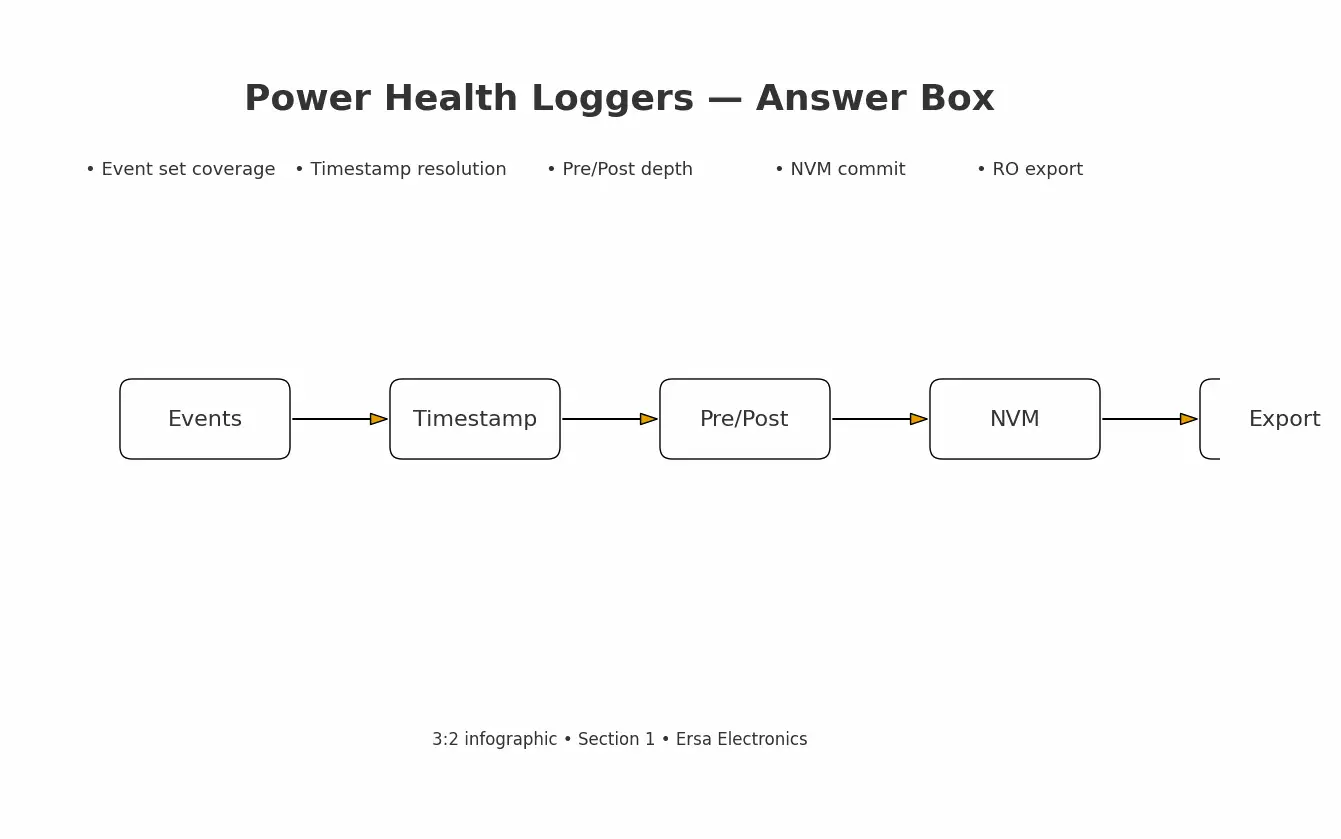
A power health logger converts OV/UV/OC/OT rail faults into structured, time-stamped evidence with pre/post windows, and safely commits records to NVM during brownouts. Logs are exported in read-only mode to preserve the chain of custody—enabling trustworthy post-mortem analysis, faster FA/QA loops, and parameter convergence across builds.
- Needs post-loss evidence
- Fast “fault → proof” loop
- Power Monitor / ADC
- Sequencer (power timing)
- PG Aggregator (voting)
What is it (Definition & Boundaries)
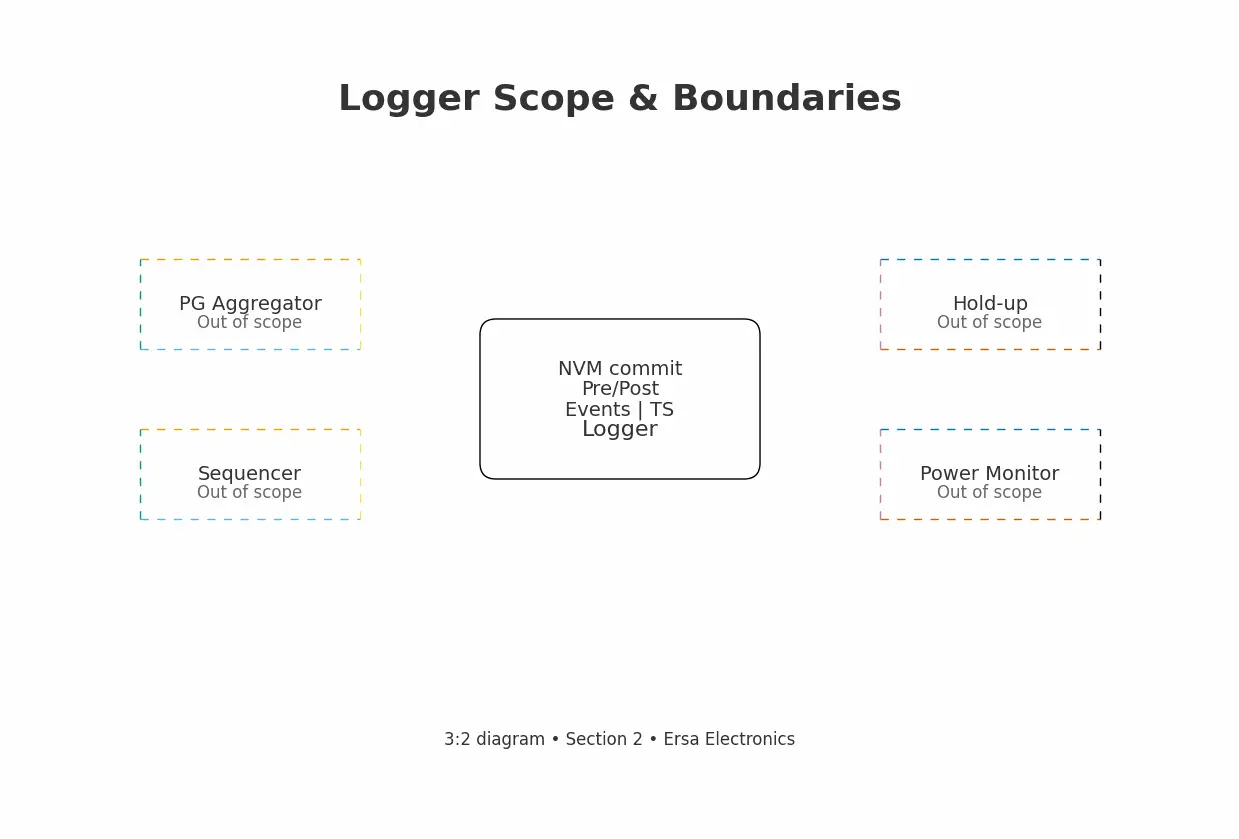
A power health logger is a focused module that detects rail exceptions, time-stamps them, preserves pre/post context, and commits records to non-volatile memory during brownouts. Data exports in read-only mode to maintain evidentiary integrity. Its scope excludes power sequencing, continuous power monitoring, and PG aggregation.
EEPROM vs FRAM—trade endurance, commit energy, and latency.
Local ticks with a health flag and a recent calibration offset.
Threshold/window comparators with minimum-pulse glitch rejection.
Fixed header (Type/TS/Flags/CRC) + TLV extensions for peaks/duration/tags.
Working Principle (Architecture & Data Path)
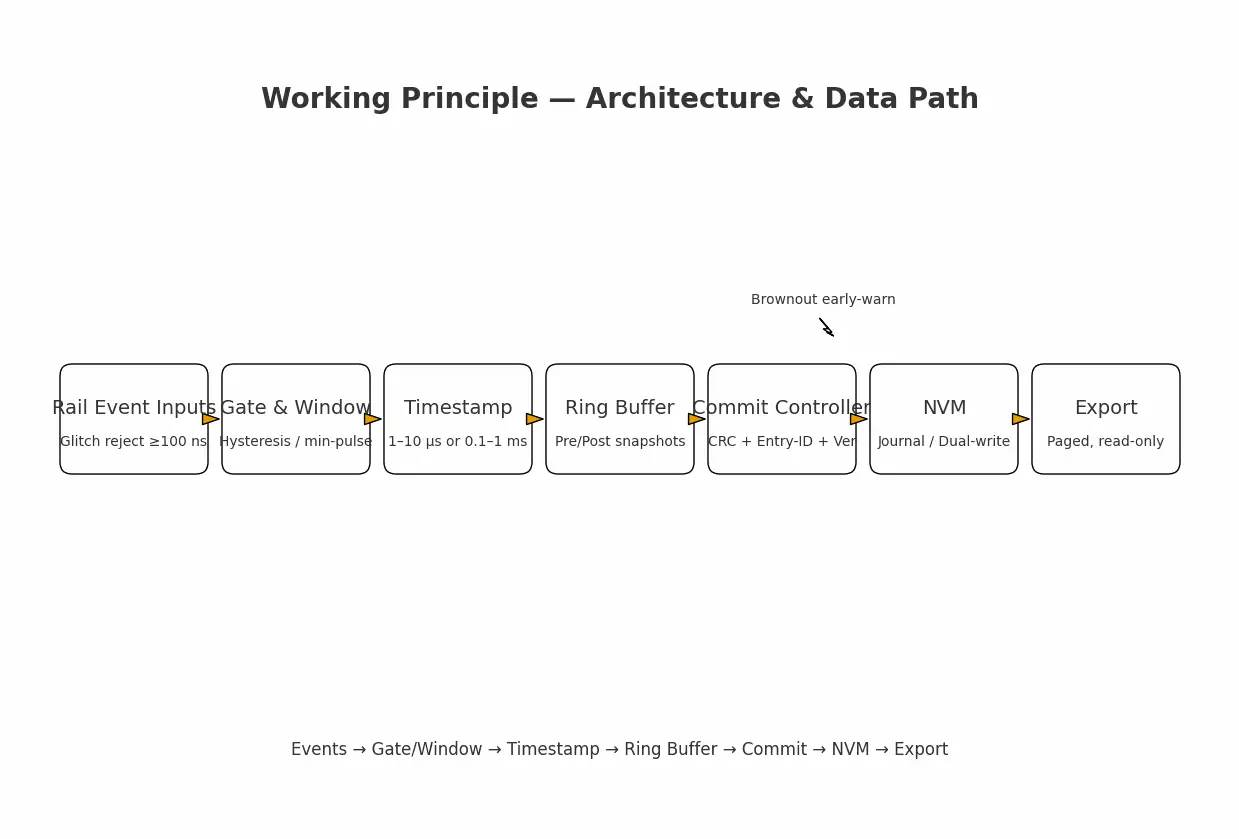
The logger converts rail exceptions into a durable, replayable narrative: event sensing → gating/windowing → timestamping (timebase) → pre/post ring buffer → brownout-aware commit → resilient NVM (journal/dual-write/CRC) → paged, read-only export. Every block is scoped to logging only, preserving chain-of-custody.
Programmable thresholds, hysteresis, minimum-pulse reject; tri-phase tags (Start / Peak / End) for causal replay.
Tip: reject narrow EMI glitches; keep thresholds outside ripple envelopes.
Local RC or crystal; record Timebase-Health and Last-Calibration-Offset for drift transparency.
Resolution matches fault physics: 1–10 µs (fast) or 0.1–1 ms (slow).
Circular snapshots preserve prelude before faults and recovery/secondary behavior after.
Keep narrative context with fixed-budget sampling; compress repetitive OK states.
Brownout early-warning, smallest write unit, priority commit; CRC + Entry-ID + Config-Version with commit ticket.
Write what matters first; prove it with a ticket; rollback on partial tails.
Journal pages or dual-write; monotonic Entry-ID; rollback if tail mark is broken.
Never trust half-written data; validate with CRC/Fletcher.
Paging, rate-limiting, read-only export; compliant clear/erase policy with audited admin events.
Get logs out fast without breaking chain-of-custody.
Technical Breakdown (Mechanisms & Field Definitions)
The following mechanisms define how evidence is generated, made consistent, and exported without overstepping into sequencing or continuous power monitoring. Each block lists key Fields, Acceptance criteria, and typical Pitfalls.
Crossing, Duration (≥X), Peak, Rate-of-Change (dv/dt).
- Fields: Type, Threshold-ID, Min-Pulse, Start/Peak/End TS, PeakValue, Duration
- Acceptance: Precedence reconstructable in post-mortem
- Pitfalls: Treating ripple as faults; missing dv/dt spikes
Minimum pulse, pulse count, jitter window; EMI false-positive control.
- Fields: MinPulse, DebounceMode, Accepted/Rejected counters
- Acceptance: Rejected-glitch rate matches scope validation
- Pitfalls: MinPulse too long → real UV lost
Choose 1–10 µs for fast faults, 0.1–1 ms for slow; record timebase health & last calibration offset.
- Fields: TSResolution, TimebaseHealth, CalOffset, SyncMarker
- Acceptance: Drift within budget; analyzer can correct
- Pitfalls: Unstated resolution/offset breaks comparability
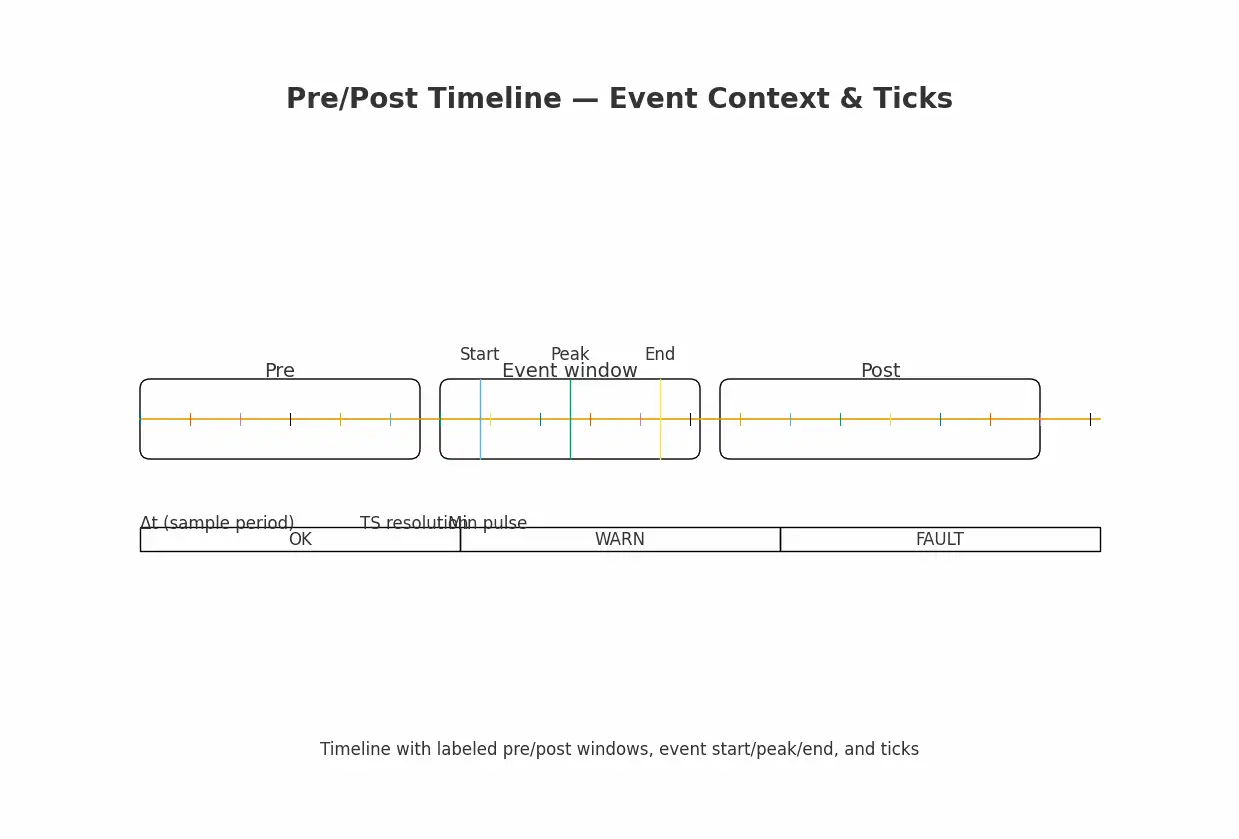
Depth from T_pre / Δt and T_post / Δt; compress repeated OK states.
- Fields: PreDepth, PostDepth, SamplePeriod (Δt), OKCompression
- Acceptance: Prelude + recovery captured without buffer exhaustion
- Pitfalls: Sampling too slow; prelude missing
Journal/dual-write/CRC; monotonic Entry-ID; Commit-Ticket; rollback on broken tail mark.
- Fields: EntryID, CRC, CommitTicket, PageTailMark
- Acceptance: No “ghost entries” after abrupt loss
- Pitfalls: Large write unit; commit energy underestimated
Two-step + time window; log the admin clear event; allow partial-range erasure.
- Fields: ClearArmed, ClearWindowTS, AdminEvent
- Acceptance: Evidence chain preserved; intended ranges only
- Pitfalls: Auto-purge on boot
Shared timebase + ChannelID; offline alignment only; no sequencing actions implied.
- Fields: ChannelID, per-channel delay constants (doc), SyncMarker
- Acceptance: Analyzer infers precedence across rails
- Pitfalls: Hidden comparator skew; missing IDs
Key Metrics (What to measure & how to size)
A logger’s value is set by detectability (events, thresholds, min-pulse), temporal fidelity (TS resolution, pre/post depth), and durability/integrity (commit latency, NVM endurance, CRC/dual/journal), within the bounds of export bandwidth and power budget.
| Event Types | Threshold Step | Min-Pulse | TS Resolution | Pre Depth | Post Depth | Commit Latency | NVM Endurance | Data Integrity (CRC/dual/journal) | Export Bandwidth | Supply & Iq | Op-Temp |
|---|---|---|---|---|---|---|---|---|---|---|---|
| OV/UV/OC/OT (+dv/dt) | 2–20 mV / 0.5–2% | 100 ns – 1 ms | 1–10 µs / 0.1–1 ms | 8–128 samp | 8–256 samp | ≤ 1–10 ms | EEPROM 1e5–1e6 / FRAM 1e10+ | CRC + journal/dual | 10–500 kB/s | Active 2–8 mA; Standby < 0.5 mA | –40…85/105/125 °C |
| OV/UV/OC/OT | 5–10 mV / 1% | 200 ns – 500 µs | 2–5 µs / 0.2–0.5 ms | 16–64 samp | 16–128 samp | ≤ 5 ms | EEPROM 1e6 / FRAM 1e12 | CRC + dual | 50–200 kB/s | Active 3–6 mA; Standby < 0.3 mA | –40…105 °C |
| OV/UV/OC/OT (+peak) | ≤ 5 mV / 0.5% | ≥ 100 ns | ≤ 2 µs / ≤ 0.2 ms | ≥ 64 samp | ≥ 128 samp | ≤ 2 ms | FRAM 1e12+ | CRC + journal + tail mark | ≥ 200 kB/s | Active 2–4 mA; Standby < 0.2 mA | –40…125 °C |
- Pre depth:
Pre ≥ ceil(T_pre / Tsample) - Post depth:
Post ≥ ceil(T_post / Tsample) - Commit energy:
E_commit ≥ N_pages × E_write_per_page - Export time:
T_export ≈ Size / Throughput
- TS_res ≤ (shortest real event)/10
- Min-Pulse ≤ (shortest fault)/2
- Commit latency < brownout margin; E_commit within headroom
- NVM endurance ≥ lifetime writes × safety factor
- Export completes within service window
- No CRC, no ship
- Never erase without audit
- Journal or dual-write only
- Timebase health flag required
- Clear = two-step + timed window

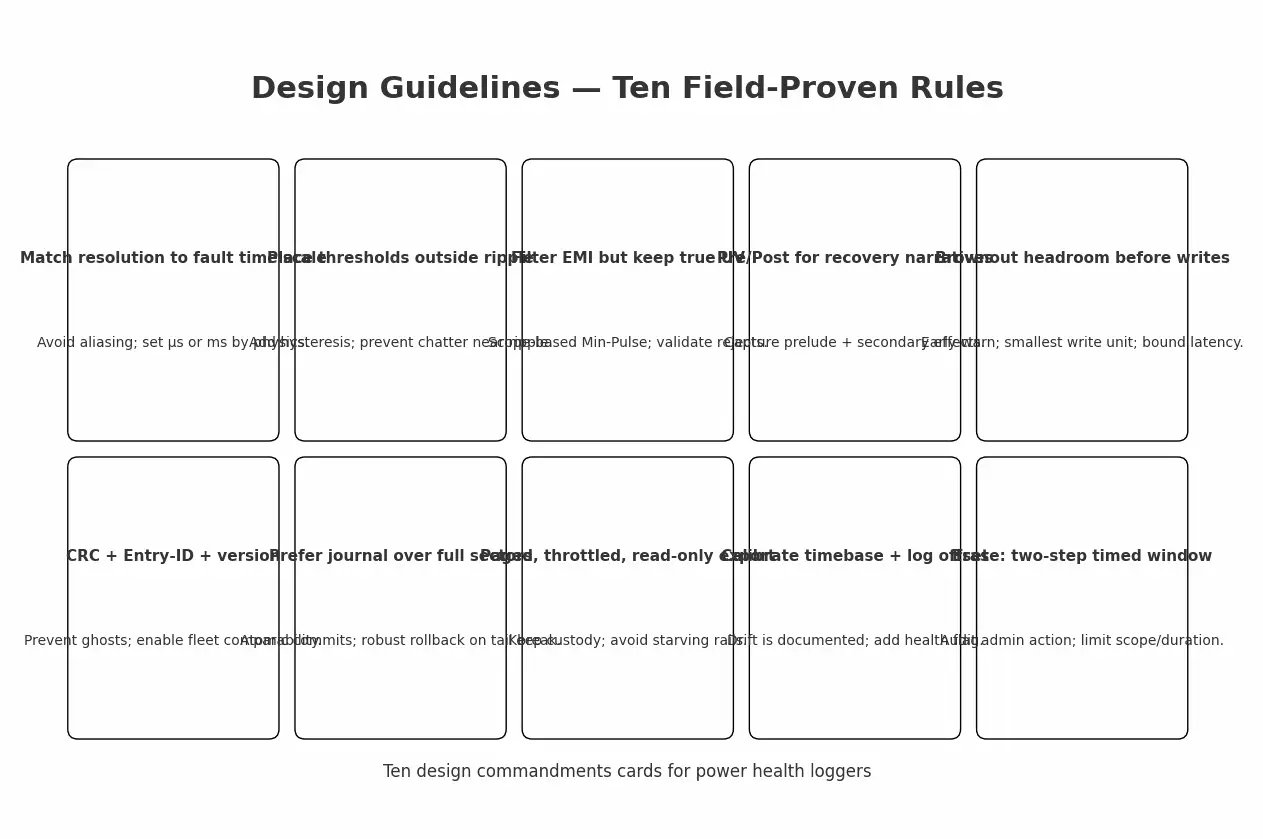
Design Guidelines (10 field-proven rules)
Practical guardrails to hit first-time success and maintain an auditable evidence trail—without stepping into sequencing or continuous power monitoring.
Avoid aliasing; size TS in µs or ms by physics.
Test: scope vs log timestamps agree.
Add hysteresis; avoid chatter near steady ripple.
Test: 0 false trips in ripple scan.
Set Min-Pulse from scope stats; validate rejection rate.
Test: rejects ≥95% injected glitches.
Capture prelude + secondary effects; compress OK states.
Test: full recovery captured.
Early-warn + smallest write unit; bound commit latency.
Test: survives injected cut at −Z ms.
Prevent ghost entries; enable fleet comparability.
Test: corrupt tail → clean rollback.
Short atomic commits; robust rollback on tail break.
Test: no half-writes after power loss.
Preserve chain-of-custody; avoid starving rails.
Test: 1 kB page < X ms at Y kbps.
Drift is documented, not hidden; add health flag.
Test: analyzer corrects to spec.
Admin event is logged; limit scope/duration.
Test: audit log shows clear intent.
Troubleshooting Matrix (Diagnose → Observe → Fix)
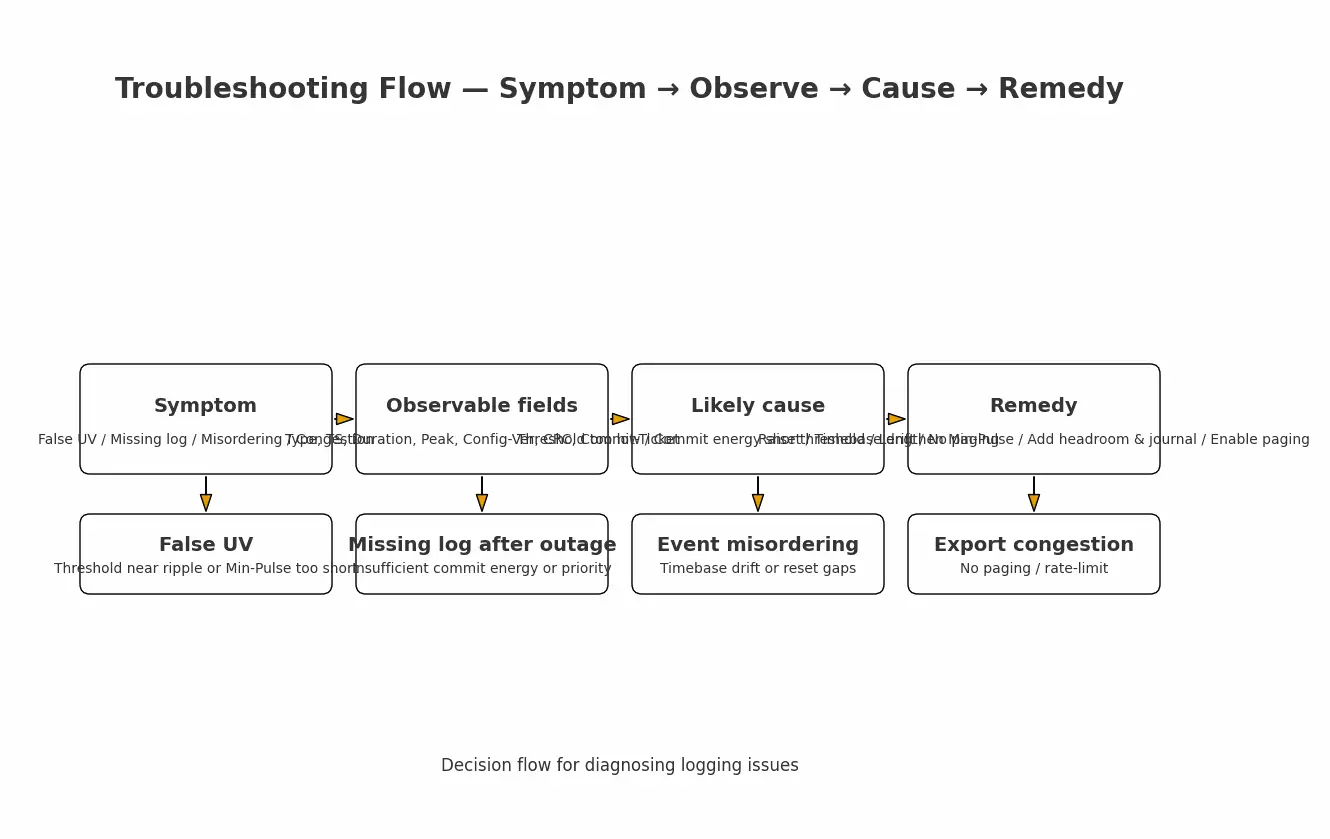
Use this matrix to move from symptom to trigger condition to the smallest set of observable fields that prove the likely cause, then apply a single remedy you can test within a day. Reuse your own table form—this page defines which fields to capture and how to fill them consistently.
- Symptom
- Trigger Condition
- Observable Fields (Type, TS, Duration, Peak, Config-Ver, CRC, Commit-Ticket)
- Likely Cause
- Remedy
- Type: OV/UV/OC/OT/(dv/dt) — keep taxonomy consistent.
- TS: order & spacing first; check Timebase-Health bit.
- Duration: separates chatter vs sustained faults.
- Peak: compare to threshold & ripple envelope.
- Config-Ver: bind behavior to configuration.
- CRC: trust only verified entries.
- Commit-Ticket: proves atomic write.
- TS + Commit-Ticket (ordering & durability)
- Peak vs Threshold (binning sanity)
- Duration vs Min-pulse (chatter vs real)
- Config-Ver (stale configs?)
- CRC (trust boundary)
Applications & Schematics (Topologies & Export)
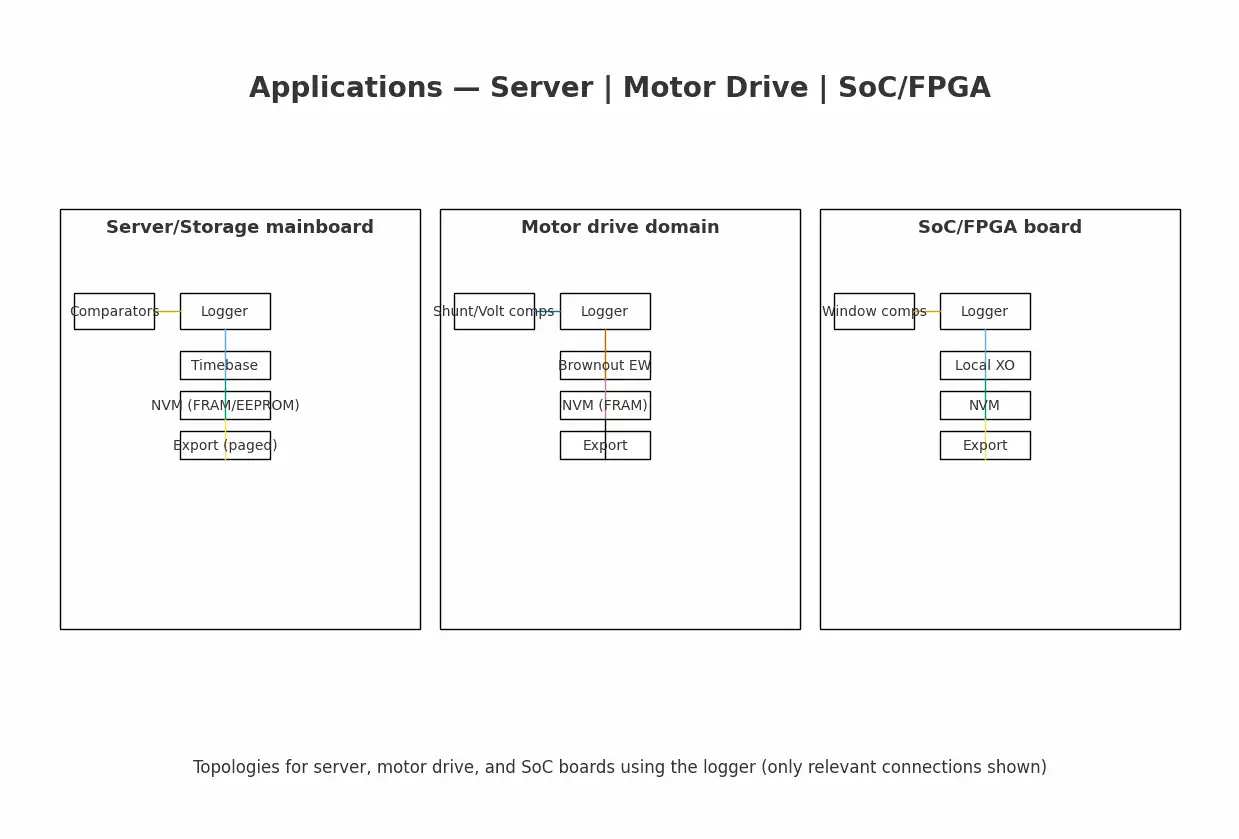
Three canonical use cases show only the logger-relevant wiring—event inputs, timebase, NVM, and export. Sizing remains strictly within logging scope (no sequencer or continuous ADC functions).
- Log: multi-rail UV/OV/OT; confirm “UV then OC”.
- Wire: PoL comparators → logger channels; local timebase + calibration offset; close NVM; service-header export.
- Size: TS 1–10 µs; Pre/Post for VRM recovery; journal unit ≤ brownout headroom.
- Evidence: monotonic Entry-ID + Commit-Ticket; paged export.
- Log: startup inrush UV and thermal OT interactions.
- Wire: shunt/voltage comparators → logger; brownout early-warn; FRAM for endurance.
- Size: Min-pulse rejects PWM spikes; deep Post for thermal settle.
- Evidence: Peak corroborates UV depth; Timebase-Health under EMI.
- Log: droop events under burst loads (no DVFS policy here).
- Wire: window comparators → logger; local XO with periodic offset log; export in maintenance slot.
- Size: low-µs TS; Pre captures prelude; short dense Post; journal writes.
- Evidence: Pre/Post frames reconstruct burst envelope; CRC + tail mark intact.
- Event inputs: comparator/window outputs; digital alerts.
- Timebase: local RC/XO + Last-Calibration-Offset field.
- NVM: on-die or near-die to reduce commit energy.
- Export: paged API with throughput cap; read-only mode; export in low-load windows.
API: LIST(page, cursor) | READ(page_id) | STATUS() | LOCK_RO(enable)
Cursor: opaque cursor; payload carries monotonic EntryID
Integrity: per-page CRC; optional tail mark
Formats: CSV & JSON → {EntryID, Type, TS, Duration, Peak, ConfigVer, CRC, CommitTicket}
Safety: LOCK_RO(true) before export; clear via two-step timed window (admin logged)
Data Model & NVM Commit
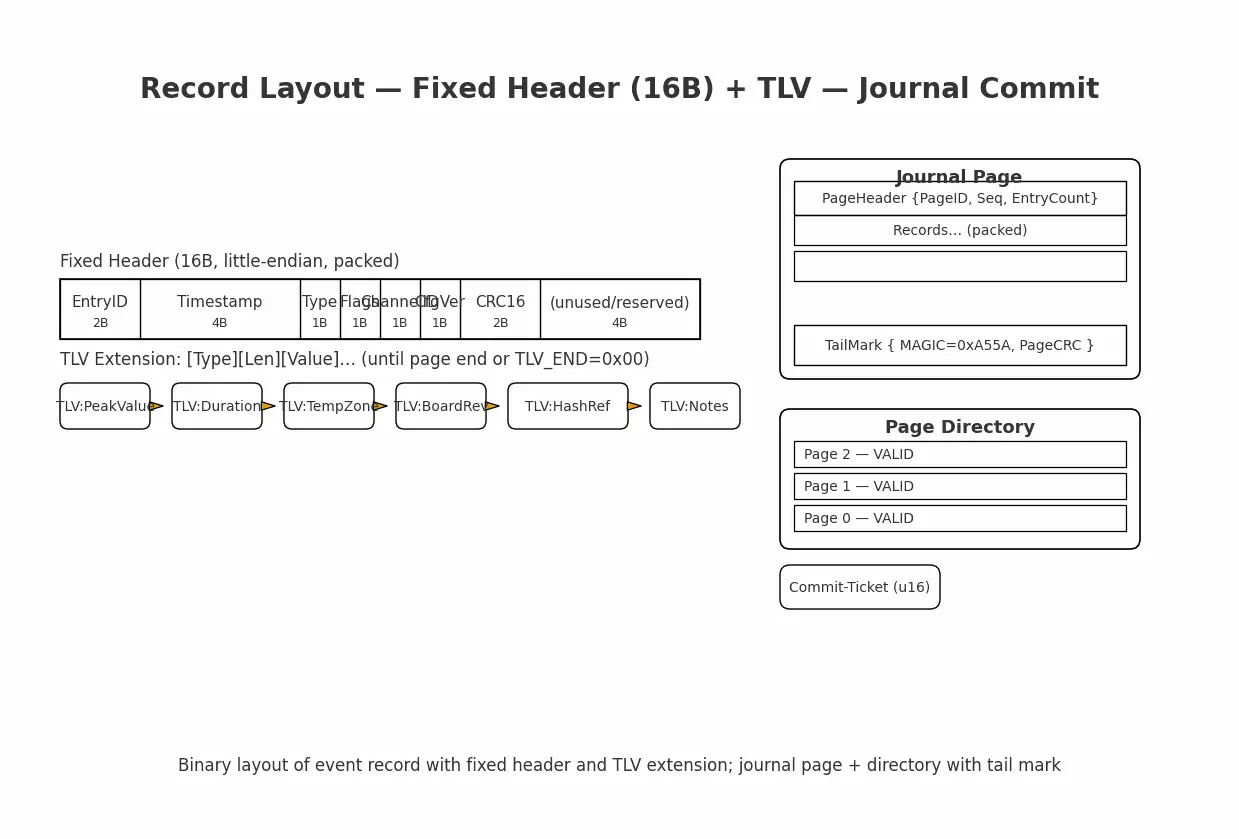
Define a compact binary record that is self-validating and consistent across fleets, then use a journal-first commit with tail mark and rollback so logs survive brownouts without ghost entries. Export is paged and read-only with cursoring.
u16 EntryID |
Monotonically increasing (wrap-aware) |
u32 Timestamp |
Tick unit + epoch/offset policy |
u8 Type |
Enum: OV/UV/OC/OT/dvdt… |
u8 Flags |
Phase(Start/Peak/End), Timebase-Health, Brownout-Commit… |
u8 ChannelID |
Rail/zone code |
u8 CfgVer |
Config/firmware version ID |
u16 CRC16 |
Header CRC (CRC-16/CCITT-False recommended) |
0x01 PeakValue(u16/u32)0x02 Duration(u16 in µs/ms)0x03 TempZone(i16, 0.1°C)0x04 BoardRev(u8)0x05 HashRef(16B digest → immutable config blob)0x06 Notes(ASCII/UTF-8 ≤ 32B)
Format: [u8 Type][u8 Len][Len bytes Value]… until page end or TLV_END=0x00.
- Append record (header with CRC + TLVs)
- Update
EntryCount(write-through) - Write
TailMark{MAGIC,PageCRC} - Flip Page Directory to
PAGE_VALID - Increment
Commit-Ticket(dual-copy)
- Invalid MAGIC/CRC → discard last page; adjust ticket delta
- Valid page → continue append or open new page
Range or session clear → RO lock → two-step arm → timed window → erase → write Admin Event (Type=ADMIN_CLEAR, operator ID).
READ_PAGE(idx, window) → {records[], next_offset}
STATUS() → {LastEntryID, CommitTicket, RO_Lock}
LOCK_RO(enable) → one-way during export session
CSV/JSON fields: {EntryID, TS, Type, Flags, ChannelID, CfgVer, CRC, TLVs…}
- EntryID monotonic (wrap-aware)
- Power cut at −Z ms → valid page + ticket advanced
- Zero ghost entries; CRCs pass
- Every record maps to HashRef of config
Validation & Evidence Chain
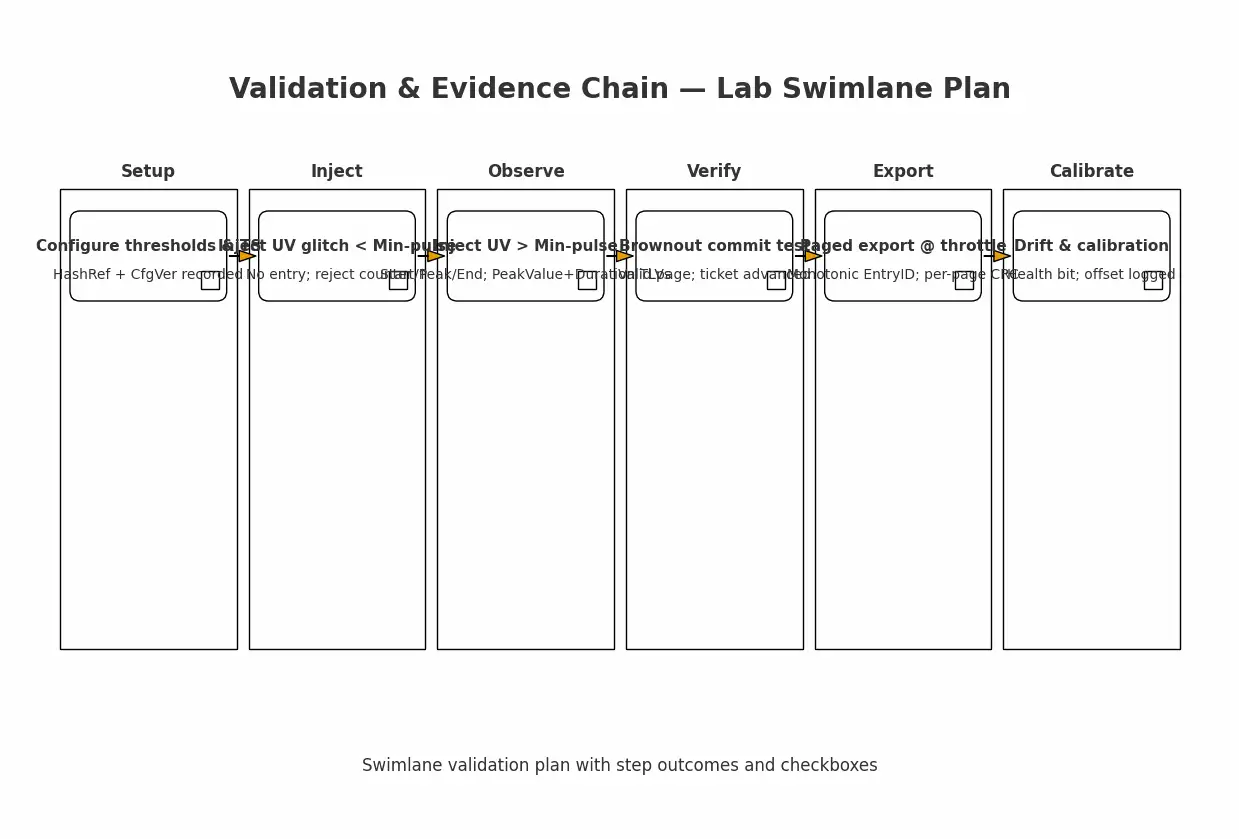
Prove detectability, ordering, durability, and integrity under controlled faults. Each test yields objective metrics and an audit trail, culminating in a defensible chain-of-custody from event to export.
- Configure thresholds & TS resolution → record HashRef + CfgVer
- Inject UV glitch < Min-pulse → no entry; reject counter ↑
- Inject UV > Min-pulse → Start/Peak/End; PeakValue & Duration TLVs
- Brownout test (−Z ms pre-cut) → page valid; Commit-Ticket advanced
- Paged export with throughput cap → monotonic EntryID; page CRCs
- Timebase drift & calibration → Health bit; offset logged
- FPR ≤ 5% (glitch rejections)
- FNR = 0% at spec amplitudes
- Commit success ≥ 99.9% at profile
- Export throughput ≥ target with RO lock
- Evidence reliability 100% CRC; scope timing within TS resolution
- Export is read-only (
LOCK_RO(true)) - Admin ops (clear/unlock) produce Admin Events
- All logs map to immutable HashRef of config
- Reports bundle CSV/JSON + scope screenshots + tool versions
FAQ
Answers stay within 40–70 words and reference logger fields only (Type, TS, Duration, Peak, CfgVer, CRC, Commit-Ticket).
How is commit guaranteed after power loss?
Use a journal-first flow with a small atomic write unit, TailMark {MAGIC, PageCRC}, and a dual-copy Page Directory. Raise a separate Commit-Ticket after the tail lands. On boot, accept pages with valid TailMark and CRC; otherwise roll back the last page. Brownout early-warn provides headroom to finish the tail or skip safely.
How fine should the timestamp be?
Match TS resolution to physics: microseconds for fast droop or UV edges, milliseconds for thermal OT. Record a Timebase-Health bit and Last-Calibration-Offset so analysis corrects drift. If you synchronize to an external cadence, log the sync marker as an event. Absolute RTC is optional unless wall-clock traceability is a requirement.
How large should Pre/Post buffers be?
Size with simple rules: Pre ≥ ceil(T_pre / Tsample) and Post ≥ ceil(T_post / Tsample). Pre captures the prelude to a fault; Post reconstructs recovery and secondary effects. Prefer power-of-two depths for ring buffers, and compress OK-state samples to save bandwidth without losing narrative fidelity in exported evidence.
How do I prevent UV/OV false triggers?
Place thresholds outside the ripple envelope and add hysteresis. Set Min-Pulse long enough to reject EMI spikes yet short enough to keep real UVs. Window comparators and optional dv/dt guards reduce chatter. Validate with scope statistics, then target at least 95% rejection of injected glitches under representative load and temperature.
What integrity checks are recommended?
At minimum, a header CRC16 per record and a per-page PageCRC inside the TailMark. Prefer journal or dual-write so half-writes can roll back. Enforce monotonic EntryID, versioned CfgVer, and optional HashRef to an immutable config blob. Never ship without CRC; treat failed-CRC entries as non-evidentiary during analysis.
How do I export logs without blocking the bus?
Export is paged, throttled, and read-only. Provide READ_PAGE(idx, window) that returns a limited number of records plus next_offset. Rate-limit bytes per second, and schedule readout in idle windows. Set LOCK_RO(true) before export, and log the export session as an admin event to preserve chain-of-custody across teams.
Do I need an RTC for valid analysis?
No. A stable local tick with Timebase-Health and Calibration-Offset is sufficient for ordering, duration, and channel correlation. If wall-clock time matters, add an occasional sync marker to tie the local epoch to RTC or host time. Keeping RTC optional reduces cost, power, and complexity in compact designs.
How should configuration context be recorded?
Store a short CfgVer in the header and a HashRef TLV to a read-only config blob that contains thresholds, scaling, and table IDs. Include BoardRev or TempZone TLVs when relevant. Every entry becomes traceable and comparable across fleets, enabling audits without guessing which configuration produced each record.
What makes a compliant clearing strategy?
Clearing uses a two-step timed window with RO lock engaged during export. Limit scope by range or session ID, erase journal pages, and immediately log an Admin Event that records operator, range, and timestamp. The admin entry itself is not silently removed, preserving a verifiable evidence trail for audits.
How do I correlate multiple rails without a sequencer?
Use a shared timebase and include ChannelID in every entry. Post-analysis aligns by TS and Duration rather than enforcing a power-up order. The logger remains neutral: it records OV, UV, OC, and OT with Pre/Post windows; it does not orchestrate sequencing or PG voting, which are outside this page’s scope.
Reference & CTA
- Event coverage: OV / UV / OC / OT (+ optional dv/dt).
- Threshold granularity: 2–20 mV or 0.5–2% steps; hysteresis available.
- Min-Pulse window: 100 ns – 1 ms; validated against ripple/EMI.
- TS resolution & health: 1–10 µs or 0.1–1 ms; Health bit + Calibration-Offset.
- Pre/Post depth: computed from targets; ring buffer; OK-state compression.
- Commit latency & energy: brownout headroom; tail mark; ticket.
- NVM type & endurance: FRAM vs EEPROM; page size; wear policy.
- Integrity policy: CRC16 header + PageCRC; journal/dual-write; EntryID monotonic.
- Export bandwidth: paged + rate-limited; RO lock; expected throughput.
- Operating limits: supply, Iq (active/standby), temperature range.
We provide device shortlists, eval boards, export scripts, and calibration flows.

Related Articles
- ·HBM3 vs. HBM3E: Complete Technical Comparison for AI, HPC, and Global Component Procurement
- ·How Large Language Models Work
- ·SK Hynix & Samsung: The Unprecedented HBM Expansion Race
- ·Micron 6600 ION 245TB Redefines Data Center
- ·Why Memory and Storage Define the Next Decade
- ·How Artificial Intelligence Acquires “Knowledge”
- ·How DRAM Will Change the World
- ·Why SSD Write Cache Is Crucial for AI Applications
- ·DRAM Product, Technology & Application Guide
- ·HBM4 compared to HBM4E










.png?x-oss-process=image/format,webp/resize,h_32)


