
 German
 Japanese
 Portuguese
 Korea
Korea
 Mexico
 Dutch
Dutch


Power Monitors with ADC: Shunt Sensing, ADC, Bus Telemetry, ALERT

Quick Browse
1) Answer Box | Decision Snapshot
6–8 punchy lines to clarify what it is, what it solves, how to select, how to deploy, and common pitfalls—so a team can start a selection review immediately.
An ADC-based power monitor that digitizes rail voltage/current/power/energy, exposes registers via I²C/SMBus/PMBus, and asserts ALERT on thresholds.
Makes rails observable, actionable, and traceable—enabling efficiency profiling, protection triggers, and faster field diagnostics.
- Choose common-mode range and ADC resolution/SPS to avoid saturation and capture events.
- Match PGA gain + Rshunt to thermal drop and surge I²t limits.
- Define window/hysteresis/latch per channel to reduce false trips.
- Wrong current polarity convention → negative readings.
- Energy counter rollover not handled → period loss.
- Too little averaging near thresholds → ALERT chattering.
- No SMBus PEC/timeout or brownout recovery flow.

2) What is it | Definition & Boundaries
A Power Monitor with ADC integrates a sense front-end, ADC, digital averaging, power/energy math, register map, and threshold/ALERT, exposing rail telemetry via I²C/SMBus/PMBus for a protection + observability loop.
- 🚫 Rail power-up sequencing or multi-rail timing control.
- 🚫 Multi-rail power coordination and orchestration.
- 🚫 Remote-sense/compensation amplifiers for regulation loops.
- 🚫 Thermal management or temperature control controllers.
- Select high-side or low-side sensing per application; verify common-mode range and ground bounce.
- Place the device close to the shunt (Rshunt); keep S± matched in length and away from switch nodes and return trunks.
- Connect upstream to MCU/FPGA management via I²C/SMBus/PMBus.

3) Working Principle | System Block Diagram
The full signal chain from the shunt to registers/ALERT: Rshunt → differential front-end (high-CMR) → PGA → ADC (ΣΔ / SAR) → digital filter/averaging → math for V/I/P/E. Protection runs in a parallel path via window thresholds, hysteresis, deglitch time, and optional latch, while the host reads a mapped register set over I²C/SMBus/PMBus.
- Rshunt with Kelvin pick-off; route S± away from switch nodes/return trunks.
- Differential front-end tolerates high common-mode; verify input range vs. rail maxima.
- PGA aligns ΔV to ADC’s optimal span; check step/overload behavior.
- ADC (ΣΔ: high resolution with built-in digital filtering; SAR: higher SPS, add averaging).
- Digital averaging and decimation feed stable V, I, then compute P = V×I and E = ΣP·Δt with a fixed time base.
- V [V], I [A], P [W] = V×I, E [J] = Σ P·Δt (Δt from the sampling tick).
- Energy accumulator may be optional (dashed-box in figure); define width and rollover handling.
- Use atomic read (shadow registers or read-lock) for multi-byte E to avoid torn reads.
- Upper/Lower windows with hysteresis; per-channel independence preferred.
- Deglitch time tdeglitch and optional “time-over-limit” gate reduce border chatter.
- Latch vs. non-latch semantics; define clear-on-read / write-1-to-clear policy consistently.
Register map (subset): SHUNT_V, BUS_V, CURRENT, POWER, ENERGY_L/H, AVG_CTRL, LIMIT_HI/LO, HYST, DEGLITCH, ALERT_MASK, STATUS, CONV_TIME, MODE.
- PEC (SMBus CRC-8) on transfers; handle clock stretching and timeout.
- Define a brownout recovery sequence and default-value audit on power-up.
- tconv (conversion time), sampling rate SPS = 1 / tconv.
- N (averaging window or effective decimation).
- tdeglitch for ALERT filtering.
- End-to-end latency ≈ N·tconv + tdeglitch (first-order estimate).

- Zero-current offset → full-scale linearity → step-load capture → threshold trigger & deglitch → energy rollover.
- Record (tconv, N, tdeglitch) matrix and resulting latency; lock ALERT clear policy end-to-end.
4) Technical Breakdown | Seven Layers
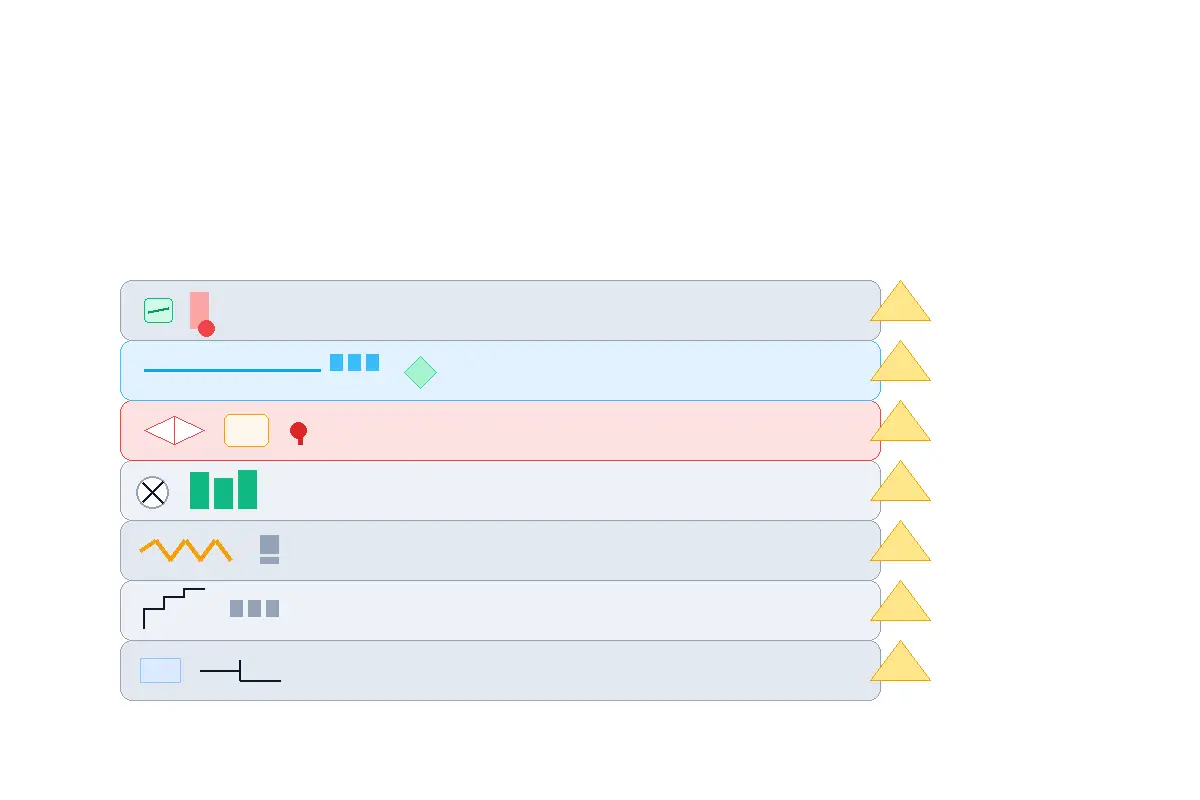
A vertical, deep-dive decomposition of measurement, timing, thresholds, bus robustness, and calibration. Each layer summarizes Decision → Rules/Math → Risks → Validation, without crossing into sibling topics.
- Decision: common-mode range, ground bounce, drop budget, start-up over-voltage margin.
- Rules: Vcm,max ≥ rail max + noise margin; evaluate low-side ground coupling.
- Risks: start-up over-CM, reverse flow, ground-referenced noise injection.
- Validate: power-on/off/surge waveforms; CM sweep; injected ground-bounce tests.
- Decision: resolution, SPS, bandwidth, noise/ENOB, latency budget.
- Rules: ENOB↑ ≈ 0.5·log2N for white-noise averaging; ΣΔ: built-in digital filters; SAR: rely on external averaging/filters.
- Risks: over-averaging → slow response; tconv beats with Fsw; filter passband ripple.
- Validate: step-load + swept-tone; correlate equivalent noise/bandwidth vs transient response.
- Decision: ΔV=I·R, full-scale drop ≤ 1–2%·Vrail, pulse energy I²·R·t, TCR, PGA gain.
- Rules: pick R for SNR vs drop/heat; choose PGA so input sits in the ADC sweet spot.
- Risks: short-pulse heating, TCR drift, PGA saturation or recovery delay.
- Validate: thermal sim + IR; steady-state rise; linearity across FS.
- Decision: current sign convention (source/load or charge/discharge); accumulator width & read order.
- Rules: unify sign across firmware; use shadow/locked reads; handle rollover explicitly.
- Risks: sign flips causing P spikes; accounting gaps on rollover; Δt mismatch bias.
- Validate: direction-switch test; long-horizon energy audit vs. bench reference.
- Decision: window widths, hysteresis, tdeglitch, time-over-limit, channel queue/priority.
- Rules: hysteresis ≥ (3–5)×σnoise; tdeglitch ≥ (1–2)× control-cycle jitter.
- Risks: border chatter, uncleared latch, race conditions in cascaded protection.
- Validate: boundary sweeps + jitter injection; ALERT clear & re-entry tests.
- Decision: enable PEC; set timeout (SMBus ~35 ms typical); allow clock stretching; resolve address conflicts.
- Rules: define brownout recovery; verify reset/default registers; re-probe + backoff.
- Risks: bus lock, abnormal NACK, mis-reads/writes, multi-master collision.
- Validate: fault injection/hot-plug; PEC error injection; large-batch address scans.
- Decision: zero/gain models, temperature coefficients, factory record format, field re-cal flow.
- Rules: short-zero, two-point (or multipoint) gain; build T vs correction; persist cal constants in NVM.
- Risks: drift accumulation, lot variation, harness drop causing system-level bias.
- Validate: chamber-based calibration; field quick-recal with known load/current source.
- Topology choice memo (high-side/low-side) + CM/ground-bounce evidence.
- ADC mode & averaging settings with ENOB vs latency plot; tconv vs Fsw beat check.
- Rshunt/PGA selection table (drop, heat, pulse I²t, TCR drift) and linearity sweep.
- Threshold window/hysteresis/deglitch numbers; latch policy; ALERT queue/priority.
- Bus robustness plan (PEC, timeouts, recovery); calibration record & field re-cal procedure.
5) Key Metrics | Field Definitions + Selection Hints
What to look at, why it matters, and how to verify on the bench. Desktop presents a compact table; a card grid below mirrors the same content for small screens.

6) Design Guidelines | Ten Executable Tips
Ten practitioner rules with Why → How → Verify, focused strictly on ADC power monitors.

Lock common-mode headroom, size Rshunt + PGA for FS fidelity, choose ADC mode & N for latency/ENOB, harden ALERT semantics, and enforce PEC/timeout with a repeatable calibration + audit flow.
7) Layout & EMI | PCB Guidelines
Prevent measurement errors and ALERT chatter by partitioning the power and sensing domains, routing S± as a clean Kelvin pair, and hardening the bus and interrupt lines.
- Separate Rshunt + S±, ADC front-end, and power switching zone.
- Draw a grounded “moat” between high-dv/dt nodes and the sensing island.
- Mark the SW-node vicinity as a no-go shadow for S± traces.
- Kelvin pick-off; S± tightly coupled, equal length, minimal vias.
- Keep away from switch nodes, fast current returns, and slot cuts.
- Place the RC input filter close to the monitor pins.
- Join AGND ↔ PGND at a single point; avoid sensing return crossing power return.
- Use via fences/guard traces where S± transition layers or pass noisy zones.
- Start with 10–100 Ω / 1–10 nF; set pole below ADC bandwidth.
- Size ALERT pull-up by bus fan-out/capacitance; add small RC deglitch if needed.
- Estimate line C and pick pull-ups for compliant edges; allow clock stretching.
- Enable PEC; place ESD near the connector; consider series damping for long runs.
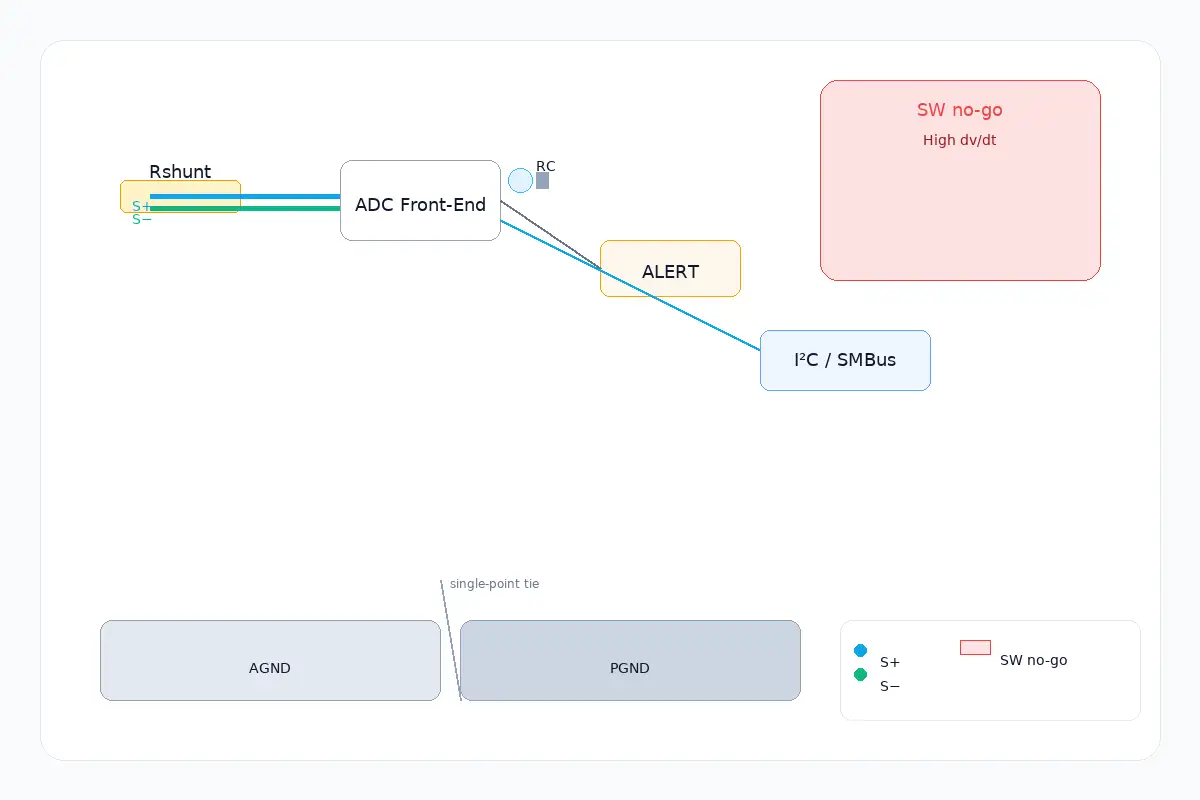
- Kelvin S±; keep a continuous reference plane below the pair.
- Place RC at the monitor pins; verify step fidelity vs noise.
- Single-point AGND–PGND tie with clear return planning.
- Don’t cross S± over the SW node or split planes/slots.
- Don’t share S− return with high di/dt loops.
- Don’t oversize bus pull-ups; avoid ringing/slow edges.
- Near-field probe and step-load sweep before/after RC and routing changes.
- Zero-current drift vs temperature with AGND/PGND tie variations.
- ALERT chatter statistics under boundary sweeps and injected jitter.
- I²C edges, timeout, stretching and PEC error-injection report.
8) Register & Data Model | Minimal Closed Loop
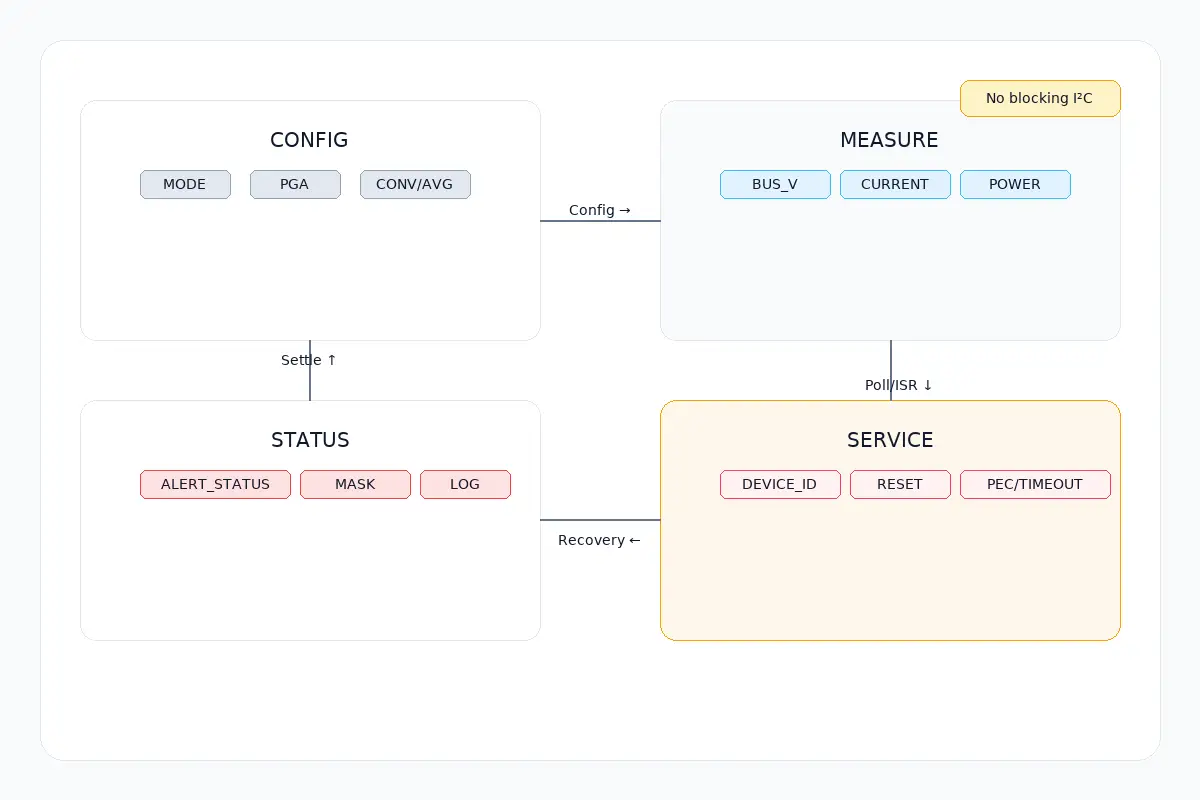
A minimal, production-ready register set grouped as CONFIG, MEASURE, STATUS, and SERVICE, plus a power-on→run→interrupt→recovery→settlement flow.
MODE,CONV_TIME,AVG/N,PGA.THRESH_HI/LO(V/I/P),HYST,DEGLITCH,PERSIST.
BUS_V,SHUNT_V,CURRENT,POWER.ENERGY_L/H,TIMEBASE, direction bit (source/load or charge/discharge).
ALERT_STATUS,ALERT_MASK,FAULT_LOG[n](timestamp + reason).- Optional
ROLL_CNTfor energy rollover accounting.
DEVICE_ID,REV,RESET.- Telemetry health:
PEC_ERR_CNT,TIMEOUT_CNT.
- Read
DEVICE_ID/REV& issueRESET. - Write
MODE,CONV_TIME,AVG,PGA. - Program
THRESH_HI/LO,HYST,DEGLITCH,PERSIST; clearALERT_STATUS.
- Periodic shadow/locked reads of
MEASURE; compute P/E; log. - On ALERT#: read
ALERT_STATUS/FAULT_LOG→ act → clear (W1C/read-to-clear aligned). - If
TIMEOUT_CNTorPEC_ERR_CNTgrows: bus reset, re-probe, re-apply CONFIG. - Periodic settlement: read
ENERGY_L/H(+ optionalROLL_CNT) and archive.
- Atomic energy reads via shadow/lock; verify no torn updates across L/H words.
- Publish unit scales (μV/LSB, mA/LSB, mW/LSB, mJ/LSB) and a versioned TIMEBASE.
- Unify current/power sign convention across registers and host calculations.
- FAULT_LOG stores type, thresholds, persistence duration, and timestamp.
9) Firmware Patterns | ISR & Polling Flow
A vendor-agnostic organization pattern for power monitors with ADC: a non-blocking main loop, a minimal ISR, a single-producer/single-consumer event queue, and deterministic settlement tasks.
- Single monotonic clock drives t_conv, averaging N, deglitch t_deglitch, and settlement cadence.
- Main Loop (non-blocking): shadow/locked reads → scale/smooth → energy accumulate (E += P·Δt).
- ISR (ALERT): capture minimal set (status + offending regs), timestamp, push to ring buffer. No blocking I²C
- Beat schedule avoids integer relationships with Fsw; jitter if necessary.
- Choose N: boundary decisions → larger N; event capture → smaller N.
- Secondary firmware thresholds (window/hysteresis/persist) reduce chatter.
- On ALERT#: ISR snapshots
ALERT_STATUS+ related channel → enqueue (ts, type, rail, persist ticks). - Worker task performs deglitch/persist confirmation; logs to FAULT_LOG and triggers protection/UI.
- Prioritize PG/protection events > statistics to avoid queue starvation.
- If
PEC_ERR_CNT/TIMEOUT_CNTexceeds threshold: bus reset → re-probe address → re-apply CONFIG (idempotent). - Power-loss resume: verify DEVICE_ID/REV, clear status, re-align TIMEBASE.
- Daily/weekly energy roll-up (read
ENERGY_L/H+ROLL_CNT), persist peak Ipk/Ppk. - Optional signing/hash for evidence chain with TIMEBASE & coefficient version.

- Single producer (ISR) / single consumer (worker) ring buffer; fixed length; overwrite policy keeps latest and increments
drop_cnt. - Payload:
ts_ms,rail_id,type,persist_ticks,status_bits.
10) Calibration & Validation | Traceable Accuracy
A reproducible, traceable workflow covering factory coefficients, field quick-check, environmental validation, energy rollover tests, and documentation for audits.
- Offset (open/short loop); Gain (0, Imid, Imax); Temp drift (two-point).
- TIMEBASE ppm vs reference clock; version the scale/units.
- Persist coeffs/date/fixtureID/firmwareREV/CRC to info area; printable certificate.
- Known load or current source for two-point check; step method for linearity.
- Two-temperature correction or LUT update from temp_coeff.
- A/B before/after report: bias, gain, repeatability.
- Sweep: I: 0→Imax→0, N samples/point; record V/P/E synchronously.
- Thermal: −20→85 °C; extract offset(T), gain(T); check limits.
- Linearity/Repeatability thresholds; Energy rollover with
ROLL_CNT. - ALERT boundary sweeps (PERSIST/DEGLITCH combos); bus PEC/timeouts injection tests.
- Log: coefficients, TIMEBASE, ROLL_CNT, PEC_ERR_CNT, operator/location/fixtureID, firmware REV.
- Version mapping for coeff tables and rollback path; optional signature/hash.

- Zero-offset ≤ X μA @25 °C, drift ≤ Y μA/°C.
- Gain error ≤ Z %FS across temperature.
- Repeatability ≤ R % (10 repeats/point).
- Energy deviation ≤ E % vs external meter.
- Programmable PSU + e-load + DMM (SMU ideal), optional thermal chamber.
- Four-wire Kelvin connections; short, shielded leads; robust Kelvin clips.
11) Accuracy Budget | Error Sources & RSS
A fast, traceable way to estimate uncertainty for I, P, and E with ADC-based power monitors: map contributors, combine with RSS, and validate with minimal scripts.
- PGA gain error (εgain) and offset Voff.
- Quant/Noise (ENOB, LSB/√12, averaging N), INL/DNL.
- Rsh TCR & self-heating (I²R·θJA), lead mismatch (non-Kelvin).
- Bandwidth/anti-alias deficit (kBW), temp drift of gain/offset.
- Current estimate: Î = ΔVsh / (APGA·Rsh).
- Offset to current: ΔIoff ≈ Voff / (APGA·Rsh).
- Quantization σ: σq ≈ (LSB/√12)/√N → σI,q = σq / (APGA·Rsh).
- TCR term: ΔR/R ≈ TCR·ΔT ⇒ scales I, P, E.
- RSS combine (current): uI ≈ √[(εgain·I)² + ΔIoff² + σI,q² + (εINL·I)² + (TCR·ΔT·I)² + ΔIlead²].
- Power: uP ≈ √[(I·uV)² + (V·uI)²]; Energy: timebase + power uncertainty.

- Increase tconv and N; avoid integer beats with Fsw.
- Front-end RC & anti-alias; confirm step fidelity.
- Factory + field calibration; LUT for TCR/drift.
- Wider hysteresis + deglitch for boundary decisions.
- Strict Kelvin routing; symmetric leads.
- Offset/Noise: short loop + long sampling stats.
- Gain/Linearity: multi-point current steps; fit + residuals.
- TCR/Drift: two-temp or chamber run; log ΔR and gain/offset drift.
- Bandwidth: step & frequency sweep → kBW factor.
- Timebase: ppm vs reference clock.
12) Production Test | Flow & Traceability
Integrate power-monitor capability into the mass-production quality loop: fixture, flow, thresholds regression, energy rollover test, bus robustness, and complete data capture.
- Four-wire Kelvin to Rsh; programmable PSU + e-load/SMU; precision DMM.
- Sense MUX (optional), thermal chamber (optional, sampling).
- I²C/SMBus adapter with PEC/timeout/stretch support; ESD protection; cable discipline.
- Golden board/device for daily drift check.
- Per-rail sweep 0→Imid→Imax; log V/I/P.
- Write offset/gain/temp coeffs; version the info area.
- Threshold regression: window/hysteresis/persist/latched behavior.
- Energy rollover: force overflow (timebase or width) and verify ROLL_CNT + daily/weekly settlement.
- Bus robustness: PEC faults/timeout injection; verify recovery script (reset → re-probe → restore CONFIG).
- Archive to MES/DB; print label or QR.
- Per-channel flow ≤ 60–90 s (no chamber).
- Daily golden check ≤ 10 min; drift out-of-control triggers maintenance.

- Offset out-of-limit / Gain out-of-limit / ALERT behavior mismatch / Rollover abnormal / Bus robustness fail / Minor drift.
- Each exception maps to a Fail Code → Rework Order with cause, action, and retest requirements.
- Link each SN to its black-box record in the quality page.
13) Troubleshooting Matrix | Symptom → Fields → Cause → Fix
A minimal closed loop for first-line diagnosis. Map the symptom to observable fields, identify the likely cause, then apply the corrective action.

Tip: These CTAs are fully responsive, tap-friendly, and keep contrast high for accessibility.
14) Applications & Reference Circuits (Brand-agnostic)
Four minimal yet sufficient templates that cover the most common field patterns. Each tile: one small circuit and 5–7 bullet points, with verification tips.

- High-side shunt, wide common-mode front-end.
- t_conv chosen non-integer vs F_sw; N=16–64.
- I/P windows with hysteresis; latched optional.
- Energy accumulator with daily/weekly settlement.
- Verify: step load + long-run energy audit.
- Per-channel PGA/FS; shared TIMEBASE.
- Independent thresholds/deglitch per channel.
- Shared ALERT with queue; priority documented.
- Verify: cross-channel ordering & queue saturation.
- Minimal drop; high PGA; moderate N to avoid jitter.
- Strict Kelvin sense; slit ground guard if needed.
- Verify: ground-bounce injection & false-alert rate.
- Wide common-mode input; RC set; surge margin.
- Cold-start transient tolerance; startup delay.
- Persist and hysteresis balanced for compliance.
- Verify: surge pulse + cold-start; check logs.
Tip: These CTAs are fully responsive, tap-friendly, and keep contrast high for accessibility.
15) Reference ICs & BOM Hints (examples only)
A landing pad for selection: grouped by need — High-resolution + Energy, Wide common-mode + Multi-channel, Fast response + Event capture. Part numbers are examples; before publishing you can swap to your in-stock/advantaged SKUs and link to your Ersa/Ampheo inquiry page. No cross-topic content.

- Use when: metering, efficiency profiling, long-period energy settlement.
- Why: ΔΣ + programmable averaging → low noise; on-chip P/E/TIMEBASE.
- Edges: ΔΣ bandwidth; energy width & rollover policy.
- TI INA228 (I²C, 20-bit ΔΣ, P/E regs)
- TI INA229 (SPI, 20-bit ΔΣ)
- ADI LTC2947 (energy metering)
- Microchip PAC1934 (I²C, 4-ch accumulators)
- Use when: 24–60 V buses; board multi-rails with shared ALERT.
- Why: consolidated cost; centralized interrupt & queue.
- Edges: channel interleave; CM/surge margin at cold-start.
- TI INA3221 (I²C, 3-ch)
- Microchip PAC1934 (I²C, 4-ch)
- ADI LTC2992 (I²C, dual-rail)
- Use when: boundary enforcement; narrow spikes; ISR-driven alerts.
- Why: shorter t_conv; deglitch & PERSIST tuned for events.
- Edges: noise vs SPS trade-off; non-blocking I²C in ISR.
- TI INA238 (I²C, higher SPS)
- ADI LTC2946 (I²C, rich event regs)
- Renesas ISL28022/28030 (I²C, robust ranges)
- Good wattage for 1–5 A ranges; cost-effective.
- Metal alloy & large pads → better thermal handling.
- Check: full-load drop ≤ 1–2% Vrail, I²t surge.
- Higher pulse energy reserve; lower drop at same I.
- Wide body improves vibration robustness.
- Check: layout clearance & Kelvin routing.
- Thin-film precision; low TCR for standby/current sense.
- Good for low-drop high-current rails.
- Check: power derating vs ambient.
- Ultra-low value → minimal budgeted drop.
- High current with large footprint heat spreading.
- Check: measurement resolution with chosen PGA.
- Low drift dielectric; stable transfer function.
- Check: place near S±; Kelvin first.
- Stronger anti-alias; watch step fidelity.
- Check: validate transient reproduction.
- Local decoupling for monitor VDD.
- Check: bias derating of X7R.
- Series input damping; sets RC pole.
- Check: not too high to distort step.
- Higher damping option for noisy rails.
- Check: ADC BW & ENOB impact.
- Short runs, low Cbus.
- Check: pad strength vs rework cycles.
- General default; robust footprint.
- Check: rise-time to spec at target data rate.
- For larger Cbus or 200 kHz.
- Check: IOL margin on all devices.
- Long runs, heavier loading.
- Check: bus sink capability & heating.
Tip: keep ALERT pull-up separate from SCL/SDA; add 1–4.7 nF RC on ALERT if boundary jitter is observed.
- Shielded probing for noise/spectrum capture.
- Check: mechanical strain relief.
- PMBus/I²C field maintenance port.
- Check: include a ground pin & shielding.
- Clamp-friendly Kelvin access for scopes.
- Check: spacing vs high-voltage rails.
- Rail voltage/common-mode (incl. cold-start surge) → pick family.
- Resolution vs bandwidth (ΔΣ vs SAR; N & t_conv).
- Channels & queueing (shared ALERT vs per-channel).
- On-chip energy/timebase/rollover needs.
- Bus robustness (PEC/timeout/clock-stretching).
- Register model vs your minimal usable set (see Section 8).
- Metering: 0→Imid→Imax→0 fit + residuals; 2-point temp.
- Events: pulse-width sweep; PERSIST, hysteresis, deglitch matrix.
- Roll/Δt: force energy rollover; record TIMEBASE ppm drift.
- Production: write coeff → threshold regression → roll → PEC/timeout injection → archive.
Tip: These CTAs are fully responsive, tap-friendly, and keep contrast high for accessibility.
16) FAQ — Power Monitors with ADC
Below are the most asked, conversion-oriented questions. Answers are concise (≈40–70 words), brand-agnostic, and match the front-end copy exactly. Use the anchors to deep-link from other sections. This chapter intentionally contains no JSON-LD output here.
How do I choose Rshunt and PGA for tiny standby currents?
How should tconv and digital averaging avoid beating with the switch frequency?
What initial values are safe for window thresholds, hysteresis, and deglitch?
How do I prevent data loss when the energy counter rolls over?
When should ALERT be latched versus non-latched?
What should I do if the PEC error counter rises?
What is the fastest practical field re-calibration flow?
How do ΣΔ and SAR ADCs trade off in V/I/P monitoring?
What are layout pitfalls for high-side versus low-side sensing?
How do I keep “peak I/P snapshots” consistent between production test and field logs?
How do I avoid ground bounce on low-voltage rails with low-side sensing?
When do I need a multi-channel monitor instead of multiple chips?

Related Articles
- ·HBM3 vs. HBM3E: Complete Technical Comparison for AI, HPC, and Global Component Procurement
- ·How Large Language Models Work
- ·SK Hynix & Samsung: The Unprecedented HBM Expansion Race
- ·Micron 6600 ION 245TB Redefines Data Center
- ·Why Memory and Storage Define the Next Decade
- ·How Artificial Intelligence Acquires “Knowledge”
- ·How DRAM Will Change the World
- ·Why SSD Write Cache Is Crucial for AI Applications
- ·DRAM Product, Technology & Application Guide
- ·HBM4 compared to HBM4E








.png?x-oss-process=image/format,webp/resize,h_32)


