
 German
 Japanese
 Portuguese
 Korea
Korea
 Mexico
 Dutch
Dutch


Power Sequencers & Reset Managers

Quick Browse
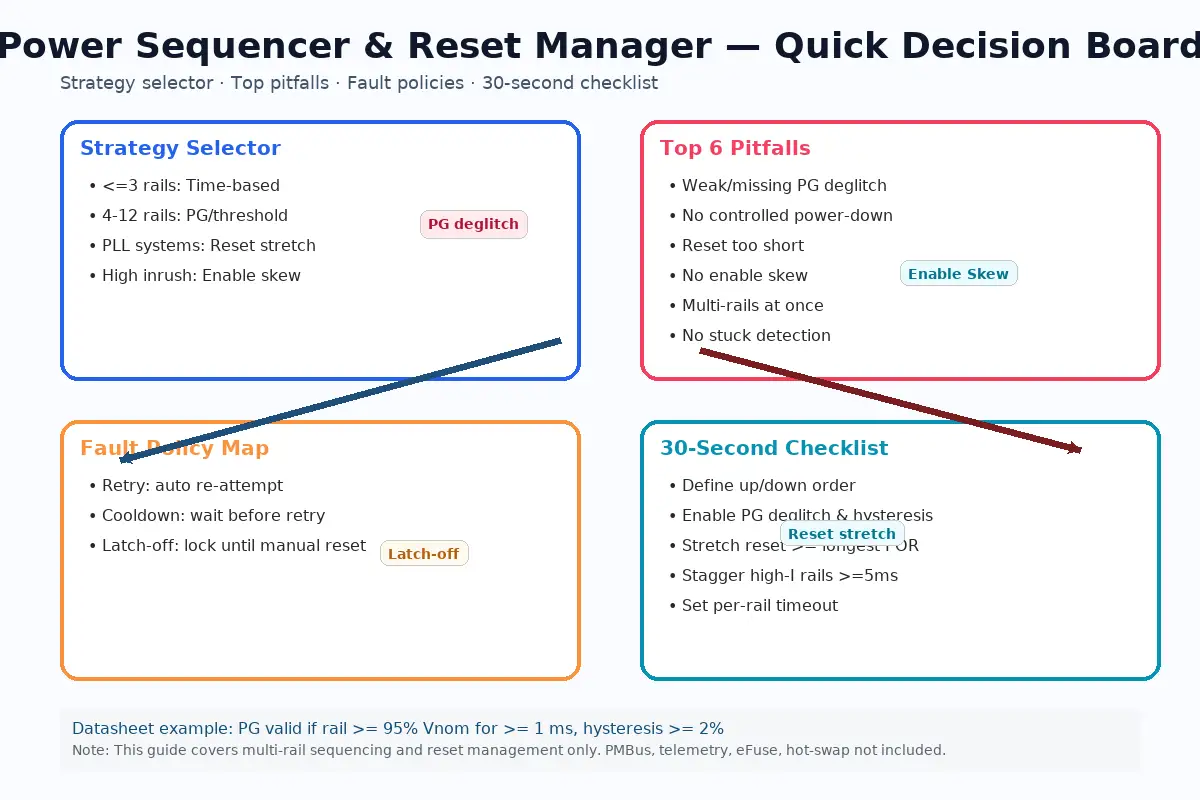
Power Sequencer & Reset Manager: Quick Answer
Select the right sequencing strategy, avoid classic pitfalls, and set robust fault handling—for reliable, multi-rail power design.
Strategy Selector
- ≤3 rails: Time-based sequencing
- 4–12 rails: PG/threshold-based
- PLL/clocked logic: Add reset stretch + PLL_LOCK
- High inrush: Stagger enable/skew per rail
Top 6 Pitfalls
- No or weak PG deglitch/hysteresis
- No controlled power-down order
- Reset too short for system startup
- No enable skew—inrush spike
- Multiple high-I rails start at once
- No detection for “stuck-half-on” state
Fault Policy Map
- Retry: Auto restart after timeout/cooldown
- Cooldown: Wait period before retry
- Latch-off: Lock until manual reset
30-Second Checklist
- Set both power-up and down order—never just one
- Enable deglitch and proper hysteresis for PG
- Stretch reset to match longest downstream POR
- Stagger high-I rails by at least 5–50 ms
- Set per-rail timeout and total bring-up deadline
What is a Power Sequencer & Reset Manager?
A power sequencer & reset manager is the control hub that ensures every power rail in a multi-voltage system is enabled and disabled in the correct order, with proper PG (power-good) validation, reset stretching, and explicit fault-handling logic. This guarantees that sensitive loads—like FPGAs, SoCs, DDR, and peripherals—start and stop safely under all real-world conditions.
- Sequencing: Up to 20+ rails, controlled enable and disable order
- PG validation: Threshold and window comparators with deglitch/hysteresis
- Reset stretching: Meet all downstream minimum reset and clock-lock times
- Fault policy: Retry, cooldown, latch-off, and controlled discharge
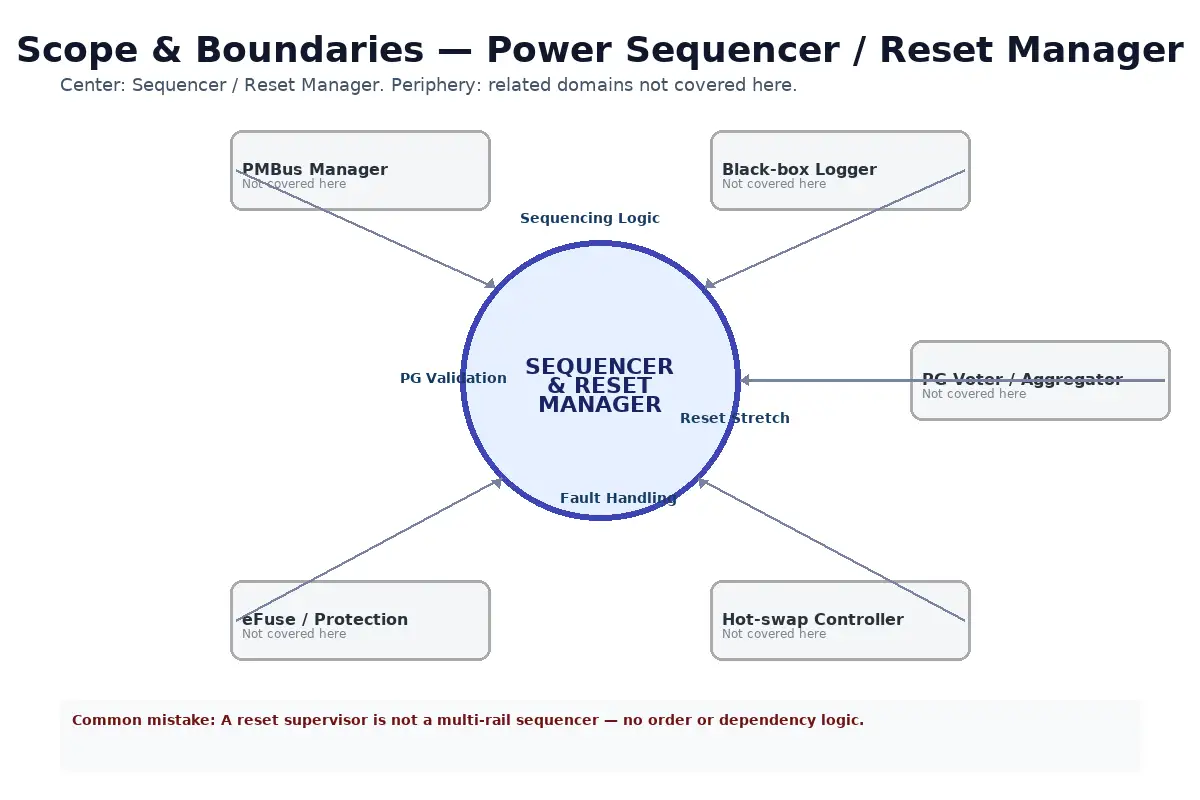
What is not included?
- PMBus/SMBus system power managers
- Black-box event loggers
- eFuse or hot-swap controllers
- PG aggregators and voting logic
Each of these has its own specialized control and is not covered in this guide.
FPGA/SoC Multi-Rail
PG = (Core ∧ PLL_LOCK ∧ IO)
DDR & MCU System
Controlled power-down: DDR last
PG = (MCU ∧ REF) → DDR
Multi-board Domain
System PG is the AND of all domains
PG = (Domain1 ∧ Domain2 ... ∧ DomainN)
System Overview & Working Principle
From a system viewpoint, power sequencing is a closed loop: qualified PG inputs enter a dependency graph, which schedules staggered EN and coordinates System_PGOOD and nRESET (aligned to PLL_LOCK). Any timeout/undervoltage triggers a fault policy: retry, cooldown, or latch-off, and a controlled reverse shutdown with discharge.
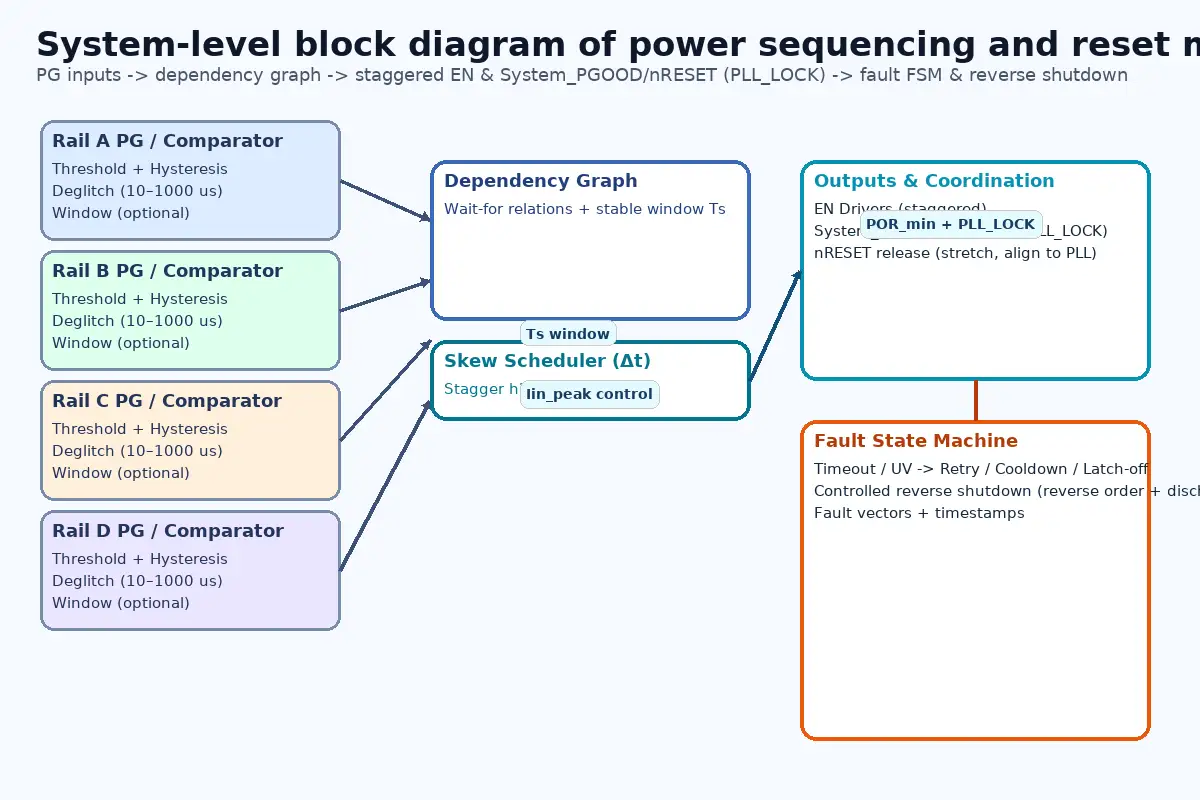
1) Inputs: PG & Sense Front-End
Each rail exposes a power-good source: device PG pin or comparator tap (remote or Kelvin sense). Before entering the scheduler, every PG must be qualified:
- Thresholds: typical 90–97% of Vnom, per-rail specific.
- Hysteresis: 0.5–5% of Vnom, sized against ripple and dV/dt noise.
- Deglitch: programmable 10–1000 µs; reject spikes without delaying protection.
- Window (optional): VLOW–VHIGH band defines the “ready region.”
The output of this stage is a set of PG_VALID[i] events (with timestamps) and PG_BAD[i] flags used for fault logic.
2) Dependency Graph & Stable Window
Rails are modeled as a directed acyclic graph where each node N declares prerequisites P(N). A node is ARMED when all P(N) have been PG_VALID for at least its stable-time window Ts(N).
- Stable window: prevents racing on just-crossed thresholds; typical 0.2–5 ms depending on load dynamics.
- Global skew Δt: staggers high-current rails (5–50 ms) to limit Iin_peak.
- Bring-up deadline: a total timeout budget avoids “forever wait.”
3) Outputs: EN, System_PGOOD, nRESET
- EN scheduling: assert ENN only after N is ARMED and its skew slot opens; verify with PG_VALID[N].
- System_PGOOD: logical AND of critical PG_VALID rails with PLL_LOCK.
- Reset stretch: hold nRESET low until max(PORmin) is satisfied and PLL_LOCK is high; optionally align release to a reference clock edge.
4) Fault Handling & Controlled Reverse Shutdown
- Timeout on bring-up: retry N times with cooldown Tc; otherwise latch-off.
- Run-time undervoltage: initiate reverse order shutdown with controlled discharge to prevent backfeed.
- Evidence: log the rail/fault vector and timestamps for post-mortem correlation.
| Parameter | Meaning | Typical | Notes |
|---|---|---|---|
| PG_TH% | PG threshold as % of Vnom | 90–97% | Per-rail; documented in spec |
| HYS% | Hysteresis width | 0.5–5% | ≥ 3× ripplepp% is a good start |
| TDG | PG deglitch timer | 10–1000 µs | Reject spikes, keep response fast |
| Ts(N) | Stable window per node | 0.2–5 ms | Prevents threshold racing |
| Δt | Global skew between rails | 5–50 ms | Limit inrush to budget |
PG Qualification & Filters
An engineering-grade PG is not “above a threshold once,” but “inside a ready window for long enough,” hardened by hysteresis and deglitch to reject ripple, ringing, and load steps.
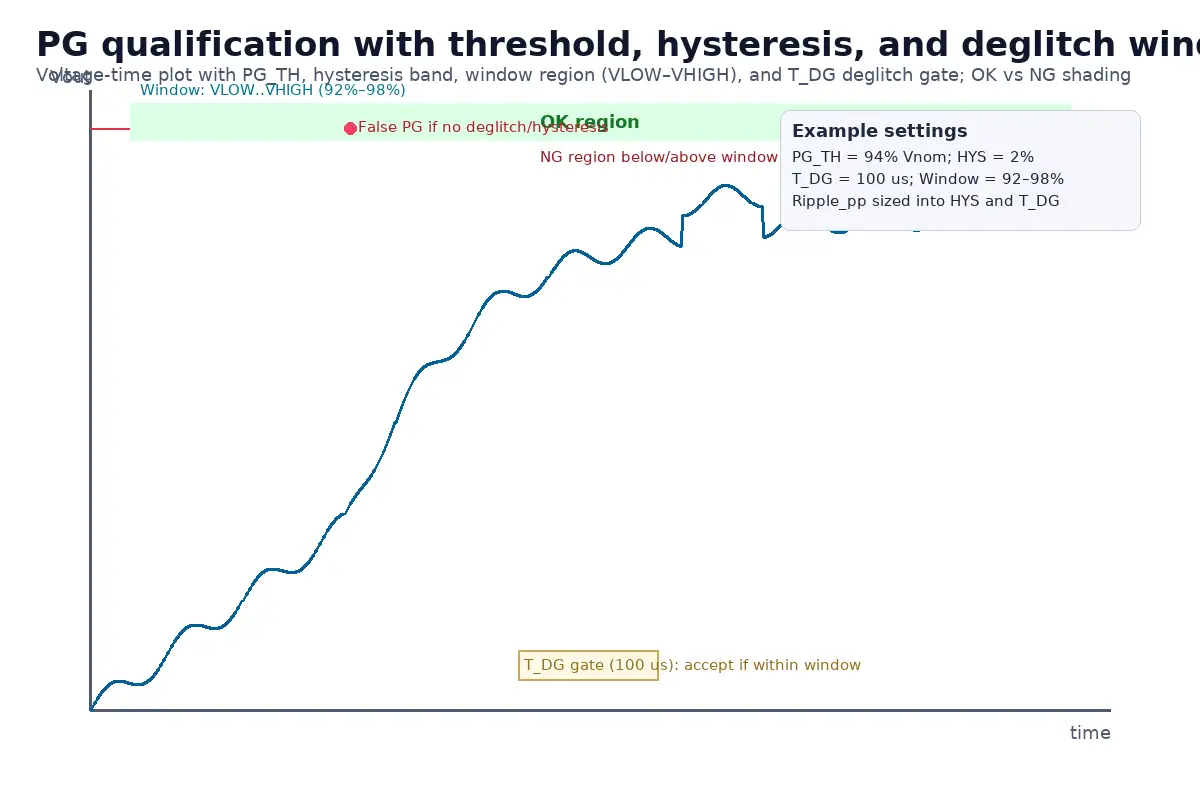
1) Thresholds & Hysteresis
- PG_TH: 90–97% of Vnom, documented per rail.
- HYS% sizing rule: choose HYS% ≥ max(3× ripplepp%, noise_guard%).
- Hysteresis prevents chatter near the boundary when load dI/dt or switching ripple is significant.
2) Deglitch Window (10–1000 µs)
- Pick TDG long enough to ride through the dominant ripple envelope (2–5 ripple periods).
- But keep it short enough not to delay fault response or total boot time.
- Document TDG per rail; fast CPU rails may use shorter windows than bulk rails.
3) Window Qualification (VLOW–VHIGH)
Declare PG_OK when VLOW ≤ VOUT ≤ VHIGH for at least TDG. Windows reduce false-ready caused by overshoot ringing or asymmetrical noise.
4) Ripple & Load-Step Impact
- Convert ripplepp to % of Vnom; size HYS% accordingly.
- If step response crosses PG_TH briefly, increase HYS or TDG, or add a small RC/IIR pre-filter.
- Improve grounding/return current routing to reduce ground bounce near the comparator reference.
| Parameter | Setting Guidance | Typical Value | Validation Note |
|---|---|---|---|
| PG_TH | Per rail based on load sensitivity | 0.94 × Vnom | Verify under worst ripple |
| HYS% | ≥ 3× ripplepp% | 2% | Tune for chatter margin |
| TDG | ≥ 2–5 ripple periods | 100 µs | Do not exceed fault budget |
| Window | Use for overshoot/ringing environments | VLOW=0.92; VHIGH=0.98 | Plot OK/NG shading |
| Pre-filter | RC or digital IIR (1-pole) | Cutoff near ripple peak | Avoid excessive phase lag |
Sequencing Strategies & Dependency Graph
Build a verifiable dependency DAG and a staggered enable plan. Choose between time-based, threshold-based, or hybrid chains to balance correctness, inrush, and boot time. Publish timestamps and inrush evidence so decisions are auditable.

1) Strategy Profiles
- Use when: tolerant digital trees; low analog sensitivity.
- Pros: simple, predictable code path. Cons: PVT drift; ignores ripple/bounce.
- Controls: min/max delay bounds; watchdog for “no-PG” timeout.
- Use when: FPGA/SoC/DDR, precision references, clock trees.
- Keys: qualified PG (threshold + hysteresis + deglitch) and Ts stable window.
- Per-rail: timeout budget; PG_VALID gating.
- Use when: mixed domains; need correctness plus bounded boot time.
- Pattern: PG_VALID ∧ (t ≥ tEN,min) ∧ (t ≤ tEN,max).
- Benefit: avoids early glitches and endless wait tails.
2) Dependency Graph (DAG)
Model rails as nodes; edges indicate prerequisites. A node N is ARMED when all P(N) are PG_VALID for at least its stable window Ts(N). Each node carries tEN,min/max, timeout, and a skew slot.
3) Enable Skew & Inrush Budget
- Choose Δt = 5–50 ms for high-current rails; allow bulk-cap recharge.
- Compute Iin,slot = ΣΔI of rails in that slot; enforce Iin,slot ≤ Ibudget.
- Rule: never place two high-I rails in the same slot.
4) Power-Down & Discharge
- Reverse the critical bring-up order; coordinate discharge paths per rail.
- Avoid backfeed via body diodes or pull-ups; clamp energy safely.
- Keep logging active until “black state” if hardware allows.
| Rail | Prereqs | Ts (ms) | tEN min/max (ms) | Skew slot | Timeout (ms) | Critical? |
|---|---|---|---|---|---|---|
| VCORE | — | 0.5 | 1 / 20 | S0 | 50 | Yes |
| VIO | VCORE | 0.5 | 2 / 25 | S1 (Δt=10) | 60 | Yes |
| VDDR | VCORE, VIO | 1.0 | 5 / 40 | S2 (Δt=10) | 80 | Yes |
| VANA | VCORE | 0.2 | 1 / 15 | S1 (Δt=10) | 40 | No |
Reset Management (POR/BOR, Stretch & Sync Release)
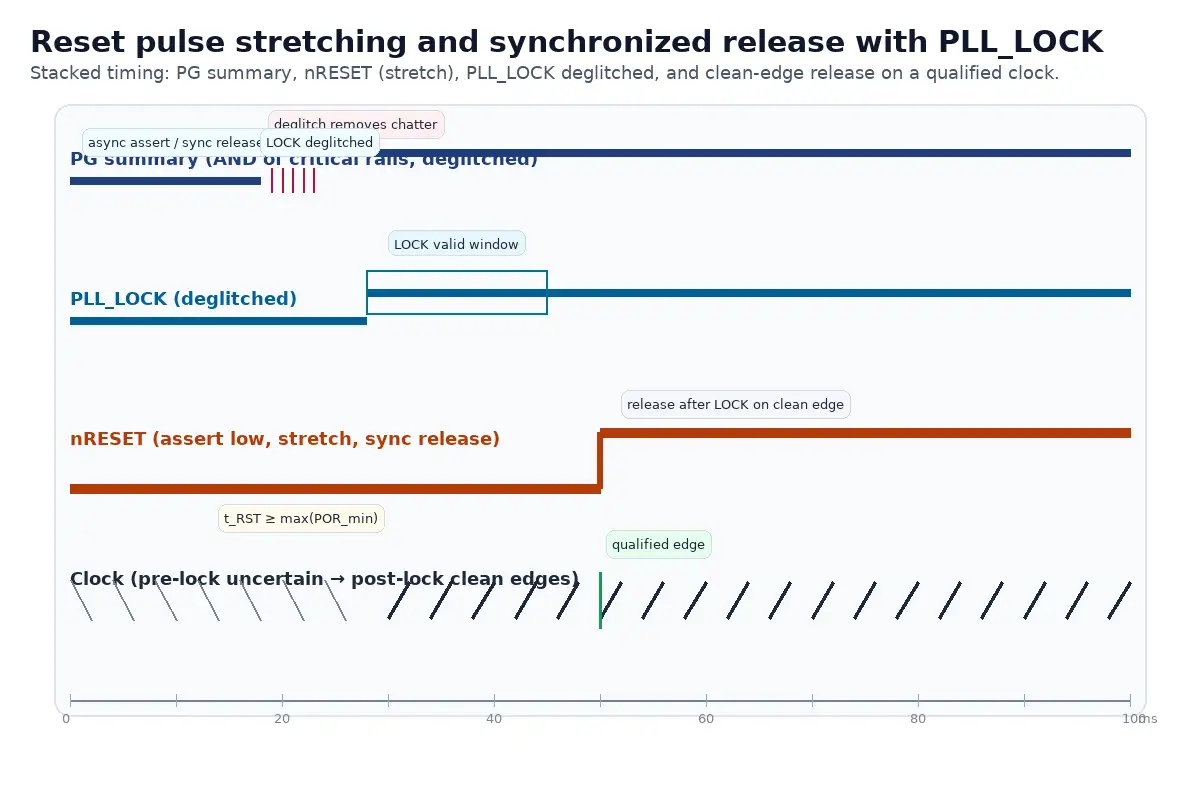
Guarantee reset width and release timing meet the strictest downstream tPORmin, under a clean clock after PLL_LOCK. Default to asynchronous assert and synchronous release. Arbitrate manual, watchdog, and PG-derived resets without glitches.
1) Reset Pulse Fundamentals
- Asynchronous assert: immediate reaction to BOR/PG loss.
- Synchronous release: re-time to system/always-on clock to avoid metastability.
- Pick the release clock consciously (fabric or AON) and document it.
2) Reset Stretching
- Set t_RST ≥ max(POR_min across critical domains); typical 10–100 ms.
- Add guard for PLL_LOCK settling and clock-tree enable latency.
- For multi-clock systems, stage releases: core → fabric → peripherals.
3) PLL_LOCK & Clean-Edge Release
- Require PLL_LOCK high and deglitched before release.
- Deassert nRESET on a qualified edge (1–2 reference cycles post-lock).
- If multiple PLLs: vote critical locks or define a composite LOCK.
4) Multi-Source Reset Arbitration
- Inputs: manual, watchdog, PG supervisor, optional thermal fault.
- Assert path is OR-wired; release path is synchronized and filtered.
- Log reset cause and duration; add cooldown to stop oscillations.
| Domain | POR_min (ms) | PLL used? | LOCK time (ms) | Required t_RST (ms) | Release clock | Cause log? |
|---|---|---|---|---|---|---|
| CPU | 20 | Yes | 8 | ≥ 28 | Ref clk | Yes |
| Fabric | 12 | Yes | 5 | ≥ 17 | Ref clk | Yes |
| DDR | 30 | Yes | 12 | ≥ 42 | Ref clk | Yes |
| Peripherals | 8 | No | — | ≥ 8 | AON clk | Optional |
Fault Policies & Safe Power-Down
Define a provably safe resolution path for timeout and undervoltage events. Bound retries with a cool-down, cap total bring-up with a global ceiling, and always execute controlled reverse shutdown with discharge to eliminate backfeed and tail current.

1) Timeout Model
- Per-rail timeout TTO[i]: max time to reach PG_VALID under its stable window Ts.
- Global ceiling TBOOT_MAX: prevents indefinite boot when dependencies never resolve.
- Abort rules: missing prerequisite PG_VALID, queue starvation, over-long skew slot wait.
- Evidence: log failing rail, elapsed time, dependency snapshot at timeout.
2) Retry with Cool-Down
- Fixed N retries: N=2–4 typical; cool-down Tcool allows bulk caps to recharge and thermal to settle.
- Exponential backoff: Tcool,k=T0·2k when source droop/thermal stress is suspected.
- Counters: maintain per-rail and global retry counts; stop oscillation across rails.
3) Latch-Off & Service Path
- Enter LAT-OFF when retries exhausted or on fatal faults(OV/OT/short).
- Re-arm: manual action, power cycle, or authenticated PMIC command.
- Black-box hooks: fault vector, last-N events, millisecond timestamps.
4) Controlled Reverse Power-Down
- Reverse the bring-up order; isolate first, then gate-off sources.
- Provide discharge paths(bleeders or PMIC FET discharge)to avoid tail voltage and backfeed.
- Tail V spec: V(t) below limit by Toff_spec; verify on scope and publish curves.
- Keep telemetry/logging alive until safe “black state” if supported.
| Rail | T_TO (ms) | Retries (N) | T_cool (ms) | Backoff | Discharge Path | Tail V @ T_off |
|---|---|---|---|---|---|---|
| VCORE | 50 | 3 | 150 | Exp (×2) | PMIC discharge FET | < 0.3 V |
| VDDR | 80 | 2 | 200 | Fixed | Bleeder 2 kΩ | < 0.5 V |
| VPERI | 60 | 4 | 120 | Exp (×2) | Load switch + Rpd | < 0.4 V |
Interlocks & Inrush Control
Constrain concurrency and cap input current peaks during bring-up. Use mutual-exclusion interlocks, grouped enables for small loads, and Δt staggering for heavy rails. Gate peripherals until System_PGOOD.

1) Mutual-Exclusion Interlocks
- Define conflict sets(e.g., {CPU_VCORE, DDR, GPU_CORE})that cannot overlap in time.
- Enforce with semaphore tokens or slot capacity limits in the scheduler.
- Record violations; auto-redistribute if deadlines allow.
2) Grouped Enables & Staggering
- Group small loads(refs, IO)in the same slot; isolate heavy rails with Δt=5–50 ms between slots.
- Compute Iin,slot = ΣΔI and enforce Iin,slot ≤ Ibudget per slot.
- Publish EN density per slot and total Tboot impact to justify trade-offs.
3) PG-Gated Loads
- Keep key peripherals off until System_PGOOD; then ramp using soft-start or controlled switches.
- Use reverse-block load switches or ideal diodes to prevent sneak currents.
| Slot | Rails in Slot | ΣΔI (A) | I_in,slot (A) | I_budget (A) | OK? | Notes |
|---|---|---|---|---|---|---|
| S0 | VCORE | 1.6 | 1.6 | 2.0 | Yes | Heavy rail isolated |
| S1 (Δt=10 ms) | VIO, VANA | 0.6 | 0.6 | 2.0 | Yes | Grouped small loads |
| S2 (Δt=10 ms) | VDDR, VPERI | 1.1 | 1.1 | 2.0 | Yes | Meets I_budget |
Validation & Bring-Up Procedure
The goal is to elevate a “working” sequence into a provable and repeatable process with auditable evidence and pass/fail guardrails covering power-up, power-down, and fault handling.
Why validation matters
If it isn’t timestamped, it didn’t happen. Robust systems record EN/PG/RESET/PLL_LOCK edges, verify limits across corners, and leave a trail of CSV logs and scope captures that manufacturing can reproduce.
Baseline bring-up script (repeatable steps)
- Prepare probes for EN_x, PG_x, RESET, PLL_LOCK; define rail list and dependency order.
- Start capture; apply input power; record rising and falling edges with timestamps (ms resolution or better).
- Log PG deglitch counters and any chatter under a controlled load step (small-signal and large-signal).
- Enforce per-rail timeouts and a global bring-up deadline; if violated, trigger fault policy and log the state.
- Export a CSV per run: columns include run_id, rail, event, t_stamp_ms, value, result, notes.
run_id,rail,event,t_stamp_ms,value,result,notes
B01,Core,EN_rise,0.0,1,pass,—
B01,Core,PG_rise,8.7,1,pass,deg=0
B01,PLL,LOCK_rise,11.2,1,pass,—
B01,System,RESET_fall,15.0,0,pass,stretch=20ms
Limits & guardrails (min/max windows)
Define explicit pass/fail bands for thresholds, deglitch, hysteresis, reset stretch, skew, and timeouts. Any out-of-band event must deterministically trigger the configured fault policy.
| Metric | Min | Max | Method | Notes |
|---|---|---|---|---|
| PG “good” threshold | ≥ 95% Vnom | ≤ 98% Vnom | Scope + divider | Window + hysteresis ≥2% |
| PG deglitch | ≥ 50 µs | ≤ 200 µs | Glitch inj + counter | Tune vs. ripple |
| Reset stretch | ≥ longest POR | + PLL_LOCK margin | Edge cursoring | Async assert, sync de-assert |
| Enable skew per rail | ≥ 5 ms | ≤ 50 ms | Current probe | Inrush envelope control |
| Per-rail timeout | ≥ 1 ms | ≤ 1000 ms | Timer + log | Triggers fault policy |
Force-fault & test-mode patterns
- UV/timeout injection: pull a rail below the PG window or delay its ramp; verify retry/cooldown/latch-off.
- Stuck-half-on: PG never validates; confirm safe reverse power-down and discharge path.
- Recovery: manual reset path after latch-off; log the recovery timestamp.
Corner coverage (temperature/load/ripple)
- Temperature: cold/hot (e.g., −40/85/105 °C) with identical scripts and limits.
- Load: min/max current, fast steps; capture PG chatter and input droop.
- Ripple spectra: worst-case switching noise; confirm deglitch and hysteresis immunity.
Evidence pack & sign-off
A releaseable bundle that manufacturing can replay:
- Scope screenshots with edge cursors for EN/PG/RESET/PLL_LOCK.
- CSV timestamp logs for bring-up, faults, and recovery runs.
- Corner matrix report summarizing pass/fail and margins.

Key Metrics & Selection Matrix
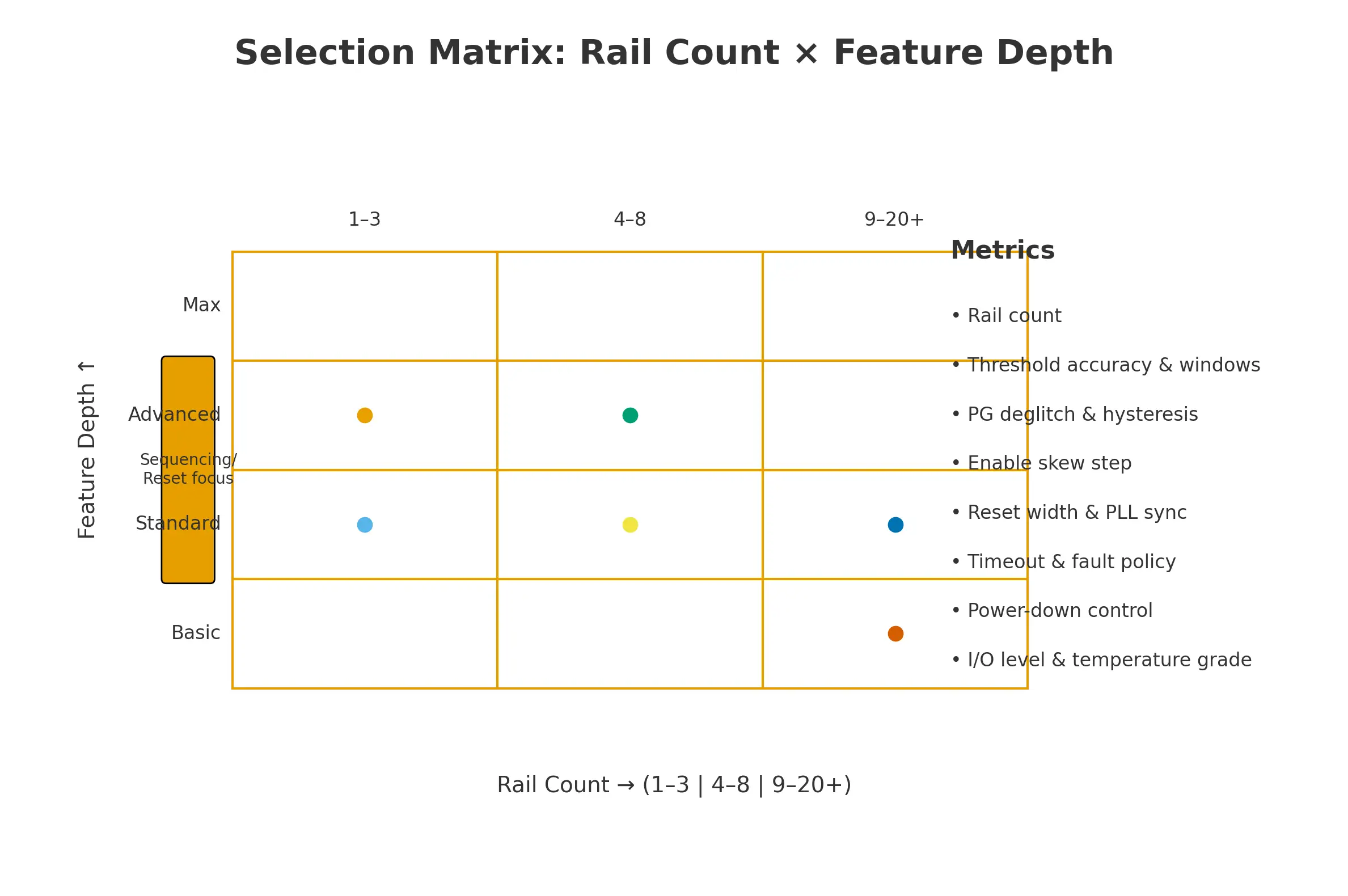
Turn raw specifications into scenario-driven choices. Start with rail count, then match accuracy, reset features, and fault policy, finally align I/O levels and temperature grade to your environment.
Key metrics explained
- Rail count supported: 3–20+; grouping and staged enables.
- Threshold accuracy & windowing: single threshold vs. window comparator; define hysteresis.
- PG deglitch & hysteresis: noise immunity vs. detection latency.
- Enable skew granularity: ms steps for inrush control; stagger heavy rails.
- Reset pulse & sync: async assert, synchronous de-assert; PLL_LOCK awareness.
- Timeout & fault policy: retry/cooldown/latch-off behaviors.
- Controlled power-down & discharge: reverse order, no backfeed.
- I/O levels: 1.8/3.3/5 V tolerance and logic domain alignment.
- Temperature grade: −40…+105/125 °C for industrial/automotive spans.
Selection path
- Fix rail count (and grouping) first—this sets architectural bounds.
- Choose threshold accuracy/windowing if rails interact tightly (FPGA/DDR/refs).
- Require reset stretch & sync for clocked logic or firmware bring-up.
- Pick fault policy to meet safety/availability goals (retry vs. latch-off).
- Match I/O level to the logic domain; then lock temperature grade.
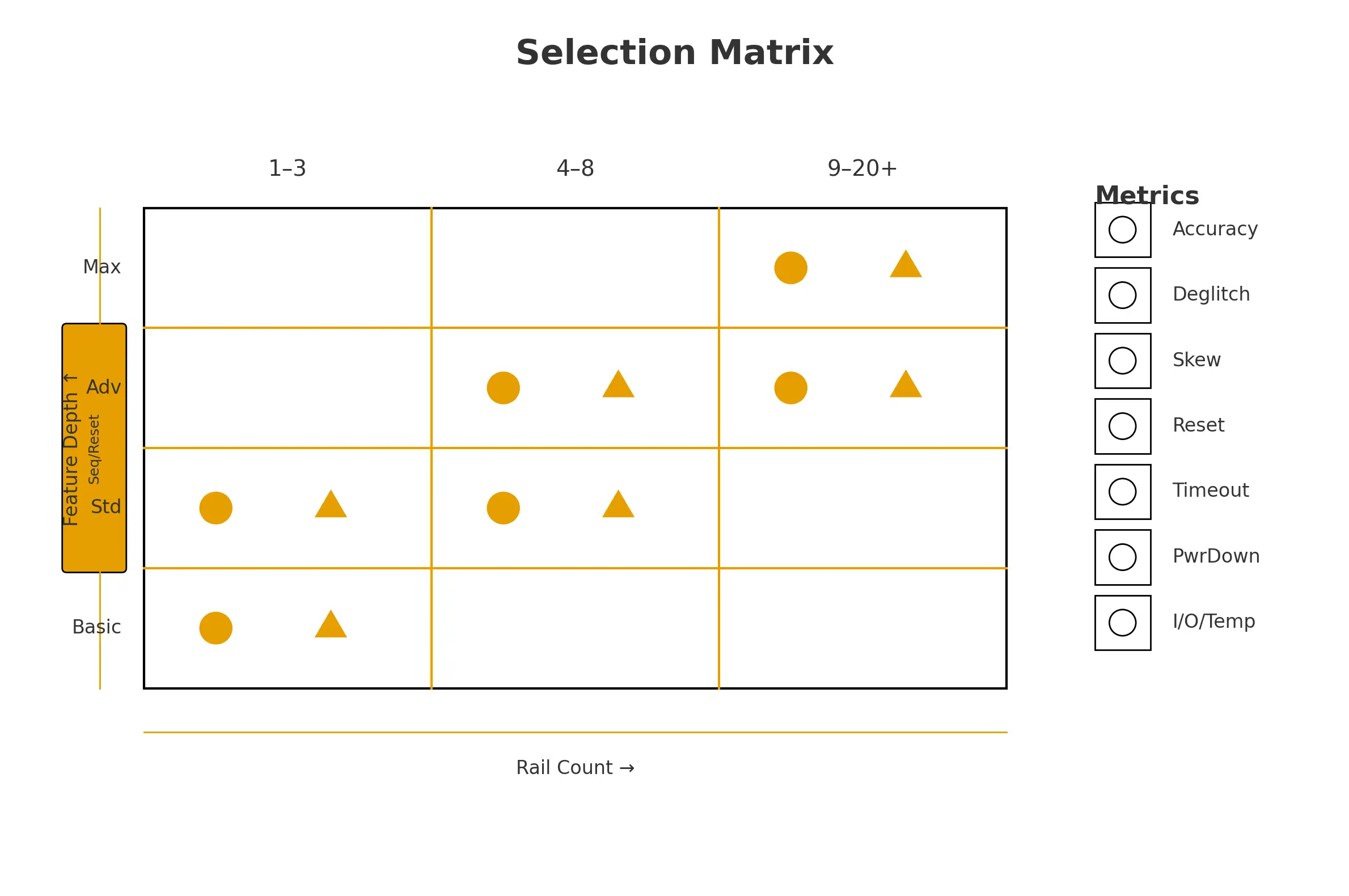
Selection matrix (rail count × feature depth)
| Rail Count | Accuracy & Windows | PG Deglitch / Hysteresis | Enable Skew Step | Reset & PLL_SYNC | Timeout & Policy | Power-Down Control | I/O & Temp |
|---|---|---|---|---|---|---|---|
| 1–3 rails | Basic threshold OK | Short deglitch, small hysteresis | Coarse (≥5 ms) | Minimal reset stretch | Simple timeout + retry | Basic reverse order | Match logic level; −40…85 °C |
| 4–8 rails | Window comparator preferred | 50–200 µs; ≥2% hysteresis | Medium (5–20 ms) | Stretch to longest POR; PLL_LOCK aware | Timeout + cooldown/retry | Controlled discharge paths | 1.8/3.3/5 V tolerant; −40…105 °C |
| 9–20+ rails | Tight accuracy; window + trims | Programmable deglitch; robust hysteresis | Fine (≤10 ms per step) | Async assert; synced de-assert; PLL gating | Per-rail timeout; latch-off for safety | Reverse order + backfeed protection | Level-shifting as needed; −40…125 °C |
Production lock & audit
- Freeze parameters: thresholds, hysteresis, deglitch, enable skew, reset width, timeouts, power-down order.
- Read-only checksum/signature: store configuration integrity for factory QA.
- Conformance sheet: one page with limits, test points, and acceptance criteria.
Design Guidelines (10 Hard Rules)
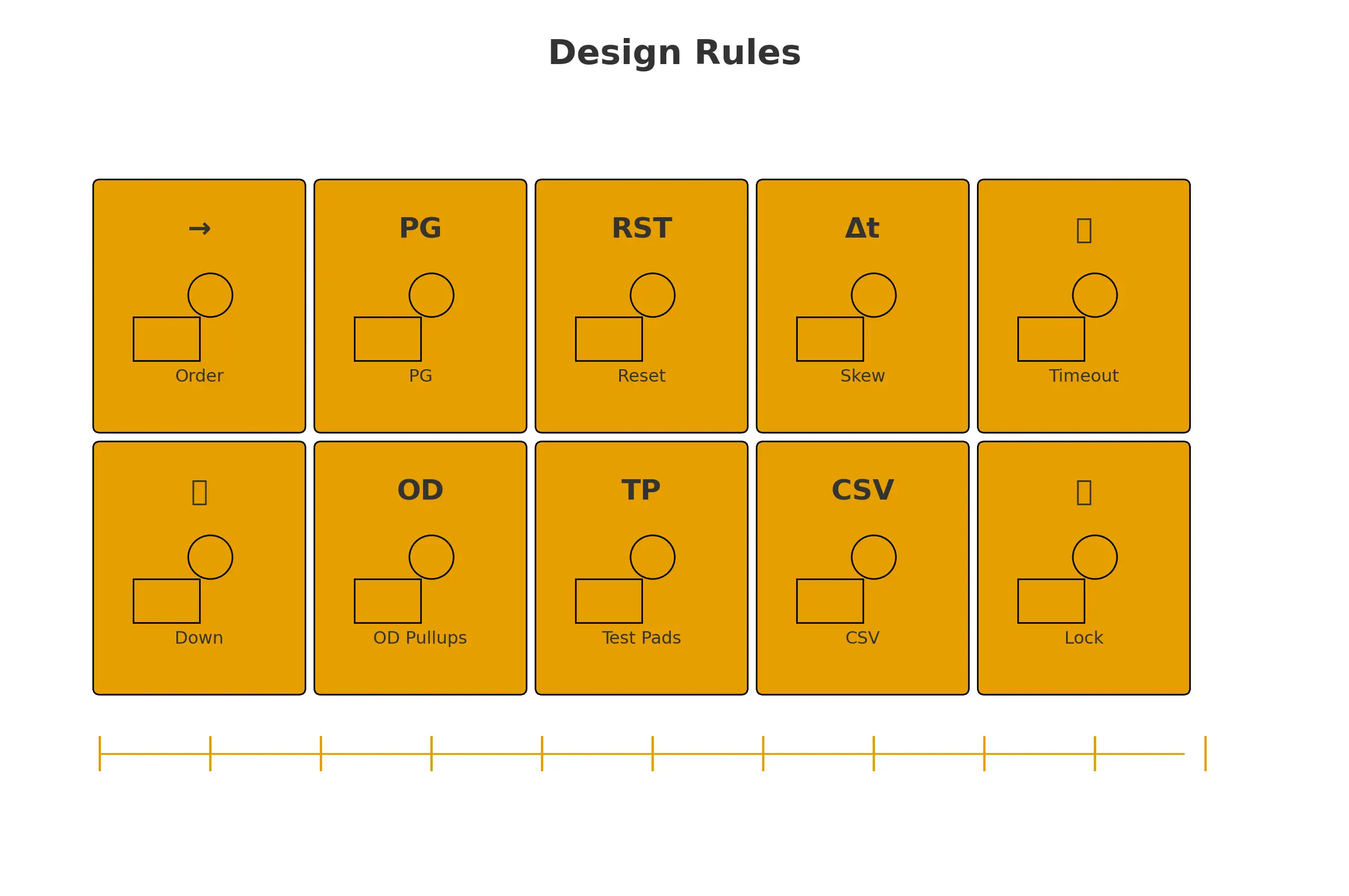
Apply the rules below to turn a “working” power sequence into a provable, repeatable, and manufacturable behavior with measurable margins.
1) Set power-down order first
Define reverse order explicitly; design for safe discharge and no backfeed.
- Reverse order documented and versioned
- Size discharge paths for stored energy
- Backfeed prevention verified on scope
2) PG requires deglitch + hysteresis
Noise immunity without adding false latency.
- Window target ≥2% hysteresis
- Deglitch 50–200 µs typical
- Validate vs. worst ripple spectra
3) Reset stretch ≥ strictest POR; sync to PLL_LOCK
Guarantee reset integrity across all domains.
- Async assert; synchronous de-assert
- Guard-time beyond PLL lock
- Verify under cold/hot corners
4) Stagger enables to control inrush (5–50 ms)
Don’t let heavy rails start together.
- Heaviest rails last
- Target surge < 1.2× steady-state
- Measure input current profile
5) Per-rail timeouts + global bring-up deadline
Never allow indefinite half-on states.
- Timeout triggers policy immediately
- Global deadline caps total sequence
- Log both to CSV with run_id
6) Controlled power-down + discharge; forbid backfeed
Shut down safely every time.
- Reverse order is enforced in silicon
- Discharge FETs/res sized for energy
- Backfeed test included in QA
7) PG/RESET open-drain with proper pull-ups; clean routing
Robust logic interfacing and signal integrity.
- Matched logic domains and levels
- RC not so large it masks faults
- Short, direct traces; common reference
8) Reserve test pads and divider taps
Measurability is non-negotiable.
- Probe points for EN/PG/RESET
- Scaled rail monitor for scopes
- Label nets for factory inspection
9) Script your bring-up; keep CSV + waveforms
Evidence proves repeatability and margins.
- EN/PG/RESET/PLL_LOCK timestamps
- PG glitch counters and chatter
- Run IDs, corner tags, pass/fail
10) Freeze production parameters + read-only checksum
Lock what you verify; verify what you lock.
- Thresholds, hysteresis, deglitch, skew
- Reset width, timeouts, power-down order
- Store signature for QA conformance
Troubleshooting Matrix
Resolve issues through a closed loop from symptom to observable fields to root cause to action. Always capture timestamps for EN/PG/RESET/PLL_LOCK, PG glitch counters, and input current peaks in CSV and scope shots.
| Symptom | Trigger Condition | Observable Fields | Likely Cause | Corrective Action |
|---|---|---|---|---|
| Power-up stuck | Rail_X timeout | Timestamps: EN_X→PG_X delta; Counters: PG glitches; Thresholds: window width | PG window too tight; insufficient deglitch | Loosen window; increase deglitch; validate ramp slope |
| Intermittent self-reset | Load step / ripple | Timestamps: RESET asserts vs. PG chatter; Counters: chatter spikes | Insufficient hysteresis/deglitch; weak decoupling | Add hysteresis and deglitch; improve decoupling |
| DDR training fails | Reset too short / unsynced | Timestamps: RESET width vs. POR; Flags: PLL_LOCK present? | Reset stretch below requirement; no PLL sync | Stretch and synchronize reset to PLL_LOCK |
| Start-up overcurrent | No stagger | Peaks: input surge vs. steady-state; Timestamps: EN overlaps | Simultaneous heavy rails | Increase EN skew; reorder heavy rails to last |
| Large shutdown tail current | No discharge path | Timestamps: power-down order; Paths: backfeed detection | Backfeed path; uncontrolled discharge | Add controlled discharge and isolation; enforce reverse order |
| Random lock-up | Dependency conflict | Graph: illegal dependency; Timestamps: PG ordering vs. logic release | Contradictory rail dependencies | Clarify dependencies; add mutual exclusion; delay logic release |
Applications & Schematics
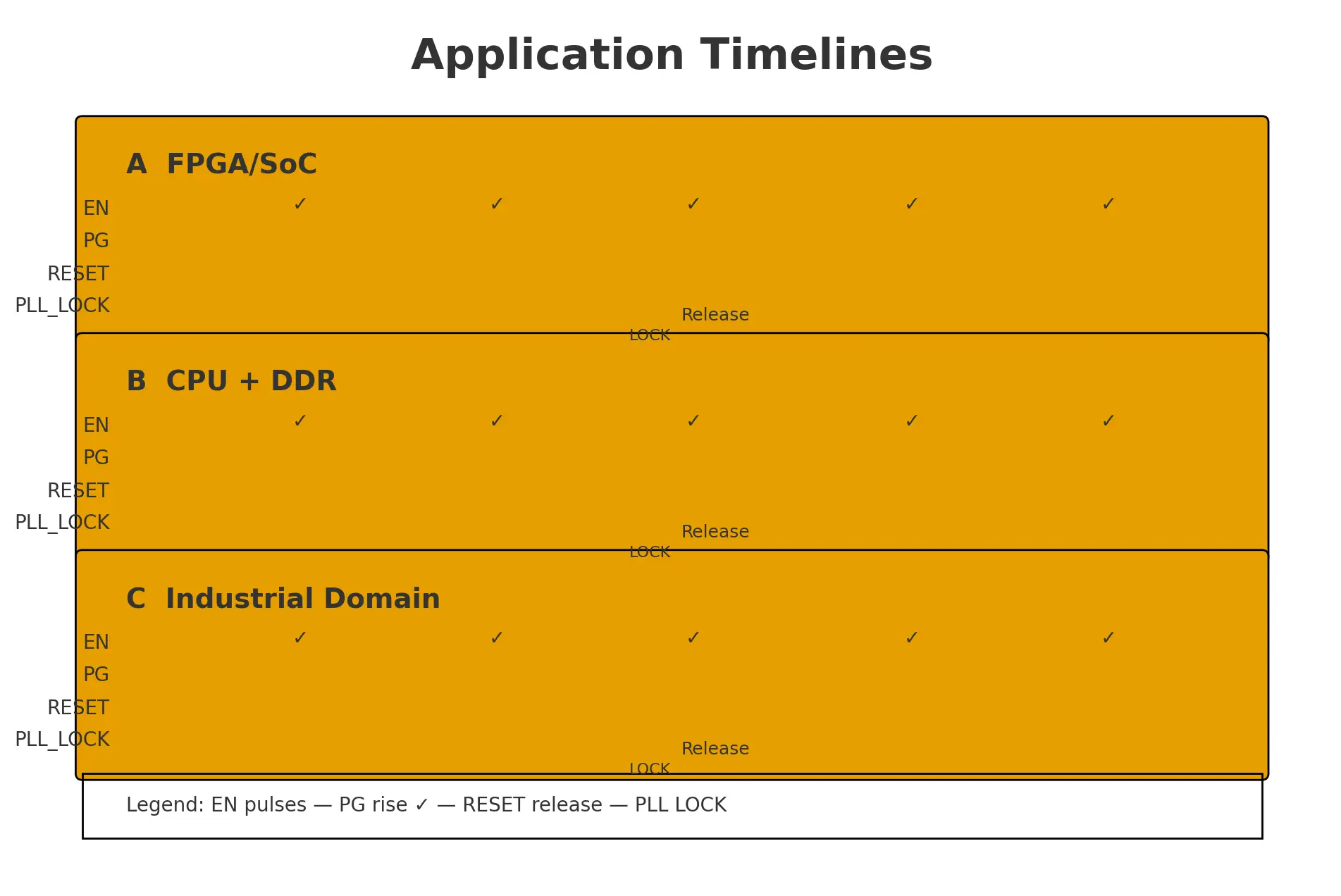
Apply sequencing and reset discipline to three representative systems. Scope is strictly sequencing & reset (no PMBus managers, eFuse, hot-swap, or unrelated helpers). Each application shows a gating formula, safe release of nRESET, and a reverse power-down pattern that prevents backfeed.
A) FPGA/SoC Multi-Rail
Sequence: Core → PLL/BRAM → Aux → IO → DDR
System_PGOOD: (Core_OK ∧ Aux_OK ∧ IO_OK ∧ DDR_OK ∧ PLL_LOCK)
nRESET release: After System_PGOOD with reset stretch ≥ strictest POR; de-assert synchronous to system clock.
- PG window 95–98% Vnom; ≥2% hysteresis
- Deglitch 50–200 µs; tune to ripple
- Enable skew 5–20 ms; heavy rails later
Reverse power-down: DDR → IO → Aux → PLL/BRAM → Core with controlled discharge paths.
B) CPU + DDR + Peripherals
Sequence: REF/CORE first → DDR next → Peripherals last
System_PGOOD: (CORE_OK ∧ REF_OK) then gate DDR; peripherals gate on DDR_OK.
nRESET release: After DDR rails pass PG and training prerequisites; include PLL_LOCK margin.
- DDR VTT/VREF windows ±2–3%
- Reset stretch ≥ DDR training requirement
- Deglitch tuned per DDR vendor timing
Reverse power-down: Peripherals → DDR (controlled VTT/VREF discharge) → CORE/REF.
C) Industrial Domain / Backplane
Sequence: Bring domain rails to OK, then assert Domain_PGOOD for interop to the backplane.
Maintenance: Force-Fault / Bypass ports to reproduce/clear faults without firmware.
- Enable skew 10–50 ms for bulky loads
- Isolation for no backfeed into adjacent domains
- Clear Domain_PGOOD rules and timeouts
| Application | PG Window | Deglitch | Enable Skew | Reset Stretch | Notes |
|---|---|---|---|---|---|
| A) FPGA/SoC | 95–98% Vnom; ≥2% hyst | 50–200 µs | 5–20 ms | ≥ strictest POR + PLL_LOCK | Heavy rails last; DDR reverse-down last |
| B) CPU+DDR | VTT/VREF ±2–3% | Vendor-timing tuned | 5–15 ms | Covers DDR train + PLL | Peripherals after DDR_OK |
| C) Industrial Domain | 95–97% Vnom; robust hyst | 100–300 µs | 10–50 ms | Per backplane sync | Domain_PGOOD advertised after local OK |
Reference IC Selection Notes
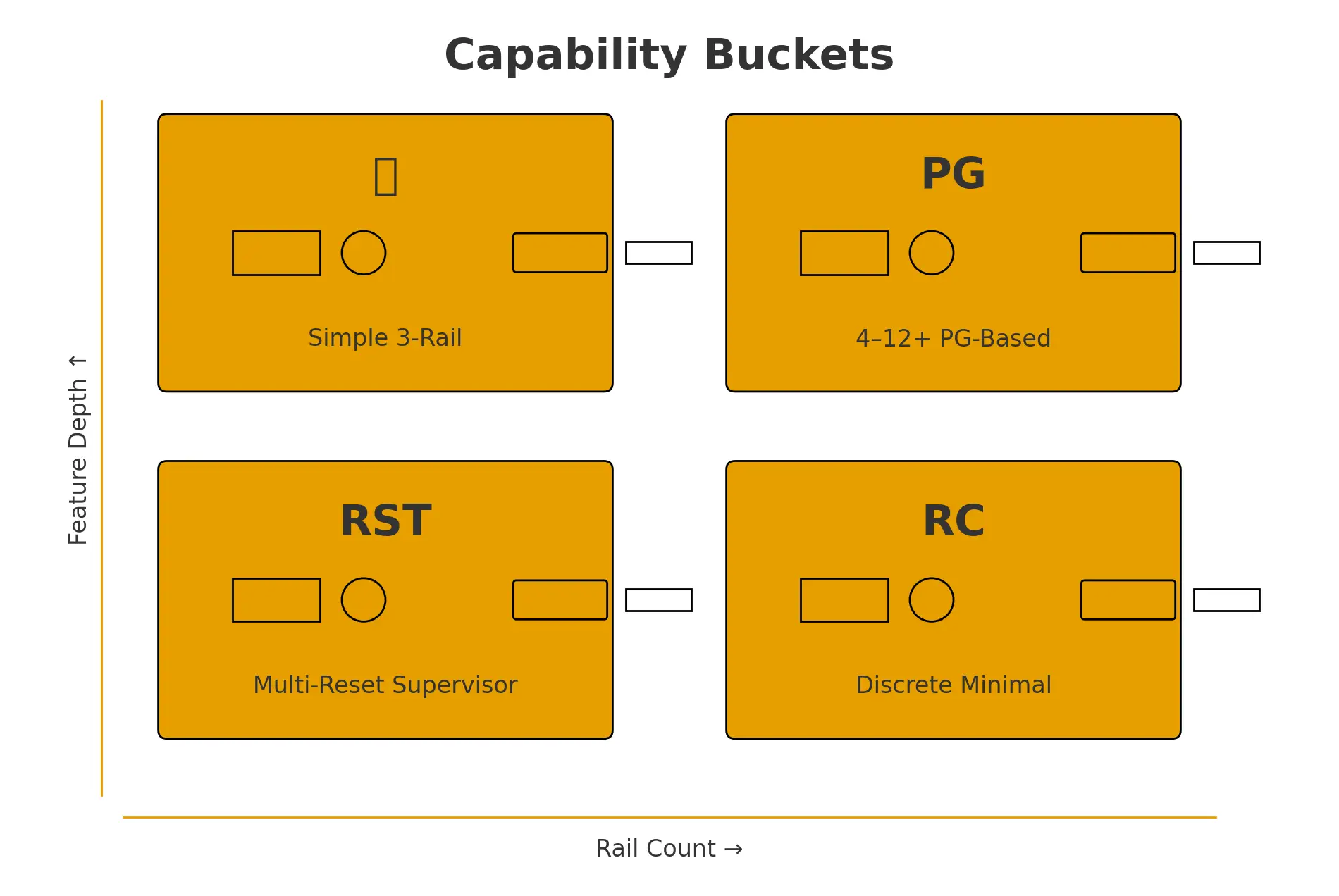
Choose by needs, not by brand: rail count, PG/threshold quality, deglitch/hysteresis programmability, reset stretch/sync, timeouts/fault policy, controlled power-down, I/O levels, and temperature grade. Keep BOM hooks explicit.
Simple 3-Rail Sequencer
Time-based; coarse skew; minimal dependencies.
4–12+ Rail PG-Based
Threshold windows, dependencies, timeouts, skew.
Multi-Reset Supervisor
Windowed thresholds, reset stretch, POR guards.
Discrete Minimal
Comparators + RC + logic + open-drain ORing.
| Bucket | Rail Count | Threshold/PG | Deglitch/Hysteresis | Reset & Sync | Timeout/Policy |
|---|---|---|---|---|---|
| Simple 3-Rail | 1–3 | Basic | Fixed/limited | Basic stretch | Simple retry |
| 4–12+ PG-Based | 4–12+ | Windowed | Programmable | Stretch + PLL sync | Timeout + policy |
| Multi-Reset Supervisor | 1–6 | Windowed | Fixed/trim | Strong stretch | Reset policy only |
| Discrete Minimal | N/A | Comparator + RC | RC-defined | Discrete logic | Discrete state |
Seven Vendor Examples (PNs & Rationale)
Texas Instruments
UCD90120A / UCD9090A — 10–12 rail sequencer/monitor (dependencies, timeouts, PG deglitch).
TPS386000 / TPS386596 — multi-rail reset supervisors (windowed thresholds, stretch).
Reason: mature multi-rail control and robust reset features for 4–12+ rail architectures.
Analog Devices (incl. LTC/Maxim)
LTC2977 / ADM1266 — power system manager/sequencer; precise supervision, rich dependencies.
LTC2937 / LTC2928 — multi-rail sequencer/supervisor for PG-based order control.
Reason: high accuracy windows, programmable deglitch/hysteresis, complex trees.
Renesas (ex-Intersil)
ISL880xx / ISL9000-series — windowed reset supervisors with stretch.
ISL70321 / ISL70323 — multi-channel supervisors (industrial/hi-rel options).
Reason: broad supervisor portfolio, strong POR behavior across grades.
Microchip
MCP1316/17 / MIC803 — precise supervisors with delay/stretch options.
MCP100/101 — ultra-simple single-rail supervisors for discrete minimal builds.
Reason: proven resets; easy to pair with comparator+logic sequencing.
STMicroelectronics
STM706 / STM809 / STM810 — supervisors with selectable thresholds/delays.
STPMIC1 (sequencer outputs) — use exposed sequence outputs within scope.
Reason: ubiquitous supervisors; platform PMICs with usable sequence signaling.
onsemi
NCP30x / NCP31x — supervisors with wide threshold options.
NCP3985 — helper for controlled power-down/ideal-diode paths in discrete builds.
Reason: commodity supervisors + practical shutdown helpers.
NXP
MC33907/MC33908 PMIC — use sequencer outputs; keep within page scope.
FS6500 / safety PMICs — sequencer/reset depth aligned to safety needs.
Reason: platform PMICs that expose sequencing useful for CPU/auto systems.
BOM Hooks
- PG/RESET pull-ups sized to logic level; avoid RC so large that it hides faults.
- Discharge resistors/FETs sized for stored energy; verify thermal profile.
- Open-drain ORing/isolators for safe PG combine and contention-free aggregation.
FAQ — Power Sequencers & Reset Managers
Answers focus strictly on sequencing and reset. Each item gives a decision, how to verify, and a practical acceptance line you can reproduce on the bench.
When should I choose time-based vs threshold-based sequencing?
Use time-based for ≤3 rails and tolerant loads; it’s simple but less adaptive to ramp and ripple. Choose threshold-based for 4–12+ rails or tight dependencies, using PG windows, hysteresis, deglitch, and timeouts. Mixed schemes are common: coarse delays for minor rails, PG-gated release for Core/DDR/PLL domains to prevent false-ready and inrush coupling.
How long should RESET be stretched?
Stretch RESET for at least the strictest downstream POR plus guard time, and de-assert synchronously to the target clock after PLL_LOCK. Validate across cold/hot corners and minimum ramp rates. Acceptance: worst-case POR time + margin always passes, and training-sensitive subsystems (e.g., DDR) show repeatable success without spurious reasserts.
What PG deglitch value is appropriate?
Start at 50–200 µs and tune to the rail’s ripple spectrum and load-step behavior. Pair with ≥2% hysteresis so chatter is rejected without masking genuine brownouts. Verify by injecting load transients and counting PG glitches. Acceptance: zero false “OK” across corners with deglitch short enough not to delay legitimate faults or RESET release.
How do I avoid start-up inrush peaks?
Stagger enables by 5–50 ms with the heaviest rails last. Measure the upstream supply; target surge ≤1.2× steady-state. If limits are exceeded, increase skew, slow problematic ramps, or reorder rails. Acceptance: surge remains below the limit at cold/hot and min/max load, and earlier rails do not brown out during subsequent rail starts.
Why must I define the power-down order?
Reverse order prevents backfeed paths and undefined logic states. Provide controlled discharge for energy-dense rails and hold RESET active until essential domains decay. Acceptance: tail current follows a predictable profile, no phantom powering appears on I/O rails, and power-down is reproducible in corner conditions without violating domain dependencies.
How do I detect “half-on” or stuck mid-sequence states?
Add per-rail timeouts and a global bring-up deadline. If any rail misses PG in time, assert a fault, unwind safely, and log timestamps. Acceptance: the system never idles indefinitely in a partially powered state; it either reaches READY with System_PGOOD or transitions to a defined fault state with evidence stored for review.
Should RESET be synchronized to the clock?
Yes. Assert asynchronously for speed, but de-assert synchronously to the destination clock domain, and after PLL_LOCK. This minimizes metastability and erratic training. Acceptance: oscilloscope shows edge-aligned release without runt pulses, and corner testing reveals no unexplained resets or configuration errors following READY transitions.
How much margin should thresholds leave from nominal voltage?
Aim for a 95–98% Vnom PG window with ≥2% hysteresis, then verify against ripple, droop, and load steps. For DDR VTT/VREF, follow vendor windows (often ±2–3%). Acceptance: no false-ready during ripple bursts; real undervoltage events still trigger, and RESET remains consistent across environmental corners.
How do I declare “system ready” when DDR is present?
Gate System_PGOOD as “all essential rails OK ∧ PLL_LOCK.” Release nRESET only after DDR rails pass PG and any training prerequisites. Acceptance: DDR training succeeds repeatedly across cold/hot and min/max load, System_PGOOD shows no chatter, and resets never race with PLL lock acquisition.
What evidence should I retain from bring-up and validation?
Keep CSV logs with EN/PG/RESET/PLL_LOCK timestamps, PG glitch counts, and scope screenshots for corner runs. Tag each run with an ID and pass/fail status. Acceptance: any engineer can reproduce the procedure and reach the same conclusions; margins are visible in artifacts, not implied by anecdotal tests.
How do I choose an appropriate fault policy (retry, latch-off, cooldown)?
For benign loads, limited retries with cooldown can recover transient faults. For safety or high downstream cost, prefer latch-off and explicit service action. Acceptance: policy aligns to hazard analysis, prevents restart storms, and logs show clear cause/effect, including which rail violated timing or thresholds.
How should I pick enable skew between rails?
Start with 5–20 ms for digital rails, 10–50 ms for bulky or analog loads. Measure upstream surge and interaction with earlier ramps; place high-current rails later. Acceptance: surge stays under limit; no early rail brownouts; PG edges remain stable when subsequent rails start under worst-case loading.
Do I need controlled discharge for shutdown?
Yes—rails with significant capacitance or shared I/O must discharge predictably. Provide discharge resistors/FETs sized for stored energy and enforce reverse order. Acceptance: tail current decays along a defined profile; no backfeed is observed; RESET remains asserted until essential domains are truly inactive.
How should I wire PG and RESET—push-pull or open-drain?
Prefer open-drain/open-collector with correct pull-ups to the logic domain. It enables safe OR-ing of PG sources and avoids contention. Keep traces short and clean; choose RC values that do not hide genuine faults. Acceptance: monotonic edges, no cross-domain leakage, and clear logic levels across temperature.
What’s the minimal viable verification script for sequencing?
Record EN/PG/RESET/PLL_LOCK edges, compute inter-event deltas, enforce per-rail timeouts and a global deadline, and count PG glitches during induced steps. Save CSV per run with corner tags. Acceptance: scripts yield identical pass/fail decisions on any bench unit and expose margins rather than anecdotes.
When is a discrete comparator + logic scheme acceptable?
Use discrete comparators, RC timing, and open-drain logic for ≤3 rails or gentle dynamics with wide thresholds. Validate hysteresis and deglitch explicitly. Acceptance: the same evidence standard applies—timestamps, glitch counts, surge checks—and results remain stable across corner conditions without complex sequencing silicon.

Related Articles
- ·HBM3E vs. HBM4: What Changes for Bandwidth, Interface Width, and Packaging
- ·HBM Explained: Why High-Bandwidth Memory Is Critical for AI Accelerators
- ·Beyond Capacity: Why Bandwidth and Power Efficiency Now Define Memory Value
- ·Understanding Memory Price Cycles: Key Drivers Behind Supply and Demand Shifts
- ·DRAM vs. NAND: How AI Demand Is Reshaping the Memory Industry
- ·HBM Explained: Why High-Bandwidth Memory Is Critical for AI Accelerators
- ·Beyond Capacity: Why Bandwidth and Power Efficiency Now Define Memory Value
- ·Understanding Memory Price Cycles: Key Drivers Behind Supply and Demand Shifts
- ·DRAM vs. NAND: How AI Demand Is Reshaping the Memory Industry
- ·Memory Chip Market Outlook: What Buyers Should Watch Heading into Q4





.png?x-oss-process=image/format,webp/resize,h_32)


