
 German
 Japanese
 Portuguese
 Korea
Korea
 Mexico
 Dutch
Dutch


Voltage Comparator: Deep Guide

Quick Browse
What & When
A voltage comparator is an analog decision device that compares two input voltages and drives a binary output. Used in threshold and window detection, timing edges, and front-end protection, a voltage comparator IC asserts when the non-inverting input exceeds the inverting input and de-asserts otherwise.
How it works
- Two inputs (V+, V−) and one digital-style output (Vo).
- Huge open-loop gain turns tiny ΔVIN into rail switching.
- Propagation delay shrinks with larger overdrive and faster devices.
- Add positive feedback (hysteresis) to stop chatter near threshold.
Key features & applications
- Open-loop switching (not linear op-amp feedback).
- Threshold detection using fixed or divided Vref.
- Building block for window checks and ADC timing edges.
- Hysteresis to suppress ripple-induced toggling on slow ramps.

If V+ > V− → Vo = HIGH; otherwise LOW. Inverting topology flips the sense.
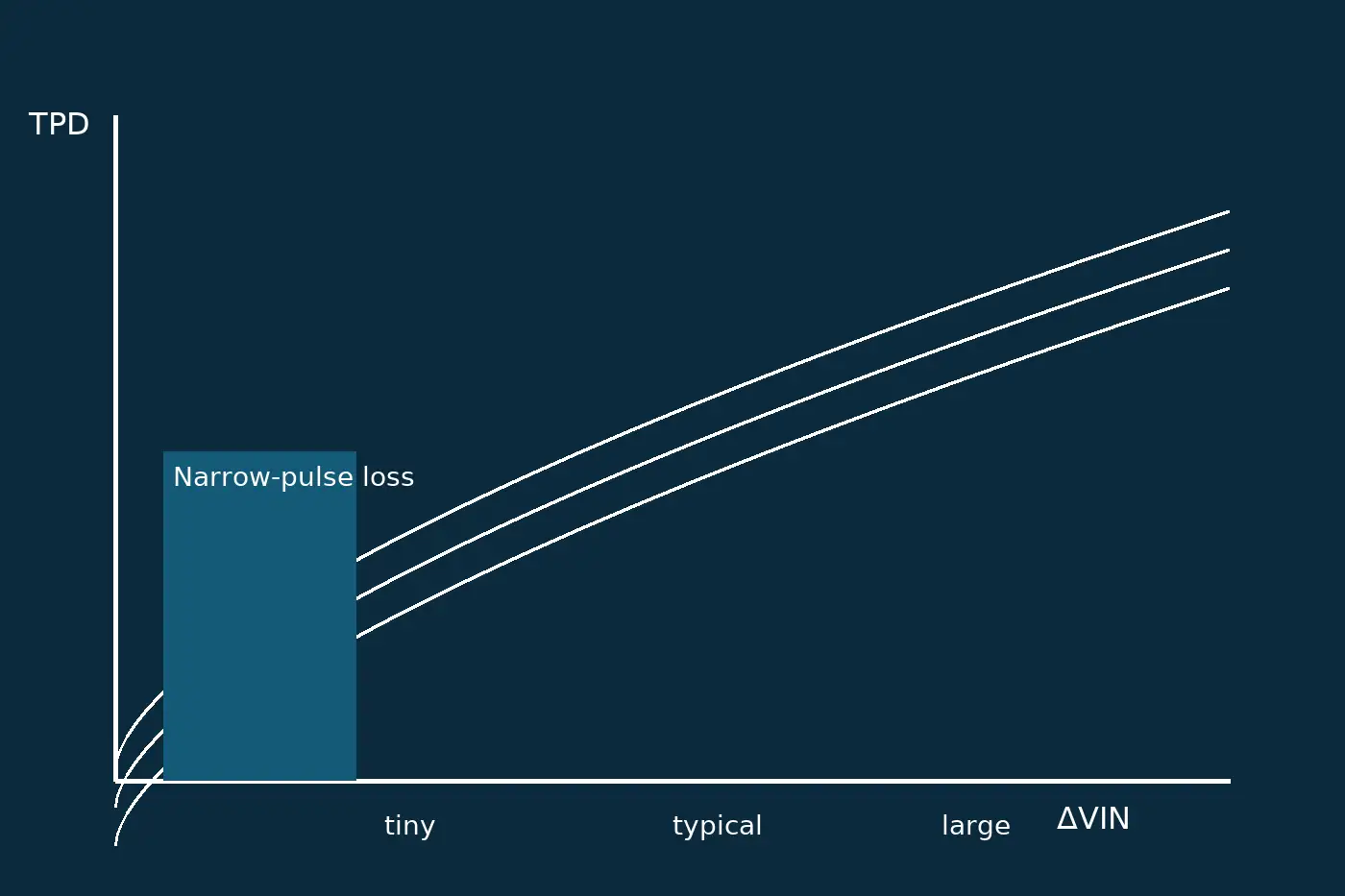
Propagation delay TPD decreases as input overdrive ΔVIN increases; at tiny overdrive expect about 1.2–1.5× nominal TPD.
Vhys ≥ 3× Vin,pp (≥ 4× for automotive) to suppress ripple-induced chatter; large source impedance can dilute hysteresis—buffer or reduce source R.
Near the rails the valid input common-mode range can shrink and TPD can worsen. Verify RRIO/CMVR and re-measure timing at corner conditions.
Overdrive vs Propagation Delay
Goal: Given shortest pulse width and ΔVIN, decide if pulses will be missed.
- ΔVIN < 5 mV → TPD ≈ 1.2–1.5× nominal (near-threshold slows switching).
- ΔVIN ≥ 100 mV → approaches device minimum TPD.
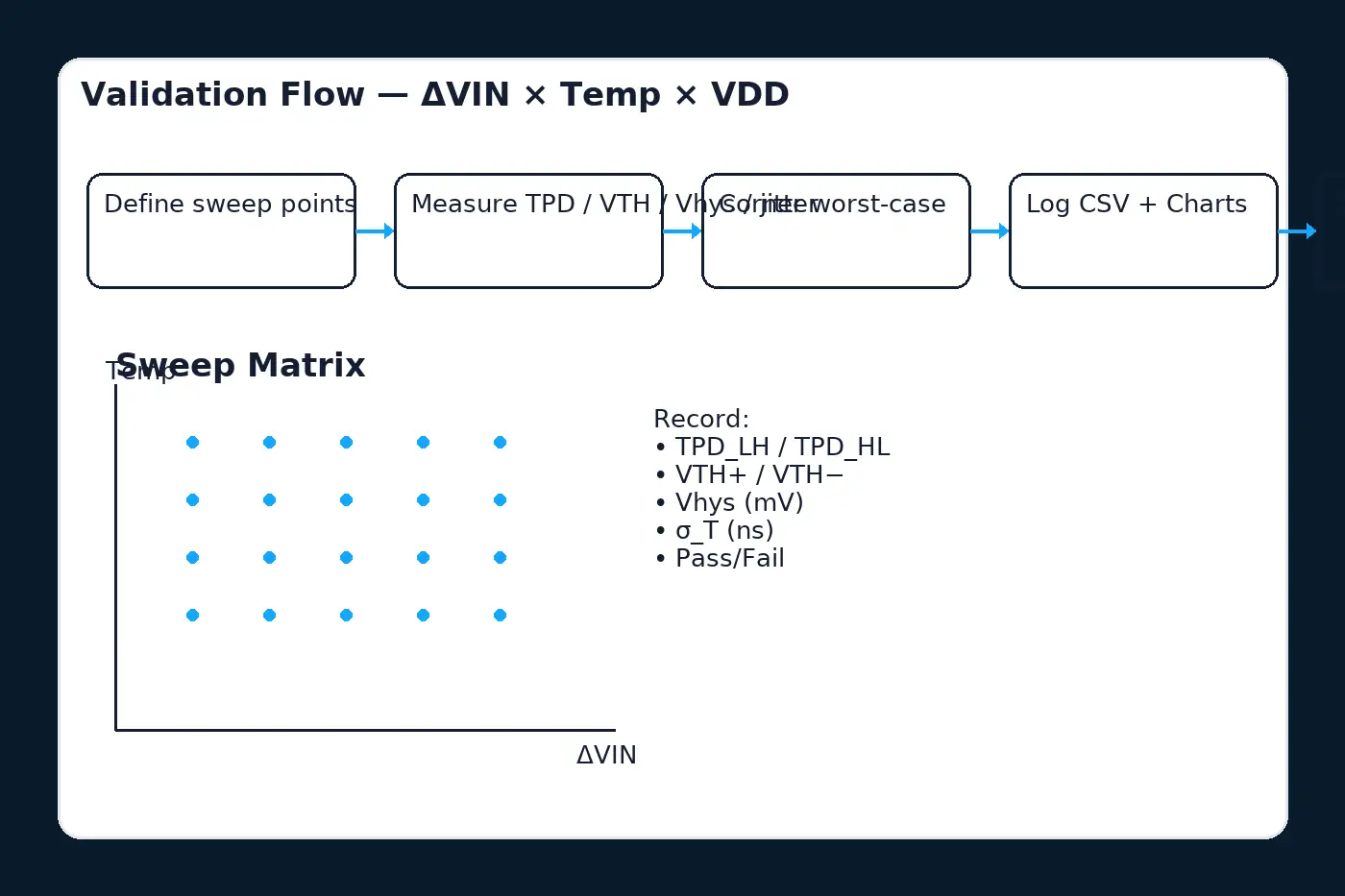
- Sweep ΔVIN × Temperature × VDD; record minimum and worst-case TPD.
- If
2 × TPD ≥ τ_min(shortest pulse), use a faster device or increase ΔVIN.
For single-shot capture, require pulse_min ≥ 3 × TPD_max to absorb asymmetry and output filter.
Cold often lengthens TPD 10–30%. Validate with small ΔVIN at −40 °C (or device minimum).
Comparator adds edge uncertainty ≈ σ_T ≈ σ_noise / (dV/dt) at threshold. Increase slew or hysteresis.
Outputs & Pull-Up Choices (OD/PP)
Goal: Choose open-drain vs push-pull; size pull-up so rise time does not clip the shortest pulse.
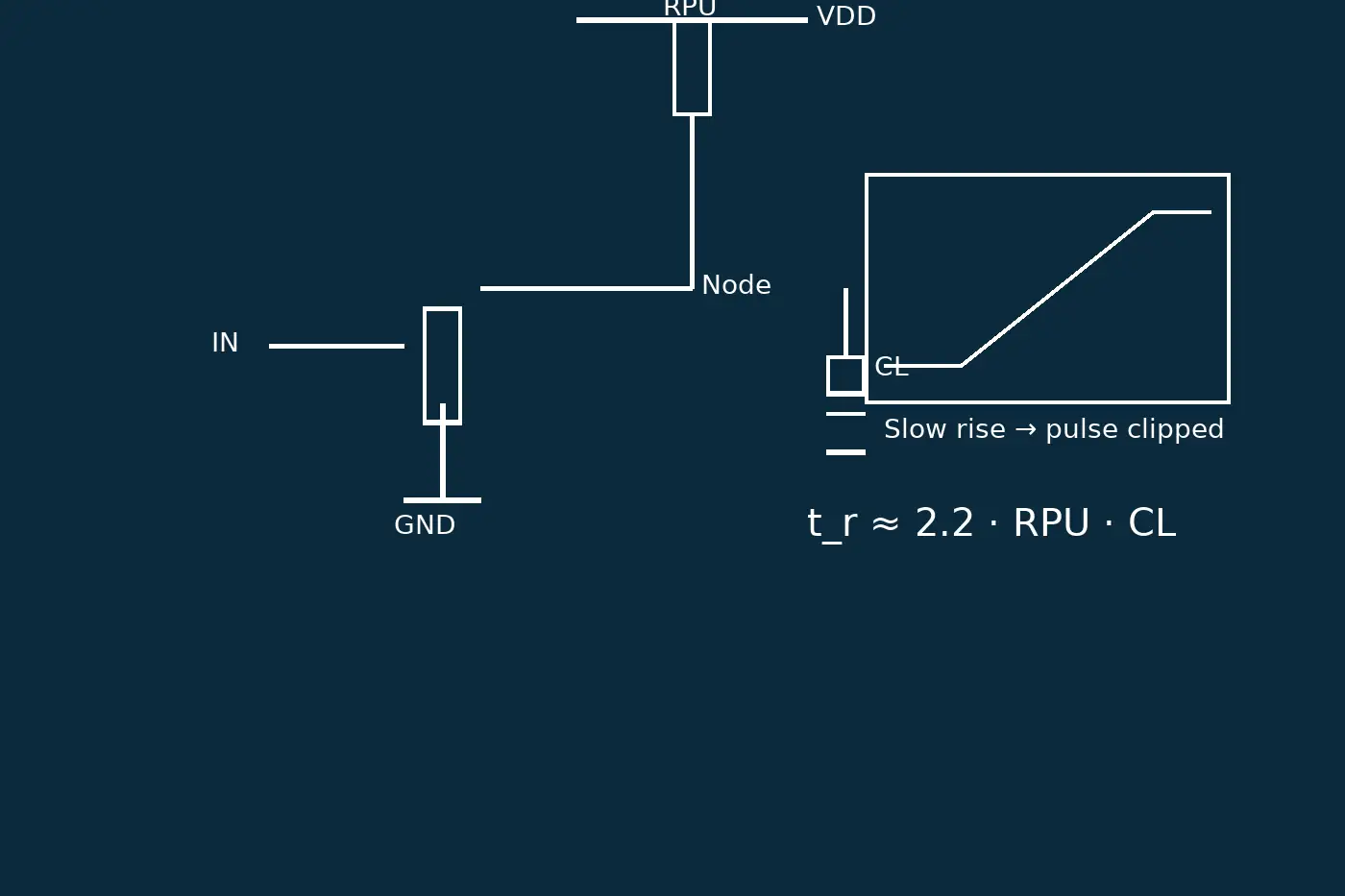
- Open-drain: easy level mixing and wired-AND; rise time set by RPU × CL.
- Push-pull: symmetric edges for higher speeds; ensure level-domain compatibility.
- Rule of thumb:
t_r ≈ 2.2 · RPU · CL; requiret_r ≤ 0.1 · τ_min. - Back-solve RPU,max and current
I ≈ VPU/RPU; for multi-sources ensureΣI_sink ≤ IOL(max).
Given τ_min and CL, set RPU ≤ 0.045 · τ_min / CL (uses 0.1× rule with 2.2 factor).
When level-shifting, pull-up to the receiving domain; confirm absolute max on the comparator’s output.
For N sinks, ensure N · Ileak + Ipullup(HIGH) ≤ IOH of the receiving gate; check low-level VOL at IOL.
Hysteresis for Noise Immunity
Goal: Choose “enough” hysteresis for ripple/slow-ramp rails and avoid chatter.
- Baseline: Vhys ≥ 3 × Vin,pp; automotive: ≥ 4 ×.
- Large source impedance reduces effective hysteresis; buffer or lower the source resistance.
- Sampling window must cover typical ripple, not rare spikes.
- Asymmetric thresholds can dodge ripple peaks/valleys.
For inverting Schmitt: Vhys ≈ VOUT,pp · R1/(R1+R2). Tune by the feedback ratio; keep bias currents in budget.
Edge stability needs Vhys > σ_noise · 6 and dV/dt high enough that σ_T ≪ τ_min/10.
For slow sensors (NTC, shunts) place RC pre-filter before comparator; set f_c below ripple, above event bandwidth.

CMVR, Input Protection & Clamp
Goal: Keep inputs safe and valid near rails and during over-voltage events.
- Near rails, confirm input common-mode range (CMVR) or RRIO tolerance.
- When ESD/clamp diodes conduct, limit Iclamp ≤ 1 mA via series resistance.
- For ±12 V, +48 V, or ISO 7637-2 transients, combine series R with TVS/RC.
- Small ΔVIN near CMVR edges can lengthen TPD — re-measure at corners.
Series R ≈ 12–22 kΩ; add small RC (e.g., 1–4.7 nF) to tame spikes.
Series R ≈ 47–100 kΩ plus SMBJ class TVS; check input leakage/headroom.
Series R + 600–1000 W TVS; validate under ISO 7637-2/ISO 16750 pulses.

Window Comparator (Two Comparators)
Goal: Detect “in-range / out-of-range” and budget threshold errors.
- Two comparators plus a divider define VTH_L and VTH_H.
- Error stack (approx.): σ ≈ √(Vref%² + Rdiv%² + VOS%²); add temperature drift linearly.
- Open-drain OR outputs share one pull-up; expect asymmetric delays.
- Supervision parts with internal reference/hysteresis reduce drift and PCB spread.
Treat divider tolerance as RSS with reference and offset; for tight windows use 0.1% resistors and low-drift ref.
With open-drain, LH and HL paths differ (passive pull-up). Check both against minimum pulse width.
Set VTH_H − VTH_L > worst-case ripple + offsets + temp drift to avoid window flapping.

Interfacing
Connect comparators to downstream logic with clear rules for current budgeting, rise/fall shaping, and level-domain matching. Focus on wired-AND behavior, pull-up placement, and module board caveats (LED + large pull-ups).
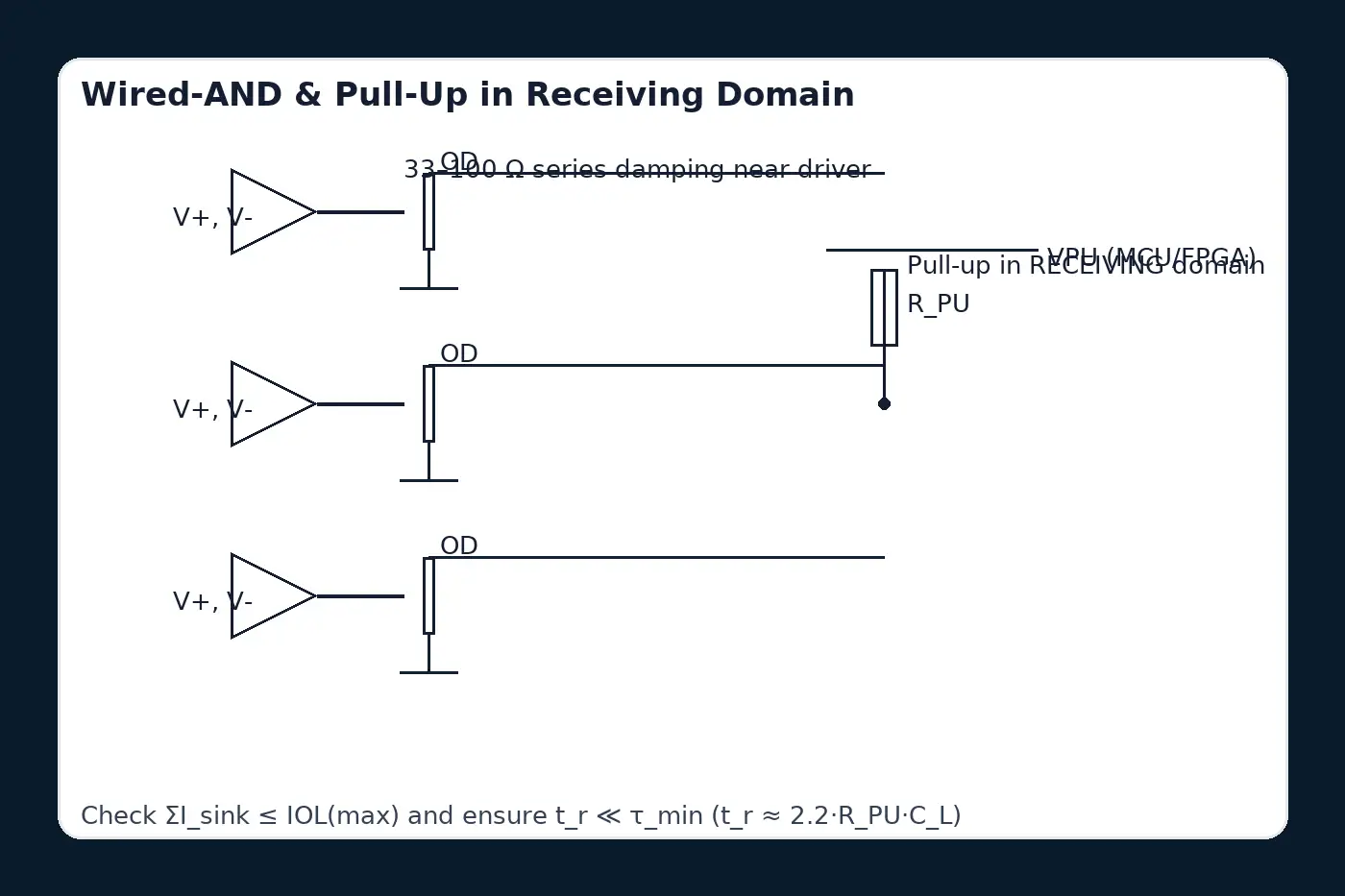
For N sources sharing one pull-up: ΣI_sink ≤ IOL(max) of the active comparator. Estimate I_sink ≈ Σ[(VPU−VOL)/RPU,i] + ΣIleak,i.
Use tr ≈ 2.2·RPU·CL and require tr ≤ 0.1·τmin to avoid pulse clipping.
Pull up to the receiving domain (MCU/FPGA). Check output absolute max and VIH/VIL windows.
Place a 33–100 Ω series resistor near the driver to tame ringing/EMI on cables/backplanes.
Given RPU=4.7 kΩ, CL=50 pF, target τmin=20 ns. Rise time tr≈2.2·4.7k·50p≈517 ns → fails. Need RPU ≤ 0.045·τmin/CL ≈ 18 Ω (use 100–330 Ω practical + driver sink check), or reduce CL/buffer the node.
- Common “comparator modules” ship with large pull-ups (10–100 kΩ) and an LED to VPU → slow edges and level mismatch.
- Fixes: (1) replace pull-up to meet
trbound; (2) move pull-up to the receiving domain; (3) remove/retime the LED or buffer it. - Check: power-up order, reverse-current paths, leakage vs. divider error, MCU VIH/VIL at temperature.

Validation & Production Notes
Comparator timing depends strongly on ΔVIN, temperature, and supply. Validate with a 3-D sweep, then lock production with statistics (CPK) and sound measurement practice.
Require max(TPD_LH,TPD_HL) ≤ spec and pulse_min ≥ 3×TPD_max.
Vhys ≥ 3×Vin,pp (automotive ≥ 4×) and |ΔVhys|/Vhys ≤ 10% across PVT.
Edge uncertainty ≈ σT ≈ σnoise / (dV/dt); target σT ≤ τmin/10.
Scope BW ≥ 5×(1/tr), 10× low-C probe or 50 Ω input; de-embed cable delay; tight local decoupling (0.1 µF + 1 µF).
| ΔVIN point (mV) | Temp (°C) | VDD (V) | TPD_LH / TPD_HL (ns) | VTH+ / VTH− (V) | Vhys (mV) | Jitter σT (ns) | Pass/Fail criterion | Samples (n) | Lot / Unit / Notes |
|---|---|---|---|---|---|---|---|---|---|
| 2 | −40 | VDD_min | TPD_max & jitter within spec | 30 | Lot#, Unit#, Fixture | ||||
| 5 | 25 | VDD_typ | Vhys ≥ 3×Vin_pp | 30 | Lot#, Unit#, Fixture | ||||
| 100 | 125 | VDD_max | σT ≤ τ_min/10 | 30 | Lot#, Unit#, Fixture |
Per lot/line/shift start with n=30. Compute CPK on TPD, VTH, Vhys; target CPK ≥ 1.33 (≥1.67 preferred).
Run GR&R for fixtures; track with X-bar/R or I-MR charts; define stop/containment when rules trip.
Tiny ΔVIN inflates TPD; module LEDs slow edges; CMVR edge + temp causes chatter; cross-domain pull-up over-volts MCU; probe loading shifts thresholds.

Patterns & Deep-Dive Previews
Hub cards preview the key comparator patterns. Each card gives a one-paragraph summary, one golden rule, one risk, and one CTA into a spoke page. We keep this section concise to preserve the main page’s vertical intent.
Hysteresis Comparator
Positive feedback creates two thresholds (VTH+ / VTH−) that suppress chatter around the trip point, stabilizing edges on ripple-rich or slow-ramp rails.
Pull-Up Sizing (OD/PP)
Choose open-drain for level mixing or push-pull for symmetry. Size the pull-up to keep rise time far below the minimum pulse width budget.
Window Error Budget
Stack reference, divider tolerance, input offset and temperature drift to bound upper/lower thresholds and their pass-band timing skew.
Debounce & Slow Inputs
For relays/switches/optos, combine RC timing with Schmitt thresholds to reject bounce and slow edges without distorting functional timing.
Tiny ΔVIN & Narrow Pulses
Overdrive-dependent propagation delay dominates near threshold. Validate minimum detectable width across ΔVIN, temperature and VDD.
High-Voltage Inputs & CMVR/Clamp
Protect low-voltage comparators with series-R, TVS/RC, and proper biasing; verify common-mode range near rails and re-measure delay vs. overdrive.
Applications (10 domains)
Comparator use cases grouped by topology, key specs, executable rules, risks, and validation notes. Each card previews the essentials and links to an application-specific IC shortlist for procurement.
Power-Good / UV-OV Supervision
Window comparator to assert PG within bounds and flag faults.
- Topology: Window + open-drain to PG tree
- Key specs: Vhys 1–3%, CMVR near rails, low Iq
- Rules: Vhys ≥ 3×Vin,pp; include divider/ref in σ
- Risks: Power-up order; OD OR delay asymmetry
- Validation: cold-crank/surge/ripple sweeps
Zero-Cross Detection
Edge detection for AC sensing and synchronous control.
- Topology: Non-inverting + mid-rail bias
- Key specs: TPD, input protection to ±HV
- Rules: Add Schmitt; filter HF noise
- Risks: CMVR edge, high dv/dt injection
- Validation: fMAX vs TPD; noise/THD injection
Battery Window / Cell Guard
In-range detection for cell voltage protection and alarms.
- Topology: Window + OD OR to fault line
- Key specs: offset & drift; built-in refs
- Rules: σ ≈ √(Vref%² + Rdiv%² + Vos%²)
- Risks: High-R divider leakage
- Validation: temp sweep + long-term drift
Over-Current / Shunt Trip
Trip on shunt voltage or with a front-end current sense amp.
- Topology: Inverting threshold
- Key specs: ΔVIN sensitivity, TPD
- Rules: Ensure ΔVIN ≥ 5–10 mV
- Risks: Cold/low-VDD misses
- Validation: narrow-pulse train sweep
Motor/Encoder Edge Recovery
Square up sensor edges on long/noisy cables for MCU capture.
- Topology: Schmitt + OD/PP
- Key specs: Vhys, ESD, EMI
- Rules: Vhys ≥ 2× noise-pp
- Risks: Ringing → add 33–100 Ω
- Validation: EMI & cable length sweep
Sensor Window Guard (Temp/Pressure)
In-range/out-of-range guard for industrial sensors.
- Topology: Window + bias
- Key specs: offset, ref accuracy, Iq
- Rules: Prefer built-in precision refs
- Risks: Drift → false windows
- Validation: temp cycling + ADC cross-check
Clock Restoration / Squaring
Restore degraded clocks for digital domains.
- Topology: High-speed PP comparator
- Key specs: tPD, tr/tf symmetry, fMAX
- Rules: fMAX ≈ 1/(tr+tf+tPD_LH+tPD_HL)
- Risks: Low input slew → jitter
- Validation: eye/jitter vs slew sweep
ADC SOC / Timing Qualifier
Clean, deterministic edge for start-of-conversion or gating.
- Topology: Non-inv + Schmitt; PP
- Key specs: deterministic delay, CMVR
- Rules: pulse_min ≥ 3×TPD_max
- Risks: ΔVIN ≈ 0 → meta-like flutters
- Validation: ΔVIN vs SOC timing plot
Windowed RPM / Speed Guard
Speed in-range detection with noise-immune thresholds.
- Topology: Zero-cross + window + debounce
- Key specs: noise immunity, Vhys
- Rules: Set τ per sensor; Vhys per ripple
- Risks: Mechanical bounce false alarms
- Validation: vibration & spectrum tests
Mains Presence / Brownout
Detect line presence and brownout with safe isolation margin.
- Topology: Rectified sense + divider + Schmitt
- Key specs: input protection, CMVR, isolation
- Rules: I_clamp ≤ 1 mA; creepage/clearance
- Risks: Surge events → TVS + series-R
- Validation: surge/ESD/EFT compliance
Selection Matrix — 7-Brand Shortlist
Texas Instruments
~4.5 ns PP outputs, good tr/tf symmetry; ideal for clock restore/edge recovery at high fMAX.
- TPD: ~4.5 ns (bin ≤10 ns) · Iq: mid
- CMVR: RRIO; Output: PP, IOUT symmetric
- VOS: low; AEC-Q100: —; Height: low
- Stock: Medium
~40 ns PP, RRIO; balanced speed/power for SOC triggers and timing qualifiers.
- TPD: ~40 ns (bin 10–100 ns) · Iq: low-mid
- CMVR: RRIO; Output: PP
- VOS: low; AEC-Q100: —; Height: low
- Stock: High
Dual OD classics for PG/window trees; massive ecosystem, easy wired-AND and second-source.
- TPD: ~130–300 ns · Iq: low
- CMVR: wide; Output: OD, strong sink
- AEC-Q100: Y; Height: varied (SOIC/TSSOP/SOT)
- Stock: High
STMicroelectronics
~8 ns PP with RRIO; robust for clock squaring and fast edge restoration.
- TPD: ~8 ns · Iq: mid
- CMVR: RRIO; Output: PP
- AEC-Q100: —; Height: low
- Stock: Medium
Open-drain high-speed; easy wired-AND and level mixing with pull-up domain control.
- TPD: ~20 ns class · Iq: mid
- Output: OD; CMVR: wide
- AEC-Q100: —; Height: low
- Stock: Medium
nA-µA class Iq for battery/wearables; perfect for slow sensors & duty-cycled sampling.
- TPD: µs bin · Iq: ultra-low
- CMVR: wide; Output: OD/PP variants
- Stock: Medium
onsemi
µA Iq with OD output for watchdog/threshold; automotive NCV variant available.
- TPD: µs bin · Iq: ultra-low
- Output: OD; AEC-Q100: Y (NCV)
- Stock: Medium
Core OD families with broad packages & second-source; LM311 as classic single with faster edges.
- TPD: ~80–300 ns (LM311 faster) · Iq: low
- Output: OD; AEC-Q100: options
- Stock: High
Microchip
~20–50 ns PP, RRIO; great for ADC SOC/timing gates with deterministic edges.
- TPD: ~20–50 ns · Iq: low
- Output: PP; CMVR: RRIO
- Stock: High
Very low Iq for battery sensors; OD/PP variants; tolerant to slow edges with Schmitt configs.
- TPD: µs bin · Iq: ultra-low
- Output: OD/PP; CMVR: wide
- Stock: Medium
Renesas (Intersil)
Super-fast comparators for sampling/clock restore where jitter budget is tight.
- TPD: sub-ns–few ns · Iq: higher
- Output: PP; CMVR: spec-dependent
- Stock: Medium
Classic dual-window supervisor; simple cell/battery guards without MCU.
- TPD: ~100 ns–µs · Iq: low
- Output: OD/PP options; AEC: project-dependent
- Stock: Medium
NXP
Workhorse OD comparators with broad packaging and second-source paths.
- TPD: ~130–300 ns · Iq: low
- Output: OD; CMVR: wide
- Stock: High
Classic single OD with faster response; suits legacy sockets & simple level detection.
- TPD: tens of ns · Iq: low-mid
- Output: OD; CMVR: wide
- Stock: Medium
Melexis
For projects bound to Melexis brand, use sensor ICs with built-in comparators to realize thresholds/edges without a discrete comparator.
- TPD: internal path; Iq: per device
- AEC-Q100: Y (sensor lines); Height: per package
- Stock: Low–Medium
BOM & Procurement
Required fields
- Vrail / Level domains (cross-domain pull-up?)
- Vth / Vhys targets (incl. tolerances)
- TPD requirement (shortest pulse, ΔVIN scenario)
- Output type / Pull-up domain / CL estimate
- Iq limit (battery) · Temp drift limit
- AEC-Q100 (Y/N) · Package height · Second-source plan
Risks & mitigations
- Pin/semantic mismatch (OD/PP, VO, EN/REF) — verify before layout
- EOL/NRND lifecycle status — avoid fragile SKUs early
- Lead time / MOQ for small builds — plan buffer SKUs
- Lot variation in TPD vs ΔVIN, VOS, Vhys — include corner sampling
- Second-source alignment of Vth/Vhys/CMVR/IOUT — lab cross-check
Submit your BOM
Send your rails, thresholds, speed & interface constraints. We’ll return a 7-brand aligned shortlist within 48 hours.
/submit-bom →- TI: TLV3501 — fast PP for edge/clock; LM2903-Q1 — auto OD for PG/window; TLV7011 — low-power RRIO for battery.
- ST: TS3011 — ~8 ns PP RRIO; TS3021 — OD high-speed, wired-AND; TS881 — ultra-low-power.
- onsemi: NCS2200/NCV2200 — µA Iq OD; LM2903 — industrial/auto staple.
- Microchip: MCP6561 — ~50 ns PP for SOC/ADC; MCP6541 — ultra-low-power for slow sensors.
- Renesas: ISL55110 — ultra-high-speed, tight jitter; ICL7665 — dual thresholds for simple guards.
- NXP: LM393/LM2903 — OD second-source paths; LM311 — faster single OD legacy fit.
- Melexis: MLX90xxx sensor ICs with internal comparator — when brand lock requires integrated solution.
FAQs — Voltage Comparator
How large should hysteresis be for 20–50 mV ripple rails?
What’s the relation between tiny ΔVIN and propagation delay—how do I avoid missing narrow pulses?
How do I size the pull-up resistor so rise time doesn’t clip the shortest pulse?
What’s a safe input clamp for high-voltage comparator ICs (±48 V into low-voltage parts)?
What’s inside a “hysteresis comparator” and how does it differ from adding RC?
When should I choose open-drain vs push-pull outputs?
How do I plan window thresholds and include Vref/Rdiv/Vos/temperature drift?
How do I wire comparator “modules” to 3.3 V MCUs when the supply is 5 V?
How do I verify thresholds/hysteresis across −40~+125 °C with CPK≥1.33?
What’s a safe acceptance criterion for tiny ΔVIN detection at low supply?
Why not reuse an op-amp comparator circuit diagram for high-speed edges? (brief)
What are common pitfalls in second-sourcing across brands (polarity, pinout, hysteresis method)?

Related Articles
- ·Beyond Capacity: Why Bandwidth and Power Efficiency Now Define Memory Value
- ·Understanding Memory Price Cycles: Key Drivers Behind Supply and Demand Shifts
- ·DRAM vs. NAND: How AI Demand Is Reshaping the Memory Industry
- ·HBM Explained: Why High-Bandwidth Memory Is Critical for AI Accelerators
- ·Beyond Capacity: Why Bandwidth and Power Efficiency Now Define Memory Value
- ·Understanding Memory Price Cycles: Key Drivers Behind Supply and Demand Shifts
- ·DRAM vs. NAND: How AI Demand Is Reshaping the Memory Industry
- ·Memory Chip Market Outlook: What Buyers Should Watch Heading into Q4
- ·EMI and EMC in Electronics Design: How to Prevent Problems Before Testing
- ·USB-C Power Delivery Explained: What Engineers Need to Know About EPR





.png?x-oss-process=image/format,webp/resize,h_32)


