
 German
 Japanese
 Portuguese
 Korea
Korea
 Mexico
 Dutch
Dutch


Remote Power Monitors (Satellite Nodes)

Quick Browse
Answer Box (one-screen decision)
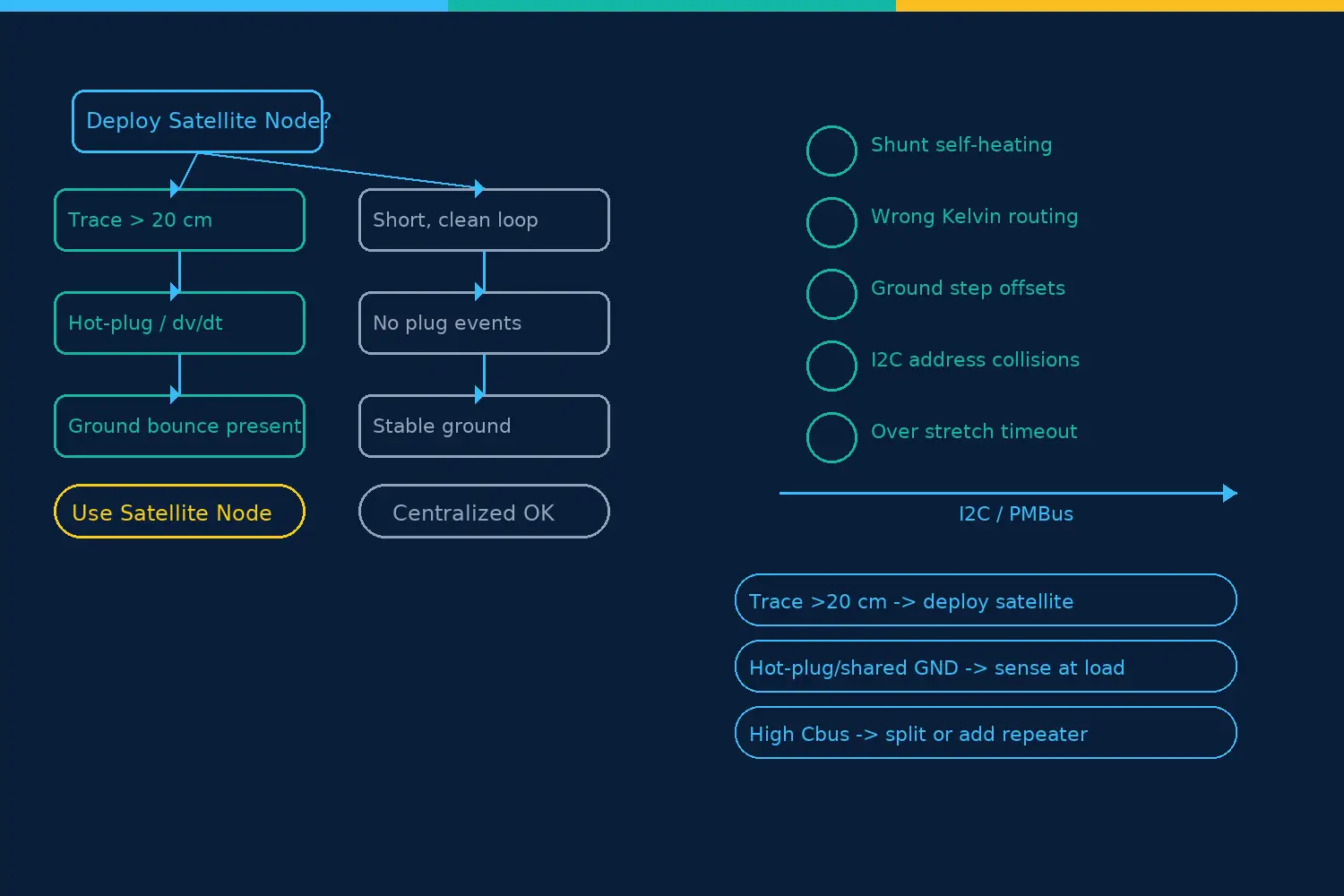
Definition & Boundaries (what it is / isn’t)
A remote power monitor (satellite node) is a near-load sensor module that measures voltage, current, and temperature, evaluates local thresholds for alerts (ALERT#/PG/FAULT), and returns telemetry over I²C/SMBus/PMBus (100 k–1 MHz).
Short Kelvin loops reduce line drop and ground-loop error that plague centralized long leads.
Local comparators + interrupts react faster than poll-only schemes across long buses.
Distributed nodes scale by bus segments, address plan, and stretch budget—not by a single long harness.
- Hot-plug dv/dt on long leads causes false trips or missed alerts.
- Load-dependent line drop injects a systematic error during transients.
- Shared-return inductance produces ground bounce; high-side/low-side readings diverge.
- Backplane EMI aliases into the front-end and destabilizes readings.
- Long alert paths with poll-only schemes miss short events.
- Address/capacitance stacking pushes I²C into timeouts or stretch violations.

Architecture & System Flow
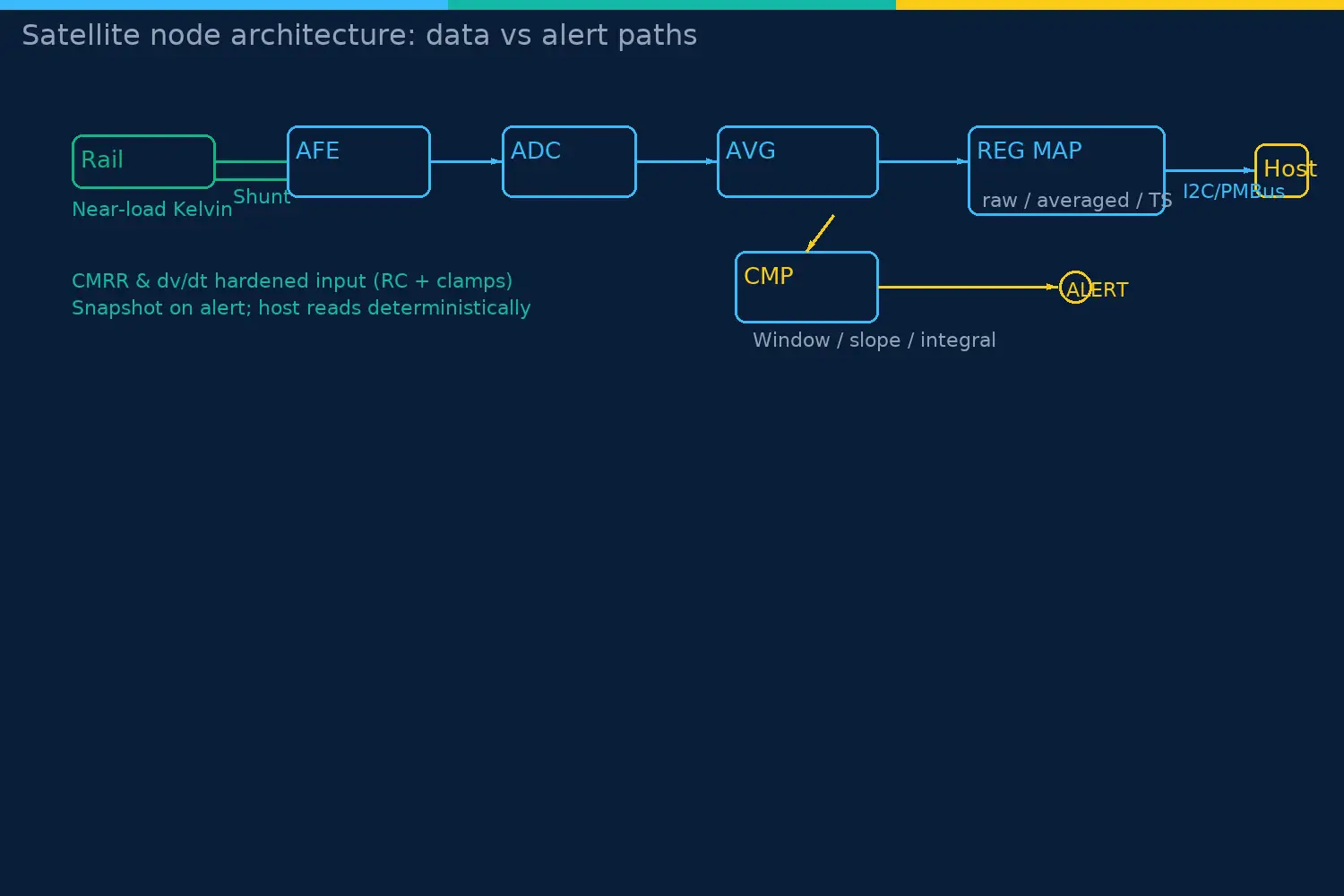
End-to-end path: Sense (V/I/T) → linearize/average → threshold compare → local interrupt & register snapshot → host read via I²C/PMBus.
Kelvin shunt (or lossless method) → instrumentation/CSA with dv/dt-tolerant input RC and clamps → CMRR@frequency sized for hot-plug edges.
Resolution/INL/DNL; SPS & averaging modes (window/moving/exponential); latency budget and raw vs averaged register mapping.
Window/slope/integral comparators, latch vs auto-recover, ALERT#/PG/FAULT and read-clear status.
Address plan; snapshot registers for TS_COUNTER/EVENT_LOG; clock-stretch ceiling aligned with host timeout.
- Star: best serviceability (slots/cages). Easy isolation; shorter per-branch Cbus.
- Daisy: few nodes & short traces only; maintenance unfriendly; stacking capacitance risks timeouts.
- Segmented (repeaters/isolators): use when Cbus or branch length exceeds budget; place boundaries at backplane connectors.

Capacitance budget
Cbus ≈ ΣCtrace + ΣCconn + ΣCdev
Rise time estimate
tr ≈ 0.8473 · Rpullup · Cbus
Stretch & host timeout (engineering ranges)
Per-transaction stretch 1–10 ms (≤25 ms max). Host timeout 35–50 ms typical; boot/scan 100–250 ms.
| Mode | tr target | Suggested Cbus | Notes |
|---|---|---|---|
| Standard (100 kHz) | ≤ 1000 ns | ≤ 400 pF | Longest reach; use segmented topology if branches proliferate. |
| Fast (400 kHz) | ≤ 300 ns | ≤ 200 pF | Backplane friendly with short stubs; avoid heavy device capacitance. |
| FM+ (1 MHz) | ≤ 120 ns | ≤ 100–150 pF | Prefer per-slot branches; repeater boundaries at connectors. |
| HS (3.4 MHz) | tight | ≤ 50–80 pF | Short segments only; use dedicated HS transceivers. |
Mechanisms & Design Physics
1 High-side / Low-side measurement & CMRR
High-side avoids load-return ground bounce but demands stronger CMRR@dv/dt and robust input protection. Low-side is simple yet inserts loop drop and can disturb system behavior.
- Size input RC and clamps so the S/H network can settle across hot-plug edges.
- Place ESD/EMI hooks at the connector and keep Kelvin pair symmetric to the shunt pads.
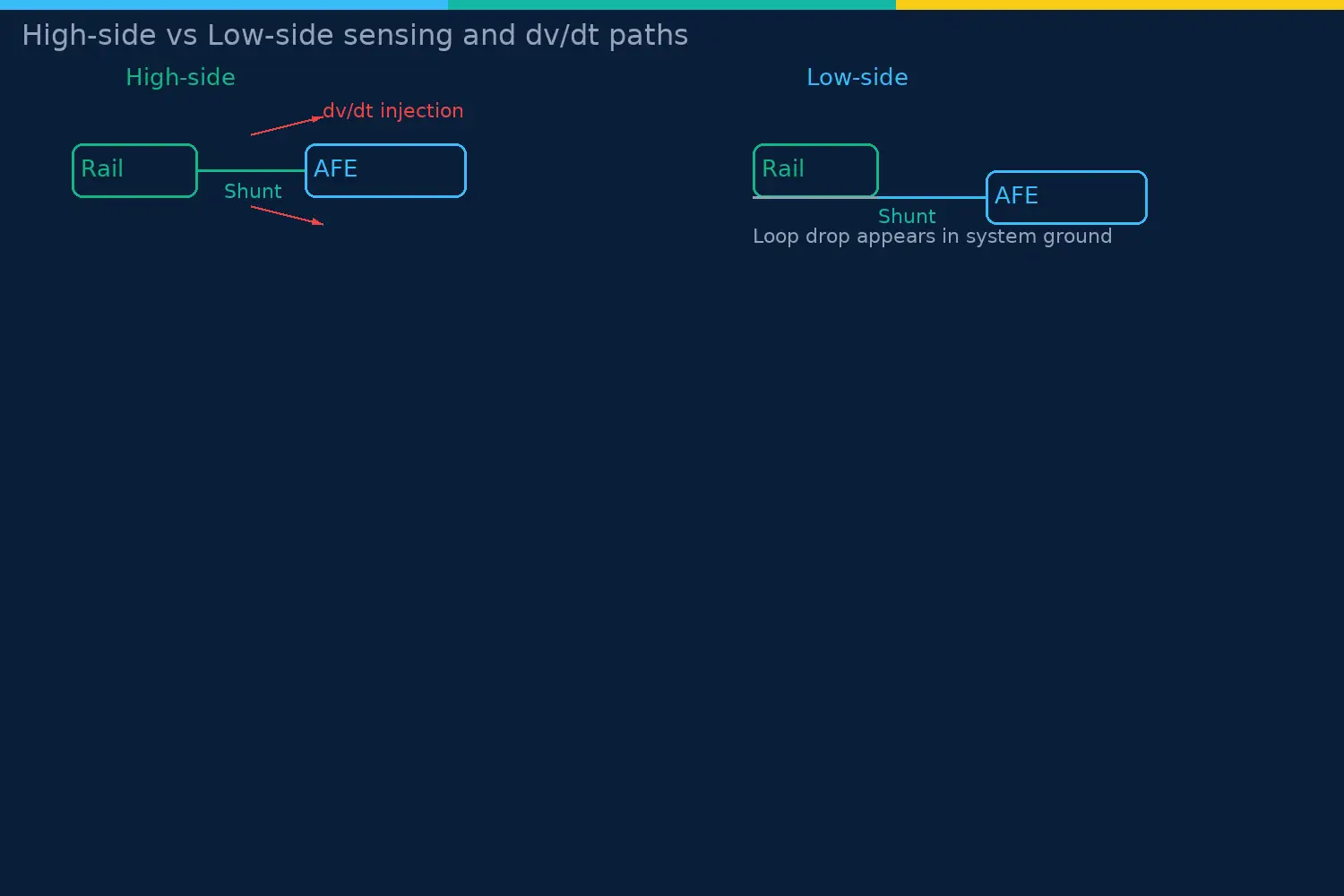
Dynamic error (approx.): Verr ≈ (dv/dt) · Zcoupling / ACMRR(f). Verify with load-step and differential probe.
2 Shunt selection
Balance range, resolution, and thermal drift. Specify Kelvin pads and keep sense loop independent from the power loop.

Pshunt = I² · R
ΔVgain ≈ I · ΔR, where ΔR ≈ R · TCR · ΔT
3 ADC & digital chain
Averaging increases SNR roughly with √N but adds latency. Use a dual-track strategy: raw channel for events; averaged channel for reports.

SNRavg ≈ SNRraw + 10·log10(N). Moving average improves noise but smears step response—keep an event-rate bypass.
4 Temperature path
Temperature supports gain compensation and protection. Prefer two-point calibration; validate thermal coupling with on-board trials near inductors and hot FETs.
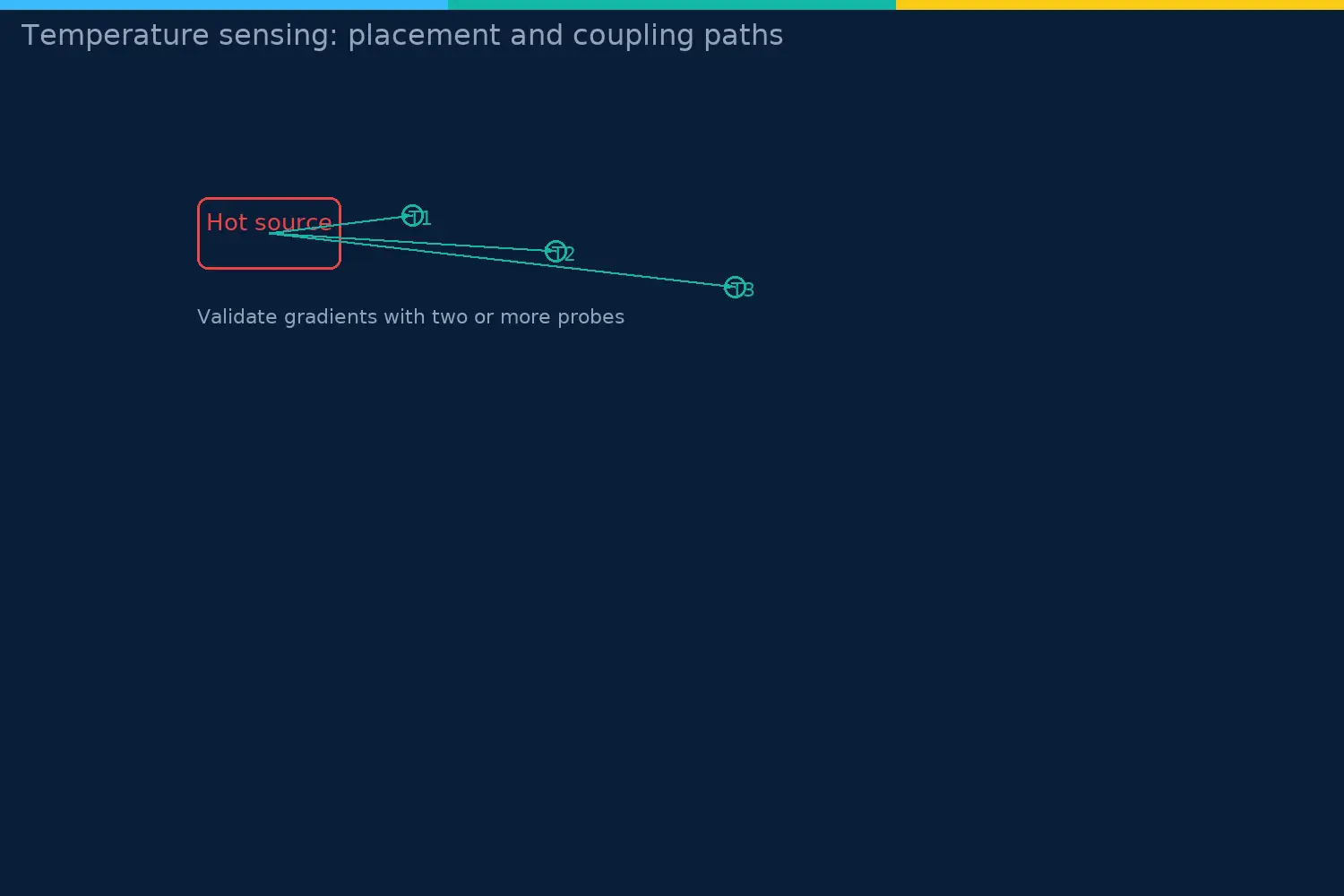
Error budget = Sensor accuracy + Thermal gradient + ADC quantization. Use at least two probes around hotspots to validate gradient.
5 Alarms & debounce
Window + integral/slope comparators resist short-lived spikes better than single thresholds. Latch for safe shutdown; auto-recover for transient excursions.

6 Bus integrity
Make Cbus the first-class constraint: compute it, back-solve Rpullup, then decide to segment or elevate to FM+. Check device IOL so pull-up current is within limits.

tr ≈ 0.8473 · Rpullup · Cbus. When Cbus > 200 pF @ 400 kHz or > 100–150 pF @ 1 MHz, segment the bus or add a repeater.
7 Timestamping & alignment
Align all nodes to a common host time base. On alerts, capture a snapshot of raw and averaged registers so reconstruction is deterministic even with stretch and poll delays.
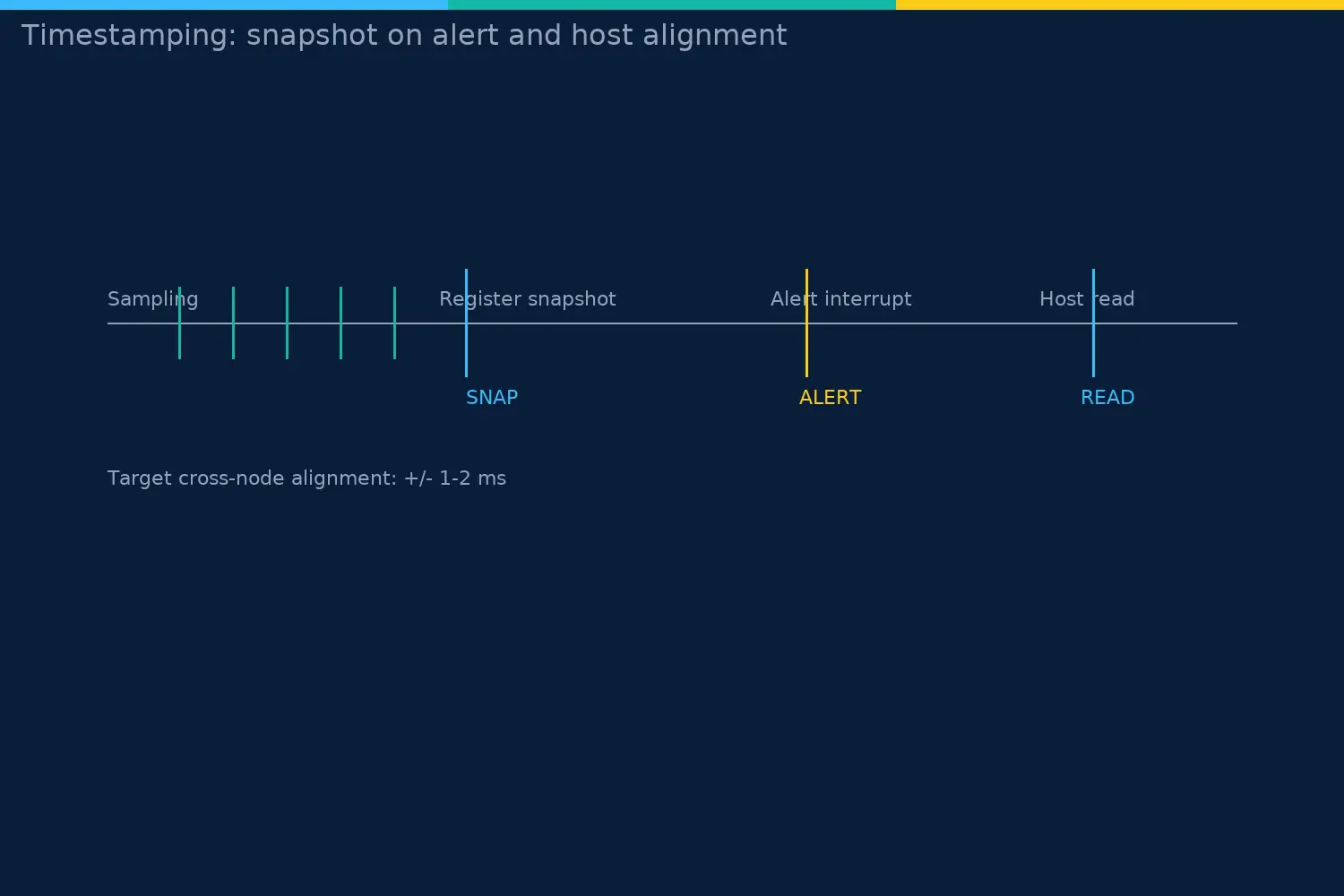
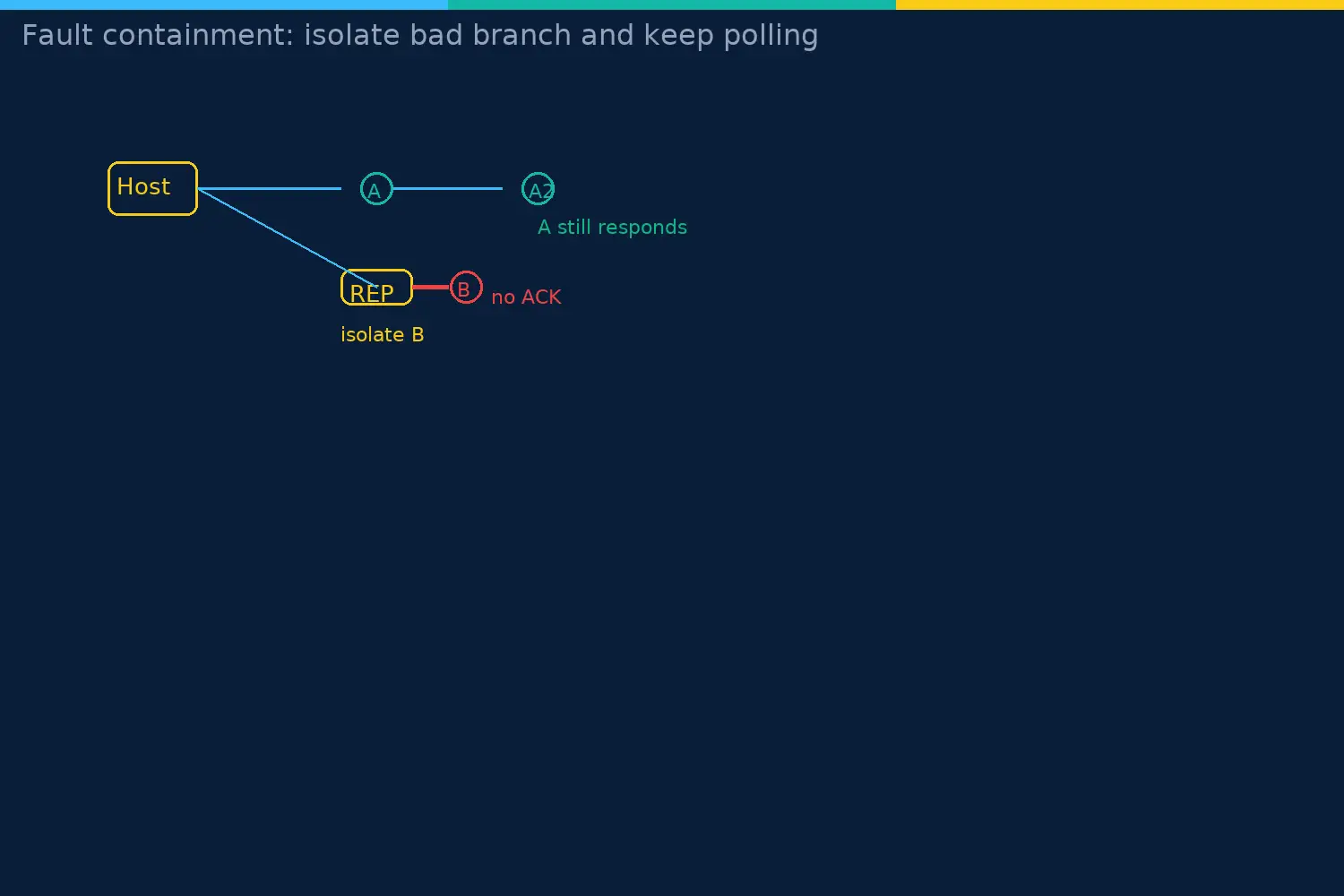
8 Safety & fault containment
No single segment/node failure should stall the fleet. Add fail-safe pull-ups, address-conflict detection at boot, and line-break/short detection. Isolate failing branches so the host can keep polling survivors.
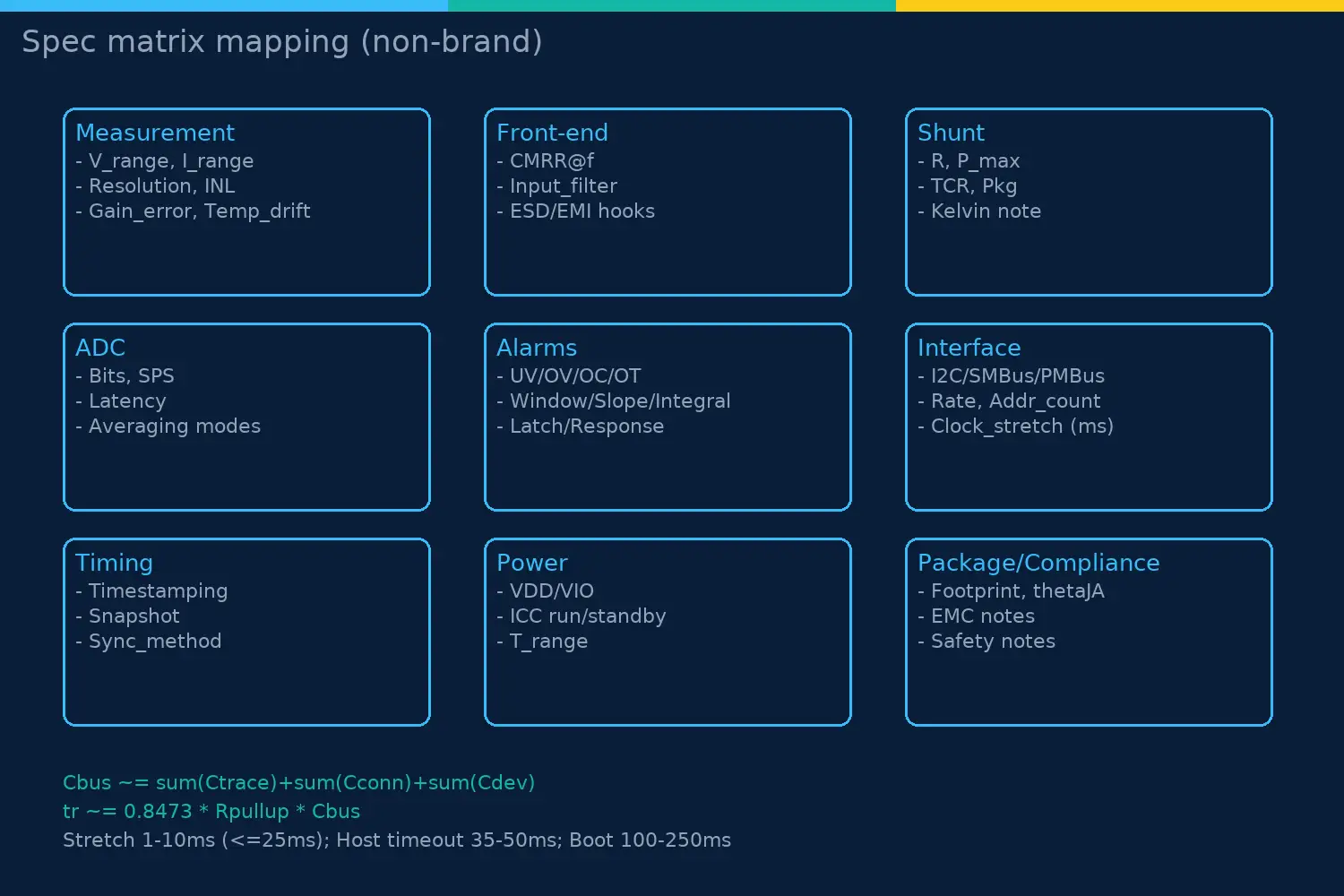
Key Specification Matrix (fields & acceptance)
Purpose: unify evaluation fields and measurement methods so purchasing, design, and validation share one yardstick. Each field includes a single-sentence method (acceptance) to avoid mismatched criteria.
Cbus ≈ ΣCtrace + ΣCconn + ΣCdevtr ≈ 0.8473 · Rpullup · CbusClock stretch per transaction 1–10 ms (≤25 ms max). Host timeout 35–50 ms typical; boot/scan 100–250 ms.
| Group | Field | Spec & Unit | Method (Acceptance) | Notes |
|---|---|---|---|---|
| Measurement | ||||
| Measurement | V_range | e.g., 0…16 V | @25°C, nominal VDD; error holds across full temp | State absolute max and headroom |
| Measurement | I_range | e.g., ±100 A | Bidirectional if stated; shunt not in thermal limit | Include pulse SOA |
| Measurement | Resolution | e.g., 15.3 µV / 0.8 mA | LSB @ selected SPS/avg; exclude digital filter gain | Report raw vs averaged LSB |
| Measurement | INL | e.g., ±0.05 % FS | @25°C, no-load, 1×FS; end-point method | Show linear-fit error if used |
| Measurement | Gain_error | e.g., ±0.1 % | @25°C, no-load, 1×FS; after zero/gain cal | State cal procedure |
| Measurement | Temp_drift | e.g., 40 ppm/°C | 25→85/105°C slope; include shunt TCR if on-board | Quote typ & max if available |
| Front-end | ||||
| Front-end | CMRR@f | e.g., 100 dB@100 kHz; 80 dB@1 MHz | Measure with dv/dt steps; ensure no overflow | Specify test fixture & probe |
| Front-end | Input_filter | RC time constant | RC matches ADC S/H; settling ≥ 2×τ before hold | Document RC placement |
| Front-end | ESD/EMI | IEC61000-4-2 or app-level | Connector clamps verified | Clamp type & levels |
| Shunt | ||||
| Shunt | R | e.g., 0.5–10 mΩ | Measured @25°C; tolerance ±x% | Four-terminal Kelvin |
| Shunt | P_max | e.g., 3 W cont. | ΔT ≤ ΔT_allow; check pulsed SOA | Thermal photo @ worst case |
| Shunt | TCR | e.g., 50 ppm/°C | 25→100°C slope; include in gain drift budget | Material system |
| Shunt | Pkg | e.g., 2512, 3920 | Land pattern supports Kelvin | θJA note if relevant |
| Shunt | Kelvin_note | — | Sense pads symmetric to inner shunt | Avoid crossing power path |
| ADC | ||||
| ADC | Bits | e.g., 16–20 ENOB | Effective bits; exclude averaging inflation | State OSR if sigma-delta |
| ADC | SPS | e.g., 1 ksps raw | Max SPS in mode; stretch within budget | List valid SPS steps |
| ADC | Latency | e.g., 2–10 ms | Pipeline + averaging; edge-to-valid measured | Report per mode |
| ADC | Averaging_modes | window/moving/exponential | Raw bypass for events | Default coefficients |
| Alarms | ||||
| Alarms | UV/OV/OC/OT | thresholds & accuracy | @25°C; drift over temp noted | Absolute vs ratioed thresholds |
| Alarms | Window/Slope/Integral | integration window | Step rejection demonstrated | Min inhibit time |
| Alarms | Response | e.g., < 2 ms | Alert-to-interrupt latency @ Y SPS | Measurement method |
| Alarms | Latch | latch/auto-recover | Clear method (read-clear) | Default on power-up |
| Interface | ||||
| Interface | I2C/SMBus/PMBus | logic levels | Pull-ups per mode; IOL not exceeded | Voltage domain stated |
| Interface | Rate | Std/Fast/FM+/HS | Per-branch Cbus checked | Mode per segment |
| Interface | Addr_count | e.g., up to 16 | Unique per slot; boot collision scan | EEPROM/strap plan |
| Interface | Clock_stretch(ms) | e.g., ≤ 10 ms | Per transaction; host timeout ≥ N+Δ | Worst-case conversion stated |
| Timing | ||||
| Timing | Timestamping | ±1–2 ms cross-node | Common host time base | Drift if free-running |
| Timing | Snapshot | raw + averaged | Alert-triggered; read-clear | Indexed if multi-event |
| Timing | Sync_method | poll + interrupt | Jitter budget stated | Bus analyzer traces |
| Power | ||||
| Power | VDD/VIO | operating window | UVLO/OVP thresholds noted | Separate I/O domain |
| Power | ICC(run/standby) | e.g., 2.5 mA / 20 µA | @25°C typical | Standby wake sources |
| Power | T_range | e.g., −40…+125°C | Operating; derating if any | Storage separate |
| Package | ||||
| Package | Footprint(mm²) | body + keep-out | Height if relevant | Connector clearance |
| Package | θJA | JEDEC 4-layer board | Airflow assumptions | Measurement setup |
| Compliance | ||||
| Compliance | EMC | front-end RC/clamp placement | Cable shield scheme | Ground zoning note |
| Compliance | Safety | isolation type (if any) | creepage/clearance | Ratings and standards |
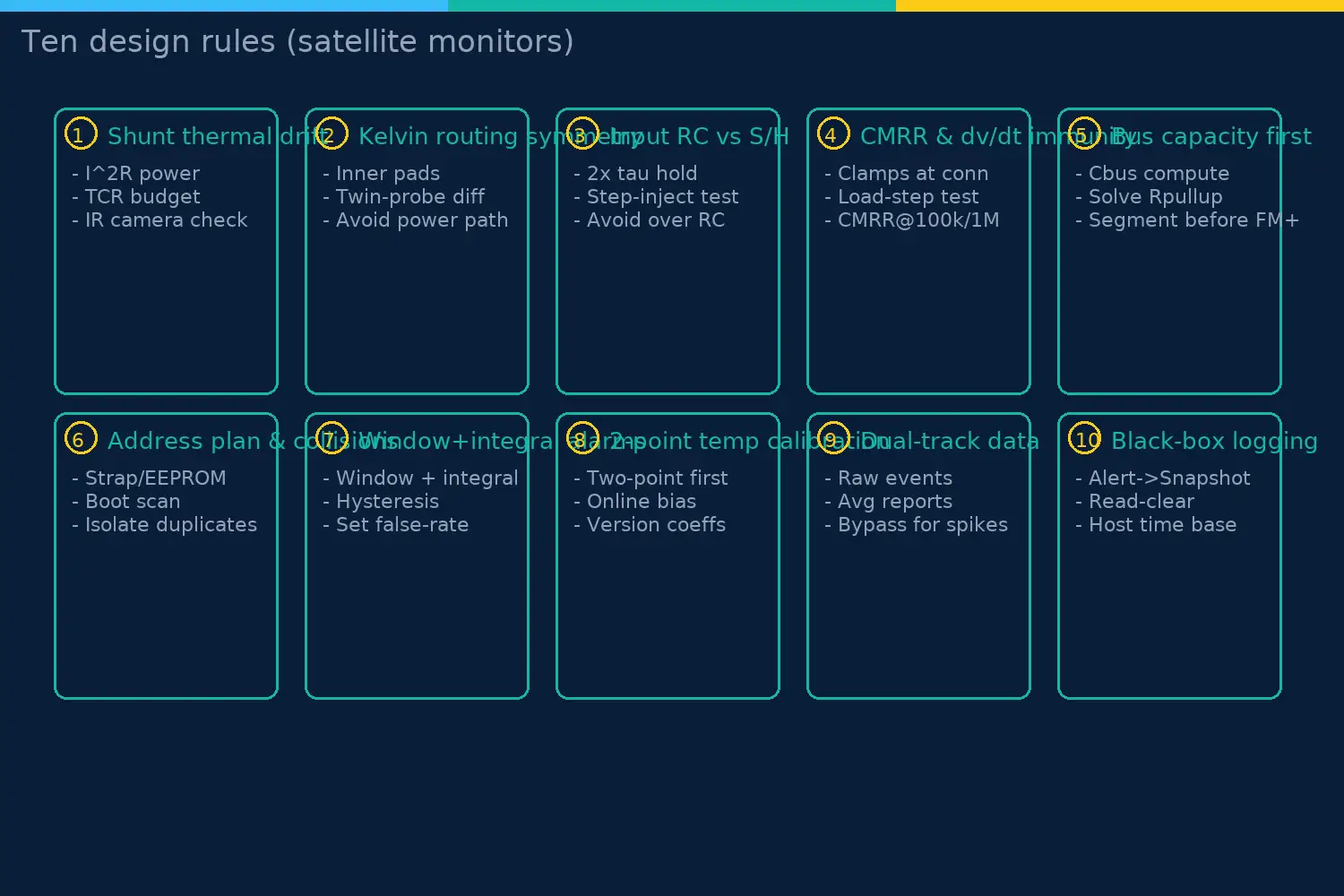
Design Rules (10 items with verification)
Ten actionable rules. Each card includes Why, How to verify, Acceptance, and a common Pitfall. Instruments: IR camera, differential probes, oscilloscope, bus/logic analyzer.
1) Shunt thermal drift: size R from I_max & ΔT_allow
- Why: I²R self-heating moves gain via TCR.
- Verify: steady-state & pulsed IR imaging; pre/post linear fit.
- Acceptance: ΔT ≤ target; equivalent gain drift ≤ budget.
- Pitfall: ignoring pulsed SOA and thermal time constants.
2) Kelvin routing: symmetric sense close to inner pads
- Why: prevents power loop drop from polluting measurement.
- Verify: twin-probe check of sense loop symmetry.
- Acceptance: step-load offset ≤ X mV.
- Pitfall: sense taken from outer pads or across high-current paths.
3) Input RC matches ADC S/H; pulse hold ≥ 2×τ
- Why: inadequate S/H charging distorts edges.
- Verify: step injection; observe phase & recovery.
- Acceptance: hold ≥ 2×τ; no false trips from over/undershoot.
- Pitfall: oversizing RC and slowing the front-end.
4) CMRR & dv/dt immunity with clamps and zoning
- Why: hot-plug/ground-bounce injects common-mode steps.
- Verify: fast load steps; watch input over/undershoot and saturation.
- Acceptance: CMRR @100 kHz/1 MHz met; no overflow.
- Pitfall: missing clamps near the connector.
5) Bus capacity first: back-solve R_pullup; segment first
- Why: excessive Cbus breaks rise-time/timeout limits.
- Verify: compute Cbus; scope tr.
- Acceptance: tr ≈ 0.8473·Rpullup·Cbus fits mode; segment before FM+/HS.
- Pitfall: shrinking Rpullup until IOL is exceeded.
6) Address plan with strap/EEPROM; hot-plug collision test
- Why: duplicate addresses stall the bus.
- Verify: boot scan & forced collision isolation.
- Acceptance: conflict detected and isolated; other nodes still ACK.
- Pitfall: relying on fixed addresses without collision tests.
7) Alarm strategy: window + integral; thresholds from data
- Why: reduces false positives versus single thresholds.
- Verify: record distributions → set window & integral → re-measure false-alarm rate.
- Acceptance: false-alarm rate ≤ target; no reset storms (min inhibit/hysteresis).
- Pitfall: hard single threshold causing chatter.
8) Temperature calibration: two-point first; online bias later
- Why: compensates gain and protection drift.
- Verify: two-point fit; add online bias tracking.
- Acceptance: residual ≤ target; coefficients versioned.
- Pitfall: single-point only or ignoring thermal coupling.
9) Dual-track data: raw for events, averaged for reports
- Why: averaging improves SNR but hides spikes.
- Verify: event channel bypasses averaging; report channel averages.
- Acceptance: event capture rate met; report stability achieved.
- Pitfall: global averaging causing missed events.
10) Black-box logging: alert → snapshot → read, unified time base
- Why: reproducible reconstruction under power loss and jitter.
- Verify: interrupt-triggered snapshot; host-time alignment.
- Acceptance: ±1–2 ms cross-node; logs remain readable.
- Pitfall: missing read-clear/index, causing duplicates.
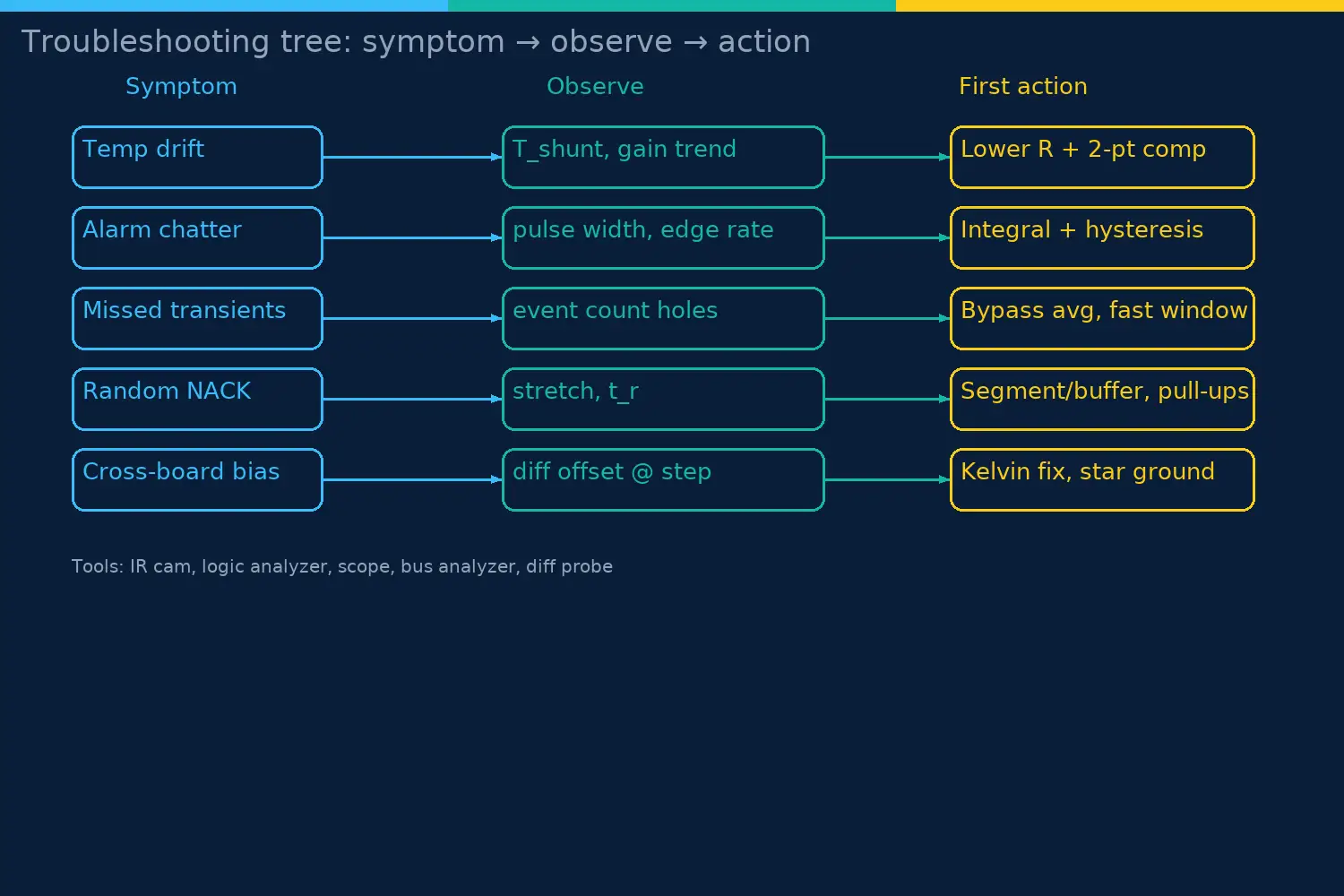
Troubleshooting Matrix (Symptom → Observe → Cause → First Action → Tools)
Use the leftmost Symptom to jump to Observable fields and apply the First Action. Verify with the suggested Tools, then lock in Prevent so the issue does not recur.
Key logs/registers: TS_COUNTER, EVENT_LOG, ALERT_SRC, SNAP_VALID, ERR_NACK, STRETCH_MS.
| Symptom | Observable | Likely Cause | First Action | Tools | Confirm | Prevent |
|---|---|---|---|---|---|---|
| Reading drifts with temperature | T_shunt, gain trend, IR photo | Shunt TCR / self-heating | Lower R or redistribute power + 2-point compensation | IR camera, multi-channel logger | Steady/pulse IR before/after; fit residual drift | Budget ΔT_allow; include TCR in gain budget |
| Alarm chatter | Pulse width, edge density, false-rate | Debounce too weak | Enable integral/hysteresis/min hold | Logic analyzer | False-rate ≤ target under stress | Thresholds from data distribution |
| Transient events missed | Event count holes, missing snapshots | Averaging too large / link latency | Bypass avg; open fast window; raise event bandwidth | High-speed oscilloscope | Pulse-inject capture rate ≥ target | Dual-track: raw for events, avg for reports |
| Random NACK on bus | Stretch timeouts, rise time t_r, ACK loss | Weak pull-up / excessive C_bus | Segment or buffer; adjust pull-ups | Bus analyzer | t_r ≈ 0.8473·R_pullup·C_bus meets mode | Capacitance budget; segment at connectors |
| Cross-board bias | Diff offset during load steps | Ground bounce / return loop | Kelvin fix; star-ground routing | Differential probe | Offset ≤ threshold under steps | Near-load nodes; ground zoning |
| Address conflict after hot-plug | Duplicate scan entries, conflict log | Fixed address overlap | Dynamic assign / DIP; isolate conflict | Host scan script, bus analyzer | Others ACK after isolation | Strap/EEPROM plan + boot self-check |
| ADC saturation / clipping | Raw code near rails, stuck alerts | Range too small / AFE overdrive | Increase range; add clamps/limiters | Scope + raw register dump | No clipping under worst-case | Range review vs load profile |
| Temperature hysteresis | Up/down curves do not overlap | Poor coupling / airflow | Relocate sensor; TIM; 2-point cal | Heat gun + IR | Hysteresis < target | Place near inductor/FET hotspots |
| Alarm storm (resets loop) | Reset count, alert queue bursts | No hysteresis / min hold | Add hysteresis + inhibit time | Logic analyzer + host logs | Storm eliminated on stress test | Integral windows; guard timers |
| Isolator/repeater sticky (SDA/SCL low) | SDA stuck, HS not achieved | I_OL exceeded / level mismatch | Re-size pull-ups; match level domains | Bus analyzer | Consistent levels across domains | Device selection with margin |
| Timestamp drift across nodes | TS differences, event reorder | No sync / missing snapshot | Unify host time; ALERT→SNAP→READ | Host sync script | ±1–2 ms cross-node | Periodic sync; read-clear logs |
| False OC due to noise | Narrow spikes trigger alarms | Front-end RC mismatch / missing clamps | Match RC to S/H; add connector clamp | Fast-edge scope | No trips on injected pulses | ESD/EMI hooks placed at connector |
| ALERT# stuck active | ALERT pin low; status latched | Missing read-clear / threshold too tight | Implement read-clear; review thresholds | Logic analyzer + host script | ALERT clears and re-arms | ISR enforces clear + logging |
| Host timeout false positives | Timeouts only during boot scans | Excess stretch from deep averaging | Raise boot timeout; shorten averaging | Bus analyzer | No timeouts with new params | Per-mode timeout table |
Applications & Reference Solution Skeletons
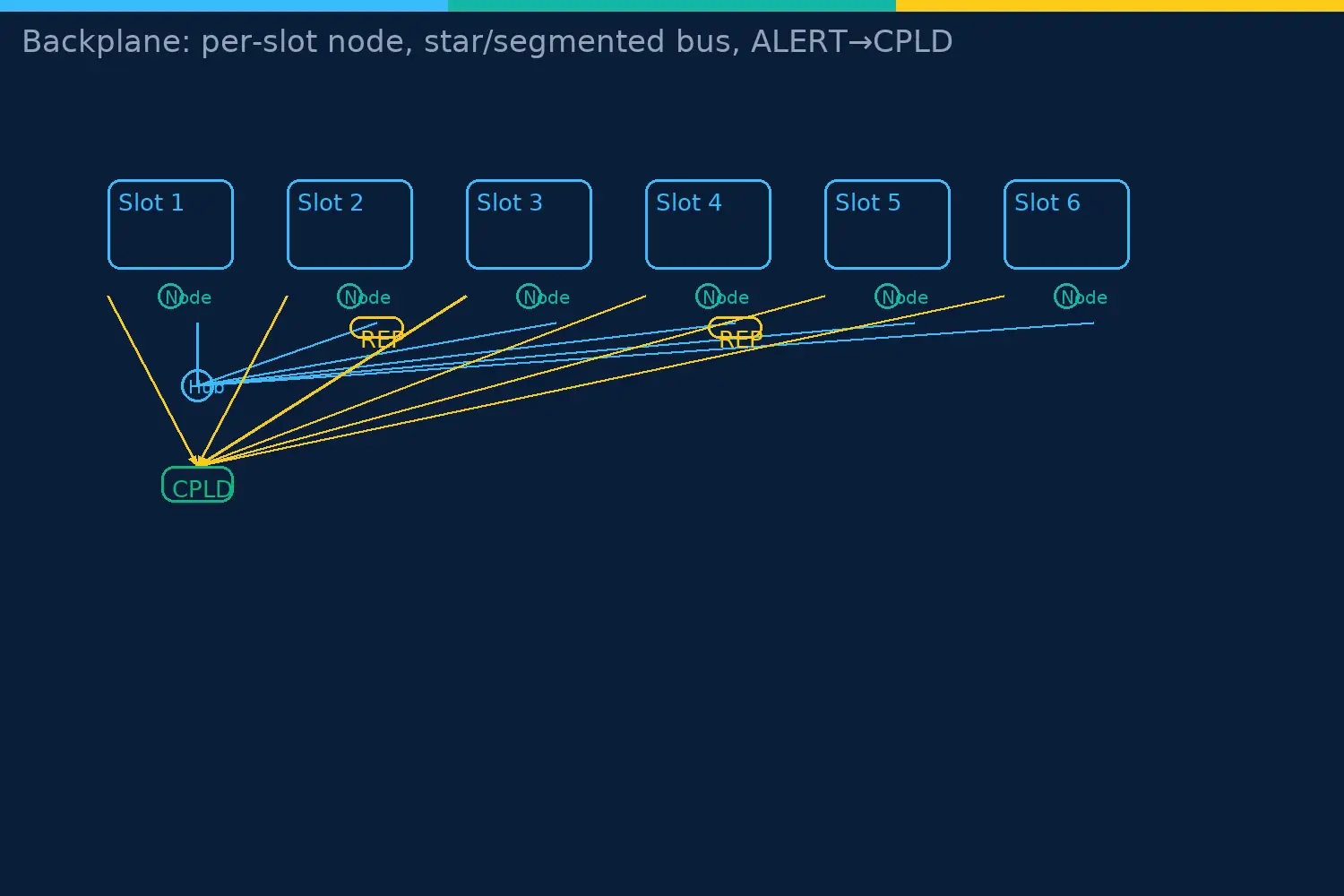
Scenario A — Server/Storage Backplane (NVMe / U.2 / U.3)
- Topology: one node per slot; Star or Segmented with boundaries at backplane connectors; ALERT# aggregated to CPLD.
- Node: shunt 1–5 mΩ; event channel ≥ 1 ksps raw; window+integral alarms; black-box logging (Alert→Snapshot→Read).
- Validation: hot-plug + load steps; bus analyzer for tr and stretch; target false-rate achieved.
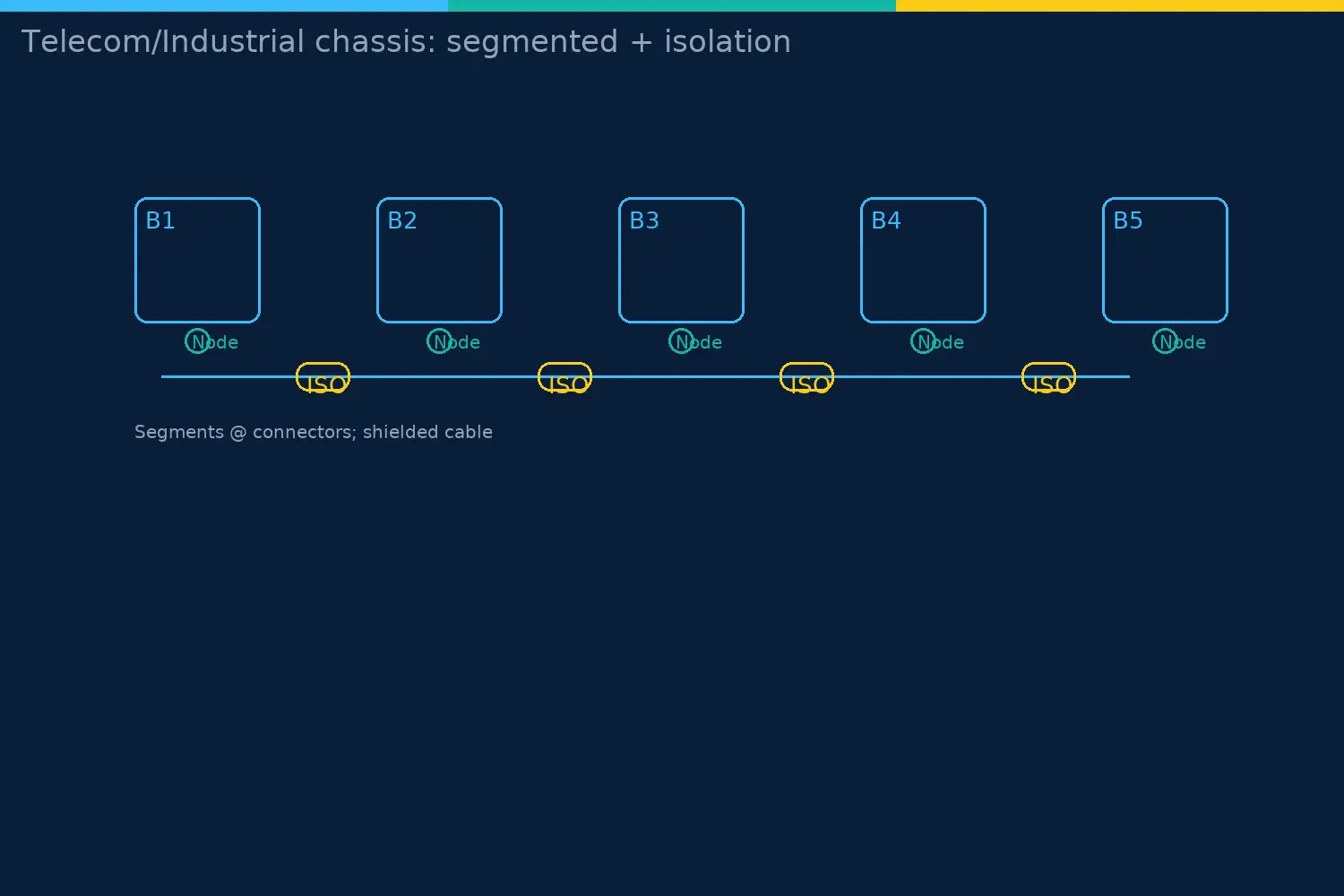
Scenario B — Telecom / Industrial Chassis
- Topology: Segmented with repeaters or isolation bridges; boundaries at board-to-backplane or cable connectors.
- Node: shunt 2–10 mΩ; temperature sensors placed near inductors/FETs; raw events bypass averaging.
- Validation: dv/dt injection on harness; ESD clamp test; Cbus budget vs measured tr.
Scenario C — Automotive Domain Controller
- Topology: near-load satellite nodes + segmented bus; isolation on critical branches; surge-aware design.
- Node: shunt 5–20 mΩ; window+integral alarms; mandatory black-box logging; unified time base (±1–2 ms).
- Validation: load pulses, cold-crank, surge tests; false-rate and capture-rate pass criteria.

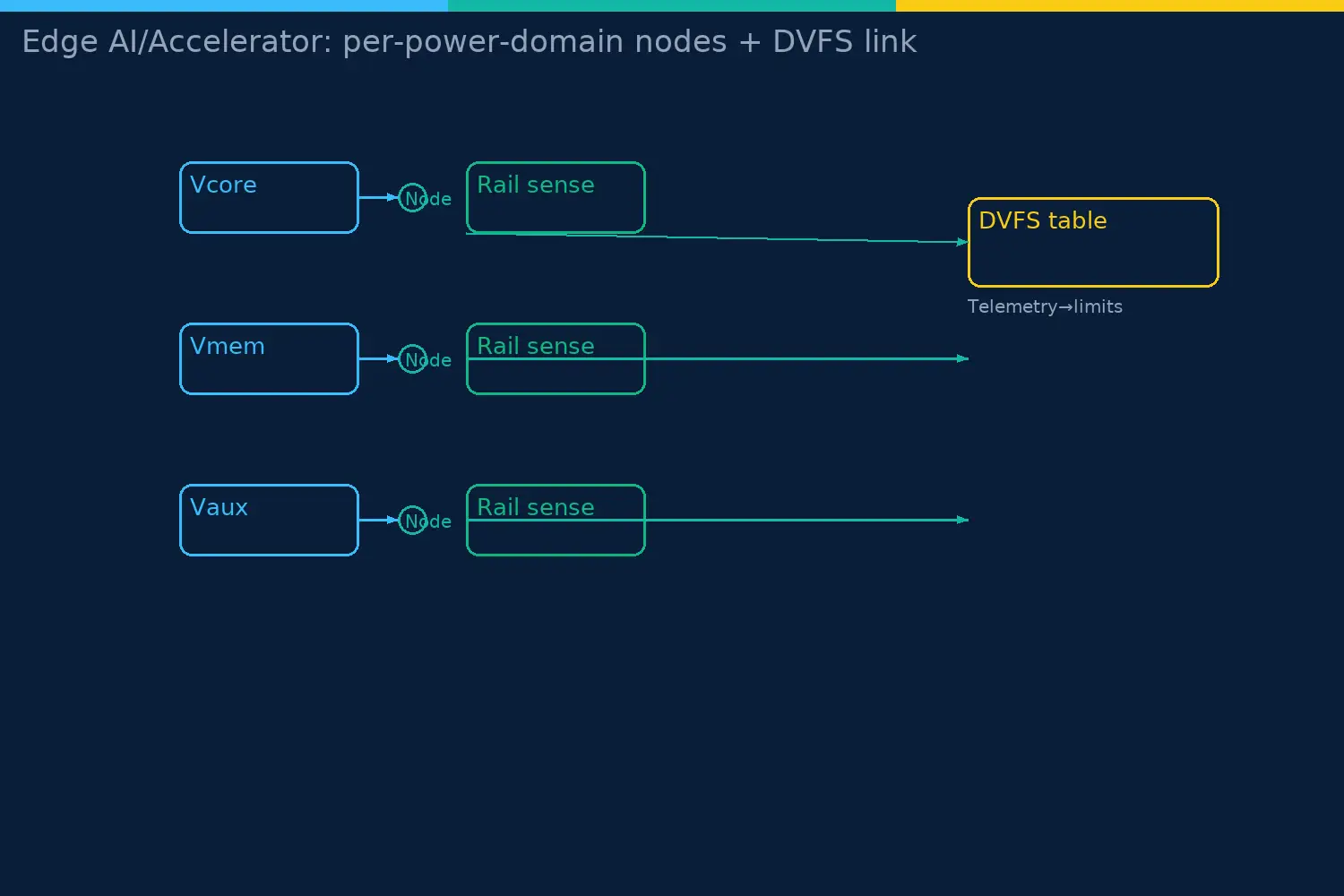
Scenario D — Edge AI / Accelerator Board
- Topology: per power domain node; Star or short segmented; telemetry linked to DVFS limits.
- Node: shunt 0.5–2 mΩ; raw channel high bandwidth; report channel averaged; slope/integral windows.
- Validation: composed pulsed loads; power-limit response time evaluated.
| Scenario | Shunt (mΩ) | Connectors | Pull-ups (kΩ) | Repeaters / Isolators | Cables / Shield | Logging & TS |
|---|---|---|---|---|---|---|
| Server/Backplane | 1–5 | High-cycle, shielded | 1–3 (per segment) | FM+/HS repeaters at slots | Short stubs, shield to chassis | Alert→Snap→Read; ±1–2 ms |
| Telecom/Chassis | 2–10 | Backplane/cable connectors | 1–4 (split by branches) | Isolation bridges at connectors | Shielded cables, drain wire | Event log indexed |
| Automotive | 5–20 | Automotive-grade | 2–4 (temp & surge aware) | Isolated segments at harness | Braided shield, surge arresters | Black-box mandatory |
| Edge AI/Accelerator | 0.5–2 | High-current board-to-board | 1–3 (short segments) | HS repeaters if needed | Short, low-inductance harness | DVFS-linked telemetry |
Reference ICs & Equivalents
Scope: neutral, vendor-agnostic shortlists to seed evaluation for remote (satellite) power monitors. No ratings or reviews. Each table is a category with comparable parts and the selection dimensions you’ll actually decide on: CMRR@frequency, SPS×Latency, Addr planning, Clock-stretch, T_range.
Methodology footnote: CMRR @ 100 kHz / 1 MHz step (dv/dt); Latency = pipeline + averaging; INL/Gain_error @ 25 °C, 1×FS, no-load; Stretch ≤ N ms/txn, host timeout ≥ N+Δ. Values are vendor-datasheet dependent—treat below cells as capability notes, not guaranteed specs.
A. I²C/PMBus Voltage/Current/Power Monitors (hi/low-side, 16–20-bit, alarms/averaging/snapshot)
| MPN | Function | Sense / CMRR@f | ADC Bits / SPS × Latency | Addr options | Clock-stretch (ms) | T_range | Pkg | Notes |
|---|---|---|---|---|---|---|---|---|
| TI INA226 | V/I/P monitor (I²C) | High-side CSA; PWM-tolerant | 16-bit ΣΔ; up to ~1 ksps; mode-dep latency | Pin-strap | Supports; budget per txn | −40…+125 °C | TSSOP/SO | Popular baseline |
| TI INA230/INA231 | V/I/P monitor | High-side | 16-bit class; avg/alert | Pin-strap | Yes | −40…+125 °C | QFN/TSSOP | Multi-vendor adoption |
| TI INA238 | V/I/P monitor | High-side; fast step | 16-bit+; low latency options | Pin-strap | Yes | −40…+125 °C | QFN | Event capture focus |
| TI INA228 | High-accuracy V/I/P | High-side; high CMRR | Up to 20-bit eff.; avg/snap | Pin-strap | Yes | −40…+125 °C | QFN | Advanced telemetry |
| ADI LTC2991 | Multi-channel monitor | Diff sense; muxed | 16-bit class; multi-SPS | Pin-strap | TBD by mode | −40…+125 °C | QFN | V/I/T mix |
| ADI LTC2992 | Dual channel power | High-side | 16-bit ΣΔ; energy accum. | Pin-strap | Yes | −40…+125 °C | QFN | On-chip energy |
| ADI LTC2946 | Wide-range power | High/low-side options | 16-bit class; fast read | Pin-strap | Yes | −40…+85/125 °C | QFN/TSSOP | Accumulators |
| Microchip PAC1931/2/3/4 | 1–4ch power monitor | High-side | 16-bit class; accum./avg | Pin-strap | Yes | −40…+85/125 °C | QFN/TSSOP | Multi-rail |
| Renesas ISL28022/23 | Power monitor (SMBus) | High-side; robust | 16-bit class | Pin-strap | SMBus stretch | −40…+125 °C | QFN | Server backplanes |
| Maxim MAX34406/07 | Multi-rail monitor | High-side | 16-bit class; energy | Pin-strap | Yes | −40…+105 °C | QFN | Data center focus |
B. Precision Current-Sense Amplifiers (wide common-mode / transient-robust)
| MPN | Function | Sense / CMRR@f | ADC Bits / SPS × Latency | Addr options | Clock-stretch (ms) | T_range | Pkg | Notes |
|---|---|---|---|---|---|---|---|---|
| TI INA240 | CSA (PWM rejection) | High-side; high CMRR@PWM | — | — | — | −40…+125 °C | TSSOP/SOIC | Motor/inductor loads |
| TI INA281/INA282 | CSA (high-speed) | Wide CM; fast edges | — | — | — | −40…+125 °C | SOT-23 | Fast transient |
| TI INA199 / INA190 | Low-power CSA | High-side; compact | — | — | — | −40…+125 °C | SOT-23 | Small rail monitors |
| TI INA290 | High-precision CSA | High CMRR; low drift | — | — | — | −40…+125 °C | SOT-23 | Precision loads |
| ADI AD8418 / AD8417 | Bidirectional CSA | Automotive-grade CMRR | — | — | — | −40…+150 °C* | SOIC | A/B domain |
| ADI AD8210 / AD8207 | High-side CSA | Wide CM; robust | — | — | — | −40…+125/150 °C* | SOIC | Legacy proven |
| Maxim MAX4080 / MAX4081 | Bidirectional CSA | High-side; fast | — | — | — | −40…+125 °C | SOIC/TSSOP | General purpose |
| Microchip MCP6C02 / MCP6C04 | High-side CSA | Fast step; low offset | — | — | — | −40…+125 °C | SOT-23 | Compact front-end |
C. Temperature Sensors (local + remote thermal-diode interfaces)
| MPN | Function | Sense / CMRR@f | ADC Bits / SPS × Latency | Addr options | Clock-stretch (ms) | T_range | Pkg | Notes |
|---|---|---|---|---|---|---|---|---|
| TI TMP451 / TMP461 | Local + remote diode | Remote diode filtering | 12–16-bit class | Pin-strap | Yes/SMBus | −40…+125 °C | MSOP/QFN | Heatsink sensing |
| TI TMP1075 / TMP75 | Local digital temp | — | 12-bit class | Pin-strap (multi addr) | — | −40…+125 °C | SOT-23/SOIC | Drop-in local sensor |
| ADI ADT7461A | Remote diode + local | CPU/GPU diode | 12-bit class | Pin-strap | SMBus | −40…+125 °C | MSOP | Legacy server use |
| ADI ADT7420 / ADT7410 | Local high-accuracy | — | 16-bit class | Pin-strap | — | −40…+125 °C | MSOP/TSSOP | Cal-friendly |
| Maxim MAX6680 / MAX6690 | Remote diode + local | Remote diode filter | 12-bit class | Pin-strap | SMBus | −40…+125 °C | TSSOP | Fan-control ecosystems |
| Maxim MAX31875 | Local digital temp | — | 12-bit class | Pin-strap | — | −40…+125 °C | WLP/SOT | Tiny footprint |
| LM75A (multi-sourced) | Local digital temp | — | 9–12-bit variants | 3-bit addr strap | — | −40…+125 °C | SOIC/TSSOP | Commodity choice |
D. I²C Repeaters / Isolation Bridges (long line / segmentation)
| MPN | Function | Sense / CMRR@f | ADC Bits / SPS × Latency | Addr options | Clock-stretch (ms) | T_range | Pkg | Notes |
|---|---|---|---|---|---|---|---|---|
| NXP P82B715 | Bus extender | — | — | — | Supports | −40…+85/125* | SO | Long runs |
| NXP P82B96 | Buffer/level | — | — | — | Yes | −40…+85/125* | SO/TSSOP | Domain bridging |
| NXP PCA9615 | Differential I²C | — | — | — | Yes | −40…+85/105* | TSSOP | Cable runs |
| NXP PCA9517 / PCA9515A | Bidirectional buffer | — | — | — | Yes | −40…+85/105* | TSSOP | Stub isolation |
| TI TCA4311A | Hot-swap buffer | — | — | — | Yes | −40…+105 °C | TSSOP | Slot cards |
| TI TCA9803 | Level-shift buffer | — | — | — | Yes | −40…+125 °C | SOT | Multi-VIO |
| TI ISO1540 / ISO1541 | I²C isolator | — | — | — | Transparent | −40…+125 °C | SOIC | Galvanic isolation |
| ADI ADuM1250 / 1251 | I²C isolator | — | — | — | Transparent | −40…+125 °C | SOIC | Isolated domains |
| ADI LTC4310 | Differential I²C pair | — | — | — | Yes | −40…+125 °C | SSOP | Long cable over twisted pair |
| ADI LTC4311 | Rise-time accelerator | — | — | — | N/A | −40…+125 °C | SOT-23 | Large C_bus help |
| ADI LTC4317 | Bus recovery / addr repair | — | — | Addr masks | Yes | −40…+125 °C | SSOP | Hot-plug friendly |
Need a neutral cross-vendor shortlist and eval samples?
Contact Ersa Electronics for a brand-agnostic comparison list and evaluation samples — including bundled BOM for shunts, connectors, repeaters/isolators. NDA support available for register maps and bring-up scripts (address scan, clock-stretch profiling, timestamp sync).
Request RFQFAQ — Remote Power Monitors (12 answers)
Practical, vendor-agnostic answers. Each entry gives a “why → how → verify” loop and aligns with earlier sections on topology, bus timing, alarms, and logging.
How do we plan multi-node addresses to avoid hot-plug conflicts?
Reserve a static DIP/strap range per slot, then serialize each board in EEPROM with a unique suffix read at boot. The host performs a startup scan, quarantines duplicates, and assigns a temporary fallback if needed. Log conflicts to aid service. Validate with scripted hot-plug, ensuring unaffected nodes ACK and the bus remains responsive.
When bus capacitance is high, should we segment or add a repeater?
Always segment first at connectors or cable boundaries, keeping each branch within its rise-time budget. Estimate with Cbus ≈ ΣCtrace + ΣCconn + ΣCdev and tr ≈ 0.8473·Rpullup·Cbus. Only add repeaters/isolators if segmentation still fails targets. Re-measure tr and stretch margins using a bus analyzer after each change.
Should Kelvin sense points sit closer to the load or the connector?
Prefer the load end. Measuring across the connector includes variable contact and harness drops that distort regulation and telemetry. Keep sense traces symmetric, short, and away from high current paths. Verify with a differential probe during step loads: the load-end Kelvin pair yields lower error and smaller dynamic offsets than connector-referenced taps.
How do we maintain CMRR under high dv/dt conditions?
Match the input RC to the ADC sample-and-hold so the front-end settles before conversion. Place clamps at the connector, use shielded routing, and keep analog/digital grounds zoned with a single-point tie. Validate with fast load steps: no overflow, minimal overshoot, and stable recovery indicate sufficient CMRR and dv/dt immunity.
When are alarm windows with integration better than single thresholds?
In noisy or bursty environments, window plus integral filtering reduces false positives by requiring duration, not just amplitude. Set minimum hold time and hysteresis based on measured distributions. Acceptance is a target false-alarm rate under stress tests. Use logic analyzer captures to confirm that chatter disappears while genuine faults still assert.
How do we capture short bursts while averaging is enabled?
Use dual-track data: the event channel bypasses averaging (raw, fast window, minimal latency), while the reporting channel applies averaging for stability. Validate with pulse injection and confirm event capture rate meets targets. Keep alerts latched until snapshot is read to avoid missing closely spaced bursts under host polling jitter.
How many calibration points are needed for temperature channels?
Two-point calibration is preferred to capture slope and offset. Add an online bias correction if packaging or airflow shifts thermal coupling over time. Record coefficient versions for traceability. Validate with controlled ramps and verify residual error across the operating range, including locations near inductors and power devices.
How do we record the last event on power loss and keep time aligned?
Use Alert-triggered snapshots, then read-clear in the ISR or high-priority thread. Synchronize all nodes to a host time base and target ±1–2 ms cross-node alignment. On brownout, capture the final snapshot and sequence numbers. Post-mortem reconstruction relies on consistent timestamps and monotonic event indices across nodes.
What EMI issues affect I²C, and how can we mitigate them?
Long cables, stubs, and poor shielding inflate Cbus and invite interference. Keep stubs short, segment at connectors, size pull-ups per rise-time limits, and use shielded or twisted-pair runs. Where necessary, adopt differential or isolated bridges. Verify with bus analyzer eye captures and ESD surge tests at cable entry points.
How should clock stretching interact with host polling and timeouts?
Define a per-transaction stretch ceiling and set host timeouts to N+Δ with margin for worst-case conversions and averaging. Use lighter modes during boot scans to avoid needless timeouts. Log stretch duration per device, and alert if it exceeds policy, indicating mis-sized pull-ups, excessive Cbus, or heavy filtering.
How can we minimize standby power without losing observability?
Throttle sampling and park noncritical channels; enable event-driven wake and shorter conversions on entry. Keep black-box logging active with minimal metadata so incidents remain traceable. Validate wake latency and confirm alerts still meet response targets. Publish a mode table showing current draw, sampling rate, and resume times.
How do we preserve register compatibility when swapping parts?
Introduce a thin hardware-abstraction layer and capability bitmap negotiated at startup. Keep a self-test that probes key registers and masks unsupported features. Provide fallbacks for alarms, averaging, and timestamp modes. Maintain versioned mapping tables so firmware can translate differences without touching higher-level telemetry pipelines.

Related Articles
- ·Beyond Capacity: Why Bandwidth and Power Efficiency Now Define Memory Value
- ·Understanding Memory Price Cycles: Key Drivers Behind Supply and Demand Shifts
- ·DRAM vs. NAND: How AI Demand Is Reshaping the Memory Industry
- ·HBM Explained: Why High-Bandwidth Memory Is Critical for AI Accelerators
- ·Beyond Capacity: Why Bandwidth and Power Efficiency Now Define Memory Value
- ·Understanding Memory Price Cycles: Key Drivers Behind Supply and Demand Shifts
- ·DRAM vs. NAND: How AI Demand Is Reshaping the Memory Industry
- ·Memory Chip Market Outlook: What Buyers Should Watch Heading into Q4
- ·EMI and EMC in Electronics Design: How to Prevent Problems Before Testing
- ·USB-C Power Delivery Explained: What Engineers Need to Know About EPR





.png?x-oss-process=image/format,webp/resize,h_32)


