
 German
 Japanese
 Portuguese
 Korea
Korea
 Mexico
 Dutch
Dutch


What Makes a Bluetooth IC HCI-Compatible:Interface-Only Chip Guide

Introduction: Understanding the Term “HCI-Compatible”
In Bluetooth system design, the term HCI-Compatible IC refers not to a protocol specification, but to a hardware selection attribute. When a Bluetooth IC is labeled as HCI-compatible, it means the chip is designed to work as a controller-only device, interfacing with a host processor via the standardized Host Controller Interface (HCI) layer.
This term is especially critical in embedded Linux and Android systems, where the Bluetooth stack (BlueZ or proprietary) resides on the host processor, and the controller IC must expose a UART, USB, or SDIO interface carrying raw HCI packets.
Unlike integrated SoCs that include both host and controller logic internally (often called “standalone” Bluetooth modules), HCI-compatible ICs are intentionally minimal—they delegate all protocol logic above the HCI layer to the host system. This enables tighter system integration, centralized firmware updates, and OS-level stack control.
Common Use Cases
- Android devices using UART-connected Bluetooth ICs for audio and peripheral connectivity
- Embedded Linux gateways requiring Bluetooth LE communication via USB-HCI
- Automotive infotainment systems that isolate the host stack in a secure MCU or SoC
Key takeaway: “HCI-compatible” is a chip classification term—not a protocol feature—used to indicate whether the IC can be controlled entirely by a host system through a standard Bluetooth HCI interface.
Key Architectural Difference: Controller-Only vs Full Stack ICs
When selecting a Bluetooth IC for your system, one of the most critical decisions is choosing between a controller-only HCI-compatible IC and a fully integrated SoC. These two options reflect fundamentally different system architectures and integration philosophies.
Controller-Only HCI-Compatible ICs
These chips implement only the lower layers of the Bluetooth protocol stack (typically the Controller layer), exposing a standard HCI interface over UART, USB, or SDIO. The Host stack—including L2CAP, GAP, GATT, and profiles like A2DP or HID—is expected to run externally, often on a Linux, Android, or RTOS-based host processor.
Key characteristics:
- Requires host-side Bluetooth stack integration
- Offers greater control, customization, and flexibility
- Ideal for systems already running an OS with Bluetooth middleware (e.g., Android with BlueZ)
Fully Integrated Bluetooth SoCs
These chips include both the Host and Controller layers internally and are often designed to run standalone without external stack support. Profiles, configuration, and applications are either hardcoded or scripted via AT commands or vendor SDKs.
Key characteristics:
- No external Bluetooth stack required
- Faster time-to-market for simple devices
- Less flexible, but highly optimized for fixed use cases (e.g., BLE beacons, fitness trackers)
Architecture Comparison Diagram
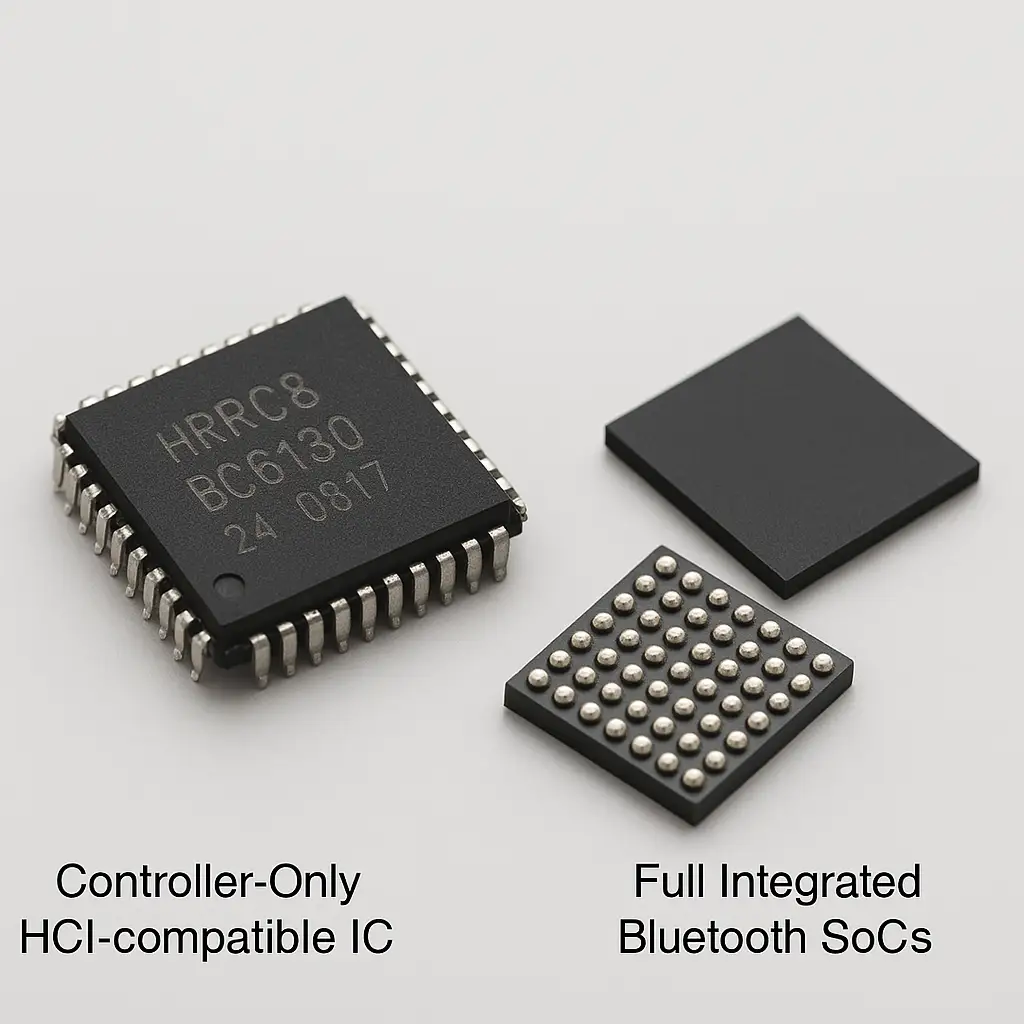
Example:
- TI CC2564: Classic Bluetooth dual-mode HCI controller over UART, ideal for Android/Linux host
- TI CC2640: BLE SoC with built-in stack and profiles, optimized for standalone operation
Understanding this architectural split helps ensure compatibility with your system’s software stack and integration path. If your device already runs a full-featured OS, HCI-compatible ICs offer superior flexibility. For ultra-low-power, embedded applications with no host processor, full-stack SoCs are the right fit.
Interface Types for HCI-Compatible ICs
HCI-compatible Bluetooth ICs primarily rely on three hardware interfaces to connect with a host processor. Each interface serves a different performance, OS compatibility, and legacy requirement. Understanding these categories is key to matching the IC with your embedded platform.
1. UART-Based HCI Interface
The most common physical interface for HCI communication, especially in Android and low-power embedded systems. UART offers a simple, cost-effective solution for host-controller communication and is widely supported by Linux’s hci_uart subsystem.
2. USB-Based HCI Interface
Preferred in systems requiring high throughput or plug-and-play functionality, such as Linux-based gateways, desktop systems, and industrial controllers. USB-HCI chips are often used in dongle-like configurations or as embedded devices on x86 boards.
3. Dual-Interface / Hybrid Support
Some Bluetooth ICs offer both UART and USB HCI interfaces (selectable via pins or firmware configuration). This hybrid capability allows the same module to be reused across different platforms or product variants, reducing BOM complexity.
Vendor Interface Support Comparison
| Vendor | UART-HCI | USB-HCI | Hybrid (UART + USB) | Representative Models |
|---|---|---|---|---|
| TI | ✔️ | — | — | CC2564MODx |
| Microchip | ✔️ | ✔️ | ✔️ | BM83, RN42HCI |
| Infineon (Cypress) | ✔️ | ✔️ | ✔️ | CYW20706, CYW920735Q60EVB-01 |
| NXP | ✔️ | ✔️ | — | QN9090, KW41Z |
| Qualcomm | ✔️ | ✔️ | — | WCN3991, CSR8811A08 |
When selecting a Bluetooth HCI-compatible IC, consider your host platform’s native driver support and physical interface availability. For example, UART is preferred in Android smartphones and Linux SBCs, while USB may be better suited to industrial gateways or PC-based systems.
For a deeper understanding of how UART-based HCI works at the protocol and system level—including H4 framing, timing, and IC integration—refer to our full guide on UART-based Bluetooth HCI Architecture.
When to Choose an HCI-Compatible IC
HCI-compatible Bluetooth ICs are not required in every design—but they are essential in systems that demand modularity, host-side control, or advanced platform integration. Below are the most relevant scenarios where HCI-based controllers outperform full-stack SoCs.
1. Host Platforms with Built-in Bluetooth Stacks
Operating systems like Linux (BlueZ), Android, or embedded RTOSes (e.g., Zephyr, FreeRTOS with BLE middleware) already support the Host-side Bluetooth stack. In these cases, using an HCI controller allows direct integration via UART or USB without duplicating stack logic.
Example: Android systems with hci_uart driver directly interface with HCI Bluetooth modules like TI CC2564.
2. Limited MCU Resources
In systems where the primary MCU cannot accommodate the full Bluetooth stack due to memory, performance, or real-time constraints, offloading the lower-layer Controller logic to a dedicated HCI-compatible chip ensures reliable operation while maintaining host-side flexibility.
3. Separation of Certification, Security, and Stack Updates
HCI-compatible ICs allow for modular validation—certify the controller hardware once and update host-side stacks independently. This modularity is valuable in regulated markets (e.g., automotive, medical) or when firmware agility is a priority.
4. Cost or Flexibility-Driven Designs
Instead of purchasing a monolithic SoC for each product SKU, using an HCI module allows the same host application code to work across multiple Bluetooth modules or suppliers, simplifying BOM and reducing long-term costs.
System-Level Trade-Offs
| Design Factor | HCI-Compatible IC | Fully Integrated SoC |
|---|---|---|
| Stack Flexibility | ✔️ Host-defined, upgradable | ❌ Fixed in silicon or firmware |
| System Cost | ✔️ Lower if host is already present | ✔️ Lower if used standalone |
| Integration Time | ⚠️ Longer, needs host stack tuning | ✔️ Faster deployment (AT or SDK) |
| Certification Burden | ✔️ Host-stack independent | ❌ Must certify each SoC variant |
| Power Consumption | ⚠️ Depends on host load | ✔️ Optimized for single-chip usage |
Ultimately, HCI-compatible Bluetooth ICs are ideal for modular systems, operating systems with stack support, and long-term scalable designs. They offer flexibility and ecosystem alignment at the cost of slightly more integration effort.
Recommended HCI-Compatible ICs by Vendor
Below is a curated list of Bluetooth ICs that support HCI-mode operation, sorted by leading vendors in embedded connectivity. These devices are designed to interface with external host stacks via UART or USB and are widely used in modular Bluetooth architectures.
| Model | Vendor | Interface | Bluetooth Version | Notes |
|---|---|---|---|---|
| CC2564MODA / MODN | TI | UART | BT 4.1 | HCI-only, certified, dual-mode support |
| PAN1326C2 | Panasonic (TI-based) | UART | BT 4.1 | Controller-only, based on CC2564 |
| CYW920819 | Infineon (Cypress) | USB / UART | BT 5.0 | Dual interface, low-power mode supported |
| RN41 | Microchip | UART | BT 2.1 + EDR | HCI/Serial, legacy-compatible |
| IS1870SF | Microchip | UART | BT 4.2 | Supports SPP/HCI, compact design |
| BLUENRG-M2SA | STMicroelectronics | UART | BT 5.0 | Supports HCI mode with ST stack |
| QN9080 | NXP | UART (HCI optional) | BT 5.0 LE | Flexible controller-only operation |
| WCN3991 | Qualcomm | UART / SDIO | BT 5.1 | Mobile-class, Android/Linux support |
Note: Always verify stack compatibility, regulatory certifications, and long-term availability when selecting HCI modules, especially across vendors.
How to Identify HCI-Compatible ICs in Datasheets
HCI-compatible Bluetooth ICs are not always explicitly labeled as such in datasheets. Engineers must look for a set of keyword patterns and documentation hints to verify whether an IC supports HCI operation over UART, USB, or SDIO.
🔍 Key Phrases to Look For
- “HCI over UART” – Indicates a standard HCI transport layer via UART interface.
- “Controller Only” – The IC handles baseband and link layer only; host must run the stack.
- “No stack included” – Confirms there is no embedded Bluetooth stack onboard.
- “Host Interface: HCI” – Frequently found in feature tables or block diagrams.
- “Compliant with Bluetooth HCI Spec” – Ensures protocol-level compatibility.
📘 Screenshot Examples
Below are annotated examples from real datasheets that clearly indicate HCI compatibility:
- TI CC2564MODN:

Feature table showing “HCI over UART” and “Bluetooth Controller.”
- Infineon CYW920819:

Block diagram indicating dual UART/USB HCI transport layers.
- Microchip RN41:
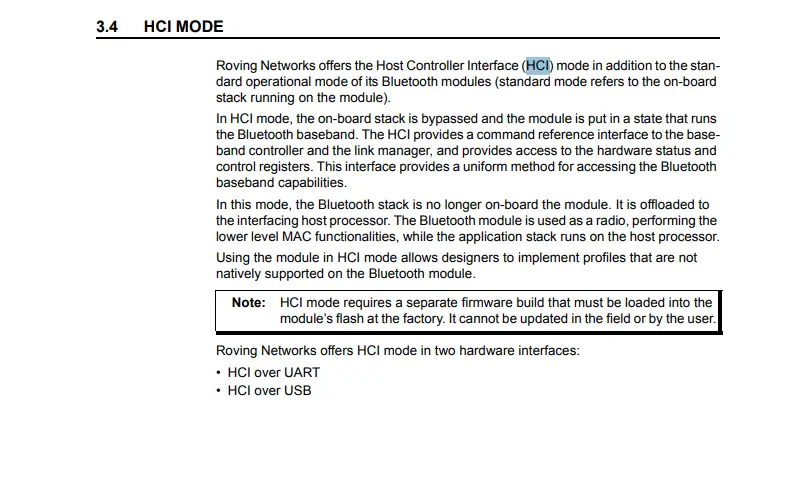
Manual section referencing “HCI Mode via Serial.”
Always verify HCI claims against the “functional block diagram,” “host interface,” and “Bluetooth profiles supported” sections in datasheets or user guides.
Summary & Further Reading
HCI-compatible Bluetooth ICs play a vital role in modular wireless system design. Unlike fully integrated SoC solutions, these ICs delegate the protocol stack to the host side, offering enhanced flexibility, upgrade paths, and certification isolation. For system architects and embedded engineers, understanding when and how to use these controller-only chips is critical for optimizing BOM, design reuse, and system longevity.
For a complete breakdown of USB and Bluetooth HCI architecture, visit our Host Controller Interface Overview.

Related Articles
- ·Beyond Capacity: Why Bandwidth and Power Efficiency Now Define Memory Value
- ·Understanding Memory Price Cycles: Key Drivers Behind Supply and Demand Shifts
- ·DRAM vs. NAND: How AI Demand Is Reshaping the Memory Industry
- ·HBM Explained: Why High-Bandwidth Memory Is Critical for AI Accelerators
- ·Beyond Capacity: Why Bandwidth and Power Efficiency Now Define Memory Value
- ·Understanding Memory Price Cycles: Key Drivers Behind Supply and Demand Shifts
- ·DRAM vs. NAND: How AI Demand Is Reshaping the Memory Industry
- ·Memory Chip Market Outlook: What Buyers Should Watch Heading into Q4
- ·EMI and EMC in Electronics Design: How to Prevent Problems Before Testing
- ·USB-C Power Delivery Explained: What Engineers Need to Know About EPR





.png?x-oss-process=image/format,webp/resize,h_32)


