
 German
 Japanese
 Portuguese
 Korea
Korea
 Mexico
 Dutch
Dutch


Current Sense Amplifiers & Shunt Monitors

Central Idea
This page distills practical methods for accurate, fast, and robust current measurement using current sense amplifiers and shunt monitors. It links device choices and design rules (Rshunt, PGA, RC filters, thresholds) to real workloads—VRM rails, USB-PD/battery ports, motors/heaters, and multi-rail servers—so you can set repeatable protections, clean telemetry, and traceable calibration with minimal false trips. Layout guidance (Kelvin routing), error budgeting, validation matrices, and PMBus/alert orchestration turn the recipes into a production-ready flow, from lab bring-up to fleet analytics.
Current Sense Amplifiers & Shunt Monitors
One-line scope: High-accuracy shunt monitors with wide common-mode range, power calculation, and fast alarms for dynamic loads.

This page focuses on shunt-resistor–based current sensing chains: high-accuracy measurement under wide common-mode rails (e.g., 12 V/48 V/USB-PD), with power calculation and fast alarms to support protection linkage and PDN/AVP optimization.
- Typical applications: battery charge/discharge monitoring, server/accelerator VR rails, motor/heater pulsed loads, automotive 12 V/48 V rails, USB-PD port limiting/metering.
- Scope & boundaries: isolation amplifiers/Σ-Δ modulators/digital isolation and magnetic/Hall solutions are covered on sibling pages. Here we only cover shunt + amplifier/monitor + alarms + telemetry (I²C/PMBus).

Principle
Shunt method: the core relation is Vshunt = I × Rshunt. Sampling can be single-ended or differential; uni- or bi-directional (via zero-point bias or register offset).
Common-mode voltage (VCM) & input swing: a wide VCM range enables high-side sensing on 0–60 V/80 V rails; ensure the amplifier input range covers VCM ± signal.
Low-side vs High-side: low-side is simpler but may disturb the ground return and inject ground noise; high-side preserves ground continuity and is preferred for port limiting/automotive rails.
Power calculation: P = VBUS × I. Distinguish instantaneous/average/window-integrated power. Select conversion time/bandwidth to capture load steps so peaks are not over-averaged.


Architecture
The shunt-based current sensing chain is organized as: Input front-end (filter/ESD) → CSA/SM → ADC/compute → Alerts/PG/PMBus → MCU/PMIC. It targets wide-VCM rails and fast-changing loads where both accuracy and latency matter.
- Input front-end: RC filter, ESD/TVS, Kelvin pick-off from the shunt pads; ensure symmetry and short loops.
- CSA/SM: gain/PGA selection, offset/bias for bi-directional sensing, input range vs VCM and clamps.
- ADC/compute: conversion time and averaging, current/power registers, scaling and calibration constants.
- Alerts/PG/PMBus: trip thresholds, hysteresis and delay, mask/enable and status; latency budgeting.
- MCU/PMIC: FW hooks, interrupt servicing, black-box logging for field correlation.

Interfaces
- I2C/SMBus/PMBus: set conversion time/averaging, read current/power, program thresholds; guard bus latency vs alarm response.
- ALERT/PG line: hardwire fast trips to protection devices (e.g., eFuse/Hot-Swap); debounce or queue in firmware if needed.
- GPIO interrupt: use dedicated IRQ for time-stamped events; keep ISR short and defer parsing.

Optional modules
- Power isolation: when the sense domain floats or safety rules apply; budget error from isolator offset/gain.
- Divider/shunt-range switch: extend measurable range; re-calibrate after switching to maintain accuracy.
- Calibration switch matrix: line-calibration for production; log post-cal constants for traceability.
Design Rules
Rshunt selection
Rule: size Rshunt from allowable drop and power, then confirm resolution and ADC code spread.
Why: drop raises dissipation and reduces efficiency; too small a value hurts resolution and noise margins.
Pitfall: self-heating and TCR drift skew calibration over temperature.

Gain/PGA configuration
Rule: choose the lowest gain that still meets LSB targets; verify the −3 dB point against step-load edge rates.
Why: excessive gain narrows bandwidth and amplifies offset; insufficient gain wastes ADC codes.
Pitfall: too-narrow bandwidth hides inrush/OC peaks.
Common-mode range
Rule: ensure VCM headroom ≥ max rail + transients; check input swing and protection clamps.
Why: wide-VCM parts (e.g., 0–80 V or −0.3 to +80 V) avoid saturation on automotive/PD ports.
Pitfall: front-end RC or TVS clamps can distort at high VCM.
Bi-directional measurement
Rule: center codes at mid-scale via zero-bias or register offset; log direction bits in firmware.
Why: symmetrical headroom for charge/discharge or source/sink currents.
Pitfall: bias drift with temperature degrades small-current accuracy.
Front-end filtering
Rule: place a differential RC close to sense pins; size a slower common-mode RC (5–10×) to tame EMI.
Why: differential RC preserves signal shape while CM RC dampens rail noise.
Pitfall: excessive phase lag near thresholds causes false trips.

Sampling bandwidth
Rule: align conversion time and averaging to the step-load spectrum; capture both peak and settle regions.
Why: fast loads span tens of kHz to MHz; telemetry must not smear short OC spikes.
Pitfall: over-averaging masks fault signatures.

Power/Energy integration
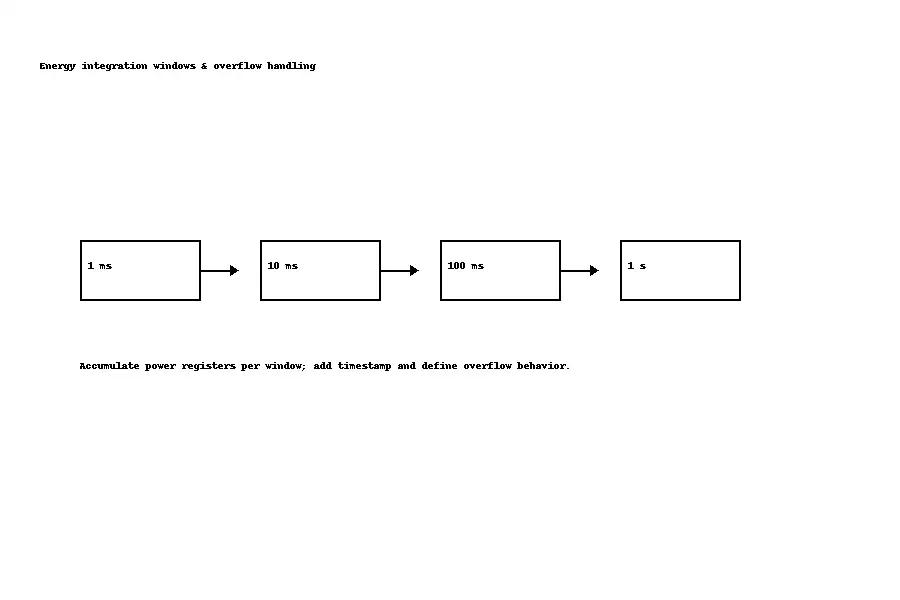
Rule: define fixed windows (e.g., 1/10/100 ms) and overflow behavior; attach timestamps.
Why: consistent windows simplify field correlation and post-mortem analysis.
Pitfall: mixed window lengths make telemetry hard to compare across units.
Error Sources & Mitigation
Build the error budget from sensor to firmware; for each source apply a clear Rule → Why → Pitfall → Mitigation.
Amplifier offset & drift
Rule: budget input-referred offset/drift before gain.
Why: offset dominates small-current accuracy and scales with gain.
Pitfall: excessive gain multiplies offset into large code errors.
Mitigation: low-Vos parts; production trim at temperature; store calibration constants.
PGA gain error
Rule: include gain tolerance/tempcos in the slope term.
Why: PGA tolerance shifts current-per-LSB.
Pitfall: mixing PGA bins breaks fleet comparability.
Mitigation: device binning; per-board slope calibration; lock PGA per SKU.
ADC quantization & conversion time
Rule: ensure LSB ≤ required resolution; tune conversion time to capture peaks.
Why: coarse LSB and long averaging smear transient signatures.
Pitfall: over-averaging hides short OC spikes → late trips.
Mitigation: dual path: instantaneous + averaged; shorten conversion under protection modes.
Rshunt tolerance & TCR (self-heating)
Rule: choose low-TCR shunts and power-derate worst-case ambient.
Why: ΔR from TCR/self-heating skews slope across temperature.
Pitfall: hot spots near pads create gradient-induced drift.
Mitigation: 4-wire Kelvin; mirrored copper for heat spreading; temperature-cal tables.
PCB copper resistance & via imbalance
Rule: Kelvin pick-off from inner shunt pads; minimize series copper.
Why: parasitic resistance adds phantom current.
Pitfall: asymmetric routes inject CM → differential error.
Mitigation: symmetric pair, matched length, short return loop.
Kelvin failure (wiring/placement)
Rule: sense from inner pads; avoid shared load/rail copper.
Why: shared current paths corrupt the sense nodes.
Pitfall: passes DC checks but fails on load steps.
Mitigation: re-probe at pads; audit vias with X-ray; enforce keep-outs.
Firmware & telemetry handling
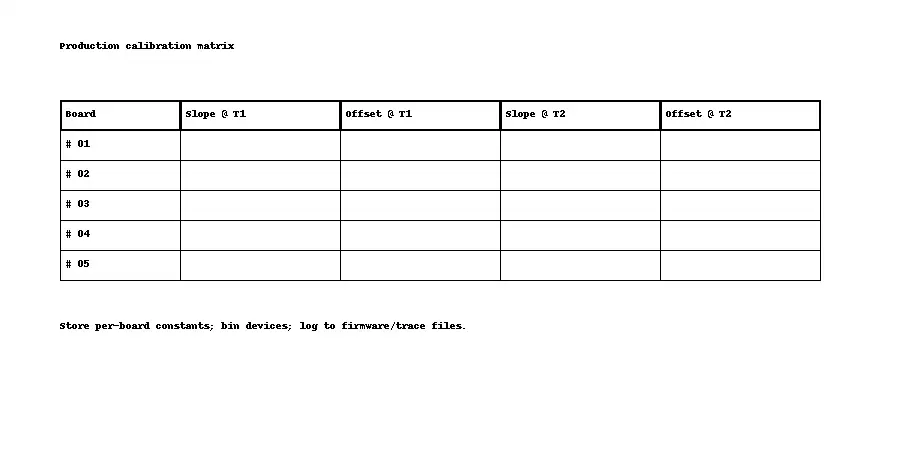
Rule: store slope/offset per board; time-stamp alerts; use moving average for reporting only.
Why: separates fast protection from slow telemetry.
Pitfall: protection based on averaged values is sluggish.


Layout & Kelvin Routing
Four-wire Kelvin connection
Rule: pick up from the inner shunt pads.
Why: eliminates drop across load/rail copper.
Pitfall: vias outside pads include IR drop; use short direct routes into CSA pins.
Differential symmetry & return path
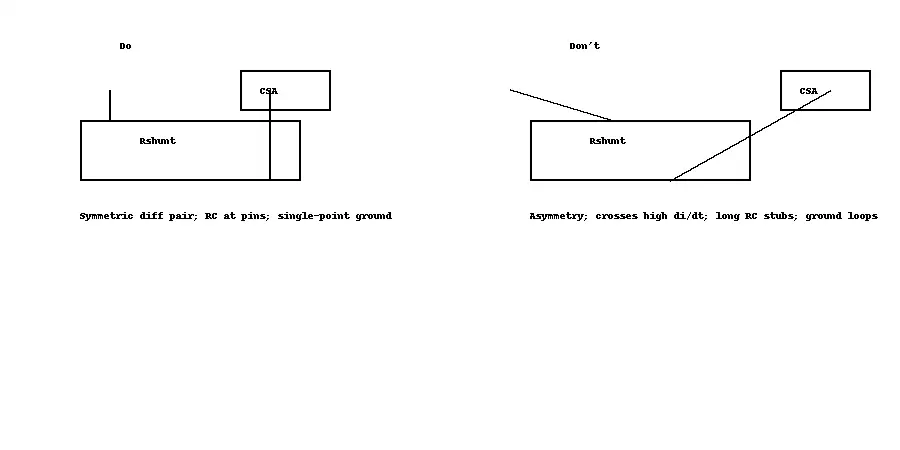
Rule: route a tight, symmetric differential pair from pads to CSA.
Why: cancels common-mode pickup and reduces loop area.
Pitfall: asymmetry and detours across high di/dt zones inject errors.
Avoid high di/dt zones
Rule: keep the sense pair away from switch nodes, inductor fringing, and hot copper.
Why: reduces injected CM and thermal gradients.
Pitfall: crossing SW nodes or gate-drive paths creates spikes and ringing in measurements.
Filter placement vs CSA
Rule: place the differential RC at the CSA pins; common-mode RC slower (5–10×); TVS/ESD near connector/rail.
Why: preserves signal integrity while improving EMI/ESD robustness.
Pitfall: long stubs between RC and pins can resonate; keep stub < 5 mm.
Single-point ground reference
Rule: star-connect the CSA reference to the measurement ground, not power ground pour.
Why: prevents ground-bounce from modulating the measurement.
Pitfall: multiple returns create loops and offset shifts.
Thermal spreading & copper design
Rule: heatsink the shunt with balanced copper; mirror pours around pads.
Why: reduces temperature gradient (TCR error) across the shunt.
Pitfall: asymmetric pours near hot parts cause drift with load.
DFM notes
Rule: lock footprint (pad chamfer, mask openings) per shunt vendor; verify via-in-pad rules.
Why: reflow variations change effective resistance and solder geometry.
Pitfall: cross-lot changes shift measurements if not controlled by SPC.


Protections & Thresholds
Configure the protection stack to react fast to faults while avoiding nuisance trips. Define, per fault, the trio Trip / Hysteresis / Delay, and coordinate the CSA/monitor with eFuse/Hot-Swap/Load-Switch for fast trips.
Fault types & responses
- Over-current (OC): sustained overload above limit. Rule: Trip slightly above worst inrush/AVP peak and add hysteresis. Pitfall: setting Trip too tight causes false trips on step loads.
- Short-circuit (SC): rapid, very high current. Rule: use a fast comparator/ALERT path (bypass slow averaging) and apply blanking. Pitfall: relying on averaged telemetry delays protection.
- Reverse/Backfeed: current into a disabled/lower rail. Rule: enable reverse-current detection or sign-bit logic and trip reverse-block in the eFuse. Pitfall: ignoring negative polarity misses the event.
Foldback & transient suppression
Foldback: above thermal or droop thresholds, reduce the current setpoint vs VOUT/temperature to keep the rail alive.
TVS/RC: use RC to tame dv/dt across the sense input and TVS at connectors; size RC to avoid phase lag at threshold.
Threshold programming
- Trip: ~1.1–1.3× max normal peak.
- Hysteresis: ~5–15% of Trip to prevent chatter.
- Delay: fast path 1–10 us; normal path 100–500 us.
- Latch vs auto-recovery: SC = latched (manual clear); OC = auto-recovery with retry counter.


Telemetry & PMBus Registers
Core registers
- Shunt Voltage — differential sense across Rshunt.
- Bus Voltage — rail sampler for P = Vbus × I.
- Current — computed from Vshunt and slope.
- Power — instantaneous and averaged power codes.
- Alert Limit — per-fault limits (OC/SC/backfeed).
- Mask/Enable — enable bits per alert source.
- Status — sticky flags and overflow bits.

Sampling configuration
- Conversion time per channel (Vshunt/Vbus).
- Averaging count (e.g., 1/4/16/64).
- Alert queue/debounce (e.g., 1/2/4 samples).
- Rule: run a dual path — instant (no averaging) for protection and averaged for reporting.

Calibration workflow
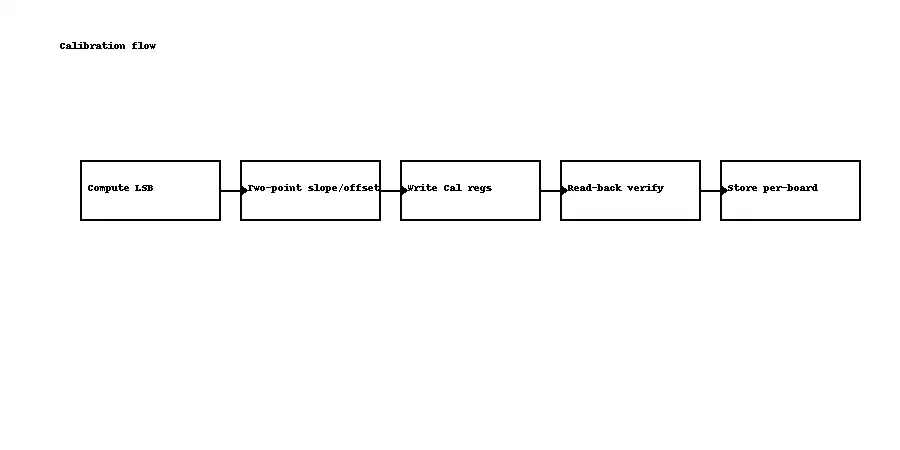
- LSB/Cal registers: program Current_LSB (A/LSB) from Rshunt & gain; write slope/offset.
- Procedure: measure two points (near-zero & mid-range) at two temperatures; compute slope/offset; write; read-back verify.
- Traceability: store per-board constants (version & checksum) in EEPROM/flash.
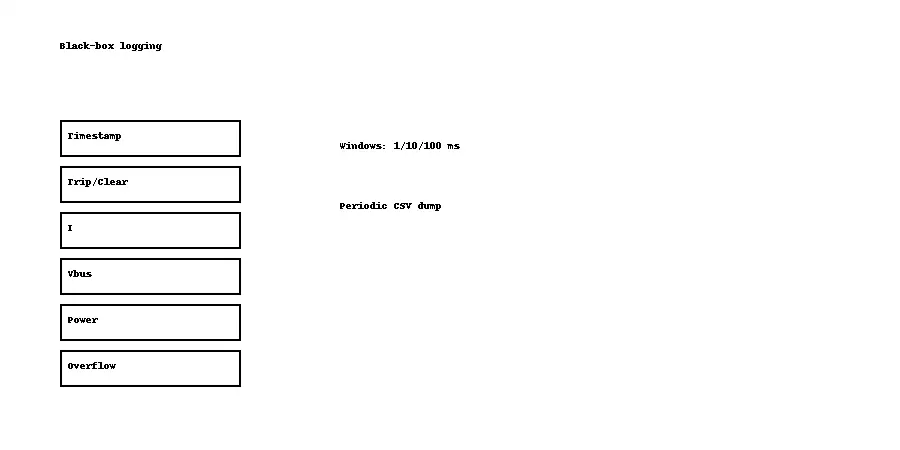
Black-box telemetry
- Timestamped events: Trip/Clear, snapshots of I/Vbus/Power, overflow markers.
- Fixed windows: 1/10/100 ms power windows for fleet comparability.
- Export: periodic CSV/diagnostic dump for field service.
Validation & Test Plan
Static: zero/mid/full-scale vs temperature
Temperature sweep from −40 to +125 °C at steps (e.g., −40/−20/0/25/60/85/105/125 °C). At each point, measure zero, mid, and full-scale current with logs: Vshunt, Vbus, Current, Power, device Temp, PGA, conversion time, averaging, timestamp.
Outputs: per-temperature slope/offset, drift (ppm/°C), and residual error.

Dynamic: step, surge/short, reverse/backfeed
- Step load: define amplitude and slew (A/us), duty/period; measure latency to ALERT, overshoot/undershoot, recovery time.
- Surge/Short-circuit: define source impedance and loop inductance; apply blanking; verify fast-trip timing.
- Reverse/Backfeed: inject negative current into a disabled/lower rail; confirm detect and reverse-block.

Quantification: error budget & repeatability
Error budget: list contributors (Vos/drift, PGA gain error, ADC LSB, Rshunt tolerance/TCR, copper parasitics); compute RSS and worst-case; compare with spec.
Consistency & repeatability: N=10 boards, 3 runs each; report mean/standard deviation and R&R index.

Documentation artifacts
- Measurement logs (CSV): fields with units for each run.
- Calibration file: slope/offset at two temperatures with version and checksum.
- Register export (CSV): per-run dumps for traceability.
- Plots/report: derived charts and summary for release.

IC Selection — 7 Brands

Brand | Family/PN: TI | INA240-Q1
VCM Range: -0.3 to 80 V Gain/PGA: 20/50/100/200 V/V ADC/Resolution: Ext ADC (12–16 bit typical)
I Range (via Rshunt): depends on shunt; bidirectional supported I2C/PMBus: SMBus-compatible (via companion monitor)
Alerts: Fast comparator/ALERT (via monitor) Package: TSSOP/SOIC AEC-Q100: Yes
Notes: Zero-drift architecture; strong CMRR for PWM environments.
Brand | Family/PN: ST | TSC2020-Q1
VCM Range: 0 to 70 V Gain/PGA: 20/50/100/200 V/V ADC/Resolution: Integrated 16-bit monitor
I Range (via Rshunt): per Rshunt sizing; bidirectional I2C/PMBus: I2C/SMBus
Alerts: OC/OV/UV comparators Package: TSSOP/QFN AEC-Q100: Yes
Notes: Integrated shunt/bus voltage sense; automotive qualified.


Application Recipes
Drop-in starting points for four common scenarios. Each recipe gives a quick Rshunt estimate, PGA setting, RC filters, and initial thresholds, plus notes for alerts/firmware coupling. Adjust with lab data from your platform and migrate the parameters into production.

VRM rail monitoring (with AVP/load-line)
High-speed transients; needs fast OC/SC and AVP-aware thresholds.
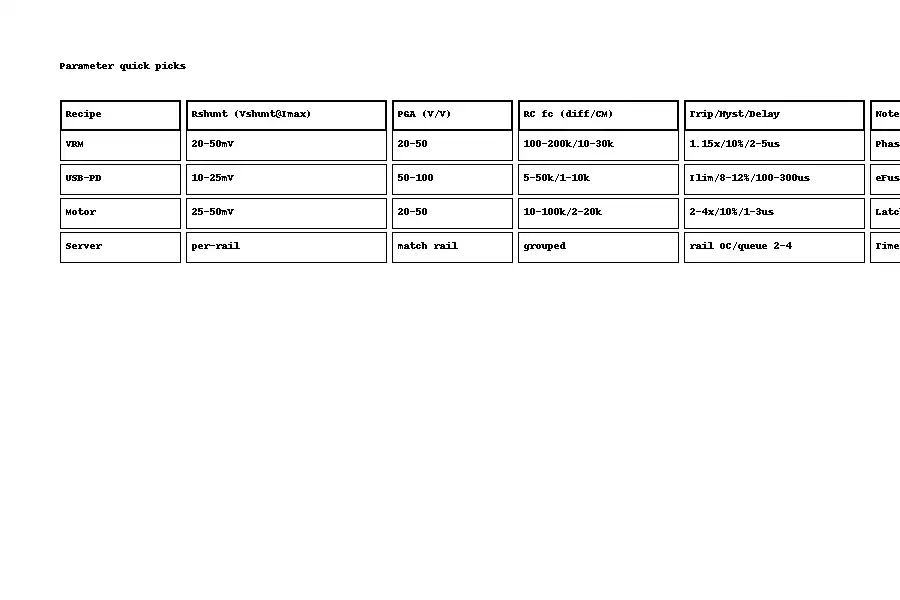
- Rshunt estimate: 20–50 mV at Imax. Example: 60 A → 0.5–0.83 mΩ.
- PGA: 20–50 V/V (keep headroom vs input swing).
- RC filters: diff RC fc ~ 100–200 kHz; CM RC ~ 10–30 kHz.
- Initial thresholds: OC Trip ≈ 1.15× normal peak; Hyst 10%; Delay_fast 2–5 µs; SC latched.
- Notes: tie ALERT to phase-gain boost; log instantaneous + 1/10 ms power windows.

Battery / USB-PD port (bidirectional, eFuse-linked)
Charge/discharge metering and port current limiting with reverse protection.
- Rshunt estimate: 10–25 mV at Ilimit. Example: 5 A → 2–5 mΩ.
- PGA: 50–100 V/V; verify wide VCM for PD rails (to ~20–24 V).
- RC filters: diff RC fc ~ 5–50 kHz; CM RC ~ 1–10 kHz; TVS near connector.
- Initial thresholds: OC Trip = Ilimit (e.g., 5.1–5.5 A), Hyst 8–12%, Delay_norm 100–300 µs; Reverse trip on persistent negative sign.
- Notes: ALERT → eFuse fast trip; PMBus logs for black-box.

Motor / heater load (short/locked-rotor, foldback)
Manage inrush and stall currents; protect with fast SC trip and foldback.
- Rshunt estimate: 25–50 mV at rated current; confirm power rating and TCR.
- PGA: 20–50 V/V; lower gain if stall peaks are large.
- RC filters: diff RC fc ~ 10–100 kHz; CM RC ~ 2–20 kHz.
- Initial thresholds: SC Trip ≈ 2–4× rated I (latched, 1–3 µs); OC Trip ≈ 1.2× rated I (auto-retry).
- Notes: ALERT → load switch/eFuse; log thermal for TCR correlation.

Server / networking (multi-rail aggregation)
Unify telemetry across many rails and align timestamps for system analytics.
- Rshunt estimate: per-rail class: VRM-like (core) or battery-like (12 V aux) targets.
- PGA: common settings per rail group to simplify calibration.
- RC filters: keep diff RC consistent per group; CM RC tuned by chassis EMI.
- Initial thresholds: rail-specific OC with alert queue 2–4 samples; power windows 1/10/100 ms.
- Notes: Telemetry Hub aligns timestamps; PG voters aggregate fault lines.

Parameter quick picks (start values)
Use these as initial targets; refine with lab measurements from your platform.
FAQs
1) Low-side vs high-side — when to choose?
Rule: low-side for simple, low-VCM rails; high-side for true load current and reverse protection.
Why: low-side adds ground lift; high-side sees real load current independent of return wiring.
How to set: check VCM range, input swing, and common-mode rejection vs your rail.
Pitfall: low-side can break PG thresholds; high-side needs wide VCM and fast alert paths.
2) How to remain linear and stable from 0 to 60 V common-mode?
Rule: select CSA/monitor with VCM headroom beyond your max bus and verify input swing vs PGA.
Why: input clamps and stage headroom set linearity and overdrive recovery.
How to set: choose PGA so Vshunt*gain stays inside input swing; validate with step loads.
Pitfall: hidden clamp activation under pulses leads to code compression.
3) RC filters for pulsed loads — how to avoid masking transients?
Rule: split filters: fast differential RC at CSA pins; slower common-mode RC 5–10x lower bandwidth.
Why: preserves edge information while taming CM injection and EMI.
How to set: pick fc based on edge content (VRM 100–200 kHz; battery 5–50 kHz; motor 10–100 kHz).
Pitfall: RC too slow hides SC edges; too fast raises noise and false trips.
4) Bidirectional zero-bias — how to calibrate and compensate drift?
Rule: set mid-scale offset and store slope/offset per board with temp coefficients.
Why: zero-drift parts still have temp/hysteresis; offset dominates low-current error.
How to set: two-point, two-temperature calibration; write registers; read-back verify; log constants.
Pitfall: using room-temp offsets only causes cold/hot bias.
5) How big should Rshunt be to keep efficiency yet ensure resolution?
Rule: budget 10–50 mV drop at max current; derate power and TCR.
Why: more drop increases resolution but wastes power and heats the shunt.
How to set: R = Vshunt_max / Imax; choose low-TCR and right footprint for self-heating.
Pitfall: asymmetric copper near pads adds gradient drift.
6) INA/CSA bandwidth vs noise — how to trade?
Rule: use the lowest gain that meets resolution; bandwidth just enough to capture needed edges.
Why: higher gain amplifies offset and noise; excessive BW adds noise.
How to set: align BW with protection edge content; rely on averaging for reporting only.
Pitfall: averaging in protection path delays trips.
7) Over-current limits — how to avoid tripping on normal inrush?
Rule: set Trip ~1.1–1.3x normal peak; Hyst 5–15%; Delay_fast 1–10 us.
Why: distinguishes transients from faults.
How to set: use dual path: instant comparator for protection; averaged path for telemetry.
Pitfall: zero hysteresis causes ALERT chatter.
8) Coordinating timing with eFuse/Hot-Swap for fast trips?
Rule: wire ALERT/PG directly to fast-trip pins; MCU supervises and logs.
Why: hardware path reacts in microseconds; firmware is slower.
How to set: strong pull-up, short trace; apply blanking to ignore switch bounce.
Pitfall: weak pull-ups slow the edge, delaying trips.
9) PMBus Alert Queue — how to prevent chatter?
Rule: set queue to require 2–4 consecutive samples before asserting ALERT.
Why: filters out narrow noise spikes.
How to set: start with queue=2; raise to 4 if environment is noisy.
Pitfall: too large a queue delays protection events.
10) Production calibration — recommended flow & traceability?
Rule: two-point calibration at two temperatures; store constants per board with checksum.
Why: captures offset and slope drift.
How to set: write LSB/Cal registers; read-back; log versioned files.
Pitfall: mixing bins or unlogged rework breaks fleet comparability.
11) Kelvin failure — typical symptoms & quick triage?
Rule: always probe at the inner shunt pads; compare readings to node points.
Why: shared current paths corrupt sense nodes.
How to set: inspect via symmetry and keep-outs; re-route if asymmetry exists.
Pitfall: passes DC test but fails under load steps.
12) Energy integration & logging — for field forensics?
Rule: integrate power in fixed windows (1/10/100 ms) and timestamp events.
Why: standard windows make fleet data comparable.
How to set: rolling accumulation with overflow markers; periodic CSV dumps.
Pitfall: variable windows make correlation hard across units.
13) AEC-Q100 scenarios — what extra tests?
Rule: add ESD/EMC, temp cycling/HTOL, vibration/shock, salt/mist, and latch-up checks.
Why: automotive reliability and environmental robustness.
How to set: align with OEM test plans; log serial and lot IDs.
Pitfall: neglecting PCB-level stress can pass IC-level but fail system-level.
14) Multi-rail aggregation — reference/ground loops & crosstalk?
Rule: star-reference measurement ground; keep differential pair symmetry and guard near aggressors.
Why: avoids ground loops and CM to differential conversion.
How to set: spacing/guard traces; avoid crossing switch nodes.
Pitfall: shared return with power devices injects switching noise.
15) High-temperature self-heating — how to control zero-drift from Rshunt?
Rule: select low-TCR shunts, derate power, and mirror copper around pads.
Why: temperature delta across the shunt biases the slope.
How to set: symmetric copper, thermal relief planning; add temp-comp tables if needed.
Pitfall: large copper on one side only creates drift with load.
CTA
Submit your BOM
We map rails to Rshunt/PGA/monitor ICs across TI, ST, NXP, Renesas, onsemi, Microchip, and Melexis.

Related Articles
- ·Next-Generation Memory Technologies: MRAM, RRAM, and PCM
- ·DDR4 vs DDR5 for Industrial Embedded Systems
- ·How to Choose Industrial DDR4 Memory for Medical Devices
- ·Memory Chip Price Increase: 2026 Market Trends, Samsung Pricing, Key Drivers and FAQ
- ·Memory Chip Manufacturers: Who Makes Memory Chips and Where
- ·Memory Chips: Materials, Applications, Types, and On-Chip Memory Explained
- ·Memory Chip Complete Guide: Definition, Manufacturers, Shortage, Manufacturing Process and Working Principles
- ·Fiber Optic Switch Guide: Definition, Connection Methods, Cabling, Disconnection and FAQ
- ·Optical Fiber Transmitter and Receiver Guide
- ·ICD Driver, LCD Driver & LCD Panel Driver Board Guide




.png?x-oss-process=image/format,webp/resize,h_32)


