
 German
 Japanese
 Portuguese
 Korea
Korea
 Mexico
 Dutch
Dutch


LM358 Pinout and Pin Configuration Guide for Dual Op-Amp IC

What is LM358?
The LM358 is a dual operational amplifier, or op-amp amplifier, that is specifically made for automotive and battery-powered applications. It is designed for single-supply operation. It can also function with two power supplies, like ±15V, which gives circuit designers flexibility. The gain-bandwidth product of the LM358 is typically approximately 1 MHz, which restricts its performance in high-frequency applications but makes it suitable for a wide range of general-purpose activities.
With its specific architecture, the LM358 Op-Amp is engineered to operate seamlessly across a wide range of voltage supplies. It performs especially well in applications involving moderate-voltage DC and low-voltage AC. Furthermore, it is a mainstay in many practical applications, including active filtering, transducer amplification, DC gain enhancement, and traditional op-amp circuitry, because of its small form factor and affordability. The LM358 IC can generate up to 20 mA per channel and can handle supply voltages between 3V and 32V DC with grace.

LM358 Pinout Configuration
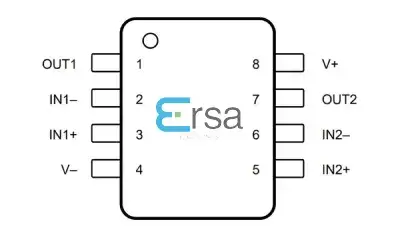
| Pin No. | Pin Name | Description |
|---|---|---|
| 1 | OUT1 | Output of the first operational amplifier |
| 2 | IN1− | Inverting input of the first op-amp |
| 3 | IN1+ | Non-inverting input of the first op-amp |
| 4 | VCC+ | Positive power supply (3V–32V) |
| 5 | IN2+ | Non-inverting input of the second op-amp |
| 6 | IN2− | Inverting input of the second op-amp |
| 7 | OUT2 | Output of the second operational amplifier |
| 8 | VEE/GND | Ground or negative power supply connection |
The LM358 IC pin diagram consists of eight pins, where:
- Pin 1 (Output 1) is the output of the first operational amplifier (Op-Amp).
- Pin 2 (Inverting Input 1, IN-) is the inverting input of the first Op-Amp.
- Pin 3 (Non-Inverting Input 1, IN+) is the non-inverting input of the first Op-Amp.
- Pin 4 (Vcc) is the positive power supply, typically ranging from +3V to +32V.
- Pin 5 (Non-Inverting Input 2, IN+) is the non-inverting input of the second Op-Amp.
- Pin 6 (Inverting Input 2, IN-) is the inverting input of the second Op-Amp.
- Pin 7 (Output 2) is the output of the second Op-Amp.
- Pin 8 (Vee/GND) is the ground or negative power supply connection.
LM358 Features
Dual Op-Amp Configuration: Two separate, frequency-compensated, high-gain op-amps are housed in a single box.
Single-Supply Operation: This device is made to run on a single supply, which enables it to work with voltages between 3 and 32 volts. This makes it especially helpful for automobile applications and battery-powered devices.
Common Mode Input Voltage Range: To ensure effective functioning without distortion, especially in audio applications, the input common-mode voltage range must span from 0V to (V+ - 2V).
Output Voltage Swing: The maximum output for a +5V supply is around 3.5V, as the output can swing to within about 1.5V of the positive supply rail. It's crucial to take this restriction into account for applications that call for larger output levels.
Gain-Bandwidth Product: The maximum gain at higher frequencies is constrained by the typical gain-bandwidth product of approximately 1 MHz. For example, the greatest gain of amplification of a 20 kHz signal would be about 50.
Slew Rate: The output's ability to react fast to abrupt changes in the input signal is influenced by the slew rate, which is around 0.25 V/µs. For applications involving high frequencies, this feature is essential.
Output Current Capability: The output current capability of the LM358 is 10 mA at a minimal source and 8 mA at a minimum sink, which is often too little to drive speakers directly but sufficient for low-power applications.
Crossover Distortion: This phenomenon is known to occur, especially in audio applications, and it can degrade the sound quality. When compared to specialist audio op-amps, this makes it less suitable for high-fidelity audio amplification.
LM358 Equivalents
Depending on the particular needs of the application, a number of comparable or different parts can be utilized in lieu of the LM358 operational amplifier. Here are a few noteworthy analogs:
| IC Chips | Description | Advantages as LM358 Equivalent |
| LM324 | A quad operational amplifier with four op-amps in one package. | Cheaper per op-amp than the LM358, suitable for applications requiring multiple amplifiers. |
| LM2904 | A dual op-amp similar to the LM358 but tested under less rigorous conditions. | Cost-effective alternative, good for applications where stringent specifications are not critical. |
| TL072 | A low-noise JFET-input operational amplifier. | Higher input impedance and lower noise, are suitable for audio applications. |
| NE5532 | A high-performance dual op-amp designed for audio applications. | Better performance in terms of noise and distortion, ideal for high-fidelity audio circuits. |
| MCP600x Series | A family of low-power rail-to-rail op-amps. | Suitable for battery-powered applications due to low power consumption and single supply operation. |
| JRC4558 | A dual op-amp is often used in audio applications. | Known for good sound quality, it is popular in guitar pedals and other audio equipment. |
| LP358 | A dual op-amp with similar specifications to the LM358. | Offers rail-to-rail output and is suitable for low-voltage applications. |
Considerations Substitutes of LM358:
The following elements should be taken into account when choosing an LM358 substitute:
Pin Compatibility: If the layout is fixed, make sure the substitute has a pinout that works.
Performance Specifications: Verify that factors such as input/output voltage ranges, slew rate, and gain-bandwidth products match the needs of the application.
Requirements for Power Supply: Confirm that the substitute can function in the same voltage supply range as the LM358.
In conclusion, although the LM358 is a flexible op-amp, there are a number of good substitutes that may be employed based on the particular requirements of the application, such as the LM324, LM2904, TL072, NE5532, MCP600x series, JRC4558, and LP358, among others.
LM358 Applications
A flexible dual operational amplifier (op-amp), the LM358 is used in a wide range of electronic circuits. The following are some typical uses for the LM358:
| LM358 Application Area | Specific Application |
| Audio Circuits | Audio Amplifiers: Although not ideal for high-fidelity audio due to crossover distortion, The LM358 can be used in basic audio amplifier circuits. |
| Active Filters: Used in designing active filter circuits for audio signal processing. | |
| Signal Conditioning | Voltage Followers: Employed as voltage followers to B: buffer signals without loading the previous stage. |
| Comparators: Utilized as comparators to detect when a signal crosses a certain threshold. | |
| Instrumentation Amplifiers: Can be configured as part of an instrumentation amplifier circuit for precise signal amplification. | |
| Power Supply Circuits | Voltage Regulators: Used in simple voltage regulator circuits to provide a stable output voltage. |
| Battery Chargers: Incorporated into battery charger circuits for charging lead-acid or NiCd batteries. | |
| Sensor Interfacing | Sensor Amplifiers: Used to amplify signals from various sensors like thermocouples, strain gauges, and pressure sensors. |
| Transducer Conditioning: Employed in circuits that condition signals from transducers like load cells and accelerometers. | |
| Automotive Applications | Ignition Circuits: Used in automotive ignition circuits to control the timing and duration of the spark. |
| Fuel Injection Control: Incorporated into fuel injection control circuits to regulate the fuel delivery. | |
| Miscellaneous Applications | Oscillators: Can be used to build simple oscillator circuits using external components. |
| Motor Control: Utilized in basic motor control circuits to drive small DC motors. | |
| LED Drivers: Used to drive LEDs and control their brightness in various applications. |
Despite being a flexible op-amp, the LM358 has some drawbacks that should be taken into account when choosing it for a given application. These include its output voltage swing and crossover distortion. In some situations, newer op-amps like the TL072 and NE5532 might perform better.
LM358 Application Circuits
LM358 for Shock Alarm Circuit:
A shock alarm circuit similar to the one below can be found in both homes and cars. Its major use is as an anti-theft alarm in autos. The shock sensor in this circuit is a piezoelectric sensor, which needs to be mounted on the door you wish to protect. The LM358 is attached in this instance as an inverting Schmitt trigger. Port 1 can set the circuit's threshold voltage, and resistor R1 serves as a feedback resistor.

Figure 1: Shock Alarm Circuit
The piezo sensor will have a low output when it is not active. The buzzer is activated when the Schmitt trigger is triggered by the piezo sensor's high output. It takes some time for the buzzer to stop beeping even if the vibration is disconnected. This happens because the state is difficult to invert and the inverting input, as it grows, has less of an impact once the LM358 IC is turned on.
LM358 for Infrared Detection Alarm:
The infrared radiation that the human body emits can be detected by this alert. An audio alert is activated when someone walks into the alarm's monitoring area. This system is appropriate for a number of important places, including residences, workplaces, warehouses, and labs.

Figure 2: Infrared Detection Alarm
An infrared sensor (IC1), a signal amplification circuit, a voltage comparator, a delay circuit, and an audio alarm circuit make up the circuit as it is depicted in Figure 1. The infrared sensor IC1 produces a faint electrical signal at pin 2 in response to detecting infrared signals emitted by a human body in front of it. The first-stage amplification circuit made up of VT1 then amplifies this signal.
The operational amplifier IC2, which offers high gain and low noise amplification, further processes the amplified signal. At this point, the output at pin 1 of IC2 is powerful enough. IC3 is a comparator of voltage. R10 and VD1 provide a reference voltage to its pin 5. The output at pin 7 of IC3 changes from high to low when the voltage at pin 6 of IC3 equals the output voltage from pin 1 of IC2. This is done by comparing the voltage levels.
The alarm delay circuit is IC4, and a one-minute delay circuit is formed by R14 and C6. Pin 7 of IC3 drops low, causing C6 to discharge via VD2. As a result, pin 2 of IC4 becomes low. Next, it contrasts the voltage at pin 3 with the voltage referenced. Pin 1 of IC4 turns high when it drops below the reference voltage, triggering VT2 to conduct and energizing the buzzer BL to sound an alert. Pin 7 of IC3 recovers to a high output when the infrared signal from the human body fades, and VD2 switches off. R14 charges C6 gradually since the voltage across it cannot fluctuate suddenly. Pin 1 of IC4 drops low, and the alarm sounds for about a minute, or until the voltage across C6 surpasses the reference voltage, which takes about a minute.
The startup delay circuit, which likewise lasts for almost a minute, is made up of VT3, R20, and C8. Its main purpose is to avoid false alarms during power outages and to delay alerts from sounding as soon as the device is turned on, giving people ample time to leave the monitored area.
With transformer T providing voltage reduction, bridge rectifier U providing full-wave rectification, and C10 providing filtering, the device runs on a 9–12V DC power source. The IC5, 78L06, provides power to the detection circuit. This gadget offers seamless, automatic switching and is compatible with both AC and DC power supplies.
LM358 for Dark Detector Circuit:
A photodiode, phototransistor, and light-dependent resistor (LDR) can all be tested with this dark sensor circuit that uses the LM358 IC. All you have to do is swap out the LDR for a photodiode or phototransistor to test other parts. Here is a diagram of the dark sensor circuit that uses an LM358 IC and an LDR. An LDR, an LM358 integrated circuit, a 9V battery, resistors (R1-330R, R2-1K, and R3-10K), a variable resistor (VR1-10K), and a transistor (Q1-C547) are needed to construct this circuit.

Figure 3: Dark detector circuit
When the LDR is swapped out for a photodiode, the circuit starts up right away. The circuit's sensitivity can be adjusted by varying the resistor in accordance with the amount of light in the space.
In a similar vein, the circuit operates instantly when a phototransistor is utilized in place of the LDR. The circuit's sensitivity can be fine-tuned to the amount of ambient light by using the variable resistor.
LM358 for High-End Current Detection Circuit:
There are restrictions when it comes to sending the voltage across the sampling resistor straight into the AD of the microcontroller. First of all, a low current also results in a low voltage across the sampling resistor, which the AD converter may need to detect with a high sensitivity. Second, because this is a low-end detection, there is no common ground for the power output and input, which may have an impact on the stability of the output voltage (regulated output = sampling resistor voltage + actual output voltage). A sophisticated detection circuit is created to address these problems, as seen in the illustration below:

Figure 4: High-End Current Detection Circuit
A vital resistor, R9 (included in the blue box), is present in this circuit and is essential in real-world applications. The LM358 would emit at least 0.7V without it. Although the addition of this resistor guarantees that the output is 0V in the absence of current, there is still a problem with this circuit. The LM358 has an output even when there is no current when the output voltage is high. In place of the real 3R33 voltage regulator circuit, the circuit uses a 7809. To preserve output stability, the 3R33 must be inserted after the sampling resistor in the voltage sampling circuit.
LM358 for DC-Coupled Low-Pass RC Active Filter:

Figure 5: DC-Coupled Low-Pass RC Active Filter
LM358 for RC Active Band-Pass Filter:

Figure 6: RC Active Band-Pass Filter
LM358 for Square Wave Generator:

Figure 7: Square Wave Generator
What is LM358 used for?
Because of its efficiency and versatility, the LM358 is a low-power dual-operational amplifier integrated circuit that is widely employed in a variety of electronic applications. The following are the LM358's main applications:
Signal Amplification: The LM358 may amplify signals from a variety of sources, including sensors and transducers, by being utilized to build inverting, non-inverting, and differential amplifiers.
Comparators: It can be used as a comparator to determine which of two input signals is greater by comparing them and producing a high or low output. Applications such as signal conditioning and level detection can benefit from this.
Active Filters: The LM358 is used to create active filters that are appropriate for audio and signal processing applications. These filters have the ability to filter or amplify particular frequencies from a signal.
Voltage Followers: Having a high input impedance and a low output impedance, it functions as a voltage follower or buffer amplifier to keep the input and output voltages constant.
Circuits for integrators and differentiators: The LM358 can be set up to carry out signal integration and differentiation, which are crucial operations in analog computing and signal processing.
Transducer amplifiers: These devices are frequently used to boost transducer signals, which are usually low-level outputs that require amplification before being processed further.
Summing Amplifiers: The LM358 is a helpful device in applications where it is necessary to combine numerous signals since it can add multiple input signals together.
In general, the versatility and low power consumption of the LM358 make it an indispensable component for electronic designs for both hobbyists and professionals.
How to Use LM358?
The LM358 must first be powered on and have its pin layout properly determined in order to be used. Connect the input signals to the inverting or non-inverting inputs, depending on the requirements of your circuit. To adjust the gain while using the LM358 as an amplifier, include feedback resistors. Make sure that the load attached to the output pin is within the current limitations of the LM358. Include decoupling capacitors near the power supply pins to stabilize the circuit. Once the circuit is assembled, turn it on, check the output, and make any required modifications to maximize performance.
| Step | Description |
| 1. Power Supply | Connect the LM358 to a suitable power supply. It typically operates with a single supply voltage ranging from 3V to 32V, or a dual supply ranging from ±1.5V to ±16V. |
| 2. Pin Configuration | Identify the pin configuration: Pin 1 (Output A), Pin 2 (Inverting Input A), Pin 3 (Non-Inverting Input A), Pin 4 (Vcc- or GND), Pin 5 (Non-Inverting Input B), Pin 6 (Inverting Input B), Pin 7 (Output B), Pin 8 (Vcc+ or Vdd). |
| 3. Input Signal | Connect your input signal to the inverting (-) or non-inverting (+) input, depending on your circuit configuration (e.g., voltage follower, comparator). |
| 4. Feedback Resistor | Add feedback resistors if you're configuring the LM358 as an amplifier to set the gain. For a voltage follower, connect the output directly to the inverting input. |
| 5. Output Load | Connect the load (e.g., speaker, LED) to the output pin, ensuring the load does not exceed the current capability of the LM358. |
| 6. Decoupling Capacitors | Place decoupling capacitors (e.g., 0.1µF and 10µF) close to the power supply pins to reduce noise and stabilize the operation. |
| 7. Testing | Power on the circuit and test the output with an oscilloscope or multimeter to ensure the LM358 is functioning as expected. |
| 8. Fine-Tuning | Adjust component values (e.g., resistors, capacitors) as needed to fine-tune the performance of your circuit. |
Advantages of Using LM358
Many benefits make the LM358 operational amplifier a popular option for a variety of electronic applications. The main advantages are as follows:
| Advantages of Using LM358 | Description |
| Dual Op-Amp Configuration | Contains two independent, high-gain operational amplifiers in a single package, allowing for multiple functionalities. |
| Wide Power Supply Range | Operates from a single supply of 3V to 32V or a dual supply of ±1.5V to ±16V, suitable for various applications. |
| Low Power Consumption | Supply current of only 700 µA, ideal for low-power and battery-operated devices. |
| Internal Compensation | Internally compensated for frequency response, eliminating the need for external compensation components. |
| Single Supply Operation | Can operate on a single supply, simplifying circuit design and reducing costs. |
| High Voltage Gain | Provides a large DC voltage gain of approximately 100 dB, effective for amplifying weak signals. |
| Wide Input Common-Mode Voltage Range | Allows direct sensing close to ground (GND) and output voltage (VOUT), versatile for signal conditioning tasks. |
| Compatibility with Logic Levels | Compatible with all forms of logic, enhancing usability in both digital and analog applications. |
| Versatile Applications | Suitable for amplifiers, active filters, comparators, integrators, and transducer amplifiers, making it highly adaptable. |
| Robust Performance | Operates within a temperature range of 0°C to 70°C and stores between -65°C to 150°C, ensuring reliability in various conditions. |
Because of these benefits, professional and amateur circuit designers prefer to use the LM358 when creating circuits that call for operational amplifiers.
Working Principle of LM358
Pin 8 is the main input for the power supply in the LM358. The LM358 can be used as a comparator with input voltages between 3 and 32 volts. Should it operate as an operational amplifier, the supply voltage should be between ±1.5V and ±16V.
Two operational amplifiers, designated as A and B in the pin diagram, are integrated by the LM358. Pins 2 and 3 are the input points for the first amplifier (A), which outputs at pin 1. Pins 5 and 6 channel input into the second amplifier (B), while pin 7 is where output emerges.
Two signals are directed to pins 2 and 3, respectively, for comparison. Two different results are produced: Output A and Output B. The voltage at pin 2 is compared to the voltage at pin 3, and in a similar manner, the voltage at pin 6 is compared to the voltage at pin 5.
The output of op-amp A adopts a high state when the input at the non-inverting input A (+) on pin 3 exceeds the input at the inverting input A (-) on pin 2. Similarly, the output of op-amp B is driven high when the input at the non-inverting input B (+) on pin 5 surpasses the input at the inverting input B (-) on pin 6.
On the other hand, the output of op-amp A flips to a low state when the input at the non-inverting input A (+) on pin 3 drops below the input at the inverting input A (-) on pin 2. Similarly, the output of op-amp B also goes to a low state when the input at the non-inverting input B (+) on pin 5 is less than the input at the inverting input B (-) on pin 6.
Interestingly, a pull-up resistor at the LM358's output is not required.
Difference Between LM358 and LM324
Although both the LM358 and LM324 are well-known operational amplifiers or op-amps, there are some notable distinctions between them, mostly in terms of their setups and features. Here is a contrast between the two:
| Specification | LM358 | LM324 |
| Number of Amplifiers | Contains two operational amplifiers in a single package (DIP-8). | Contains four operational amplifiers in a single package (DIP-14). |
| Power Dissipation | Maximum power dissipation is approximately 830 mW. | Higher maximum power dissipation at around 1130 mW, allowing it to handle more power. |
| Input Offset Voltage Drift | Typically 20 µV/°C (max). | Slightly higher at 30 µV/°C (max), which may affect precision applications. |
| Package Size | Smaller package (DIP-8) due to fewer op-amps. | Larger package (DIP-14) to accommodate four op-amps. |
| Common Applications | Can be used in amplifiers, filters, and comparators. The choice often depends on the number of op-amps required for a specific design. | Can be used in amplifiers, filters, and comparators. The choice often depends on the number of op-amps required for a specific design. |
| Common-Mode Input Range | More flexible range extending to the negative supply in single-supply configurations. | Allows for a common-mode input range that includes ground, but with less flexibility compared to the LM358. |
In conclusion, the LM358 is practically half of the LM324, offering two op-amps in a more compact design with marginally less capacity for power dissipation. The LM358 is the best option for designs requiring fewer, lower-power op-amps, while the LM324, with its four op-amps, is better suited for applications demanding numerous amplifiers in a single IC. The best option between the two will depend on the particular needs of the application, however, they are both interchangeable due to their similar electrical properties.
Difference Between LM358 and LM741
The following are the primary distinctions between the operational amplifiers LM358 and LM741:
| Specification | LM741 | LM358 |
| Power Supply Operation | Requires a bipolar power supply with both positive and negative voltages. | Can operate from a single power supply ranging from 3V to 32V or a dual supply from ±1.5V to ±16V. |
| Input Common-Mode Voltage Range | The input common-mode voltage range must be at least 2V above and below the supply rails. | Includes the negative supply rail and extends up to 1.5V below the positive supply rail. |
| Input Bias Current | Has a relatively higher input bias current compared to the LM358. | Has a lower input bias current. |
| Other Differences | An older part and not recommended for new designs. | Easily available, cheap, and a general-purpose op-amp. |
| Contains a single amplifier in an 8-pin package. | Contains two independent amplifiers in an 8-pin package, with quad versions also available. |
In conclusion, compared to the LM741, the LM358 has advantages in terms of power supply flexibility, input common-mode range, reduced bias current, and availability in dual and quad versions. A more contemporary op-amp with a broad range of uses is the LM358.
LM358 Datasheet
Frequently Asked Questions About LM358
What is the function of LM358?
The LM358 is a dual operational amplifier IC used for signal amplification, filtering, voltage comparison, and sensor interfacing in various electronic circuits.
What is the voltage input of LM358?
LM358 operates from a single power supply of 3V to 32V or a dual supply of ±1.5V to ±16V, with input common-mode range extending to the negative rail.
What is the output pin of LM358?
Pin 1 and Pin 7 are the output pins for the first and second operational amplifiers, respectively.
How to use LM358 as an amplifier?
Connect your input signal to the non-inverting input, use feedback resistors to set the gain, power the IC with 3–32V, and take the amplified signal from the output pin.
Is LM358 good for audio?
LM358 can be used for basic audio amplification but may exhibit crossover distortion. For high-fidelity applications, a low-noise op-amp like NE5532 is recommended.
How to use LM358 as a voltage comparator?
Feed two input voltages to the inverting and non-inverting pins. The LM358 output will go high or low depending on which input is higher.
What is LM358 equivalent to?
LM324 is a quad version of LM358. LM2904 and LP358 are close substitutes with similar pinouts and electrical characteristics.

Related Articles
- ·Memory Chip Complete Guide: Definition, Manufacturers, Shortage, Manufacturing Process and Working Principles
- ·Fiber Optic Switch Guide: Definition, Connection Methods, Cabling, Disconnection and FAQ
- ·Optical Fiber Transmitter and Receiver Guide
- ·ICD Driver, LCD Driver & LCD Panel Driver Board Guide
- ·Touch Screen Overlay Guide for Commercial & Industrial Applications
- ·Cold Cathode Fluorescent Lamp Guide
- ·Complete Buying Guide for LED Video Walls & Commercial LED Displays
- ·The Complete Guide to Diode Lasers
- ·LED Emitter Guide: Definition, Brightness, Beam Angle, Soldering, Flashlight Upgrade, IR Usage and Grounding
- ·Inrush Current Limiter: Working Principle, Calculation, Selection Guide, and Motor / Capacitor Applications
 FAQ
FAQ





.png?x-oss-process=image/format,webp/resize,h_32)


