
 German
 Japanese
 Portuguese
 Korea
Korea
 Mexico
 Dutch
Dutch


Transimpedance Amplifier (TIA): Current-to-Voltage Converter, Design & IC Selection Guide

A transimpedance amplifier (TIA) converts an input current into a proportional voltage, typically using an inverting op-amp with a feedback resistor (Rf).
TIAs present a low-impedance input for current-output sensors such as photodiodes, preserving linear conversion and bandwidth.
Vout = − Iin × Rf

- TI — Photodiode amplifier / transimpedance design considerations: Photodiode Amplifier Circuit (Rev. B) · Transimpedance Considerations for High-Speed Amplifiers · AN-1803: Design Considerations for a Transimpedance Amplifier (Rev. A)
- Analog Devices — Practical photodiode interfacing / TIA stability: Stabilize Your Transimpedance Amplifier · Photodiode Circuit Design Wizard (design tool)
To design a TIA that actually works in hardware, you must understand why its input must look like a virtual ground and how Rf/Cf shape gain and bandwidth — this is what we do next.
Why do we need a transimpedance amplifier? The case for a low-impedance “virtual ground”
Current-output sensors (e.g., photodiodes) read with a simple resistor suffer from load-dependent gain and slowed response as the node voltage rises. A TIA presents a near virtual ground—a low input impedance—so the sensor current flows almost entirely through the feedback path and converts linearly to voltage across Rf.
- Nonlinearity with a shunt resistor: node voltage alters sensor bias (I–V curve shifts) → readings distort.
- Bandwidth loss: node R with junction/trace capacitance (Cj) forms an RC pole that slows response.
- Noise & susceptibility: a high-impedance node picks up interference; a virtual ground limits coupling.
- TIA effect: closed-loop gain (Aβ) forces the node toward 0 V → effective Zin becomes very low; current is “forced” through Rf.
- Result: predictable transimpedance gain and a clean starting point to set bandwidth and stability with Rf/Cf.

Knowing the “why”, we now look at the exact circuit topology and how Rf/Cf make it stable and fast.
How does a TIA circuit work? Inverting op-amp with Rf/Cf and a virtual-ground node
In a canonical TIA, the sensor (a current source such as a photodiode) connects to the inverting input, while the non-inverting input is tied to ground or a bias reference Vref. The feedback network (Rf in parallel with Cf) and high loop gain hold the node at a near-virtual ground, so sensor current flows through Rf and becomes a voltage at the output.
Rf sets the DC transimpedance (current-to-voltage gain), while Cf together with junction/trace capacitances places zeros/poles that shape bandwidth and stability.
- Sensor → inverting input; output → feedback Rf//Cf → inverting input; non-inverting input → ground or Vref.
- If current entering the inverting node is defined positive, then Vout = Vref − Iin · Rf (for Vref=0, it reduces to Vout = − Iin · Rf).
- Vref biases single-supply systems so the output sits in-range for downstream ADCs.
Input capacitance raises noise gain and can erode phase margin; the feedback capacitor Cf introduces a compensating zero to control the slope and recover stability (typical targets: 45–60° phase margin).
Non-inverting TIAs exist only under specific biasing or with preceeding transconductance/current-mirror stages; they are uncommon for photodiode readout. We focus on the inverting TIA here (see FAQ for edge cases).
- The inverting node is high-impedance and sensitive: keep traces short, use guard ring/shielding, and minimize parasitics.
- Consider small series input protection + ESD devices, balancing protection with added capacitance.
- Reverse-biasing photodiodes reduces junction capacitance Cj for speed, but watch dark current/noise changes.

Once the topology is clear, you can size Rf/Cf for gain, bandwidth, and noise — which is where real design begins. Continue to Key parameters & calculations.
Key parameters & calculations: gain, bandwidth, noise, and dynamic range
How to select a TIA? Choose Rf so the output stays within headroom at Iin,max, then size Cf with the sensor/op-amp capacitances to meet bandwidth and stability. How to calculate gain/bandwidth/noise? Use the formulas below (copyable) to estimate transimpedance gain, −3 dB bandwidth, and output noise; verify with simulation and adjust for phase margin.
3.1 Gain (selecting Rf)
With the inverting topology, the DC transimpedance is set by Rf:
3.2 Bandwidth (Rf·C and GBP coupling)
First-order approximation using the total capacitance at the inverting node:
Practical sizing with stability in mind:
- Estimate C_sum = Cj + Cin + Cstray.
- For a target f−3dB,target, get a first-cut capacitor: Cf0 ≈ 1/(2π·Rf·ftarget) − Csum.
- Refine Cf via simulation/bench to achieve ~45–60° phase margin (op-amp GBP and noise gain matter).
| Application | Iin (typ.) | Rf | Csum | f−3dB |
|---|---|---|---|---|
| Optical receiver | µA–mA | 1–20 kΩ | 1–5 pF | 1–100 MHz |
| Automotive LiDAR | nA–µA (pulsed) | 10–100 kΩ | 5–20 pF | 100 kHz–10 MHz |
| Medical/Metrology | pA–µA | 100 kΩ–10 MΩ | 10–50 pF | 10 Hz–1 MHz |
3.3 Noise (resistor/shot/voltage/current noise)
Output-referred noise spectral density (V/√Hz), main contributors:
- Resistor (Johnson): eRf = √(4·k·T·Rf)
- Op-amp current noise into Rf: ei = in · Rf
- Sensor shot noise: eshot = √(2·q·Ipd) · Rf
- Op-amp voltage noise via noise gain: een = en · NG(f)

3.4 Dynamic range (limits & trade-offs)
- Upper limit (saturation): set by Vheadroom and Rf.
- Lower limit (sensitivity): set by ieq,RMS (noise-equivalent current).
- Dynamic range (linear): DR ≈ 20·log10( Iin,max / ieq,RMS ).

Worked example (copy & adapt)
Select Rf:   Rf ≤ 2 V / 50 µA = 40 kΩ  → choose Rf = 20 kΩ (margin, bandwidth-friendly)
Cap sums:    C_sum = Cj(10 pF) + Cin(3 pF) + C_stray(7 pF) ≈ 20 pF
First-cut Cf: Cf0 ≈ 1/(2π·Rf·f) − C_sum
              = 1/(2π·20k·200k) − 20pF ≈ 39.8 pF − 20 pF ≈ 19.8 pF  (fine-tune in sim/bench)

Noise @300 K:
  e_Rf   = √(4 k T Rf) = √(1.656e−20 · 20k) ≈ 18.2 nV/√Hz
  e_i    = i_n · Rf    = 2 pA/√Hz · 20k = 40 nV/√Hz
  e_shot = √(2 q I)·Rf with I_pd = 10 µA → √(3.204e−24)·20k ≈ 35.8 nV/√Hz
  e_en   (via NG) ≈ small first-cut

PSD sum:   e_out,PSD ≈ √(18.2²+40²+35.8²) ≈ 56.7 nV/√Hz
ENBW:      ≈ (π/2)·200 kHz ≈ 314 kHz
Total RMS: e_out,RMS ≈ 56.7 nV/√Hz · √314k ≈ 31.8 µV_RMS
Input eq.: i_eq,RMS ≈ 31.8 µV / 20 kΩ ≈ 1.59 nA_RMS

DR ~ 20·log10(50 µA / 1.59 nA) ≈ 90 dB (first-order estimate).
With Rf/Cf sized on paper, topology choices can further improve performance — single-ended, differential, or variable-gain TIAs. Continue to Topology choices.
Topology choices: single-ended, differential, and variable-gain TIAs (plus a transconductance comparison)
What is a differential TIA? A TIA with matched feedback on two sensor legs (e.g., balanced photodiodes) that produces a differential output with strong common-mode rejection for optical receivers.
What’s the difference between transconductance and transimpedance? Transconductance amplifiers convert voltage→current (Gm=Iout/Vin), while transimpedance amplifiers convert current→voltage (Zt=Vout/Iin).
4.1 Single-ended TIA (the common default)
- When it fits: one photodiode, moderate dynamic range, typical EMI, single-ended ADC/backend.
- Pros: simplest BOM and routing; lowest cost and power; easy to debug.
- Trade-offs: no inherent common-mode rejection; high-impedance node is layout-sensitive (short traces, guard ring, shielding).
- Design echo from §3: larger Rf raises gain but lowers bandwidth with the same Csum.
4.2 Differential TIA (balanced sensors, high CMRR)
A differential transimpedance amplifier uses matched feedback networks (Rf//Cf) on two sensor currents (e.g., a photodiode pair), yielding a differential output that rejects common-mode noise—ideal for optical receivers and long routes to differential ADCs.
- Benefits: high CMRR, improved immunity to supply/ground coupling, robust for high-speed links.
- Costs: tighter component matching, more area/power, more complex biasing and tuning.
- Design tips: match Rf/Cf, keep symmetry, align the differential common-mode with the ADC reference.

4.3 Variable-gain TIA (VG-TIA with AGC)
A variable gain transimpedance amplifier extends dynamic range by switching Rf, varying a front-end Gm, or digitally programming gain—useful when return signals vary widely (e.g., automotive LiDAR pulses).
- Implementations: stepped Rf ladder; variable Gm pre-stage + fixed Rf; mixed-signal control with MCU/FPGA.
- Trade-offs: gain-switching transients and added noise; AGC attack/release timing affects waveform fidelity and ranging accuracy.
- Use when: dynamic range is extreme; ambient and target reflections change by orders of magnitude.
4.4 TIA vs. transconductance (Gm) — direction and use cases
| Aspect | Transimpedance (TIA) | Transconductance (Gm) |
|---|---|---|
| Transfer | Zt=Vout/Iin (current → voltage) | Gm=Iout/Vin (voltage → current) |
| Typical use | Photodiodes, optical receivers, sensors | Current drivers, OTA filters, translinear cores |
| Input seen by source | Low-impedance (virtual ground) | High-impedance voltage node |
| Output type | Voltage for ADC/LA | Current for loads/filters |
| Stability focus | Noise gain, Rf/Cf, phase margin | Output compliance, load pole/zero control |

4.5 Decision checklist — when to pick which
- Choose single-ended TIA if: one sensor, moderate dynamic range, typical EMI, single-ended ADC.
- Choose differential TIA if: balanced sensors or strong common-mode noise, high-speed/long routing, differential ADC or LA.
- Choose VG-TIA if: signals span orders of magnitude (e.g., LiDAR), AGC transients are tolerable, control logic is available.
- Automotive/robustness: consider AEC-Q100 grade, temperature range, ESD/EMC strategy, and supply noise budget.
Once topology is chosen, you must implement it on a PCB that stays stable and quiet — layout and power now matter.
Design implementation: stability, compensation, PCB layout, and power
How to reduce TIA noise? Limit bandwidth with Cf, choose low-noise parts (C0G/NP0 + film Rf), minimize input capacitance and leakage with careful layout, and feed a clean supply/reference.
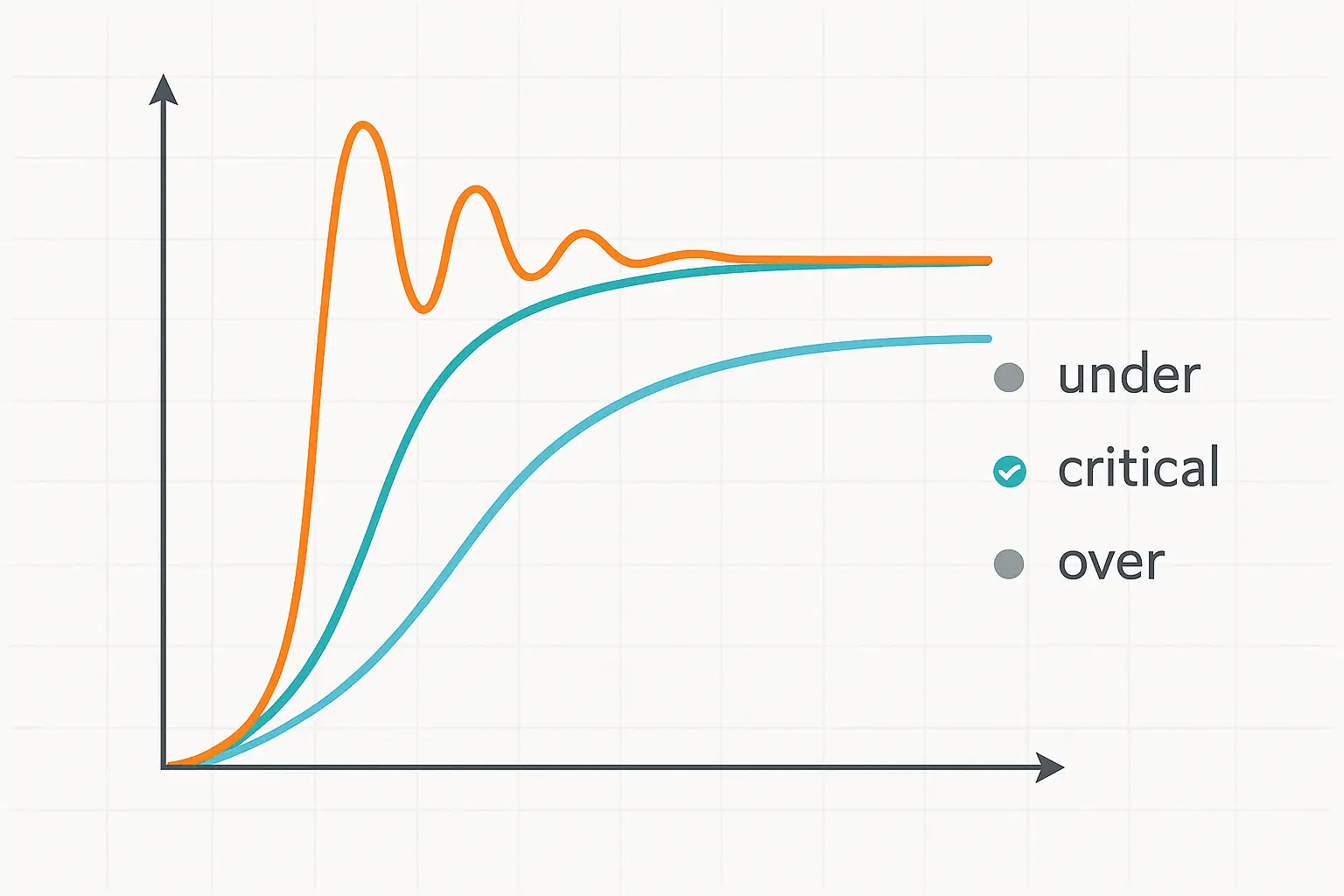
How to ensure stability? Model the total input capacitance, shape the noise-gain slope with Cf, and target ~45–60° phase margin using simulation plus step-response validation.
5.1 Stability & compensation (Rf/Cf, noise gain, phase margin)
- Total capacitance: Ctotal = Cf + Cj (sensor) + Cin (op-amp) + Cstray; larger Ctotal increases noise gain and reduces phase margin.
- Role of Cf: introduces a zero to tame the high-frequency slope; too small → under-compensation (ringing), too large → over-compensation (slow).
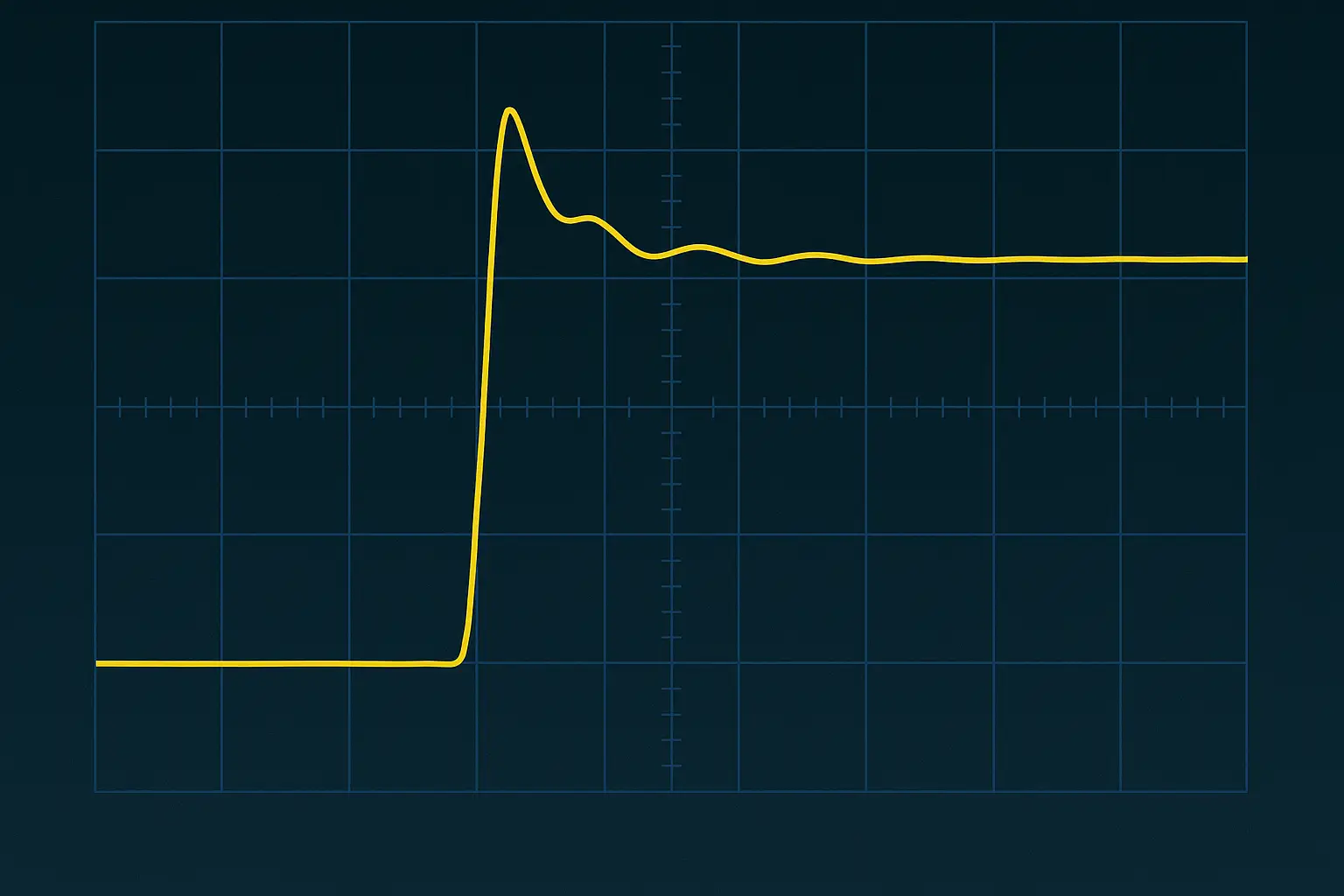
- Target margin: 45–60° (50–65° for high-speed links). Verify in AC simulation and with a time-domain step test.
- Preferred parts: C0G/NP0 for Cf; metal/foil or precision thin-film for Rf (low excess noise, low tempco).
- Estimate Csum = Cj + Cin + Cstray; pick first-cut Cf0 from §3.
- Sweep Cf (±50%) in sim; record phase margin, f−3dB, ENBW.
- Bench: inject a fast step (LED pulse or generator) and observe under/over/critical compensation; select the fastest response without excessive overshoot.
5.2 PCB layout & grounding (high-impedance node care)
The inverting node is a high-impedance, leakage-sensitive point—layout here dominates real-world noise and accuracy.
- Place Rf/Cf tight to the inverting pin; keep the feedback loop short; use Kelvin sense for Rf if feasible.
- Add a driven guard ring at the same potential (virtual ground/Vref) to suppress leakage.
- Shield the node; keep away from clocks/high-dv/dt nets; minimize copper near the node to reduce Cstray.
- For differential TIAs: match Rf/Cf, route symmetrically and equal-length, maintain a consistent dielectric environment.
- Use short coax/twisted pair from the sensor when remote; place the op-amp close to the connector.
- Long traces on the inverting node; routing across split grounds; proximity to high-speed digital.
- High-leakage dielectrics/caps; dirty/contaminated surfaces (pA leakage ruins accuracy).
- Large planes under the node without shielding—this adds parasitic capacitance.

5.3 Power & reference (LDO, decoupling, Vref)
- Low-noise LDO with good PSRR in the signal band; add π-filter/ferrite if supply is shared with digital loads.
- Local decoupling: 0.1 µF (HF) + 1 µF (MF) + 10 µF (LF) close to pins; smallest loop area back to ground.
- Reference (Vref): buffer or RC-filter it; keep impedance low and noise small for single-supply TIAs.
- Automotive/EMC: consider CISPR 25 / ISO 11452; evaluate common-mode chokes/ESD clamps and re-tune Cf if Csum changes.
5.4 ESD & input protection (capacitance trade-off)
Protection must be “just enough”: every part you add increases parasitic capacitance and can reduce bandwidth/stability.
- Prefer ultra-low-C TVS (≤0.5–1 pF class).
- Add a small series resistor for surge limiting/damping if needed.
- Provide a clean reverse-bias network for photodiodes with proper decoupling/bleed; re-calculate Csum after any changes.
5.5 Test & debug (scope/FFT/noise)
- Step tests: LED pulse or generator; inspect rise/fall, overshoot, settling error to classify compensation.
- Noise: band-limit and FFT; record ENBW and convert to input-equivalent current (see §3 formulas).
- Probing: beware probe capacitance; prefer low-C active probes or a local buffer/follower.

5.6 Design checklist (copy & use)
- Stability: target phase margin __ °; Cf sweep range = [__ pF, __ pF]; ENBW = __ kHz; cap type = C0G/NP0.
- Layout: inverting-node trace length < __ mm; guard ring present; feedback loop length < __ mm; differential symmetry (if any) within __ %.
- Power: LDO model __; PSRR @ freq __ = __ dB; decoupling 0.1/1/10 µF placed within __ mm; Vref noise __ µVrms.
- ESD/Protection: TVS C ≤ __ pF; series R __ Ω; reverse-bias network verified; post-change Csum re-measured.
- Reliability: temp range __ to __ °C; derating applied; AEC-Q100 level (if applicable).
With a robust design in hand, let’s map it to real systems where constraints are different — optical links, LiDAR, medical, and precision metrology.
Transimpedance amplifier applications & signal chains
Across applications, a TIA’s constraints are set by the sensor current range, target bandwidth, noise ceiling, EMI/ESD environment, and the downstream interface (comparator/limiting amp/ADC/DSP). The blocks below map Sensor → TIA → post-amp/ADC → processor with typical ranges and common pitfalls.
| Application | IIN / IPD (typ.) | Cj (typ.) | f−3dB target | Noise goal | Topology hint |
|---|---|---|---|---|---|
| Optical communication | µA–mA (rate-dependent) | 0.1–2 pF (PIN), APD biased | 10 MHz – >100 MHz | Low NEI; eye-diagram quality | Differential TIA |
| Automotive LiDAR & cameras | nA–µA (pulsed; wide DR) | 5–20 pF (sensor+cable) | 100 kHz – 10 MHz | Low noise; fast recovery | VG-TIA / differential |
| Medical (oximeter/PPG) | pA–µA (weak light) | 10–50 pF (incl. leads) | 10 Hz – 100 kHz | Ultra-low ieq | Single-ended, low-noise |
| Precision metrology | fA–µA (ultra-low) | Board-/probe-dependent | 10 Hz – 1 kHz | Minimum drift/1/f | High-Rf; guarded |
6.1 Optical communication (optical receiver)

PIN/APD photodiode → differential TIA → limiting/linear post-amp or CTLE → CDR/ADC → DSP/PHY. Differential routing and matched feedback help preserve eye-diagrams at high data rates.
- Typical ranges: IPD µA–mA; Cj 0.1–2 pF (PIN); f−3dB 10–>100 MHz; tight phase margin.
- Pitfalls: APD bias noise coupling; CMRR loss from mismatch; supply/ground bounce; Vref drift affecting decision threshold.
6.2 Automotive LiDAR & cameras

Photodiode/SPAD array → VG-TIA (AGC) → AA/LPF → ADC/ToF ASIC → SoC/ECU. Wide dynamic range and harsh EMC demand robust compensation and clean power.
- Typical ranges: IPD nA–µA (pulsed); f−3dB 100 kHz–10 MHz; −40~125 °C; AEC-Q100.
- Pitfalls: gain-switching transients; saturation/recovery from strong reflections; common-mode/ground noise; ISO 26262 safety interfaces.
6.3 Medical devices (oximeter/PPG)

LED optics → photodiode → low-noise single-ended TIA → LPF/gain → ADC → algorithms (SpO₂/PPG). Leakage and ENBW dominate sensitivity.
- Typical ranges: IPD pA–µA; f−3dB 10 Hz–100 kHz; extremely low ieq required.
- Pitfalls: moisture-induced leakage and drift; motion artifacts; probe contact changes; Vref noise injection.
6.4 Precision metrology (ultra-low current)
Ion/photocurrent/electrochemistry → high-Rf TIA with guarding → programmable filter/gain → high-resolution ADC → MCU/PC. Materials and cleanliness dominate accuracy.
- Typical ranges: IIN fA–µA; Rf 100 kΩ–10 MΩ+; f−3dB 10 Hz–1 kHz; minimize drift/1/f.
- Pitfalls: dielectric absorption; surface contamination (pA leakage); shield/ground details; thermal drift.
Now that constraints are clear per application, we can shortlist real ICs from major vendors that meet those constraints — continue to IC selection guide.
IC selection guide: cross-brand TIAs & AFEs (with fit-tags)
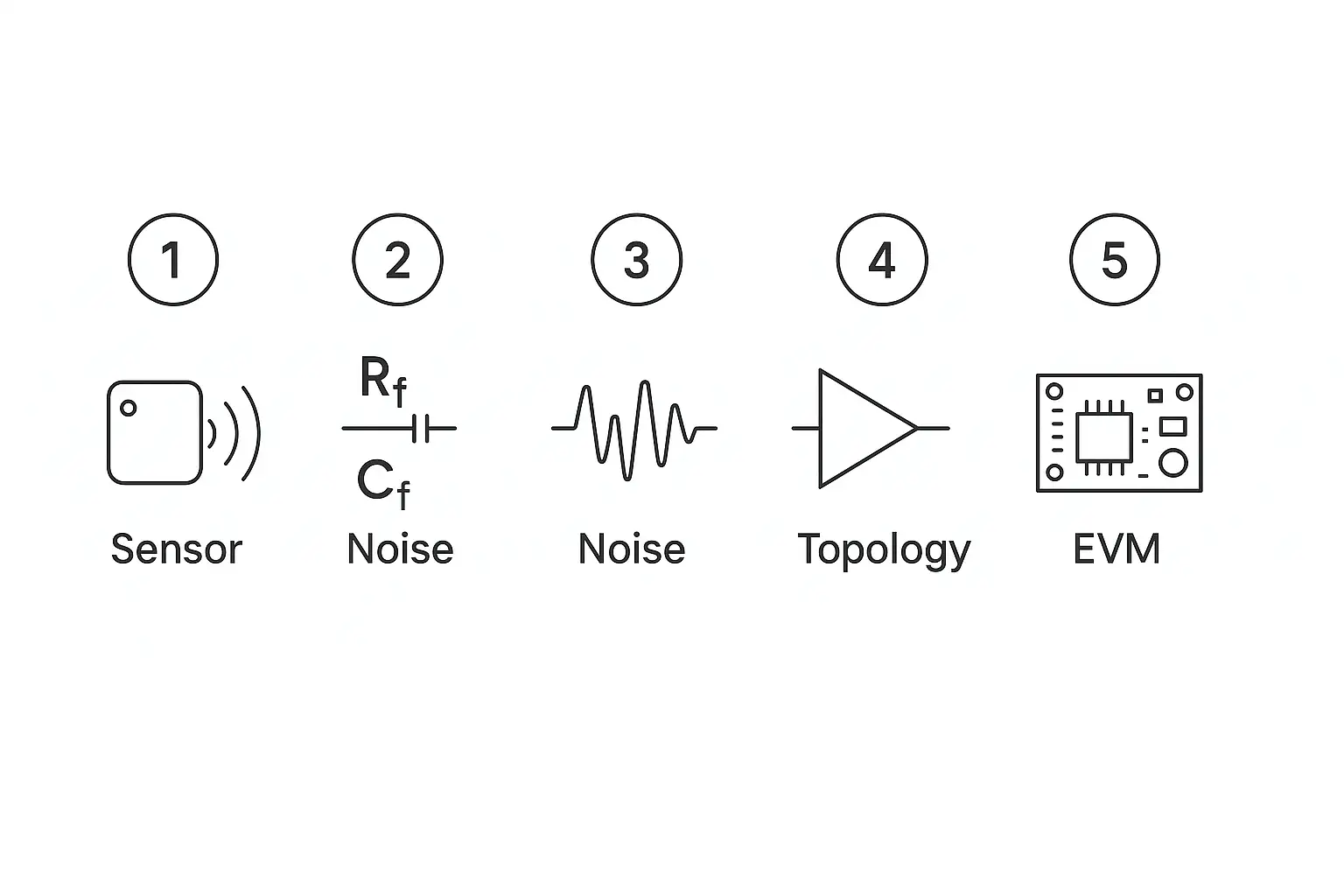
Map your calculated Rf/Cf, bandwidth, and noise targets to orderable parts. Below is a cross-brand list of transimpedance amplifier IC and op-amps used as TIAs, plus integrated AFEs. We include popular searches like TI OPA857, OPA855, onsemi NOA3306, and Renesas R-Car AFE. (We do not claim “the best”—we label fit-for-purpose.)
- By application/bandwidth: optical / LiDAR / medical / metrology.
- By span: Iin,max, Vheadroom → limit Rf (see §3).
- By noise: ieq / ENBW targets → low-noise class.
- By topology/robustness: single-ended / differential / VG-TIA; AEC-Q, temp, package.
- Verify on EVM: bandwidth, phase margin, recovery, drift.
| Brand | Part | Topology | TIA-BW / GBP | Input noise (en / in) | Supply (V) | I/O | Package | AEC-Q | Typical apps | Fit-tags | Datasheet | Eval |
|---|---|---|---|---|---|---|---|---|---|---|---|---|
| Texas Instruments | OPA857 | Dedicated TIA | See datasheet | See DS (nV/√Hz, pA/√Hz) | See DS | Diff/SE (DS) | QFN (DS) | — | Optical receiver | High-speed optical | add link | add link |
| Texas Instruments | OPA855 | HS op-amp (build TIA) | GBP (DS) | en / in (DS) | See DS | SE/Diff (design) | QFN/SOIC (DS) | — | Optical, LiDAR post-amp | High-speed optical VG-ready | add link | add link |
| Texas Instruments | OPA858 / OPA818 | HS op-amp (build TIA) | GBP (DS) | en / in (DS) | See DS | SE/Diff (design) | Packages (DS) | — | Optical/LiDAR/ADC driver | High-speed optical | add link | add link |
| STMicroelectronics | TSZ121 / TSZ122 | Low-noise op-amp (build TIA) | GBP (DS) | en (nV/√Hz, DS) | Single/dual (DS) | SE | SOT/DFN (DS) | — | Medical/low-freq photodiode | Low-noise medical | add link | add link |
| STMicroelectronics | TSU111 (ultra-low power) | Micropower op-amp (build TIA) | GBP (DS) | en (DS) | Single-supply (DS) | SE | Packages (DS) | — | Wearables/portable sensors | Low-power | add link | add link |
| NXP | Imager/ToF AFE family (placeholder) | AFE (integrated TIA path) | TIA path (DS) | See DS | Automotive ranges (DS) | Diff/SE (DS) | Packages (DS) | Varies | Cameras/ToF chains | Vision camera Automotive LiDAR | add link | add link |
| Renesas | R-Car AFE (platform) | AFE (integrated) | TIA path (DS) | See DS | Automotive ranges (DS) | Diff (DS) | Packages (DS) | Likely (check DS) | Automotive perception chains | Automotive LiDAR AEC-Q | add link | add link |
| onsemi | NOA3302 (optical AFE/TIA) | AFE with TIA path | TIA BW (DS) | See DS | See DS | SE/Diff (DS) | Packages (DS) | Varies | Optical/ambient sensing, cameras | Vision camera | add link | add link |
| Microchip | MCP6V51 (zero-drift) | Low-noise op-amp (build TIA) | GBP (DS) | en (nV/√Hz, DS) | Single-supply (DS) | SE | Packages (DS) | — | Medical/metrology (low-freq) | Low-noise medical High-Rf metrology | add link | add link |
| Microchip | MCP6022 / MCP6Hxx (HS) | Op-amp (build TIA) | GBP (DS) | en / in (DS) | Single/dual (DS) | SE | SOIC/TSSOP/DFN (DS) | — | General optical/ADC front-end | Low-noise medical | add link | add link |
| Melexis | MLX75027 (ToF sensor AFE) | Integrated AFE (incl. TIA) | TIA path (DS) | See DS | Automotive ranges (DS) | Diff (platform) | Packages (DS) | Likely (check DS) | Automotive ToF/LiDAR-like | Automotive LiDAR Vision camera | add link | add link |
Brand notes & fit guidance
- Texas Instruments — rich OPA HS amps and dedicated TIAs; strong EVM ecosystem. Fit: high-speed optical, LiDAR, lab eval.
- STMicroelectronics — low-noise/low-power op-amps (medical/wearables), plus HS families for mid-speed TIAs.
- NXP — imaging/ToF AFEs for cameras/automotive; check platform docs for TIA path specs and AEC-Q status.
- Renesas — optical/vision AFEs and automotive platforms(e.g., R-Car AFE);system-level integration focus.
- onsemi — optical/ambient/camera AFEs(e.g., NOA3306);pairs well with their imagers.
- Microchip — zero-drift & low-noise op-amps for low-freq/precision TIAs; HS families for general optical.
- Melexis — ToF sensor AFEs with TIA paths, tuned for automotive perception.
Specs in the table are datasheet-driven. Fill concrete numbers and links from the latest DS/EVM pages; do not infer TIA-BW from GBP.
If your BOM already includes a TIA or you need cross-brand alternates, here is how we support real procurement and risk control.
Procurement & alternates: lead-time comparison, pin-compatible replacements, lifecycle & compliance
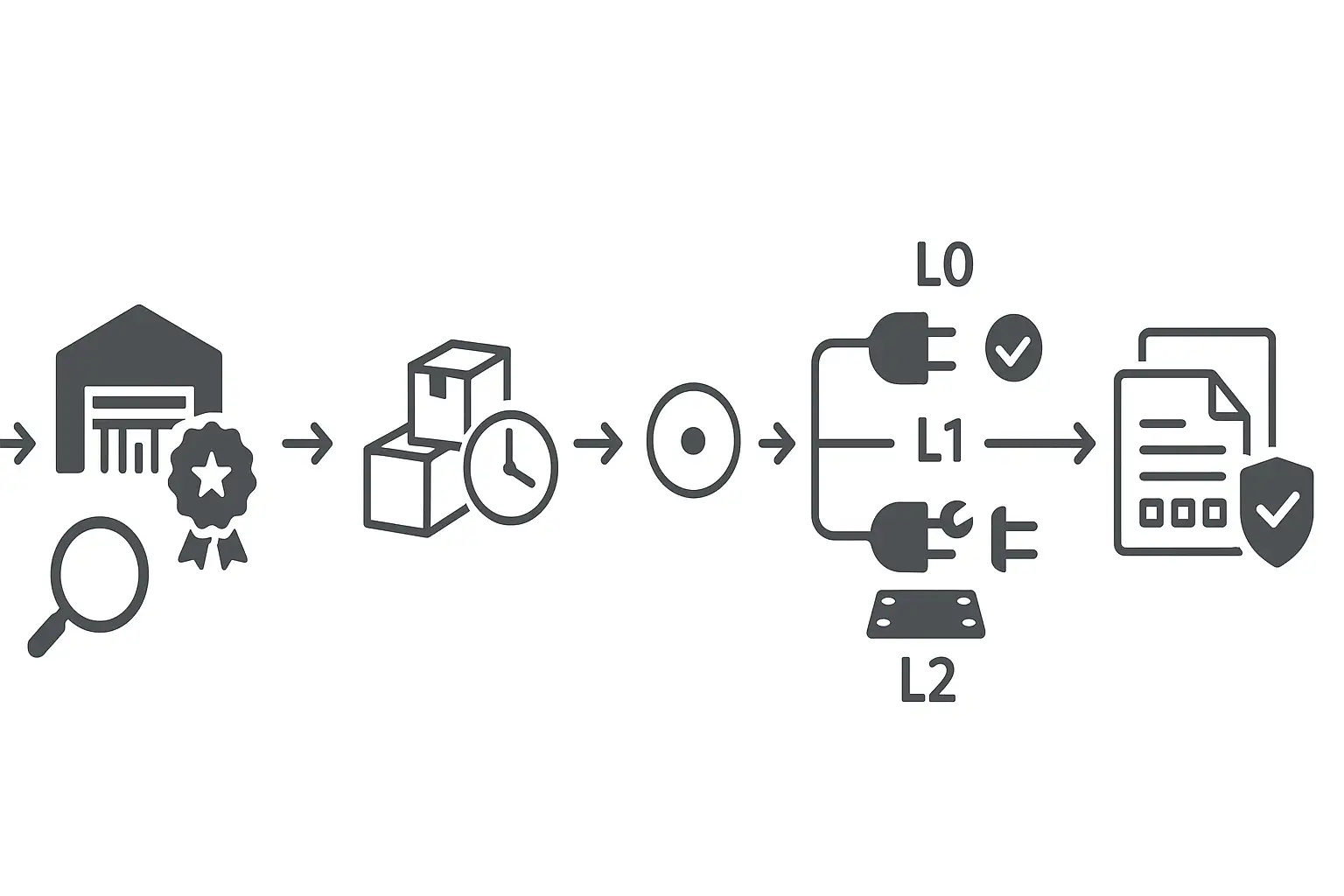
We provide lead time comparison across authorized channels, lifecycle checks (Active / NRND / EOL with PCNs), pin-compatible replacement proposals (with electrical deltas), and compliance verification (RoHS/REACH and automotive AEC-Q100 where applicable). We source only through authorized and traceable supply.

What you receive (deliverables)
- Comparison table for each MPN: brand/part/package, lead time (weeks), authorized stock, lifecycle (Active/NRND/EOL + PCN date/link).
- Pin-compatibility grade (L0/L1/L2) with electrical deltas (GBP, en/in, Iq, temp, AEC-Q, ESD, RθJA).
- Compliance notes: RoHS/REACH certificates and AEC-Q100 grade if applicable.
- Risk tags (Supply / Lifecycle / Compliance) and two recommendations (conservative vs. aggressive).
- L0 · Drop-in — same footprint & pin functions, compatible ranges; re-verify only.
- L1 · Footprint-compatible — same footprint, parameter shifts require recalculation/bench re-test (e.g., adjust Rf/Cf).
- L2 · Adapter-recommended — footprint or pins differ; use interposer/new PCB spin.
| Brand | Part | Package | Lead time (wks) | Stock (authorized) | Lifecycle / PCN | Pin-compat | Electrical deltas (notes) | Compliance | Risk | Datasheet | PCN/Cert |
|---|---|---|---|---|---|---|---|---|---|---|---|
| Texas Instruments | OPA855 | QFN/SOIC | TBD (auth quotes) | Query required | Active · PCN: add link/date | L1 | HS GBP; check en/in vs. target; Rf/Cf retune likely | RoHS/REACH Y · AEC-Q100 — | Supply Lifecycle | add link | add link |
| onsemi | NOA3306 | QFN | TBD (auth quotes) | Query required | Active · PCN: add link/date | L0 | Integrated AFE; verify I/O levels & noise vs. chain | RoHS/REACH Y · AEC-Q100 varies | Compliance | add link | add link |
| Renesas | R-Car AFE (platform) | BGA | TBD (auth quotes) | Query required | Active · PCN: add link/date | L2 | Platform AFE; PCB/firmware integration required | RoHS/REACH Y · AEC-Q100 likely (check grade) | Integration | add link | add link |
How we work
- Inputs: BOM (CSV/XLSX) with MPN, brand, qty, required date, alternates policy (strict/relaxed).
- Normalization: de-alias parts, confirm package & temp grade.
- Channel query: authorized only (factory & franchised distributors) for stock and lead time.
- Risk modeling: Supply (availability trend), Lifecycle (Active→NRND→EOL timeline, PCNs), Compliance (RoHS/REACH/AEC-Q100 docs).
- Outputs: downloadable PDF report + CSV detail with recommendations and test notes.
Before you submit a BOM, skim the common questions below—many are answered instantly. Continue to FAQ.
FAQs: transimpedance amplifiers (PAA-focused)
What is a transimpedance amplifier?
Why do we need a transimpedance amplifier (with photodiodes)?
How to select a transimpedance amplifier?
How to calculate transimpedance amplifier gain and bandwidth?
How to reduce noise in a TIA?
What is the difference between a voltage amplifier and a transimpedance amplifier?
What is meant by a transconductance amplifier?
What is the difference between transconductance and transimpedance?
What is a differential transimpedance amplifier?
Can I build a non-inverting transimpedance amplifier?
Is there an automotive-grade TIA IC?
TIA vs charge amplifier — when to use each?
Downloadable resources (PDF)
Save, share, and deep-link these concise references. Each PDF is vector-based and aligns with the site’s visual system.


Notes: parameters reflect latest datasheets where cited; app diagrams are self-drawn based on vendor application notes. For procurement and alternates, see §8.
Submit Your BOM
We compare lead-times, check lifecycle risks, find pin-compatible replacements, and ensure compliance.
Do you accept NDA and confidential BOMs?
Can you check AEC-Q100 and other compliance?
What do I receive from the review?

Related Articles
- ·HBM3 vs. HBM3E: Complete Technical Comparison for AI, HPC, and Global Component Procurement
- ·How Large Language Models Work
- ·SK Hynix & Samsung: The Unprecedented HBM Expansion Race
- ·Micron 6600 ION 245TB Redefines Data Center
- ·Why Memory and Storage Define the Next Decade
- ·How Artificial Intelligence Acquires “Knowledge”
- ·How DRAM Will Change the World
- ·Why SSD Write Cache Is Crucial for AI Applications
- ·DRAM Product, Technology & Application Guide
- ·HBM4 compared to HBM4E






.png?x-oss-process=image/format,webp/resize,h_32)


