
 German
 Japanese
 Portuguese
 Korea
Korea
 Mexico
 Dutch
Dutch

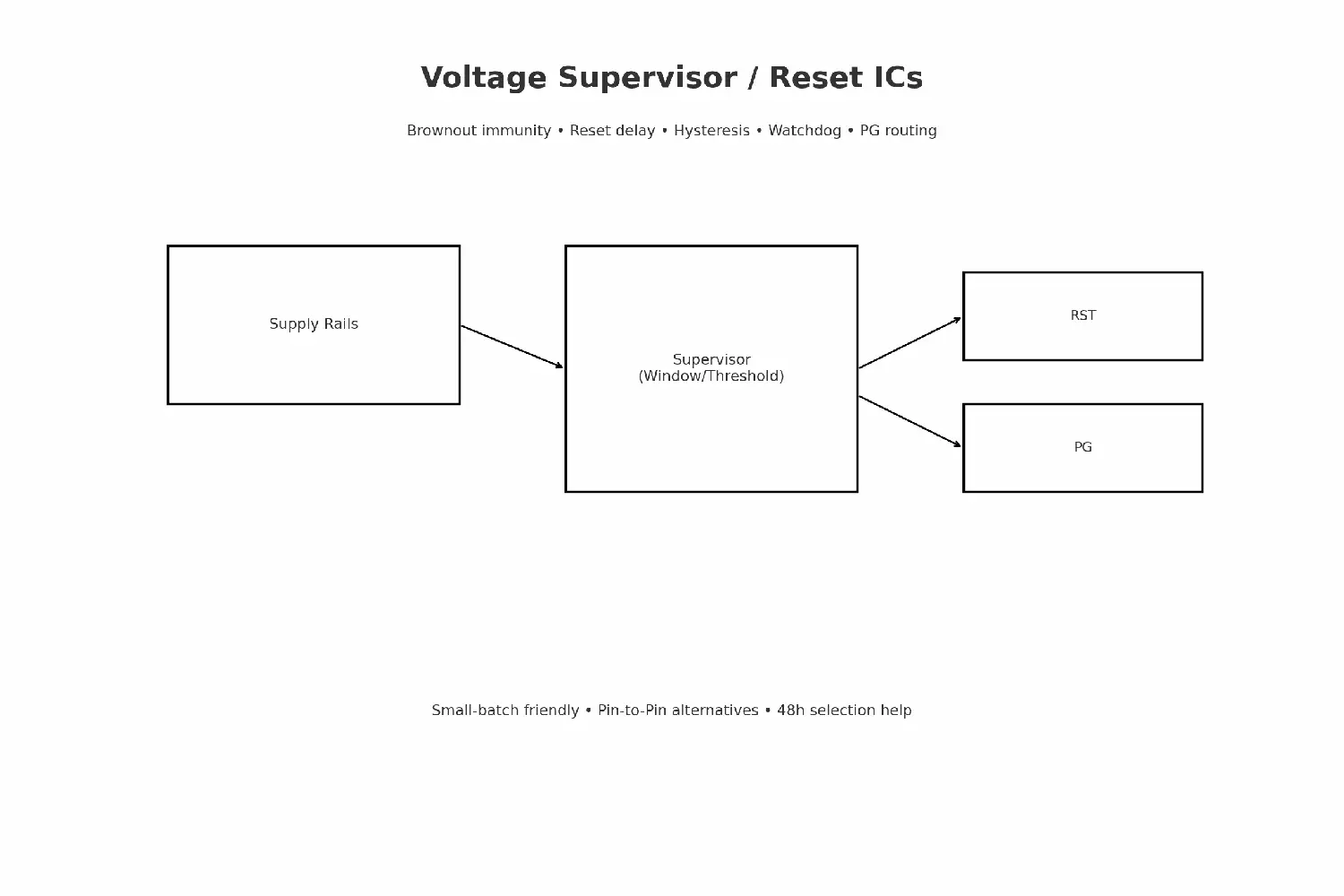
Voltage Supervisor / Reset ICs

Why External Voltage Supervisors Matter
Brownouts and noisy ramps often cause nuisance resets or release the MCU too early. An external supervisor adds precise thresholds, hysteresis, and reset delay—so rails settle before firmware runs. Small-batch friendly? Send your BOM and get a 48-hour short-list with pin-to-pin options.
Problems We Solve
Real boards brown out, ripple, and boot inconsistently. These six issues cause nuisance resets, early releases, and fragile bring-up. Each card ends with a fast route to the spec rules you can apply today.
Threshold too tight/loose → nuisance or missed brownouts
If VTH sits inside the ripple band, resets chatter; if too loose, true brownouts pass.
Size hysteresis to ≥(ripple+noise)×1.2 and consider a window supervisor when both UV and OV matter.
No hysteresis → reset chatter
At the boundary the rail crosses back and forth, toggling RST and corrupting start-up.
Use ΔVHYS ≥ ripple band, add RC deglitch or hold-off delay to let rails and clocks settle.
Reset delay too short → rails/clock not valid
Early MCU release causes random faults, especially on cold start and heavy loads.
Choose tDELAY ≥ slowest-rail settling + 10–20% margin; then re-verify with watchdog enabled.
Watchdog cadence mismatch (WDI) → false timeouts
OS tick, sleep modes, and WDI window drift apart; “healthy” firmware times out.
Align cadence to a single clock source; gate/disable watchdog during bring-up and deep-sleep.
PG and RESET logic conflict (OR/AND wiring)
Mixed polarities and levels make PG OR chains unreliable—either early release or no release.
Prefer open-drain with a known pull-up level; verify polarity and leakage on every contributor.
Multi-rail sequencing errors → brownout cascade
Wrong order or insufficient spacing triggers downstream BOD and a reset storm.
Use window + delay to constrain both voltage and timing; split into multi-channel supervision if needed.
Architectures & Types

Single-threshold
Simple, low power for clean rails. Needs correct hysteresis and reset delay to avoid boundary chatter.
Window (UV + OV)
Enforces both lower and upper bounds to resist ripple/over-voltage; ideal for noisy or sensitive rails.
Multi-rail / Programmable
Multiple channels, programmable thresholds/delays for complex sequencing with fewer external parts.
Watchdog-enabled
WDI/WDO guards firmware hangs; align cadence with OS tick and gate it during bring-up or deep sleep.
Outputs & Polarity
Open-drain eases OR-wiring; push-pull gives strong drive. Match polarity and pull-up level to MCU limits.
Understand the key specs that prevent chatter and early-release resets → jump to #features. Need a 48-hour shortlist? Submit your BOM.
Key Specs & Fast Rules
Fast Rules You Can Apply Today
- ΔVHYS ≥ 1.2–1.5 × (ripple + noise); use upper bound for noisy rails.
- Target VTH,lo ≈ 10–15% below minimum steady voltage; VTH,hi ≈ 5–8% above.
- Need UV & OV control? Choose a window supervisor.
- tDELAY ≥ max( slowest rail settle, PLL lock ) × 1.1–1.2.
- tRST ≥ 1.2–1.5 × MCU minimum reset pulse width.
- Prefer Open-Drain for multi-source OR; unify the pull-up rail across contributors.
- Keep pull-up ≤ MCU absolute max (including transients); use level shifting if domains differ.
- Push-Pull is cleaner but less flexible across domains.
- Sum device tempco + divider drift + wiring drop; re-validate margins at hot/cold.
- Match AEC-Q100 grade to environment; ESD rating augments—not replaces—system protection.

Three-Step Quick Pick
- Set thresholds & hysteresis: enter ripple/noise and allowed false-reset rate → get ΔVHYS range; pick single or window.
- Choose delays: use slowest rail settle/PLL lock/storage init → size tDELAY & tRST.
- Select outputs & polarity: match MCU RST/PG logic and voltage domains (OD/PP, Active-L/H).
Shortlist concrete parts → jump to the Selection Matrix.
Selection Matrix — 7 Brands
We can assemble a cross-brand pin-to-pin matrix in 48h. Submit your BOM for exact parts and the smallest rework path.
| Brand | Channels | VTH | Window | tDELAY / tRST | Reset Type (OD/PP, Polarity) | Watchdog | PG | Temp Grade | AEC-Q100 | Package | Notes (Pin-to-Pin / Rework) |
|---|---|---|---|---|---|---|---|---|---|---|---|
| TI | 1 / 2 / Multi | Steps / Fixed | UV / UV+OV | Programmable ranges | OD / PP, Active-L/H | Optional | Yes/No | -40~125/150℃ | G0–G3 | SOT-23 / DFN | Pin-to-pin options; verify pull-up rail vs MCU max. |
| ST | 1 / 2 | Common rails covered | UV / UV+OV | ms-level options | OD / PP, Active-L/H | Variants | Yes/No | -40~125℃ | G1–G3 | SOT-23 / DFN | Small packages; check polarity match. |
| NXP | Multi-rail focus | Fixed / Programmable | Window options | Wide timing spans | OD / PP, Active-L/H | Yes | Yes | -40~125/150℃ | G0–G2 | TSSOP / QFN | MCU-centric; check domain levels. |
| Renesas | 1 / Multi | High accuracy options | UV / Window | Programmable / fixed | OD / PP, Active-L/H | Yes/No | Yes/No | -40~125℃+ | G1–G3 | SOT / DFN / QFN | Precision thresholds; verify tempco budget. |
| onsemi | 1 / 2 | Common fixed steps | UV / Window | ms ranges | OD / PP, Active-L/H | Variants | Yes/No | -40~125℃ | G2–G3 | SOT-23 / TSOP | Classic single/dual rail; confirm polarity. |
| Microchip | 1 / 2 | Low-power steps | UV / Window | Fixed / selectable | OD / PP, Active-L/H | Yes/No | Yes/No | -40~125℃ | G2–G3 | SOT-23 / SOT-143 | Compact; check tDELAY differences vs original. |
| (Slot 7) | TBD | TBD | TBD | TBD | TBD | TBD | TBD | TBD | TBD | TBD | Use this slot for ADI/Maxim / ROHM / ABLIC per needs. |
Need pin-to-pin options fast? Get pin-compatible options.
Design & Routing
Wire supervisors to be level-safe, chatter-proof, and sequencing-aware. Use pull-ups that meet sink and rise-time limits, match logic polarity, and avoid hard-ORing push-pull outputs across domains.
Typical 3.3–5 V logic: 4.7–47 kΩ. Heavier fan-in or faster edges → 4.7–10 kΩ; low-power single sink → 22–47 kΩ.
Check sink: I_sink ≥ VPU/RPU and VOL spec. Check rise: tr ≈ RPU·Cload ≤ 0.1× timing margin.
Pull up to a rail ≤ MCU absolute max and within its VIH/VIL range. Crossing domains? Use level shifting or move the pull-up to the MCU domain.
Open-Drain (OD) is safe for multi-source OR with a shared pull-up. Do not tie two push-pull drivers together—use diodes/resistors or a logic gate.
Prefer OD+pull-up to the target domain. For push-pull across domains, insert a dedicated level shifter or buffer with defined thresholds.
Align polarity and level first. EN pins may include their own threshold/hysteresis—avoid double-hysteresis that shifts release earlier/later than intended.

Pull up RST/PG to a rail above the MCU absolute max.
Use the lowest common safe domain or add a level shifter.
Hard-OR two push-pull outputs.
Use OD+pull-up, diode-OR, or a logic gate for combining signals.
Ignore RPU×Cload rise-time on long nets or many sinks.
Size RPU so tr ≤ 10% of your timing margin.
Feed inverted PG directly to EN/MCU without checking polarity.
Normalize polarity and consider EN’s own threshold/hysteresis.
Need a level-safety check? Revisit the key specs, then shortlist parts in the matrix.
Timing & Validation
Validate with a repeatable scope script: stress cold/hot starts, slow ramps, dips, and under-voltage depth. Trigger on reset edges and threshold crossings, then judge against clear pass/fail limits.
- Cold start (lowest temp, heaviest load)
- Hot start (highest temp, typical load)
- Slow ramp (soft source / high capacitance)
- Drop/bounce (battery insert/remove, dV/dt sweep)
- Under-voltage depth sweep below VTH,lo
- Channels: Rail / RST / PG / EN / WDI (≥3–4 active)
- Bandwidth limit ~20 MHz to tame HF noise
- Sample rate ≥ 10× highest event bandwidth
- Record length ≥ tDELAY + tRST + safety window
- Trigger: RST edge; secondary on V crossing VTH
- Ambient, source, load, probes, grounding
- Measured VTH,hi/lo, ΔVHYS, tDELAY, tRST

| Metric | Pass | Fail |
|---|---|---|
| Threshold crossings | Single clean crossing per event | Multiple back-and-forth chatter |
| ΔVHYS | ≥ 1.2×(ripple+noise) target | < target; chatter observed |
| tDELAY | ≥ max(rail settle, PLL lock)×1.1–1.2 | Early release vs slowest rail/PLL |
| tRST width | ≥ 1.2–1.5× MCU min reset pulse | Below MCU min or marginal boot |
| Chatter count (start/dip) | 0 events within the window | ≥1 event within the window |
| PG→EN timing | Within required enable window | Too early/late for downstream |
| Watchdog (bring-up) | Disabled/gated; no false timeouts | False timeouts during bring-up |
Download the full timing script and bring-up checklist → go to Resources.
Automotive / Industrial Notes
AEC-Q100 grade matches ambient range—not the whole system robustness. Plan for threshold and delay drift across temperature and aging, and run pre-compliance checks for conducted/radiated noise and ESD before design freeze.
| Grade | Typical VTH Drift | Typical tDELAY Drift | Notes |
|---|---|---|---|
| G0 (-40~150 °C) | Tightest bin; budget device+divider tempco over full span | Slight increase at hot; verify worst-case PLL/rail settle | Test at -40/25/150 °C; add ΔVHYS margin for cold crank |
| G1 (-40~125 °C) | Moderate drift; divider tempco dominates if high values | Delay stretch at hot; confirm reset width remains ≥ spec | Validate EN thresholds vs PG at hot soak |
| G2 (-40~105 °C) | Looser drift; add extra hysteresis in noisy domains | Check early-release on slow supplies | Thermal profiling still required for corners |
| G3 (0~85 °C) | Largest drift budget; design for room-temp first, verify at 0/85 °C | Delay vary with RC tolerances; guard with margin | Industrial use only; automotive under-hood not suitable |
Add RC/filters near sense pins and keep ground return short to avoid false thresholds.
HBM/CDM is a device rating only—use TVS, common-mode chokes, and routing discipline for system ESD.
Place pull-ups close to receivers; avoid long OR chains and level conflicts between domains.
Need a Grade 0 option? Ask us for verified parts.
Pin-Compatible & Cross-Brand
Prioritize physical compatibility first, then electrical behavior. Follow this order to minimize rework and validation time.
- Package & pinout — exact footprint/pin order first.
- Polarity — match RESET/PG active level; avoid logic flips.
- VTH / Window proximity — keep thresholds or UV/OV window close.
- tDELAY / tRST — align release and reset width.
- Watchdog / PG features — keep behavior consistent when enabled.
Different pull-up rails can exceed MCU absolute max or miss VIH—normalize levels or shift.
Active-L/H mismatch requires inversion and software/bring-up retest.
Different tDELAY shifts release under cold/hot/slow-ramp corners—re-measure timing.
Combined tempco of device and divider moves thresholds—watch for edge resets.
We can propose minimal-rework swaps with a risk note — Submit your BOM.
FAQs
Concise answers with actionable rules. Open each item to see guidance and links to the relevant section.
Window vs single-threshold — when should I choose each?
How much hysteresis is enough relative to ripple and noise?
Reset delay vs reset width — how do they interact?
Is it safe to pull an open-drain output up to a higher voltage rail?
Can I mix open-drain and push-pull sources on the same net?
What are the hidden risks of PG OR (wired-OR / diode-OR) networks?
How do I align watchdog WDI cadence with OS tick and sleep modes?
Cold/hot start and slow ramp — what should my scope triggers be?
How do temperature drift and aging move thresholds and delay?
AEC-Q100 grades — what do G0/G1/G2/G3 practically change?
How do I coordinate supervisor outputs with LDO/DC-DC EN pins?
MCU BOD vs external supervisor — should I use both?
Multi-rail sequencing — how do I avoid brownout cascades?
Pin-to-pin across brands — what deviations are acceptable?
Still unsure? Submit your BOM for a 48h matrix.
Resources & RFQ
Download ready-to-run worksheets and scope scripts to size thresholds, delays, and validate timing. Then send your BOM for a cross-brand shortlist in 48 hours.
Cut-Tape/Partial Reel supported. Small-batch stock, lead-time comparison, and practical bring-up advice included with each shortlist.

Related Articles
- ·Beyond Capacity: Why Bandwidth and Power Efficiency Now Define Memory Value
- ·Understanding Memory Price Cycles: Key Drivers Behind Supply and Demand Shifts
- ·DRAM vs. NAND: How AI Demand Is Reshaping the Memory Industry
- ·HBM Explained: Why High-Bandwidth Memory Is Critical for AI Accelerators
- ·Beyond Capacity: Why Bandwidth and Power Efficiency Now Define Memory Value
- ·Understanding Memory Price Cycles: Key Drivers Behind Supply and Demand Shifts
- ·DRAM vs. NAND: How AI Demand Is Reshaping the Memory Industry
- ·Memory Chip Market Outlook: What Buyers Should Watch Heading into Q4
- ·EMI and EMC in Electronics Design: How to Prevent Problems Before Testing
- ·USB-C Power Delivery Explained: What Engineers Need to Know About EPR





.png?x-oss-process=image/format,webp/resize,h_32)


