
 German
 Japanese
 Portuguese
 Korea
Korea
 Mexico
 Dutch
Dutch


Dynamic Voltage Scaling (DVS): Concepts, IC Implementation, and Power Benefits

What is Dynamic Voltage Scaling?
Dynamic Voltage Scaling (DVS) is a power management technique where the supply voltage is dynamically adjusted according to workload. By lowering voltage during low activity and raising it when higher performance is needed, DVS helps optimize both energy efficiency and system stability. This concept is closely related to dynamic power scaling and widely applied in VLSI voltage scaling design.
The principle behind DVS comes from the dynamic power formula: P ≈ C · V² · f. Because power is proportional to the square of voltage, even a 10% voltage reduction can yield nearly 19% power savings.
DVS differs from other scaling concepts:
- Dynamic power scaling is a broader term that includes any method to lower dynamic power, not only voltage.
- Dynamic scaling can mean various adaptive adjustments in engineering, beyond voltage control.
- Voltage scaling in VLSI specifically refers to design-time and run-time voltage adjustments in chips and SoCs.

Procurement Case: A Tier-2 automotive T-Box supplier was required by the OEM to resolve power and thermal issues. By switching to a PMIC with DVS support, the design passed compliance tests. Lesson for small-batch buyers: do not only check the voltage range—verify whether the regulator supports DVS.
DVS vs DVFS vs AVS (and DFS)
Engineers often ask: What is the difference between AVS and DVFS? To clarify, here is a breakdown of the four related terms frequently used in ARM SoC, FPGA, and VLSI contexts:
- DFS (Dynamic Frequency Scaling): Adjusts frequency only, typically via PLL, to optimize power.
- DVS (Dynamic Voltage Scaling): Adjusts supply voltage in steps or through VID commands.
- DVFS (Dynamic Voltage and Frequency Scaling): Combines frequency and voltage scaling, coordinated by OS or firmware.
- AVS (Adaptive Voltage Scaling): Uses PVT (process, voltage, temperature) sensor feedback for real-time adaptive voltage control, often found in high-end SoCs and automotive ECU designs.
| Method | Control Target | Precision Source | Application |
|---|---|---|---|
| DFS | Frequency | PLL | Basic power optimization |
| DVS | Voltage | Step register / VID | PMIC rails |
| DVFS | Voltage + Frequency | OS / Firmware coordination | CPU / GPU platforms |
| AVS | Voltage | PVT sensor feedback | High-end SoCs / Automotive (AEC-Q) |

Procurement Case: An EMS customer listed only “DVFS-compatible PMIC” on their BOM. The sourcing team mistakenly chose a regulator that only supported DVS without frequency coordination, causing board-level failures. Lesson: when sourcing alternatives, ensure the part supports the correct interface (I²C, VID/SVI, or PVT feedback), not just the label.
How DVS/DVFS is Implemented in Hardware
Engineers often ask: How is DVFS implemented? The dynamic voltage frequency scaling technique combines hardware regulators with firmware control. In practice, the implementation requires programmable voltage regulators, standard control interfaces, and carefully tuned ramp settings, especially in ARM DVFS platforms such as SoCs and automotive processors.
Voltage Regulator Requirements
Only Buck converters or VR controllers with programmable VOUT can support DVS/DVFS. These devices must be able to adjust output voltage dynamically upon command, which is typically achieved through digital registers or VID codes. Without this feature, firmware-based scaling is not possible.
Control Interfaces
- I²C/PMBus: Common in SoC or FPGA designs, where firmware communicates with the PMIC or VR.
- VID/SVI: Used in CPU and GPU platforms (Intel, AMD), allowing fast regulator response to performance state changes.
The interface defines not only compatibility but also the slew rate control and response speed, which is why it is a critical parameter for IC replacement.
Discrete vs Continuous Scaling
DVS implementations can be either:
- Discrete scaling: Fixed preset voltage steps (e.g., 0.9V, 1.0V, 1.1V). Switching steps may introduce transient noise.
- Continuous scaling: Smooth ramping via programmable slew rate, which improves transient performance and reduces overshoot.
ARM / SoC Platform Examples
Two practical hardware examples include:
- NXP i.MX93 + PCA9451A: PMIC with DVS support, programmable ramp rates, and remote sense for accuracy.
- TI Sitara + TPS65219: Supports DVFS with firmware-controlled registers, designed for MPU and FPGA platforms.

Procurement Case: A customer sourced a regulator that only supported discrete scaling. When deployed in a high-speed ARM SoC board, the voltage step transitions triggered resets. Lesson: when buying alternatives, always check whether the IC supports continuous scaling and the correct control interface.
Key IC Parameters for DVS
When evaluating Dynamic Voltage Scaling (DVS) support in a PMIC or voltage regulator, it is not enough to see “DVS supported” in the datasheet. Engineers and buyers must check several critical parameters that determine whether the regulator will perform reliably in real systems.
Voltage Resolution (mV/step)
Most regulators specify resolution such as 5 mV/step or 6.25 mV/step. This value defines how precisely the output voltage can be tuned, and determines how well the DVFS table can map frequency to voltage levels.
Slew Rate and Ramp Time
Slew rate is usually specified in mV/µs. Programmable ramp control allows smooth transitions:
- Too fast → risk of reset or overshoot current spikes.
- Too slow → performance drop, delayed frequency scaling.
Remote Sense
Remote sense compensates for IR drop across PCB traces. It ensures that the target device (CPU, GPU, FPGA) sees the correct voltage, not just the regulator pin voltage. Without it, measured voltage can be off by tens of millivolts under heavy load.
Sequencing and Tracking
Complex SoCs require multiple rails (e.g., VDD_CORE, VDD_IO) to start up in the correct order. Sequencing ensures order, while tracking keeps rails aligned. Incorrect sequencing can lead to boot failures or device damage.
Automotive and Industrial Requirements
For automotive applications, regulators must comply with AEC-Q100 and operate from -40 °C to 125 °C. Industrial designs typically require -40 °C to 105 °C. Always verify grade and qualification when sourcing replacements.

Procurement Case: A buyer sourced a PMIC that claimed “DVS supported” but did not match the original device’s step resolution and ramp rate. On the board, the SoC repeatedly reset during load changes. Lesson: Always check datasheet parameters such as mV/step and slew rate, not just the DVS label, when sourcing alternatives.
Cross-Brand IC Examples
Multiple vendors provide dynamic voltage scaling PMICs and DVS regulator ICs. However, the implementation details differ across brands. The following brand cross comparison highlights key parameters such as control interface, ramp behavior, and automotive readiness.
| Brand | Example IC | Interface | DVS Support | Ramp / Step | Remote Sense | Application |
|---|---|---|---|---|---|---|
| Texas Instruments (TI) | TPS65219 | I²C | DVFS ready, programmable | 6.25 mV/step, slew programmable | Yes | MPU, FPGA, automotive |
| STMicroelectronics (ST) | PM6697H | VID | Discrete VID levels | 5 mV/step, fixed slew | Yes | CPU/GPU regulators |
| NXP | PCA9451A | I²C | Supports DVS with programmable ramp | 6.25 mV/step, ramp adjustable | Yes | ARM SoC (i.MX93) |
| Renesas | ISL62776 | VID | Multi-phase VR, DVS capable | Programmable slew, fine step | Yes | Processors, servers |
| onsemi | NCP81286P | SVI2 | DVS via CPU SVI commands | Programmable slew | Yes | x86 CPU/GPU |
| Microchip | MCP16502 | I²C | DVS supported on multiple rails | 5 mV/step, programmable ramp | Yes | Industrial SoC, embedded |
| Melexis | – (primarily sensor ICs) | – | Limited DVS relevance | – | – | Automotive sensing ICs |
Methodology and SOP
DVFS Methodology
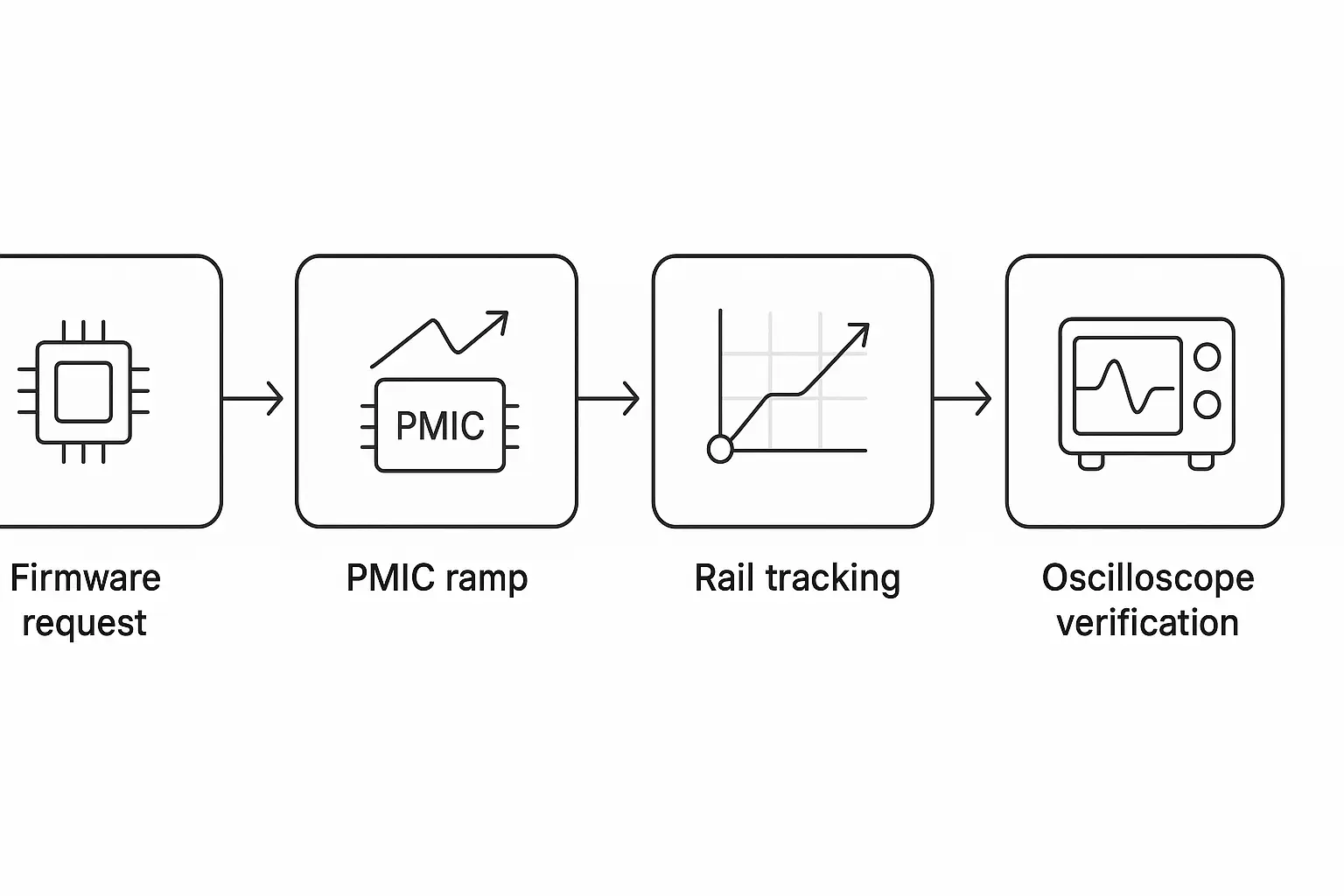
DVFS methodology follows a simple but critical sequence:
Firmware request → PMIC executes ramp → Rail tracks voltage → SoC transitions.
This ensures that supply voltage scales in sync with performance state changes. In ARM DVFS platforms, firmware uses I²C or VID interfaces to request the PMIC to adjust voltage ramps.
How to Do Dynamic Scaling
To configure scaling correctly, engineers must evaluate both step size and ramp rate:
- ΔV / step size: defines voltage granularity (e.g., 5 mV/step).
- dv/dt = IC / Cout: links ramp slope to load capacitor and current, critical for stability.
Verification SOP
Verification of DVS/DVFS implementation requires oscilloscope measurements:
- CH1 = Vout, CH2 = IL
- Trigger = load step edge
- Pass criteria: overshoot/undershoot ≤ X%, convergence ≤ Y µs
This SOP ensures ramp parameters match datasheet specifications and prevent instability during voltage transitions.
Procurement Case: A small-batch customer experienced repeated resets on prototype boards. The root cause was a second-source PMIC with a different ramp rate than the original. Lesson: Always require suppliers to confirm ramp specifications when sourcing alternatives, not just whether DVS is supported.
Scaling Factor in Power and Engineering
The dynamic scaling factor describes how performance or power changes when voltage or frequency is adjusted. In DVFS, this scaling is central to understanding efficiency and stability in real systems.
DVFS Scaling Factor (Power Law)
The fundamental relation is: P ∝ C · V² · f. This means power is proportional to the square of voltage and linearly proportional to frequency. A 10% voltage reduction leads to nearly 19% lower power consumption, making voltage scaling more impactful than frequency scaling.

How to Calculate Scaling Factor
In engineering practice, the scaling factor is often calculated as:
Scaling factor = New Value ÷ Base Value
Example: If a regulator’s ramp is improved from 500 µs to 250 µs, the scaling factor = 0.5, meaning the ramp time has been halved. This logic applies to power, current, and performance estimations.
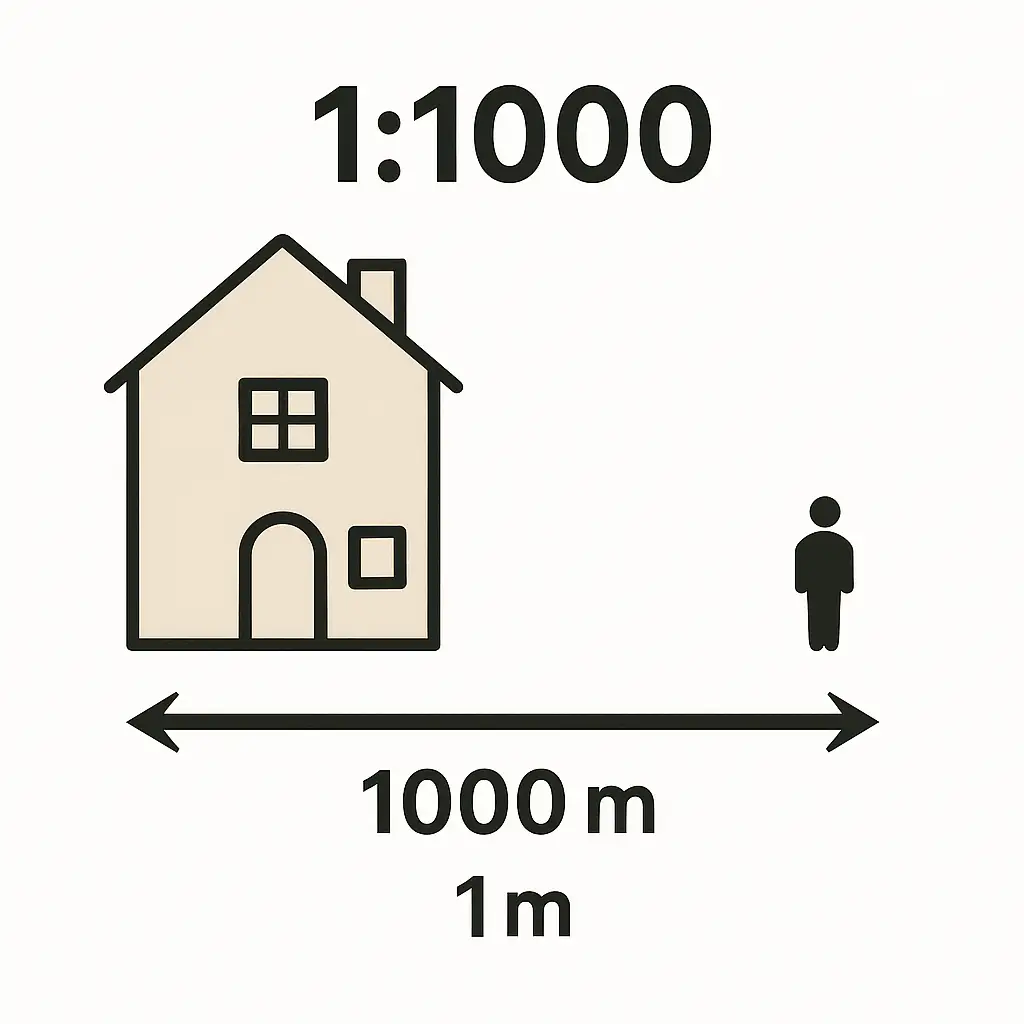
1:1000 Scale Example
Outside of electronics, scaling factors also appear in engineering drawings. A 1:1000 scale means 1 unit on the drawing represents 1000 units in real life. This concept is used widely in construction, PCB layouts, and physical modeling.
Terminology Recap
- DC in scaling: Direct current scaling in power supplies.
- DAF: Dynamic Amplification Factor, used in structural and system response analysis.
- RUF: Reserve Utilization Factor, often in capacity planning.
- MIRL: Mean Impact Response Level, measurement in vibration or stress analysis.
Heat and Throttling
Heat throttling occurs when a processor or SoC reduces its frequency to protect against overheating. By lowering power consumption through Dynamic Voltage Scaling (DVS), systems generate less heat, reducing the likelihood of thermal throttling.
Lower Heat Generation with DVS
Because power scales with P ∝ V²·f, reducing voltage has a quadratic effect on power savings. Every watt of power saved translates directly into one less watt of heat that must be dissipated. This makes DVS a valuable tool in thermal design.
Thermal Design Significance
In CPUs, GPUs, and ARM SoCs, overheating triggers thermal throttling, which lowers frequency and reduces performance. With DVS enabled, baseline power is lower, temperature rise slows down, and devices can sustain performance for longer before throttling occurs. In automotive and industrial applications, this translates to improved system reliability under harsh conditions.

Frequently Asked Questions
What is dynamic voltage scaling?
Dynamic Voltage Scaling (DVS) is the technique of adjusting supply voltage to balance power and performance. See Section 1 for full explanation and waveform example.
What is the difference between AVS and DVFS?
AVS uses PVT sensor feedback for adaptive voltage, while DVFS combines voltage and frequency scaling under OS control. See Section 2 for detailed comparison and matrix table.
How is DVFS implemented?
DVFS is implemented using firmware requests to PMICs via I²C or VID interfaces, controlling voltage ramps and rail tracking. See Section 3 for hardware block diagram and examples.
What is the dynamic scaling factor?
The scaling factor in DVFS follows the law P ∝ V²·f. It quantifies power savings with voltage/frequency changes. See Section 7 for formula and engineering scale examples.
What is heat throttling?
Heat throttling is when a processor reduces frequency to avoid overheating. DVS reduces heat generation, delaying or preventing throttling. See Section 8 for thermal design implications and comparison chart.
Submit Your BOM
Looking for IC replacement options or a BOM review? Within 48 hours you will receive:
- Ramp/step parameter verification
- Pin-to-pin alternative list (cross-brand)
- Lead-time comparison across suppliers
✔ Prevent costly failures caused by incompatible ramp rates or interfaces
✔ Access automotive-grade (AEC-Q100) and industrial-certified IC alternatives
✔ Get quick pricing even for small-batch orders


Related Articles
- ·Memory Chip Complete Guide: Definition, Manufacturers, Shortage, Manufacturing Process and Working Principles
- ·Fiber Optic Switch Guide: Definition, Connection Methods, Cabling, Disconnection and FAQ
- ·Optical Fiber Transmitter and Receiver Guide
- ·ICD Driver, LCD Driver & LCD Panel Driver Board Guide
- ·Touch Screen Overlay Guide for Commercial & Industrial Applications
- ·Cold Cathode Fluorescent Lamp Guide
- ·Complete Buying Guide for LED Video Walls & Commercial LED Displays
- ·The Complete Guide to Diode Lasers
- ·LED Emitter Guide: Definition, Brightness, Beam Angle, Soldering, Flashlight Upgrade, IR Usage and Grounding
- ·Inrush Current Limiter: Working Principle, Calculation, Selection Guide, and Motor / Capacitor Applications






.png?x-oss-process=image/format,webp/resize,h_32)


