
 German
 Japanese
 Portuguese
 Korea
Korea
 Mexico
 Dutch
Dutch


eFuse Power Switch IC: Inrush Control, OVP, Reverse Blocking & Cross-Brand Alternatives

eFuse (Electronic Fuse) — At a Glance
An eFuse is a resettable power-switch IC that protects rails by electronically shutting off a built-in MOSFET.
- Detection — monitors current/voltage against set thresholds.
- Interruption — controller shuts the MOSFET to stop the fault.
- Reset — auto-retry or host re-enable after the fault clears.
- OVP clamp to handle voltage spikes.
- Reverse-current blocking to stop backfeed.
- Inrush suppression via adjustable dv/dt or current limit.
Hot-swap boards · Automotive 12/24 V · Storage/SSD rails · Consumer devices

What is an eFuse (Power-Switch IC)
An eFuse is a resettable power-switch IC that protects power rails. Unlike traditional fuses that melt, an eFuse senses faults and electronically shuts off an integrated MOSFET.
What you get — and when you need it
- ILIM (current limit) — When: you must control inrush or short overcurrent bursts.
- OVP (over-voltage protect / clamp) — When: supply has spikes, unstable adapters, or backplane transients.
- UVLO (under-voltage lockout) — When: avoid brown-out chatter and undefined behavior at low input.
- dv/dt soft-start (slew rate) — When: large output capacitors or sensitive loads require smooth ramp-up.
- Reverse-current blocking — When: prevent backfeed during power-muxing, battery reversal, or shutdown.
- PG/FAULT pins & I²C programmability — When: you need status, telemetry, or adjustable thresholds.
Not ideal for: very high-power hot-swap domains that require large SOA — use a hot-swap controller with external MOSFETs instead.
Mini glossary (tap to expand)

How an eFuse Works: Detection → Interruption → Reset
The eFuse principle is a three-stage fault response: detect the anomaly, stop it by shutting the MOSFET, then recover safely.
- Detection — sense current/voltage, apply blanking/deglitch filtering.
- Interruption — limit or quickly shut off; controller pulls the MOSFET gate low.
- Reset — auto-retry after a cool-down or latch-off until the host clears the fault.
Speed vs False Triggers — tuning thresholds & filtering
- t_blank (blanking/deglitch) too short → ultra-fast, but noise & inrush spikes may trip; too long → real faults may pass energy.
- Thresholds (ILIM/OVP) tighter → stronger protection yet less tolerance to transients or load steps.
- Practical tip: estimate worst-case inrush, then coordinate with dv/dt soft-start to lower nuisance trips.
Reset modes: Auto-retry vs Latch
- Auto-retry — periodic re-enable after cool-down (t_retry); pros: self-healing; cons: potential flicker/thermal cycling.
- Latch-off — stays off until host clears FAULT; pros: predictable & safe; cons: requires user/MCU intervention.
- Rule of thumb: consumer/remote gear → auto-retry (limit duty cycle); automotive/critical loads → latch-off with PG/FAULT reporting.
- Estimate worst-case inrush → refine with dv/dt or current-limit mode.
- Set ILIM/OVP/UVLO with 10–20% margin; validate with load steps and line transients.
- Start t_blank ≈ 1–2× noise pulse width; shrink until false trips appear, then back off.
- If auto-retry, cap the retry duty cycle to avoid heating; if latch-off, design a clear-fault path.
- Wire PG/FAULT to MCU/logger; record events for field diagnostics (see protection functions).


eFuse vs MOSFET / Load Switch / Hot-Swap / PTC / HSD — Decision Guide
Pick the switch by protection needs and power level—integration vs external-FET capability.
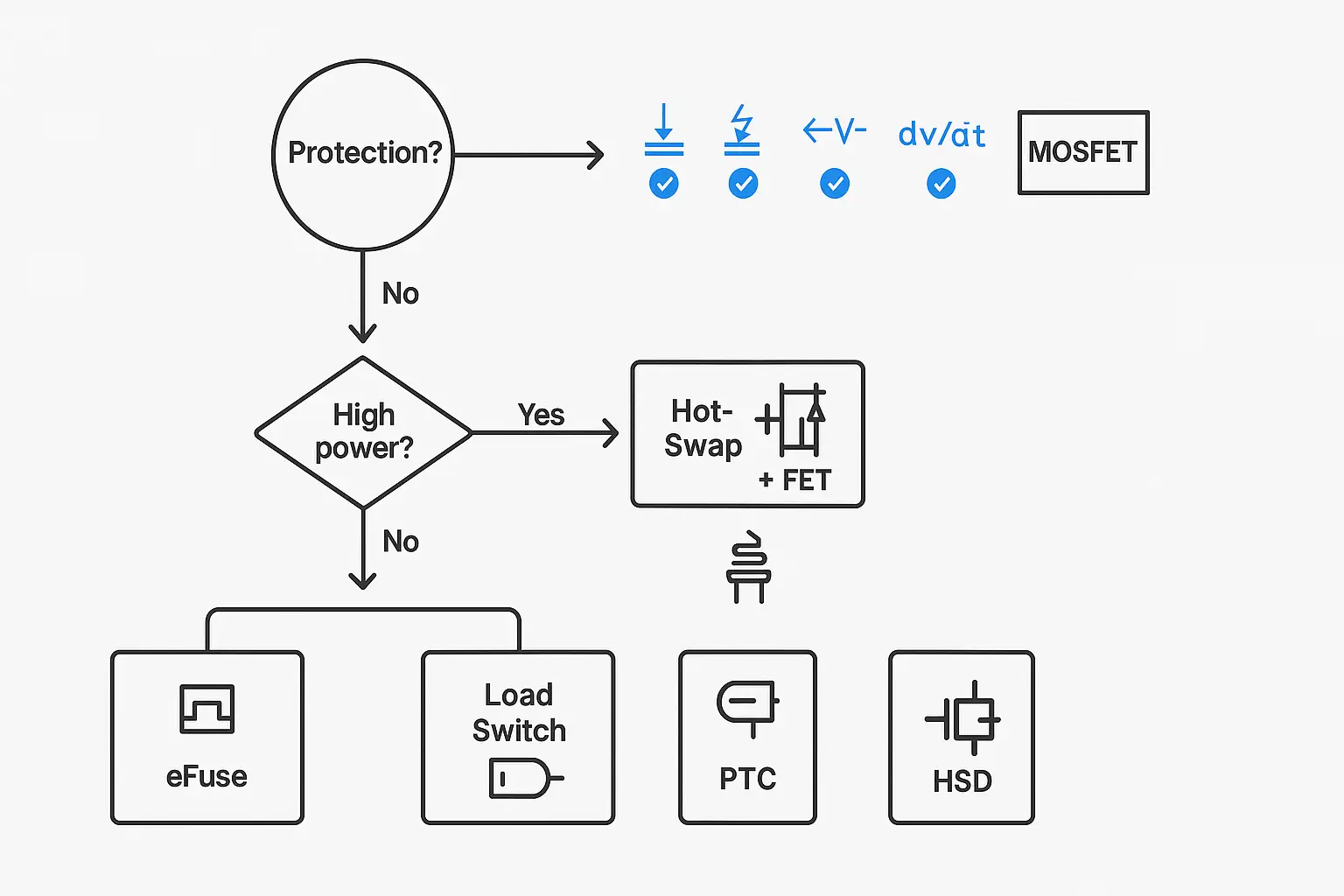
Rule #1 — Integration First
Need precise current limit, OVP, reverse-current blocking, or controlled dv/dt? Choose an eFuse for built-in protection & diagnostics (PG/FAULT).
Rule #2 — Power Boundary
For very high current or hot-swap SOA, use a Hot-Swap controller + external MOSFET. eFuse fits low-to-mid power rails.
| Aspect | eFuse | Load Switch | Hot-Swap + FET | PTC / Fuse | MOSFET (discrete) | HSD (high-side driver) |
|---|---|---|---|---|---|---|
| Typical V/I range | Low–Mid V, up to Mid I* | Low V / Low–Mid I | Mid–High V / High I (SOA via FET) | Broad V / I (passive) | Any (depends on FET) | Automotive 12/24 V loads |
| Integrated protections (ILIM/OVP/dv/dt/Reverse-block/PG/FAULT) | ✔︎ (rich) | ○ (basic soft-start) | ○–✔︎ (controller-dependent) | — (no electronics) | — (needs extra ICs) | ○ (diagnostics for loads) |
| Fault response speed (short/OVP) | ✔︎ (fast electronic) | ○ (limited) | ✔︎ (with tuned controller) | — (slow trip/thermal) | — (depends on external logic) | ○ (not for rail protection) |
| Power / thermal headroom | ○ (package-limited) | ○ (limited by Rds(on)) | ✔︎ (scales with FET SOA) | ○ (adds series R/heat) | ✔︎ (choose proper FET) | ○ (for loads, not rails) |
| Design complexity / tuning effort | Low (integrated settings) | Low (simple on/off) | High (FET + SOA + tuning) | Low (passive-only) | Medium (needs external control) | Medium (load-dependent) |
| Diagnostics / programmability | ✔︎ (PG/FAULT, I²C options) | — / ○ (few signals) | ○–✔︎ (vendor-specific) | — (none) | — (external IC needed) | ○ (diagnose loads) |
| Cost / BOM impact (relative) | Medium (saves externals) | Low (lowest) | Medium–High (multi-device) | Low (but weaker performance) | Low (FET is cheap) | Medium (feature-specific) |
| Recoverability (resettable) | ✔︎ (auto-retry/latch) | ○ (limited) | ✔︎ (controller-set) | — (one-shot/slow reset) | — (depends on logic) | ○ (driver restart) |
| Typical use cases | SSD/FPGA rails, USB-C ports, 12/24 V subsystems | Simple load on/off, low inrush needs | Server backplanes, telecom cards, big batteries | Basic fault containment, low-cost appliances | General switching (needs protection ICs) | Lighting, body ECUs, solenoids (PWM) |
* eFuse continuous current is package/thermal-limited; verify Rds(on)×I²R and layout. Use dv/dt to tame inrush.
SSD 5 V Rail (mid-current)
eFuse wins: adjustable dv/dt limits inrush, precise ILIM protects connectors, reverse-block avoids backfeed, and PG/FAULT eases diagnostics.
Server 12 V Backplane (high current hot-swap)
Hot-Swap + external MOSFET: controller tunes SOA and dV/dt for large capacitive loads; scalable with parallel FETs for thermal margin.
- Treating HSD as a rail protector — it drives loads, it doesn’t replace eFuse protections.
- Relying on PTC alone — slow/rough trip, poor for interfaces or storage rails.
- Ignoring thermal — eFuse Rds(on) × I²R needs copper area/thermal vias; validate in your layout.
Inrush & dv/dt — Control the Peak, Stabilize the Rail
Slower dv/dt means smaller inrush. An eFuse caps Ipeak with a controlled ramp or current limit.
Ipeak = C · dV/dt or with ramp time Ipeak = C · Vout / tr
- Ex.1 C = 200 µF, dV/dt = 1 V/ms → Ipeak = 0.2 A
- Ex.2 C = 100 µF, Vout = 5 V, tr = 2 ms → Ipeak = 0.25 A
- Ex.3 C = 470 µF, Vout = 12 V, tr = 10 ms → Ipeak ≈ 0.56 A
Tip: MLCC effective capacitance drops under DC bias/temperature—use 60–80% of nameplate for estimates.
Measure correctly: the window changes the “peak” you see
Sampling/averaging windows alter the reported peak. Declare probe bandwidth and window when validating inrush after dv/dt or current-limit tuning.
Current-limit behaviors — thermal & recoverability
| Aspect | Constant current | Foldback | Hiccup |
|---|---|---|---|
| Thermal stress | Highest (P ≈ Vdrop·Ilim) | Lower (I reduces with Vout) | Lowest (low duty cycle) |
| Recoverability | Stable if cooled; risk of thermal shutdown | Moderate; may lengthen start-up under heavy load | Automatic; periodic reattempts |
| Impact on load | Smooth; best for digital/IO rails | Slower rise; OK for tolerant loads | May flicker; check system tolerance |
| Typical use | SSD/FPGA, USB-C ports | Bigger capacitive rails | Harsh shorts / thermal limits |
| Notes | Validate heat at worst case | May need longer tr | Limit retry duty cycle |
- Estimate Ceff (electrolytic + MLCC; use 0.6–0.8× nameplate for MLCC).
- Decide safe Ipeak (≤ connector/PSU/wiring limits).
- Compute tr = C·Vout/Ipeak or dv/dt = Ipeak/C.
- Select limit mode: constant for stability; foldback/hiccup when heat is critical.
- Verify with stated measurement window; re-check at hot/cold/low VIN. See protection functions for OVP/reverse-block tuning.
Working at very high current? Check when to move to a hot-swap controller in the comparison section.


Protection Functions — OVP Clamp, Reverse-Current, Short-Circuit & Thermal
An eFuse combines configurable protections: reverse-current blocking, OVP clamp or shut-off, short-circuit handling (constant/foldback/hiccup), and thermal shutdown. This section gives practical decision points and a quick trigger & recovery table.
Reverse-Current Blocking
- Where needed: power ORing/muxing, backfeed on shutdown, battery reversal, USB-C bidirectional ports.
- Topologies: single-FET eFuse blocks source→load; back-to-back FETs block both directions (typical).
- vs Ideal-Diode controller: ideal-diode excels at low-drop ORing; eFuse adds precise limit/OVP/telemetry.
- Test tip: perform sink-current tests with the downstream node driven high; verify backfeed clamp during power-down.

OVP Clamp vs Fast Shut-off
- Clamp: holds VOUT ≈ Vclamp to ride through spikes; thermal cost P ≈ (VIN−Vclamp)·I — check SOA/heat.
- Shut-off: cuts the path quickly; minimal heat but may cause a momentary load drop/reset.
- Pick it: sensitive loads → Clamp (use TVS to share energy); large/long surges → Shut-off.
- Automotive: ISO 7637 & load-dump usually need TVS + eFuse co-design (see automotive).

Short-Circuit Handling — Constant / Foldback / Hiccup
- Constant current: smoothest for digital/UI rails; highest dissipation during faults.
- Foldback: ILIM decreases as VOUT collapses; lowers heat but can slow heavy start-up.
- Hiccup: periodic attempts with low duty cycle; lowest average heat yet may cause visible flicker.
- Coordinate with dv/dt soft-start to reduce nuisance trips; avoid too-low ILIM that prevents start-up.
Thermal Shutdown & Derating
- Heat sources: RDS(on)·I²R, clamp energy, and Vdrop·ILIM during limits/shorts.
- Layout: watch RθJA; use copper pour, thermal vias, and a well-tied exposed pad.
- Strategy: for auto-retry, constrain duty-cycle; for critical/automotive loads, use latch-off + FAULT/PG reporting.
| Condition | Trigger / Threshold | Action | PG | FAULT | Recovery | Notes |
|---|---|---|---|---|---|---|
| Overcurrent | I > ILIM (blanked) | Limit or shut-off | Low | Assert | Auto-retry or latch-off | Tune dv/dt to reduce false trips |
| Short-circuit | Very low VOUT + high I | Const./foldback/hiccup | Low | Assert | Auto-retry or latch-off | Check thermal headroom |
| Reverse current | Irev detected / VOUT>VIN | Block / shut-off path | Low (if path opens) | Optional | Auto when condition clears | Prefer back-to-back FETs |
| OVP (spike) | VIN > VOVP | Clamp or shut-off fast | Low (if out of spec) | Assert | Auto when VIN normal; latch if set | Use TVS for ISO pulses |
| UVLO | VIN < VUVLO | Disable output | Low | Optional | Auto when VIN recovers | Prevents brown-out chatter |
| Thermal shutdown | TJ > TSD (typ.) | Shut-off; cool down | Low | Assert | Auto when cool or latch | Limit retry duty-cycle |
- From dv/dt, set target Ipeak and ramp time; avoid too-low ILIM that blocks start-up.
- Set ILIM/OVP/UVLO with 10–20% margin vs worst-case rails & load steps.
- Need ORing/backfeed immunity? choose back-to-back FET eFuse.
- Choosing Clamp? estimate P=(VIN−Vclamp)·I & duration; pair with TVS.
- For high-power rails, review the boundary in the comparison section (hot-swap + external FET).
Automotive 12/24 V — ISO 7637, Load Dump, Harness & Thermal
In vehicles, harness inductance and load switching create harsh transients. TVS absorbs energy while the eFuse limits/blocks (ILIM, OVP clamp/shut-off, reverse-current, reset behavior). Co-design is key.

| Event | Phenomenon | Typical cause | Primary protection | Notes |
|---|---|---|---|---|
| Pulse 1 (− spike) | Negative kick on supply | Inductive loads opening | TVS (bidirectional), eFuse UVLO | Route returns tightly; check MCU brownout |
| Pulse 2a (+ spike) | Fast positive spike | Alternator switching, relay bounce | TVS, eFuse OVP clamp | Clamp continuity vs shut-off choice |
| Pulse 2b (+ spike) | Positive spike, slower tail | Switched inductive source | TVS, eFuse clamp/shut-off | Energy may be non-trivial → thermal check |
| Pulse 3a/3b (fast) | Fast ± transients (EMI-like) | Switching, ESD-like events | TVS, input filtering | Short & fast → TVS first |
| Load Dump (+ high energy) | Long positive surge, high energy | Battery disconnect while charging | High-power TVS + eFuse shut-off (or clamp+limit) | Size TVS for energy; check eFuse SOA/heat |
Reverse, Jump-start & Power Path ORing
- Reverse-current blocking: back-to-back FET eFuse prevents backfeed during power-mux and power-down.
- Jump-start: pick a high-voltage eFuse + TVS; avoid relying on series diode drop only.
- ORing: ideal-diode controllers minimize drop; eFuse adds limits/OVP/telemetry.
- Verification: perform downstream-driven-high sink-current tests to confirm reverse blocking.
Thermal & Layout — RDS(on)·I² and ΔT estimate
Conduction loss Pcond ≈ Irms2·RDS(on). When clamping, add Pclamp ≈ (VIN−Vclamp)·I averaged over time. Temperature rise: ΔT ≈ (Pcond + Ptransient,avg)·θJA.
Example: I = 3 A, RDS(on) = 40 mΩ → P ≈ 0.36 W. If θJA = 50 °C/W → ΔT ≈ 18 °C (add copper/thermal vias).
- Use large copper pours and 6–12 thermal vias on the exposed pad to inner/ground planes.
- Prefer thicker copper / multi-layer spreading; keep high-current paths short and wide.
- Place bulk caps near the eFuse; consider an RC snubber for harness ringing.
See dv/dt to manage inrush and reduce nuisance trips; for high-current boundaries, check the comparison section.
- Size the TVS for ISO spikes/load-dump energy; pick eFuse VIN rating & OVP strategy (clamp/shut-off).
- Select AEC-Q100 grade & temperature range; prepare COC, Date Code, AEC-Q100, RoHS/REACH docs.
- Use back-to-back FET eFuse for reverse/backfeed protection; validate with sink-current tests.
- Estimate P = I²·R and ΔT; reinforce copper/vias accordingly; verify at hot/cold/low VIN.
- For persistent surges, favor shut-off; for brief spikes, use clamp + TVS (see protection functions).
USB-C / Port Power — eFuse Protection for VBUS
For USB-C eFuse protection, pair a TVS with an eFuse to manage inrush, OVP clamp/shut-off, and reverse-current. Proper ILIM and dv/dt settings balance heat, cost, and stability.
What matters on USB-C VBUS
- VBUS transients — plug/unplug and cable inductance create spikes: the TVS absorbs energy, the eFuse handles inrush control and fast OVP clamp/shut-off.
- Reverse-current — in bidirectional/battery systems the system can backfeed into Type-C. Use a back-to-back FET eFuse and perform “downstream-driven-high” sink-current tests.
- OVP set-point — 5 V sinks often target ~6–7 V; with PD 9/12/15/20 V, require adjustable/wide-range OVP with ~10–15% headroom. Large-energy events favor shut-off over long clamp.
- ILIM vs heat/cost — higher ILIM avoids adapter OCP trips but raises I²R loss; lower ILIM cuts heat yet may cause PD renegotiation. Coordinate with dv/dt soft-start.
Three practical “port recipes”
Sink · 5 V Only
- Low-voltage eFuse with dv/dt, ILIM, reverse-block
- OVP ≈ 6–7 V + SMBJ/SMF TVS near connector
- Limit Ipeak to ease cable/connector stress (calculator)
Sink · PD up to 20 V
- High-voltage eFuse (wide OVP, fast shut-off), back-to-back FET
- PD controller drops/turns off before re-enabling the eFuse on profile change
- Use TVS + shut-off for large-energy surges
DRP / Bidirectional (with battery)
- Use true bidirectional/back-to-back eFuse
- Prevent battery/system backfeed to cable
- Ideal-diode controller for low-drop ORing; eFuse adds protection/limits
ILIM & dv/dt — system impact
- ILIM too high: higher I²R heat; more risk of thermal shutdown during faults.
- ILIM too low: start-up fails or PD re-negotiates repeatedly; lengthen ramp tr to reduce Ipeak.
- Guideline: ILIM ≥ adapter steady current × 1.2–1.5; then validate thermal and measurement window (see dv/dt).
- Place a TVS at the connector; size for clamp voltage & energy.
- Choose eFuse with back-to-back FET, adjustable OVP/ILIM; wire PG/FAULT to the PD controller.
- Set OVP headroom per profile (5 V→6–7 V; PD levels +10–15%). Prefer shut-off for large-energy events.
- Estimate I²R and ΔT; lower RDS(on) reduces heat but may raise cost—find balance.
- Test “downstream-driven-high” reverse blocking and plug/unplug transients; state the sampling window.
More on inrush & dv/dt and OVP/reverse-current behaviors. For high-power boundaries, see the comparison section.

Cross-Brand eFuse Alternatives — Unified Comparison
Quick matches for popular parts (e.g. tps2595 alternative) with unified engineering fields: VIN/OVP, ILIM mode, RDS(on), ICONT, reverse-block, I²C/PG, AEC-Q100, package, and application tags.

| Part | Brand | VIN / OVP | ILIM mode | RDS(on) typ [mΩ] | ICONT [A] | Reverse-Block | I²C / PG | AEC-Q100 | Package | Application tags | Small-lot |
|---|---|---|---|---|---|---|---|---|---|---|---|
| TPS2595 | Texas Instruments | Low-mid VIN · Adj OVP (Clamp/Shut) | Constant / Foldback (config.) | — (see DS) | — (see DS) | ✔︎ Back-to-Back FET | PG ✔︎ / I²C ○ | ○ (variant-dep.) | DFN/QFN | SSD · USB-C · General rails | Cut-tape / Partial reel |
| TPS26600 | Texas Instruments | Wide VIN (to ~60 V) · OVP options | Const./Foldback/Hiccup (config.) | — (see DS) | — (see DS) | ✔︎ Reverse-Block | PG ✔︎ / I²C ○ | ✔︎ (variant-dep.) | HTSSOP/QFN | Industrial · 12/24 V auto | Lead-time compare |
| MAX17525 | Analog Devices / Maxim | Wide VIN (to ~60 V) · OVP config. | Const./Foldback (family-dep.) | — (see DS) | — (see DS) | ✔︎ Reverse-Block | PG ✔︎ / I²C ○ | ○ (variant-dep.) | TQFN/QFN | Industrial · Telecom | Cut-tape options |
| NIS5021 | onsemi | 12/24 V focused · OVP/UVLO | Constant / Foldback (family) | — (see DS) | — (see DS) | ○ / ✔︎ (by variant) | PG ✔︎ / I²C — | ○ (variant-dep.) | SOIC/QFN | Automotive · General 12 V | Stock-check |
| STEF12 | STMicroelectronics | 12 V class · OVP options | Const./Foldback (family) | — (see DS) | — (see DS) | ✔︎ Reverse-Block | PG ✔︎ / I²C — | ○ (variant-dep.) | DFN/QFN/SO | Industrial · Consumer | Lead-time compare |
| Renesas (family) | Renesas | 5–24 V / Wide VIN options | Const./Foldback/Hiccup (by PN) | — | — | ✔︎ (variants) | PG / I²C (by PN) | ✔︎ (selected) | QFN/DFN | USB-C · 12/24 V | Submit BOM |
| Microchip (family) | Microchip | 5–24 V (family-dep.) | Const./Foldback (by PN) | — | — | ✔︎ / ○ (by PN) | PG / I²C (by PN) | ○ | DFN/QFN/SO | Consumer · General | Stock-check |
Notes: Specs vary by variant—always verify in the official datasheet. Clamp vs shut-off behavior impacts heat/continuity (see protection functions).
Top queries — quick cross-matches
TPS2595 alternative
TPS26600 alternative
MAX17525 alternative
onsemi NIS5021 alternative
Rule #1 — Match the feature set first
Align Reverse-Block, OVP strategy (Clamp/Shut-off), ILIM mode, and I²C/PG. Then compare RDS(on) & ICONT.
Rule #2 — Pin-compatible ≠ drop-in
Verify EN/PG/ILIM polarity and OVP setting method before layout reuse. See pin-to-pin notes.
High-energy surges may prefer shut-off vs long clamp (thermal). For wide VIN industrial/automotive rails, wide-range parts can improve robustness (see automotive).
Pin-to-Pin Replacement Maps — Check Pin Functions, Polarities & Methods
Before a pin compatible eFuse swap, verify EN/ILIM/PG polarities and OVP/UVLO setting methods. “Footprint compatible” often still needs resistor or wiring tweaks.


| Source PN | Target PN | Package / Footprint | Gate Topology | EN polarity | PG/FAULT logic | ILIM setting | OVP method | UVLO method | Reset default | Thermal Pad | Footprint Compatible? | Notes (≤10 words) |
|---|---|---|---|---|---|---|---|---|---|---|---|---|
| TI TPS2595 | ST STEF12 | QFN/DFN 3×3 class | Back-to-Back FET | High (typ.) / pull-down EN | Open-drain PG (low active) | R-set / pin-strap | Adjustable clamp / shut-off | Fixed / divider (family) | Auto-retry (config.) | EPAD to GND copper | ⚠️ | Check PG polarity & OVP net |
| onsemi NIS5021 | ADI MAX17525 | QFN/TQFN 4×4 class | Back-to-Back FET | High (typ.) | Open-drain PG / FAULT | R-set (variant dep.) | Clamp/shut-off options | Fixed / adjustable (family) | Latch or auto-retry | Large EPAD, vias 6–12 | ⚠️ | Confirm EN pullups & UVLO |
| TI TPS26600 | ST (wide-VIN alt.) | HTSSOP/QFN footprint diff. | Back-to-Back FET | High (enable) | PG open-drain (typ.) | R-set / strap / hiccup cfg. | Clamp &/or shut-off | Adjustable (divider) | Auto-retry (cfg.) | EPAD to GND plane | ⛔ | Footprint not same family |
Legend — ✅ drop-in; ⚠️ minor edits (resistors/wiring); ⛔ layout change. Always re-check official datasheets.
EN & PG/FAULT differences
EN active-high/low varies; PG/FAULT may switch from open-drain to push-pull. Add pull-ups / series resistors, or invert in the MCU if needed.
ILIM / OVP methods
ILIM may move from resistor-set to pin-strap / I²C; OVP from fixed threshold to adjustable. Confirm divider values and the default Clamp vs Shut-off (see protection functions).
Single vs Back-to-Back
Reverse-current behavior differs. If the board already uses ideal-diode/ORing, evaluate the whole path when swapping (see comparison).
- Thermal pad & vias: tie EPAD to large copper; add 6–12 thermal vias.
- Sensing nodes: place ILIM/OVP/UVLO dividers close to the IC; clean ground; avoid high-current returns.
- VIN/VOUT routing: short & wide; keep away from PG/FAULT/EN traces.
- Trial first: use jumpers / 0 Ω to validate differences before final layout.
- Pick candidate PN in #alternatives.
- Use this map to check polarity/setting/reset differences.
- Not sure? Send us your schematic/layout for a pinmap review.
FAQ — Quick Answers & Deep Links
One-line answers to common questions, with Read more links to section anchors and a short OTP/eFuse disambiguation.
Basics
What is an eFuse (meaning)?
An eFuse is an electronic fuse IC that protects a power path. Read more → #intro
What is the eFuse principle?
Detect faults → limit/shut off → reset safely. Read more → #how-it-works
Is an eFuse an IC or a fuse?
It’s an IC using MOSFETs and control logic to provide resettable protection. Read more → #intro
What are eFuse characteristics?
ILIM, OVP, UVLO, dv/dt, reverse-block, PG/FAULT, optional I²C. Read more → #functions
What is eFuse memory / OTP vs power eFuse?
OTP eFuse stores one-time bits; power eFuse protects supply rails. Read more → OTP blog
Compare & Selection
eFuse vs MOSFET (discrete)?
eFuse integrates protection; discrete MOSFET needs external control. Read more → #compare
eFuse vs load switch?
Load switches give simple on/off; eFuses add precise protection. Read more → #compare
eFuse vs hot-swap controller?
High-power hot-plug prefers hot-swap + external FET SOA. Read more → #compare
eFuse vs PTC / fuse?
eFuses trip fast and resettable; PTC/fuse are slow and coarse. Read more → #compare
eFuse vs HSD (high-side driver)?
HSD drives loads; eFuse protects rails and power paths. Read more → #compare
Behavior & Tuning
What sets eFuse inrush (dv/dt)?
Ipeak = C·dV/dt; slower ramps cut inrush peaks. Read more → #dvdt
OVP clamp vs shut-off?
Clamp keeps output alive; shut-off minimizes heat load. Read more → #functions
What is reverse-current blocking?
Back-to-back FETs stop backfeed and power-mux cross-talk. Read more → #functions
Constant, foldback, or hiccup?
Constant is smooth; foldback lowers heat; hiccup minimizes average heat. Read more → #functions
How to set ILIM safely?
Target ≥ adapter steady current ×1.2–1.5 with ramp control. Read more → #dvdt
Automotive & Interface
Is there an AEC-Q100 eFuse?
Yes—select grade/temperature and verify declarations. Read more → #automotive
Can eFuses handle ISO 7637 / Load Dump?
TVS + eFuse co-design is required; long energy favors shut-off. Read more → #automotive
Is eFuse useful on USB-C VBUS?
Yes—for inrush, OVP, and reverse-current with a TVS. Read more → #usb
Disambiguation
What is Knox eFuse?
A phone SoC’s OTP eFuse flag, not a power-path eFuse. Read more → OTP blog
How many eFUSEs does Xbox 360 have?
Refers to SoC eFUSE rows, unrelated to power eFuses. Read more → OTP blog
Is EEPROM the same as eFuse memory?
No—eFuse is one-time programmable; EEPROM is rewritable. Read more → OTP blog
Need part picks or replacements? See cross-brand alternatives and pin-to-pin maps.
Submit Your BOM — 48h lead-time compare & cross-brand alternatives
Upload your BOM or send a quick quote. We’ll reply in 48h with: lead-time comparison, alternatives (pin-to-pin noted), footprint compatibility, and risk remarks.
- ✓ Lead-time compare across brands
- ✓ Alternatives with pin-to-pin notes
- ✓ Risk remarks (OVP/ILIM/EN/PG differences)
- ✓ Docs on request: COC / Date Code / RoHS / REACH / AEC-Q100
A. Upload BOM (recommended)
B. Quick Quote (1–3 MPNs)
Need ideas first? See cross-brand alternatives and pin-to-pin maps.
Secure HTTPS upload. Files are purged within 30 days and used only for quote & cross-match. We support Cut-tape / Partial reels and can attach COC / Date Codes on request.
Small-lot eFuse (1–1000 pcs). Cut-tape & partial reels.
Pin-to-pin alternatives. 48-hour quote with lead-time compare & risk notes.
- Low MOQ
- Pin-to-pin & cross-brand
- Cut-tape / Partial reels
- 48h quote

Buy Scenarios — pick your path
Pick your scenario and we’ll provide fast routes for in-stock, alternatives, and document packs with risk notes (eFuse sample · automotive eFuse sample · 12V eFuse · USB-C eFuse).

A | Urgent repair / spares 1–50 pcs
Need: nearby stock + one pin-to-pin equivalent (or minimal rework).
- Check in-stock signals (cut-tape / partial reels).
- Provide one equivalent as a fallback.
- Go straight to Quick Quote (you can enter just 1–3 MPNs).
Risk notes: confirm EN/PG polarities and OVP thresholds (see #pinmap / #functions).
B | Pilot run 100–300 pcs
Need: build a second-source set (primary PN + backup).
- In the cross-brand table, tick: Reverse-Block / Low RDS(on) / USB-C / 12V.
- Narrow to 2–3 candidates; verify differences via the Pin-to-Pin Map.
- Submit the BOM; within 48h we return lead-time comparison + risk notes.
Risk notes: Clamp vs Shut-off affects heat and continuity (see #functions).
C | Automotive prototype AEC-Q100
Need: AEC-Q100 only with a document pack (COC / Date Code / AEC-Q100 / RoHS / REACH).
- Read the Automotive guide (TVS + eFuse co-design).
- Tick in the cross-brand table: Automotive (AEC-Q100) / Wide VIN.
- In the BOM, select Grade (0/1/2); we’ll return candidates and a document pack by grade.
Risk notes: for ISO 7637 / load dump, we recommend TVS + Shut-off/Clamp synergy (see #automotive).
Within 48 hours: lead-time comparison + alternatives + pin-compatibility verdict + risk notes (OVP / ILIM / EN / PG). Need 1–1000 pcs? Submit BOM →
Seven-brand eFuse shortlist — easy to buy / replace / footprint
Fast shortlist across seven eFuse brands: prioritize “easy to buy / easy to replace / easy footprint,” with 3–5 picks per card + one cross-brand starting point (links to programmatic PN pages).

Texas Instruments (TI)
Easy to buy · Easy to replace · Easy footprintCommon packages, broad families, thorough documentation — good for small-lot and second-source.
- TPS2595
VIN/OVP: family-dep. · ILIM: const/fold (cfg) · Reverse-block: BTB · Package: DFN/QFN
- TPS2596
VIN/OVP: see DS · ILIM: cfg · Reverse-block: BTB · Package: QFN
- TPS26600
Wide VIN class · ILIM: const/fold/hicc (cfg) · Reverse-block: BTB · Package: HTSSOP/QFN
- TPS25940
VIN/OVP: see DS · ILIM: cfg · Reverse-block: BTB · Package: QFN
tps2595 alternative: start with ST STEF12 → see cross-brand table · pin-map notes.
STMicroelectronics (ST)
Easy to buy · Easy footprintCovers 12 V / USB-C scenarios; common packages; complete documentation.
- STEF12
12 V class · ILIM: family-dep. · Reverse-block: BTB · Package: DFN/QFN/SO
- STEF01
VIN/OVP: see DS · ILIM: cfg · Package: SO/DFN
- STEF05
5 V class · ILIM: cfg · Reverse-block: family-dep. · Package: DFN/SO
- STEF215
Dual rail (family) · Details: see DS · Package: QFN
st efuse alternative: TPS2595 peers → cross-brand table.
onsemi
Easy replacement · Automotive optionsSuited for 12/24 V rails and industrial scenarios; broad family coverage.
- NIS5021
12/24 V focus · ILIM: family-dep. · Reverse-block: variant-dep. · Package: SO/QFN
- NIS6131
VIN/OVP: see DS · ILIM: cfg · Package: QFN
- NIS546x (family)
Wide VIN options · ILIM: cfg · Package: family-dep.
onsemi efuse alternative: peers for NIS5021 → ADI MAX17525.
Analog Devices / Maxim (ADI)
Wide VIN · IndustrialWide-voltage, common for industrial and telecom power; well-documented.
- MAX17525
Wide VIN class · ILIM: const/fold (family) · Reverse-block: BTB · Package: QFN/TQFN
- LTC4368 (controller)
Ideal diode + protection controller · Ext. FET · Package: MSOP/QFN
- MAX176xx (family)
Family options · ILIM/OVP: see DS · Package: QFN
Cross-brand: MAX17525 ↔ TPS26600.
Renesas
Automotive options · Broad familyWide VIN / AEC-Q100 options; good for 12/24 V rails and industrial.
- Family pick #1
VIN/OVP: wide options · Reverse-block: BTB (by PN) · Package: QFN
- Family pick #2
Details: see DS · Package: family-dep.
- Family pick #3
Automotive options · Package: QFN/HTSSOP
Cross-brand: Renesas wide-VIN ↔ onsemi NIS series.
Microchip
Common packages · Stable supplyRich power-distribution/protection lineup; suited for 5–12 V rails in consumer/industrial.
- Family pick #1
5–12 V focus · Reverse-block: by PN · Package: SO/QFN
- Family pick #2
ILIM/OVP: see DS · Package: DFN/QFN
- Family pick #3
Low RDS(on) options · Package: family-dep.
Cross-brand: Microchip 12 V rail ↔ ST STEF12.
Diodes Incorporated
Cost-effective · Common packagesGood for cost-sensitive, common-package replacements; easy for small-lot deployment.
- Family pick #1
USB-C / 5 V focus · Package: DFN/QFN
- Family pick #2
12 V rail options · Package: SO/QFN
- Family pick #3
Reverse-block: by PN · Package: family-dep.
Cross-brand: Diodes DFN/QFN ↔ TI TPS259x family.
Notes: fields above summarize family/common traits; always refer to official datasheets for specifics. Clamp vs Shut-off behavior affects thermal and continuity (see #functions). For pinout and polarity differences, see #pinmap.
Lead-time compare (48h) · No mixed lots · COC & Date Code · MSL dry-pack · Counterfeit control SOP
Lead-time — three paths

In-Stock
- Ship today / next day (multi-warehouse, nearest origin)
- Cut-tape / Partial reel supported (see fee policy)
- Stock can be held 48h (subject to confirmation)
Second-Source
- 48h cross-brand lead-time comparison
- Mark pin-to-pin compatibility & risks (EN/PG/OVP/ILIM)
- Best for pilot runs 100–300 pcs
Buildable
- Factory / build schedule (weeks)
- Staged shipments supported (scheduled)
- Transparent MOQ/MPQ rounding policy
| Path | Availability signal | Typical lead time | Cut-tape / Partial reel | Repack (if any) | Best for | Notes |
|---|---|---|---|---|---|---|
| In-Stock | Multi-warehouse / hold 48h | Same/next day | Yes — see cut tape fee policy | No (factory reel preferred) | Urgent repair 1–50 | COC & date code provided |
| Second-Source | Cross-brand peers | 48h compare + ETA | Likely yes | No / Minimal | Pilot 100–300 | Pin-to-pin & risk notes |
| Buildable | Factory build slots | Weeks (scheduled) | Factory full reel | N/A | Planned batches | MOQ/MPQ rounding disclosed |
Tip: quote the three paths in parallel — deliver with a mix of fast and scheduled orders.
Price & packaging transparency
Cut tape fee
Charged by threshold; bundle-waive / fee cap supported (subject to PO confirmation).
Partial reel
Partial reels supported; keep labels and inner core (if applicable) and mark remaining quantity.
No mixed lots
No mixed lots within one PO; multiple date codes only with prior consent.
COC / Date Code
Provided by default via shipment/email; automotive orders can add an AEC-Q100 statement.
MSL / ESD
Desiccant + humidity card + vacuum bag; label MSL level & open-time; bake and re-seal if needed.
Counterfeit control & QA

- Source traceability: prioritize authorized/trusted channels; keep purchase records (available on request).
- Appearance / label verification: logo/marking/reel/box SN consistency.
- Package & leads: microscopy for moisture, oxidation, sanding marks.
- Random sampling (as needed): ILIM/UVLO/OVP typical ranges & protection response.
- X-ray (optional): internal structure consistency (family comparison).
- Dry re-seal: bake per MSL level, then vacuum with HIC.
Terms (plain language)
Warranty / DOA / RMA
Brand-new genuine parts; DOA within 7–10 days prioritized for replacement; RMA/return if not per confirmed specs.
Returns
Packaging/labels intact; MSL unopened or re-sealed per spec. Restocking fee may apply for non-quality reasons.
Payment & logistics
T/T, corporate card, PayPal; EXW/FOB/CIF; DHL/UPS/FedEx; HS code & customs documents available.
Compliance & privacy
Country of Origin and RoHS/REACH available; BOM/files used only for quoting and cleared in 30 days; NDA available.
FAQ — policies & safeguards
Can I get COC and date code?
Yes — included by default (PDF/email or on-pack); automotive orders can add AEC-Q100 statements.
Do you mix lots or date codes?
No mixed lots for one PO; multiple date codes only with prior consent.
How is cut tape fee calculated?
Based on a small threshold; we support bundle-waive or fee cap — final policy confirmed on PO.
Do you support partial reel?
Yes — we keep inner core/labels (if applicable) and mark remaining quantity clearly.
How do you control counterfeit eFuse risk?
We follow a sourcing → inspection → test → dry-pack SOP; records can be provided on request.
What is your 48h lead-time compare?
We quote In-Stock · Second-Source · Buildable in parallel and flag pin-to-pin and risks.
Automotive samples — what documents?
AEC-Q100 statement, COC, Date Code; PPAP/IMDS can be discussed if applicable.
RMA / Returns process?
Email case → isolate → re-verify → replacement / return / refund per terms.
How do you handle MSL?
Dry-pack with desiccant & HIC; if opened, bake per level then vacuum re-seal.

Related Articles
- ·HBM4 compared to HBM4E
- ·What Is The Difference Between DRAM and NAND
- ·Next-Generation Memory Technologies: MRAM, RRAM, and PCM
- ·DDR4 vs DDR5 for Industrial Embedded Systems
- ·How to Choose Industrial DDR4 Memory for Medical Devices
- ·Memory Chip Price Increase: 2026 Market Trends, Samsung Pricing, Key Drivers and FAQ
- ·Memory Chip Manufacturers: Who Makes Memory Chips and Where
- ·Memory Chips: Materials, Applications, Types, and On-Chip Memory Explained
- ·Memory Chip Complete Guide: Definition, Manufacturers, Shortage, Manufacturing Process and Working Principles
- ·Fiber Optic Switch Guide: Definition, Connection Methods, Cabling, Disconnection and FAQ






.png?x-oss-process=image/format,webp/resize,h_32)


