
 German
 Japanese
 Portuguese
 Korea
Korea
 Mexico
 Dutch
Dutch


Glitch Filters & Window Detectors

Time-constant glitch filters and window comparators reject narrow blips and certify “voltage ready” windows. In multi-rail systems, PG, resets, and supervisors can chatter during ramps and cross-loads. These helpers shape signals by blocking sub-microsecond spikes, adding hysteresis, and enforcing a valid window before downstream enables or resets are released.
Who This Is For & How We Help
- Hardware/validation engineers & PI owners: care about threshold accuracy, propagation delay, and minimum pulse rejection.
- Firmware leads: focus on PG/Reset de-glitch and start-up sequencing; prefer clarity on open-drain vs push-pull outputs.
- Small-batch purchasers: look for AEC-Q100 grades, packages, lead time/alternatives, and cross-brand candidates for quick validation.
Primary conversion: Submit your BOM (48h cross-brand options).
Secondary conversion: Ask an engineer (short form) — place at the end of Validation Playbook. Positioning: neutral, engineering-first; emphasize multi-brand alternatives and AEC-Q100 availability with measurable specs (mV, %, µs).
Introduction & Search Intent
Time-constant glitch filters and window comparators reject narrow blips and certify “voltage ready” windows. In multi-rail systems, PG, resets, and supervisors can chatter during ramps and cross-loads. These helpers shape signals by blocking sub-microsecond spikes, adding hysteresis, and enforcing a valid window before downstream enables or resets are released.
- Solves: chattering PG, false “voltage ready,” brown-out bounces, POR oscillation, and downstream LDO/controller false starts.
- Typical positions: at PG pins; at supervisor outputs; between analog comparators and digital logic; at enable pins of DC/DCs, PMIC rails, or load switches.
When to Use Glitch Filters vs Window Detectors
Glitch Filter
Cleans a single-threshold line (PG, reset, PGOOD) by enforcing minimum pulse width and minimum stable time. Ideal in digital logic paths to stop sub-µs blips from reaching downstream enables or resets.
Window Detector
Certifies a rail stays inside [V_LO, V_HI] for a hold time thold before asserting “valid,” with hysteresis on both edges. Best for analog domains such as ±5% windows, ADC references, and sensor rails where accuracy matters.
Decision Matrix (Quick Guide)
Edge model: Single-edge cleanup → Glitch; Dual-edge/window certification → Window.
Accuracy: Tight ±2–5% threshold → Window; Basic logic de-glitch → Glitch.
Latency budget: RC/digital filter delay acceptable → Glitch; Comparator + hysteresis delay acceptable → Window.
Use cases: PG/Reset pulse debouncing → Glitch; ADC ref & ±5% sensor rails → Window.
I/O stage: Open-drain bus OK → both; Require push-pull/defined polarity → pick by device family.
Supply/common-mode: Wide common-mode & temp drift control needed → Window preferred.
Rule of thumb: Enforce a minimum pulse width/stable-time on PG/Reset → choose a glitch filter. Require a rail to remain inside [V_LO, V_HI] for thold with dual-edge hysteresis → choose a window detector.
Avoid solely using RC filters to certify “voltage ready” on slow ramps or brown-out rebounds—use a proper window when ±% accuracy is critical. Always verify system-level propagation delay against downstream sequencing.
Architectures & Signal Paths
Digital/RC Time-Constant Filters
Forms: RC + Schmitt trigger, monostable (one-shot), retriggerable monostable. Strengths: simple BOM, tunable minimum pulse width/stable-time. Cautions: tMIN depends on R/C tolerance & temperature; added propagation delay must fit sequencing; slow ramps and bounce need validation.

Analog Comparator Windows
Structure: two comparators + resistor ladder (VLO, VHI) or integrated window comparator with dual-edge hysteresis. Why: percent-grade accuracy for analog domains (±x%), explicit hold-time before “valid”. Watch-outs: comparator input bias/leakage ≪ ladder current; propagation-delay spread & temp drift enter the error budget.

Supervisor-Class Devices vs Discrete Networks
- Supervisor-class: factory-trimmed thresholds, tight tolerance, small delay spread, short signal paths, small BOM; flexibility tied to vendor options.
- Discrete comparator + ladder: fully configurable windows/hysteresis/domains; higher sensitivity to R/Ref tolerance and input bias; more validation effort.
Automotive Considerations
Prefer AEC-Q100 parts (correct grade) with wide supply/common-mode, robust ESD, and characterized behavior on slow ramps and brown-outs. Validate across temperature extremes and cranking; ensure output stage (open-drain/push-pull) and pull-ups are safe within system domains.
Design Rules & Sizing Recipes
Glitch Filter — RC Time Constant
Choose R·C so worst-case PG bounce (rise & fall) keeps the filter node below VTH (no false trigger). Use the working estimate tMIN ≈ −R·C·ln(1 − VTH/VSTEP). Include tolerance stacks for R, C, VTH, and temperature; add ~20–30% margin after corner analysis.
Window Ladder — VLO / VHI
Set VLO = VNOM(1 − x%) and VHI = VNOM(1 + x%); choose resistor ratios accordingly. Ensure comparator input bias ≪ ladder current (e.g., Ibias ≤ 1% · Iladder). Add ladder TCR and VREF drift to the overall threshold tolerance.
Hysteresis Target
Set ΔVHYS ≥ (2–3) × the maximum ripple at the comparator input to avoid chatter. With positive feedback, a quick rule is ΔVHYS ≈ IFB · RFB; validate both edges across temperature corners.
Propagation Delay Budget
Make sure the “rail-good → dependent converter enable” path (filter + comparator + logic) fits the sequencing order and inrush margins. If necessary, increase thold or advance upstream PG to preserve timing headroom.
Open-Drain vs Push-Pull
Open-drain: choose pull-up for bus fan-out and edge rate (rise-time vs power); use level shifting across domains. Push-pull: best for tight timing, but check domain tolerance and backfeed paths when crossing supplies.
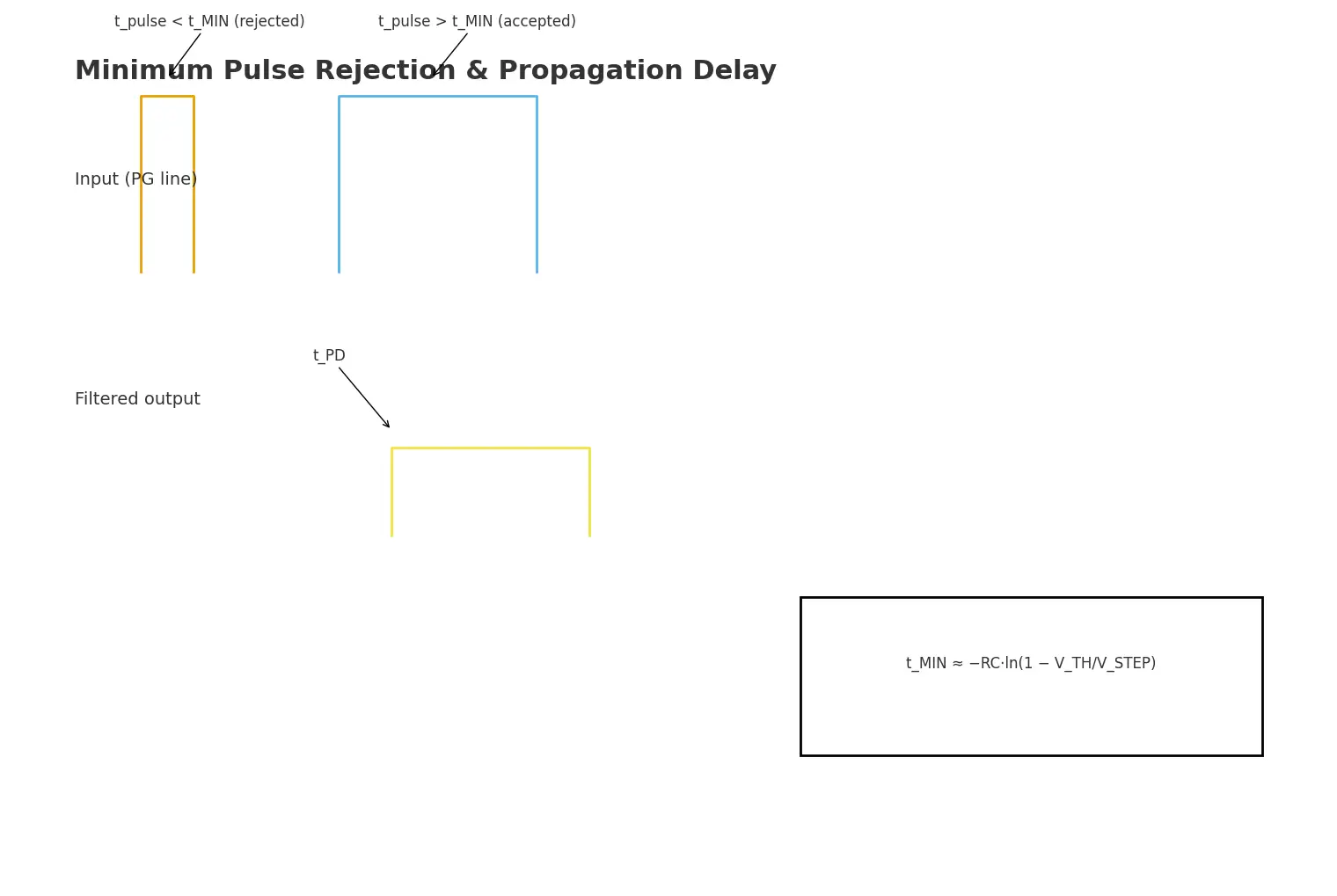
Timing & Math Cheat-Sheet
Minimum Pulse Rejected
tMIN ≈ −R·C · ln(1 − VTH/VSTEP)
Define VSTEP at the filter node (effective step seen by the RC) and VTH as the Schmitt/comparator threshold. Check both rising and falling edges. After cornering tolerances, add ~20–30% margin.
Tolerances: R/C tolerance & tempco, threshold drift, supply variation. Re-evaluate if the upstream edge is slew-limited (finite dV/dt).
Window Comparator Thresholds (3-Resistor Ladder)
VLO = VREF × Rbottom / (Rtop + Rbottom)
VHI = VREF × (Rbottom + Rmid) / (Rtop + Rmid + Rbottom)
Choose ladder ratios for VLO=VNOM(1−x%) and VHI=VNOM(1+x%). Ensure comparator input bias is much smaller than ladder current (e.g., Ibias ≤ 1% · Iladder) so thresholds do not shift.
Include tolerances (R TCR, VREF ppm/°C, comparator offset). Recommended: quick Monte-Carlo with temperature steps to bound VLO/VHI spread.
Hysteresis via Feedback
ΔVHYS ≈ IFB · RFB (or device-specific relation).
Target ΔVHYS ≥ 2–3 × ΔVRIPPLE at the comparator input. Budget extra headroom for expected undershoot/overshoot during transients. Verify both edges across temperature corners.
Larger hysteresis improves chatter immunity but increases release latency; check sequencing dependencies.
Quick Rules
- Size RC from worst-case VSTEP and add 20–30% margin.
- Keep Ibias ≤ 1% · Iladder to protect threshold accuracy.
- Set ΔVHYS ≥ 2–3× ripple to guarantee chatter-free edges.
- Account for comparator/logic propagation delay tPD in the enable chain.
Validation Playbook
Bench Setup
- Profiles: slow/fast ramps and brown-out dips; add load steps and injected ripple.
- Measure: PG jitter, assert/deassert times, and false-trip rate.
- Log: annotated waveforms with timestamps; repeat at cold/room/hot temperature points.
Sweep Cases
- VIN ramp speed: e.g., 0.1 / 1 / 10 V·ms−1.
- Temperature: device corners (e.g., −40 / 25 / 85 °C or per grade).
- Ladder tolerance: swap R bins by ±1/±2 to emulate production spread.
- Noise injection: 10–100 mVpp, 10 kHz–2 MHz; observe window integrity and chatter immunity.
Pass Criteria
- No PG chatter at min/max ripple levels.
- Window asserts only while the rail remains inside [VLO, VHI] for thold.
- Consistent release on down-ramp with hysteresis preserved.
- False-trip rate below project limit (e.g., ≤10−6/s) and bounded worst-case scenario documented.
Need a quick review of your test plan? Ask an engineer (attach your scope captures).
Layout & EMI Notes
Comparator Inputs & Ladder
- Keep comparator inputs short; route away from high dV/dt nodes. Add guarding/ring around sensitive nodes.
- Place the resistor ladder close to the device; return its ground to a local star-point, not into power loops.
- RC de-glitch networks should be near the source pin (PG/Reset). Shield the RC node from switch-node coupling.
Pull-Ups & PG Nets
- Place pull-ups near the receiver. Avoid long, high-impedance PG lines; keep returns tight.
- Keep debounced lines away from power switch edges. If ringing persists, add a small series R (50–200 Ω) plus C (100–470 pF) snubber.
- For domain crossing, use defined polarity and check level shifting (open-drain + proper pull-up, or push-pull with tolerance checks).
EMI & Automotive Considerations
- Prefer AEC-Q100 devices with wide supply/common-mode ranges and robust ESD.
- Model slow power ramps and brown-out profiles; verify release/hold behavior across temperature.
- Where needed, add ESD/EMI clamps at the input; re-run chatter tests with injected ripple.
IC Selection Guide (Engineer-Oriented)
Choose glitch filters for single-threshold PG/Reset lines where minimum pulse width and stable-time dominate. Choose window comparators/supervisors when a rail must remain inside [V_LO, V_HI] for a defined hold time with dual-edge hysteresis. Prioritize accuracy, propagation delay budget, input common-mode/supply range, output I/O type (OD/PP), and AEC-Q100 availability.
- Accuracy & temp drift drive window/supervisor choices; RC-only filters are best for pulse cleanup.
- Keep comparator input bias ≪ ladder current (target ≤1%·Iladder); verify hysteresis ≥2–3× input ripple.
- For small-batch builds, prefer cut-tape friendly packages and readily available grades.
| Brand / PN | Function | Threshold Accuracy | Prop Delay / Min Pulse | Hysteresis | Sense / Supply | IO Type | AEC-Q100 & Temp | Package / Availability | Notes |
|---|---|---|---|---|---|---|---|---|---|
| TI TPS3702-Q1 | Supervisor-style Window | High-precision (PN-dependent) | Typ/Max per DS | Internal (band options) | VSNS/VDD per DS | Open-drain / Push-pull (var.) | Yes / −40~125 °C | SOT-23-6; cut-tape friendly | Tight window; delay options |
| TI TLV6700-Q1 | Window Comparator (dual comp + ref) | By ladder (ref accuracy per DS) | Comparator tPD per DS | External FB sets ΔV | Wide CM; 1.8–18 V (typ) | Open-drain | Yes / −40~125 °C | SOT-23-6; cut-tape | Simple window builds with ladder |
| ST LM2903H / LM2903WH | Dual Comparator (discrete window) | By ladder (temp-graded) | Comp tPD per DS | External FB sets ΔV | Wide CM / Supply per DS | Open-collector | Automotive variants | SO/THN; broad stock | Low-cost window via ladder |
| Renesas ISL88001 / 2 / 3 | Voltage Supervisor | ±~1–2% variants | Fixed delay options | Internal (device-dep.) | Sense vs VDD per DS | OD / PP options | Grades available | SOT/SC; cut-tape | Low Iq; compact BOM |
| onsemi NCV308 | Voltage Supervisor (auto) | PN-specific | Programmable delay | Internal | Per DS | OD/PP variants | AEC-Q100 / −40~125 °C | SOT-23; cut-tape | Good for reset + delay |
| onsemi NCV33161 | Voltage Monitor / Window (dual) | By ladder | Comp tPD per DS | External FB | Per DS | Open-collector | Automotive | SO/TSSOP | Dual channel convenience |
| Microchip MIC841 / MIC842 | Comp/Window-style Monitor | By ref/ladder | Fast comp; per DS | Internal / external | Wide CM / low Iq | OD/PP options | Grades vary | SOT-23; cut-tape | Glitch-resistant front-end |
| Microchip MCP1319 (AEC-Q100) | Voltage Supervisor | PN-specific (mV) | Fixed delay choices | Internal | Per DS | OD or PP | Yes / −40~125 °C | SOT-23; cut-tape | Automotive supervisor |
| NXP FS85 Safety SBC | System PMIC (with supervisors) | PMIC-grade | Programmable (PMIC) | Integrated | Multi-rail; per DS | Mixed (system) | Automotive | SBC pkgs | Good for multi-rail platforms |
| Melexis (see sensor PMIC range) | — | — | — | — | — | — | — | — | Primary focus on sensors; use others for window/supervisor |
Populate numeric fields from datasheets during build. Verify package/grade availability for cut-tape orders. Check open-drain vs push-pull pin options and polarity before routing.
Need part-to-part alternatives or pin-compatible swaps? Submit your BOM (48h cross-brand options).
Brand Matrix — Seven Brands (Placeholders)
Texas Instruments (TI)
Window comparators & glitch filters; automotive variants where applicable.
Placeholders: [TI-PN-1], [TI-PN-2]
Notes: accuracy bands, delay options, OD/PP variants, AEC-Q100 selections.
STMicroelectronics (ST)
Schmitt/comp + ladder-based window families; supervisor/reset lines.
Placeholders: [ST-PN-1], [ST-PN-2]
Notes: low-cost discrete windows; automotive comparator variants available.
NXP
Supervisors/window functions in SBC/PMIC lines; system-oriented.
Placeholders: [NXP-PN-1], [NXP-PN-2]
Notes: multi-rail platforms, safety features, automotive focus.
Renesas
Precision comparators & supervisors with window capability.
Placeholders: [REN-PN-1], [REN-PN-2]
Notes: tight thresholds, low Iq, OD/PP options.
onsemi
Automotive comparators & window-detect / supervisor families.
Placeholders: [ONSEMI-PN-1], [ONSEMI-PN-2]
Notes: NCV automotive grades, programmable delays, reset logic.
Microchip
Low-power comparators & compact window/supervisor solutions.
Placeholders: [MCHP-PN-1], [MCHP-PN-2]
Notes: SOT-23 footprints, cut-tape friendly SKUs.
Melexis
Automotive supervisors/window detect (sensor-centric portfolio).
Placeholders: [MLX-PN-1], [MLX-PN-2]
Notes: lean discrete-window builds may be preferred for general rails.
Note: Actual series/PNs will be populated from vendor datasheets during build to meet the “100% real, no fabricated info” rule.
Buying Triggers & Small-Batch Notes
Pilot Run (20–50 pcs)
- Mix standard & automotive temp grades for coverage.
- Validate ladder tolerances & temp drift; record VLO/VHI spread.
- Confirm ΔVHYS ≥ 2–3× ripple; log assert/deassert timing.
- Track false-trip rate across corners; capture worst-case scenario.
Single-Chip Window vs Discrete
- Single-chip window/supervisor → tighter accuracy, smaller BOM, faster bring-up.
- Discrete comparator + ladder → flexible & stock-friendly, but more validation and tolerance control.
- Choose by accuracy band, availability, and bring-up schedule risk.
Cross-Brand Equivalents
- Match by threshold accuracy (±%/mV), hysteresis band/program, tPD.
- Verify AEC-Q100 grade, temp range, and I/O type (OD/PP, polarity, leakage).
- Prefer cut-tape friendly packages for pilot builds and quick swaps.
Need pin-compatible alternatives or a short-list per rail? Submit your BOM (48h cross-brand options).
Frequently Asked Questions
How much hysteresis is enough to stop PG chatter?
Size hysteresis at the comparator input to be at least 2–3× the peak ripple under worst load and temperature. Add budget for reference drift and component tolerance. Larger ΔVHYS increases release latency, so re-check sequencing. Typical rails tolerate 1–3% of VNOM as a practical range.
RC vs digital glitch filter—latency and tolerance trade-offs?
RC filters set tMIN from R·C but drift with R/C tolerance and TCR; they’re simple and analog-friendly. Digital/monostable filters offer stable thresholds and delays, yet add fixed tPD and require supply/logic constraints. Use RC near noisy analog nodes; use digital when tight timing repeatability matters.
Setting V_LO/V_HI for ±5% rails with ripple present
Start from VLO=VNOM(1−5%) and VHI=VNOM(1+5%), then add half the expected ripple as guard. Ensure Ibias ≤ 1%·Iladder so thresholds do not shift. Run quick Monte-Carlo including R TCR, VREF ppm/°C, and comparator offset to confirm yield across temperature.
Propagation delay vs downstream inrush and sequencing
Add filter tMIN + comparator tPD + logic tPD into the “rail-good → enable” budget. Ensure the upstream rail’s hold time still precedes the dependent rail’s inrush window. If margin is tight, increase thold, reduce downstream soft-start slope, or move the enable point earlier in the sequence.
Implementing minimum-assert-time (t_hold) without a microcontroller
Use a monostable or an RC+Schmitt that stretches a valid level by thold. A quick estimate is t ≈ −R·C·ln(1−VTH/VSTEP); include 20–30% guard after tolerances. Some supervisors provide configurable delay pins, avoiding analog drift and simplifying board-to-board repeatability.
Open-drain pull-up value for multi-fanout PG buses
Target a controlled rise time: RPU ≈ tr/CBUS using the worst-case bus capacitance (lines + inputs). Example: CBUS=50 pF, tr=1 µs ⇒ R≈20 kΩ. Balance EMI (slower edges) vs latency (faster edges). Place the pull-up near the receiver and verify VOL margins at maximum sink current.
Avoiding false window passes during slow ramps
Use dual-edge hysteresis and enforce a thold before “valid.” Validate with slow brown-in profiles and injected ripple. If edges are too slow, add a small RC at the input to limit dV/dt, or promote to a supervisor IC that specifies behavior on ramped supplies and temperature extremes.
Window detect for bipolar/negative rails (–V): options
Use differential comparators or level-shift networks that bring the −V rail into a valid input common-mode. Check input bias vs ladder current and ensure the reference remains isolated. Prefer devices rated for negative inputs or choose a window comparator with stated CMR covering the application range.
Automotive cranking and brown-out survival tips
Validate at −40/25/125 °C with realistic cranking dips and recovery. Ensure window thresholds and ΔVHYS avoid chatter; log false-trip rate. Use AEC-Q100 devices with wide supply and ESD ratings. If resets must persist, add hold-up capacitance or use supervisors with guaranteed delay across temperature.
Level-shifting window outputs across logic domains
With open-drain, pull up to the target domain and confirm VIH/VIL and leakage. With push-pull, ensure tolerance to the destination rail and block back-feeding. Account for added propagation delay through translators or clamps. Re-measure rise/fall times and verify polarity conventions in reset/PG aggregators.
Comparator input bias and ladder current sizing
Keep Ibias ≤ 1%·Iladder so thresholds remain accurate. Compute Iladder=VREF/REQ and include worst-case bias drift, input leakage, and temperature. For low-power ladders, raise current only enough to dominate bias while controlling dissipation and noise pickup on long traces.
When to prefer supervisor-class window ICs over discrete comparators
Choose a supervisor-class window when accuracy, delay repeatability, startup behavior, and logging/fault pins matter. Discrete comparators with ladders are flexible and cost-effective but demand tighter validation, tolerance control, and EMI review. Supervisors often reduce BOM and bring-up time in multi-rail platforms.
EMI: why filters pass on a quiet bench but fail in chassis
In chassis, return paths, cabling, and SW-node radiation inject correlated noise the bench lacks. Repeat tests with chassis grounding, bundled cables, and ripple injection. Increase ΔVHYS, shorten inputs, add series R + small C, and relocate ladders. Re-validate against the EMI spectrum and worst load transients.
Dual-rail correlation (tracking) with two windows
Combine two window-valid signals using AND/OR/majority voters per system policy. Track phase skew and tolerance stack; log which rail is last-arriving. For sequence-critical rails, gate enables with a small monostable that asserts only when both windows are valid for thold to suppress intermittent overlap.
Calculating minimum pulse rejection with component tolerances
Start from tMIN ≈ −R·C·ln(1 − VTH/VSTEP). Corner R, C, and VTH with tolerance and temperature, then add 20–30% guard. If the upstream edge is slew-limited, re-derive using the exponential RC charge crossing VTH. Validate with injected noise at frequencies near the loop bandwidth.
Tip: keep answers and lab evidence synchronized—attach annotated waveforms when routing PG/Reset decisions to safety reviews.

Related Articles
- ·Next-Generation Memory Technologies: MRAM, RRAM, and PCM
- ·DDR4 vs DDR5 for Industrial Embedded Systems
- ·How to Choose Industrial DDR4 Memory for Medical Devices
- ·Memory Chip Price Increase: 2026 Market Trends, Samsung Pricing, Key Drivers and FAQ
- ·Memory Chip Manufacturers: Who Makes Memory Chips and Where
- ·Memory Chips: Materials, Applications, Types, and On-Chip Memory Explained
- ·Memory Chip Complete Guide: Definition, Manufacturers, Shortage, Manufacturing Process and Working Principles
- ·Fiber Optic Switch Guide: Definition, Connection Methods, Cabling, Disconnection and FAQ
- ·Optical Fiber Transmitter and Receiver Guide
- ·ICD Driver, LCD Driver & LCD Panel Driver Board Guide







.png?x-oss-process=image/format,webp/resize,h_32)


